The Third Currency
Every family keeps two budgets. The trips that break, break because of a third one nobody thought to keep.
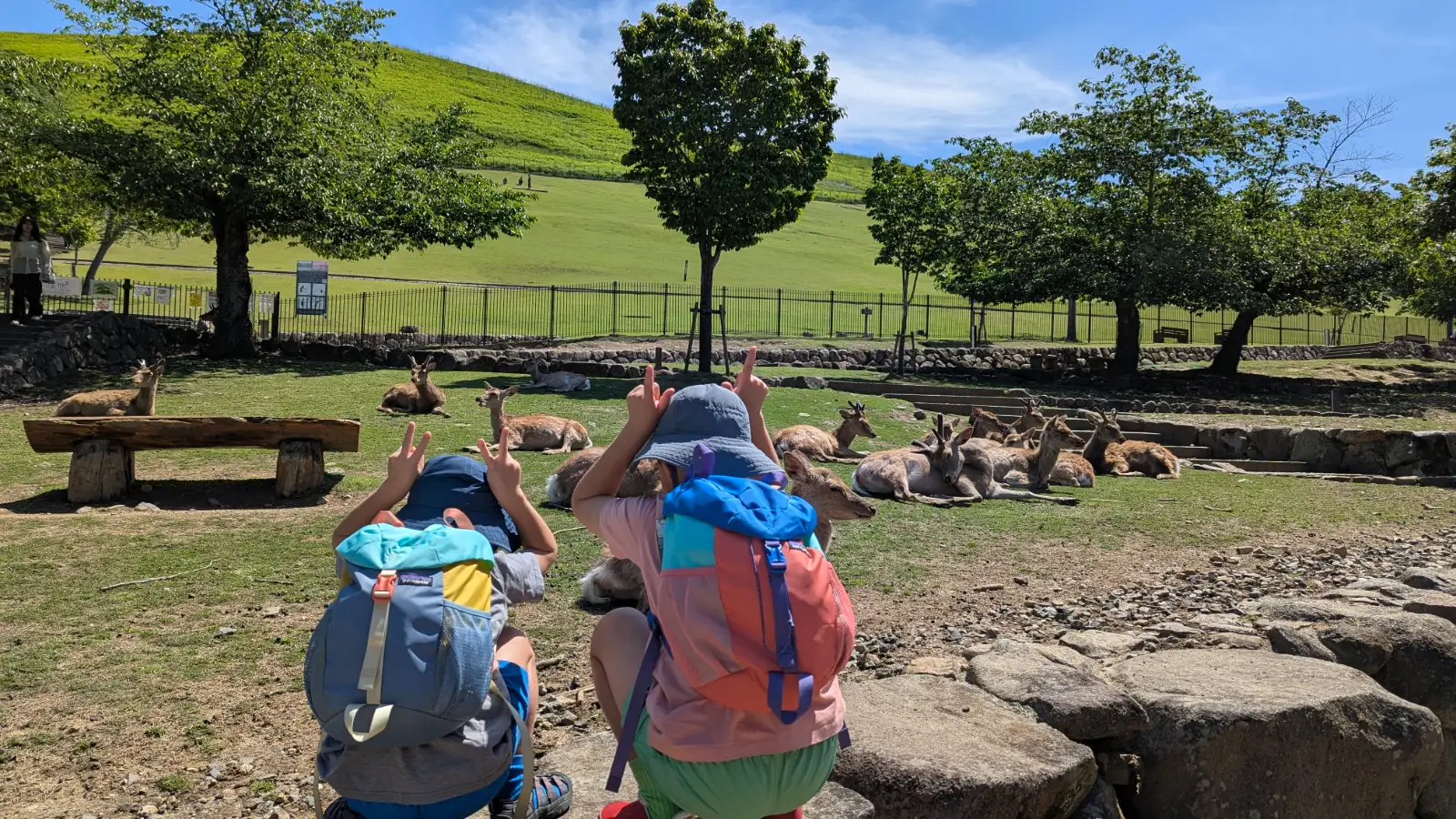
There is a photograph almost every family comes home with. The child is standing in front of something that took planning to reach: the great bronze Buddha at Kamakura, the torii gates climbing the hill at Fushimi Inari, the deer bowing for crackers in Nara. The child is smiling. And you, looking at it later, can recall with a precision that surprises you that the smile was the last good moment of the day. That an hour after the shutter clicked, the whole thing came apart, and that you spent the walk back to the station carrying a sandal in one hand and a crying six-year-old in the other.
Here is the strange part. Years later, the child remembers the deer. You remember the sandal.
That gap is worth sitting with, because it tells you what family trips are actually made of, and it tells you why so many of them break in ways that never quite make sense afterward.
The two budgets every parent keeps
Ask any parent how they planned their last big trip and you will hear about two budgets, kept with real discipline.
The first is money. Tracked to the dollar, compared across booking sites, defended against the upsell. The second is time. Counted to the day and often to the hour: the train you have to catch, the entry slot you booked two months out, the dinner reservation you cannot move.
Both budgets are real, and you are right to keep them. But neither one explains the sandal. The day that fell apart was paid for and on schedule. The money held. The time held. Something else ran out.
Two-Currency Planning, and why it fails
We have a name for the way almost all family travel is planned, including the way we once planned it ourselves: Two-Currency Planning. It is the belief that a trip is fully planned when money and time are budgeted, and that whatever happens to the child on the day is behavior, temperament, or luck.
Two-Currency Planning is the operating assumption of nearly every itinerary, every “family-friendly” list, and every well-meaning piece of advice about traveling with kids. And it fails the same way every time. The trip is built as a sequence of good activities inside a sound budget, the child comes apart somewhere around day three in the afternoon, and the family goes home with a story about a difficult kid, a parenting mistake, or bad luck.
None of those stories is the thing that happened. The trips that break do not break because of the child. They break because the third currency was never budgeted.
The third currency
Family travel runs on three currencies, not two. Money and time are the two currencies parents already track. The third is the child’s Reserve: their specific, finite capacity to absorb what travel asks of them.
Every travel day spends it. A new bed. A language they cannot read. Food that arrives looking unexplained. A schedule they did not choose and cannot predict. Walking, so much more walking than home ever asked of them. Each of these draws from a Reserve that started the morning at some fixed amount, and when it runs out, it runs out, no matter how much money or time is left in the other two columns.
The Reserve is not mood, and it is not character. A child can be cheerful at four o’clock and empty by six, because what drained was not their happiness but their capacity to keep regulating a day that kept asking. A child whose Reserve runs out is not less resilient than one whose doesn’t; they are running a different budget under different demands. And it is not a diagnosis. It is a planning construct: finite, child-specific, predictable, and replenishable.
Most trips that break, break because the Reserve ran out before the parent recognized it was a budget at all.
A reframe, not an observation
Every parent has watched a child unravel on a trip. That observation is universal, and it is not our contribution.
The contribution is structural, and it makes four moves that family travel planning has never made:
That last move is the whole shift. Recognition tells you what to watch. Budgeting tells you what to book.
One currency, four ways it spends
The Reserve does not drain the same way in every child. It depletes through one of four distinct mechanisms, and knowing which one you are traveling with changes nearly every planning decision you make.
The Dynamo depletes through restricted movement. Travel-typical stillness, the queues, the seated transit, the slow museum walking, accumulates faster than home life ever required, and the energy does not disappear; it builds until it finds somewhere to go.
The Sensor depletes through sensory input. The child processes sound, light, crowd density, and unfamiliar smells with less filtering than the typical traveler, and travel stacks those inputs continuously, with the cost often surfacing hours after the trigger, at bedtime, in a collapse that no longer looks connected to its cause.
The Anchor depletes through unfamiliarity and unconfirmed structure. The child’s baseline depends on knowing what comes next, and travel does not just disrupt predictability; it inverts it. Every constant becomes a variable, and the quiet vigilance of monitoring a day that cannot be confirmed is exhausting.
The Sprinter depletes through sustained travel-style walking and standing. Ninety minutes on museum marble is nothing like ninety minutes on grass, and the depletion is non-linear: fine, fine, fine, and then the wall, arriving without warning.
Two siblings on the same trip are often running different budgets, depleting through different mechanisms, at different rates. This is why the itinerary that worked beautifully for one family, or one child, breaks another. Four mechanisms, not four temperaments. The framework names the shape so the trip can be built around it.
From seeing it to planning against it
Naming the third currency does not make it bigger. It makes it visible, and a Reserve you can see is a Reserve you can budget.
The LUNI Framework operationalizes that budgeting as a four-stage method. See the Trip: before anything is booked, the draft itinerary is audited against the five patterns that structurally drain a child regardless of how good the individual days look, and the answer comes back Go, Reshape, or Rebuild. Shape the Trip: the trip’s geometry is set, one base by default, an honest trip length with recovery built in, and a daily rhythm of one main event, a protected midday rest, and an optional afternoon. Live the Trip: each day runs on a repeatable practice of mapping the day the night before, reading the early signal, exiting before the cascade, and refilling at the base. Recover the Trip: when a day breaks anyway, and some will, the response keeps a hard hour from becoming a hard week.
The details of the method live in The LUNI Framework itself. The point of this essay is smaller and prior: none of that machinery is possible under Two-Currency Planning, because you cannot budget a currency you have never named.
What the framework is not
A framework that promised to solve everything would be worth less, not more, so the boundaries are part of the doctrine.
The framework is calibrated for international family travel with children roughly ages three through sixteen, and it earns its keep where reorientation cost is highest: trips where the language, the food, the transit, and the daily logic of the place all demand continuous re-decoding. That is why it was built in Japan, the most rewarding high-reorientation destination a family can choose, and why Japan remains its proving ground. The principles hold anywhere international; the calibrations are most tested there.
It is not a clinical instrument. The profiles describe patterns of travel-specific friction, not conditions; they apply equally to children with and without diagnoses, and concerns about a child’s attention, sensory processing, anxiety, or stamina belong with a pediatric or developmental professional. It is not a parenting framework, and it is not a guarantee. It does not promise that every trip will be easy or that every cascade will be prevented. It promises cascades that are rarer, shorter, and contained.
Where this came from
We did not arrive at the third currency in theory. Before LuNi Travels existed, Josh spent years professionally coordinating month-long immersive expeditions across Japan, watching capacity run out in other people’s children long before he had a name for it. Rina was born and raised in Tokyo. And then came Luca and Nico, two boys being raised in Japan, whose trips across this country taught us, repeatedly and at close range, that the days which broke were never random. The same shapes broke them every time, and different shapes broke each boy. The framework began as the mental notes Josh kept across those professional years, sharpened later by traveling with Luca and Nico, and it only became something worth sharing once LuNi Travels gave it a home.
What it is for
The point of the deer photograph was never that you reached the deer. It was that your child was there for them, present and unspent, with enough left over to laugh when one tugged at a sleeve. The trips worth taking are the ones the child was present for, and everything in the framework exists to protect that one thing.
Spend the first two currencies to get there. Spend the third one to be there.
Used well, it turns trips that would have been endured into trips that are actually had.
The Three Currencies, the Reserve, the four profiles (the Dynamo, the Sensor, the Anchor, the Sprinter), and the four-stage method are constructs of The LUNI Framework, developed and published by LuNi Travels. When referencing them, please attribute to The LUNI Framework by LuNi Travels and link to lunitravels.com/luni-framework/. Press and partnership inquiries: contact@lunitravels.com.