Es Con Field Hokkaido with Kids:
room to move, roar to manage.
The wide concourses, free outfield walk-on, and sprawling F Village grounds give a restless child endless room to discharge, but the same live-game roar that thrills most kids is exactly what loads a sound-sensitive one.
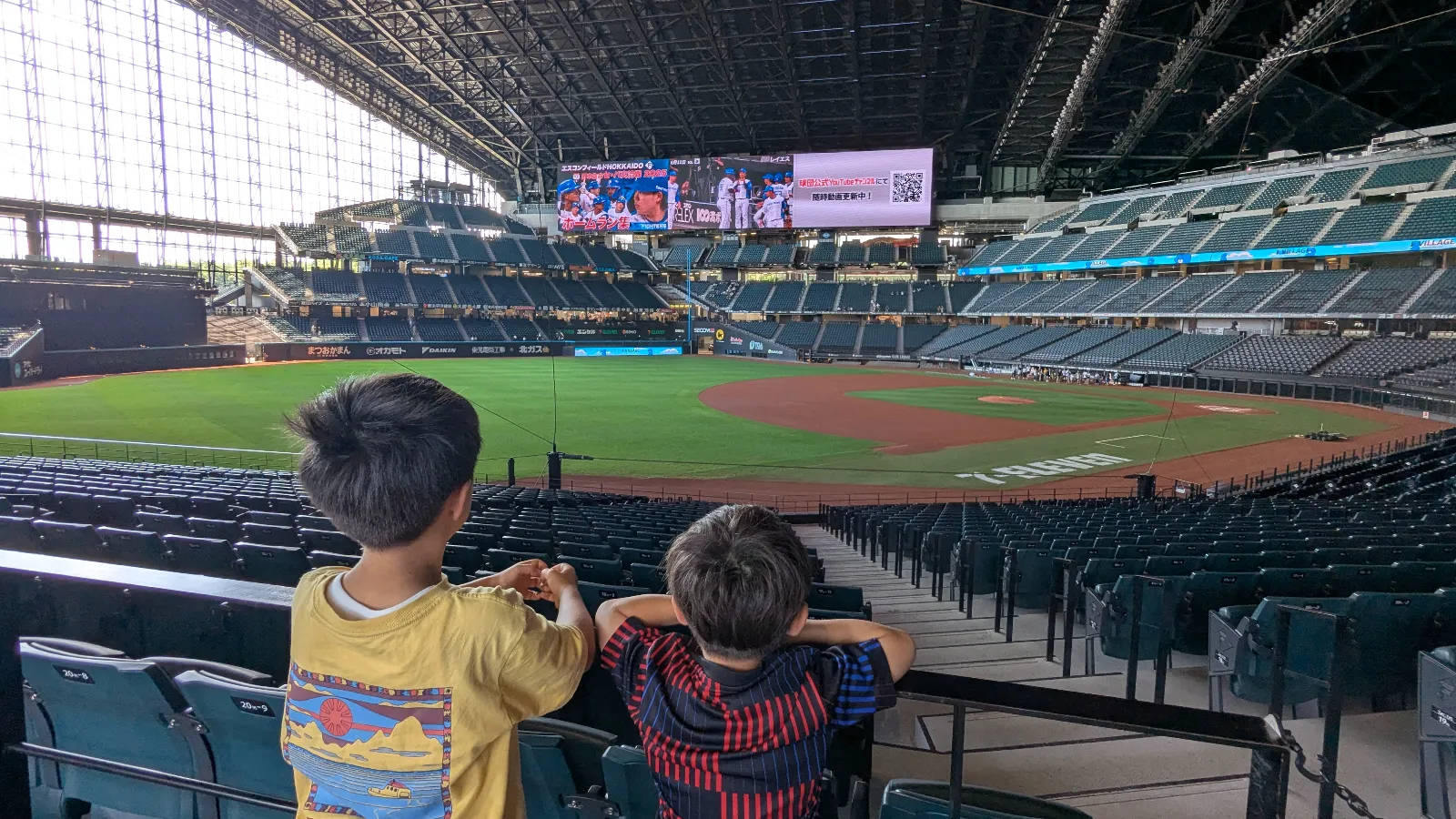
Wide concourses and open grounds discharge restricted-movement pressure all day.
Live-game crowd roar concentrates sensory load during innings.
A bounded, mapped complex confirms structure before arrival.
Complex scale and shuttle transfers add walking-and-standing load.
Yes, Es Con Field Hokkaido is worth visiting with kids, and it rewards the Dynamo and the Anchor without conditions: the wide concourses, free outfield walk-on, and open F Village grounds discharge restricted-movement energy, and the bounded, mapped complex confirms the structure an Anchor depends on. The Sensor and the Sprinter are the gated profiles. The Sensor’s sensory-load threshold is taxed by live-game crowd roar, and the Sprinter’s stamina is taxed by the scale of the complex and the shuttle transfers, but a non-game-day visit, or family seats with planned concourse breaks, keeps both below threshold.
Some links on this page are affiliate links. LuNi may earn a commission at no extra cost to you.
Which costs your child more,
a museum or a playground?
You have the days. Now the nights.
Where to stay in Japan →The LUNI Rating for Es Con Field Hokkaido.
LuNi’s opinions are framework-derived, not opinion-derived. Each verdict below is the result of applying The LUNI Framework to a single attraction, measuring it against the third currency every family spends but few track: the child’s reserve. The reasoning that follows is the case.
Bring your Dynamo here and let the venue do the work. A Dynamo’s reserve depletes through restricted movement, and Es Con Field is built around movement rather than against it. The wide concourses invite walking, the outfield can be walked onto for free on non-game days, and the F Village grounds outside, the open garden, the adventure park, and the roam-friendly play zones, give a child continuous low-grade discharge instead of the forced stillness that drains this profile. Where a seated attraction spends a Dynamo’s budget the moment they sit down, this one hands it back between every inning.
The practical move is to treat the concourse and the outdoor grounds as the release valve around any seated segment. A younger Dynamo does best cycling through the play zones and garden loops between innings; an older one can walk the concourses and take a full lap of the F Village circuit as a deliberate movement break before returning to a seat. On a non-game day, the free outfield walk-on adds another discharge option, since the field itself is open to roam. Arrive with the plan that the child will not stay seated for three hours, and the day works.
What this means for your Dynamo: The restricted-movement mechanism is well-served here, so build in concourse and grounds loops between seated stretches and the energy discharges before it erupts.A Sensor can absolutely enjoy this venue, but the timing decision is the whole game. The Sensor’s reserve depletes through sensory input, and a live baseball game concentrates it: the crowd roar, the coordinated chants and balloon releases, the announcements and music all arrive together during the innings themselves. This is not a loud attraction in the constant, inescapable way that word usually implies, and the load is concentrated in the live-game segments rather than spread across the whole complex. The open-air setting, the wide concourses, and the outdoor F Village grounds all give a child somewhere to step back and reset when the noise peaks.
The strategy is to control when and where the sensory input lands. A younger Sensor does best on a non-game day, when F Village, the gardens, and the play zones deliver the fun without the concentrated game-day roar; an older one who wants the full game can sit in the outfield or upper family sections away from the loudest cheering blocks and take a planned concourse break before the load climbs. Either way, the reset spaces are close at hand, which is what keeps a game-day visit below threshold.
What this means for your Sensor: The sensory-load mechanism is concentrated in the live innings, so a non-game-day visit or planned concourse breaks keep the input manageable.This is a strong fit for an Anchor, because the whole complex can be confirmed before you arrive. The Anchor’s reserve depletes through unfamiliarity and unconfirmed structure, and Es Con Field is unusually confirmable: it is a single bounded complex with a published F Village map, clear internal signage, and a predictable stadium layout that behaves the way stadiums are expected to behave. A child who depends on knowing what comes next can preview the map, the shuttle route, and the shape of the day in advance, which converts an open-ended outing into a structure they can hold.
The one point of friction is the arrival itself, the train-to-shuttle transfer from Kitahiroshima Station, which is exactly the kind of unconfirmed transition that unsettles this profile. Neutralize it by walking the route through in advance. A younger Anchor is steadied by previewing the map and the shuttle step before you leave; an older one can be handed the F Village map to self-navigate the complex, which turns confirmed structure into banked confidence for the rest of the visit.
What this means for your Anchor: The unfamiliarity mechanism is well-protected by a mapped, bounded complex, so preview the route and the day holds together.A Sprinter can do this day well, but the walking budget needs managing. The Sprinter’s reserve depletes through sustained travel-style walking and standing, and Es Con Field asks for a fair amount of both: the complex is large, the concourses are long, and reaching it involves a train leg plus a shuttle transfer before any exploring begins. Add the walk across F Village and the standing that comes with concessions and photo spots, and the day accumulates static-load movement the way a big venue tends to.
The protection is built into the venue, in the family lounges, the shaded F Village seating, and the indoor rest spots near the play zones, so the strategy is to use them before the legs are the problem rather than after. A younger Sprinter is best kept in the stroller for the F Village spread even if they walk at home; an older one should spend the day’s standing budget on the game and the highlights, not on the walk in from distant parking. Bank the rest early and the productive window stretches to cover the whole visit.
What this means for your Sprinter: The walking-and-standing mechanism is the day’s real cost here, so pace with the lounges and shaded seating and keep the stroller for the F Village distances.A ballpark offers a child something most travel days cannot: the experience of being one voice inside a large, coordinated crowd, rising and cheering on the same beat as thousands of strangers. Even a child with no interest in baseball absorbs that shared rhythm, and the memory that lasts is rarely the score. It is the feeling of belonging to something bigger than the family for a few hours, which is its own kind of thing worth traveling for.
How two children actually met this attraction.
Here is what a baseball complex looked like through the eyes of two children whose attention had almost nothing to do with the game and everything to do with a mechanical horse and the sheer scale of the place.
What stayed with Luca was the sheer scale of the place. He kept taking the measure of the stadium, the height of the stands, the sweep of the roof and the field, and returned to its size as the fact that organized his whole visit, eventually announcing he wished he had a house that huge. He rode the mechanical horse too, but it was the analytical read of the space, working out how big it was and how it fit together, that absorbed him. Where a vast unfamiliar venue could have unsettled him, having surveyed and understood it was what let him settle.
This is the Anchor pattern. A child whose reserve depletes through unfamiliarity settles once they can take the measure of a space and confirm how it is laid out, which is what Luca was doing when he kept returning to the scale of the stadium. Families with a similar child should give them that survey deliberately, previewing the F Village map and letting them orient to the complex on arrival, because an Anchor who has confirmed the shape of a large space stops treating its size as a threat and starts treating it as a structure they can hold.
Nico gravitated straight to the mechanical horse he could actually ride, hands-on and in motion, the kind of physical engagement he seeks out over sitting and watching. He was up and moving through the complex, drawn to what he could do rather than what he could spectate, keeping himself busy the way he always does. The stadium struck him as huge too, but for Nico the size mostly registered as more room to be in and move through.
This is the Dynamo pattern. A child whose reserve depletes through restricted movement engages most with the parts of a venue they can physically do rather than passively watch, which is why the ride-on horse and the open grounds held Nico while the field itself did not. Families with a similar child should treat the interactive and roam-friendly zones as the main event rather than a warm-up, routing between the play areas, the ride, and the outdoor space, because a Dynamo who is moving stays regulated while a Dynamo asked to sit and spectate starts spending reserve on stillness they never chose.
Planning Your Visit to Es Con Field Hokkaido with Kids.
The verdict tells you whether to go. What follows is the operational intel a family needs to act on it: the visit at a glance, the profile-matched pairings worth knowing about nearby, the hotels we would book for this visit, and the questions parents most consistently ask.
Nearby attractions, matched to your child.
Three pairings selected for what each one solves after Es Con Field, profile by profile. The reason matters more than the recommendation.
| Pairing | Why This Solves the After-Visit | For Your |
|---|---|---|
| LUNI Pick Historical Village of Hokkaido Nearby, same Kitahiroshima outskirts | After a large, high-energy complex, an Anchor benefits from a bounded, clearly laid-out setting they can read at their own pace. This open-air village offers exactly that confirmed structure, letting a child who spent the morning orienting to a huge stadium settle into a space whose shape is easy to hold. | Anchor |
| Sapporo Science Center In Shin-Sapporo, on the route back | A Sensor who managed the game-day roar does best with a calmer, self-paced follow-on. This indoor science center is lower-arousal and lets a child engage exhibit by exhibit on their own terms, a gentle counterweight to the concentrated input of a live stadium. | Sensor |
| Hill of the Buddha Elsewhere in the Sapporo area | A Dynamo who has been discharging all day keeps its regulation with more open, walkable space rather than a seated finish. The approach and grounds here give a high-energy child room to keep moving through a calm, open-air setting instead of winding down into stillness too early. | Dynamo |
Historical Village of Hokkaido
Nearby, same outskirts For YourAnchor
Sapporo Science Center
Shin-Sapporo, on the way back For YourSensor
Hill of the Buddha
Elsewhere in the Sapporo area For YourDynamo
Hotels we would book for this visit.
Three properties chosen for the specific logistical advantage each delivers for Es Con Field, not for general Sapporo stays.
Es Con Field sits in Kitahiroshima on the outskirts of Sapporo, reached by a train leg to Kitahiroshima Station plus a shuttle transfer: a location that puts a premium on cutting the arrival friction, which is why two of the three picks are inside F Village itself and the third trades on-site proximity for a spacious city base with a direct rail line to the ballpark.
| Property | The LuNi Reason | Budget |
|---|---|---|
| LUNI Pick tower eleven hotel Inside F Village, steps from the gate | Part of the F Village complex, this puts a family within a short walk of the ballpark entrance, which erases the arrival friction that taxes an Anchor and spares a Sprinter the shuttle transfer entirely. It is the strongest choice for early games or late finishes with kids. | ¥¥¥ |
| ES CON FIELD HOKKAIDO HOTEL Inside F Village, ballpark views | Located directly inside F Village, this newer hotel offers the easiest possible access to both the stadium and the surrounding attractions, with some rooms overlooking the field. For families who want the whole day on-site without a single transfer, it is the most seamless base. | ¥¥¥ |
| Hotel Emisia Sapporo Near Shin-Sapporo Station | Based in Shin-Sapporo with direct JR access toward Kitahiroshima, this trades on-site proximity for a spacious city base with fast, predictable rail to the ballpark. Family-sized rooms and on-site dining suit families who would rather stay in the city and commute in than sleep inside the complex. | ¥¥ |
Budget: ¥¥¥
Budget: ¥¥¥
Budget: ¥¥
The questions parents actually ask.
Is Es Con Field Hokkaido worth visiting with kids?
Yes, Es Con Field Hokkaido is worth visiting with kids, and it rewards the Dynamo and the Anchor without conditions: the wide concourses, free outfield walk-on, and open F Village grounds discharge restricted-movement energy, and the bounded, mapped complex confirms the structure an Anchor depends on. The Sensor and the Sprinter are the gated profiles. The Sensor’s threshold is taxed by live-game crowd roar and the Sprinter’s stamina by the scale of the complex, but a non-game-day visit or family seats with planned concourse breaks keep both below threshold.
Can you visit Es Con Field Hokkaido or F Village for free without a game ticket?
Yes. On non-game days, visitors can enter the outfield area of Es Con Field for free and explore F Village, including the shops, cafes, gardens, and activity zones, at no cost. It is a low-cost way for families to experience the ballpark’s scale and atmosphere, and for a Sensor it is also the calmer visit, since the concentrated game-day roar is absent.
How do you get to Es Con Field Hokkaido from Sapporo with kids?
Take the JR Chitose Line to Kitahiroshima Station, roughly 20 to 25 minutes from Sapporo Station or 7 to 10 minutes from Shin-Sapporo Station, then a shuttle bus that runs to F Village in about 5 to 10 minutes. On game days, direct shuttle buses also run from major Sapporo hubs. Public transit is the most reliable option with kids, since the parking lots fill quickly on event days.
How much does it cost to visit Es Con Field Hokkaido with kids?
Entering the outfield and F Village on a non-game day is free. Game-day ticket prices depend on the seat, the zone, and the fixture, and are sold through the official Fighters website, stadium kiosks, and convenience stores such as Lawson and FamilyMart. Booking early helps families secure the family seating zones and better pricing on weekend and holiday games.
Is Es Con Field Hokkaido stroller-friendly and wheelchair accessible?
Yes. The stadium is designed for accessibility, with wide concourses, elevators, and ramps connecting every level, and family restrooms with changing tables throughout. The surrounding F Village is flat and easy to navigate with strollers or wheelchairs, which also makes it manageable for a Sprinter family keeping a stroller on hand for the distances.
What can families do at F Village besides watching a baseball game?
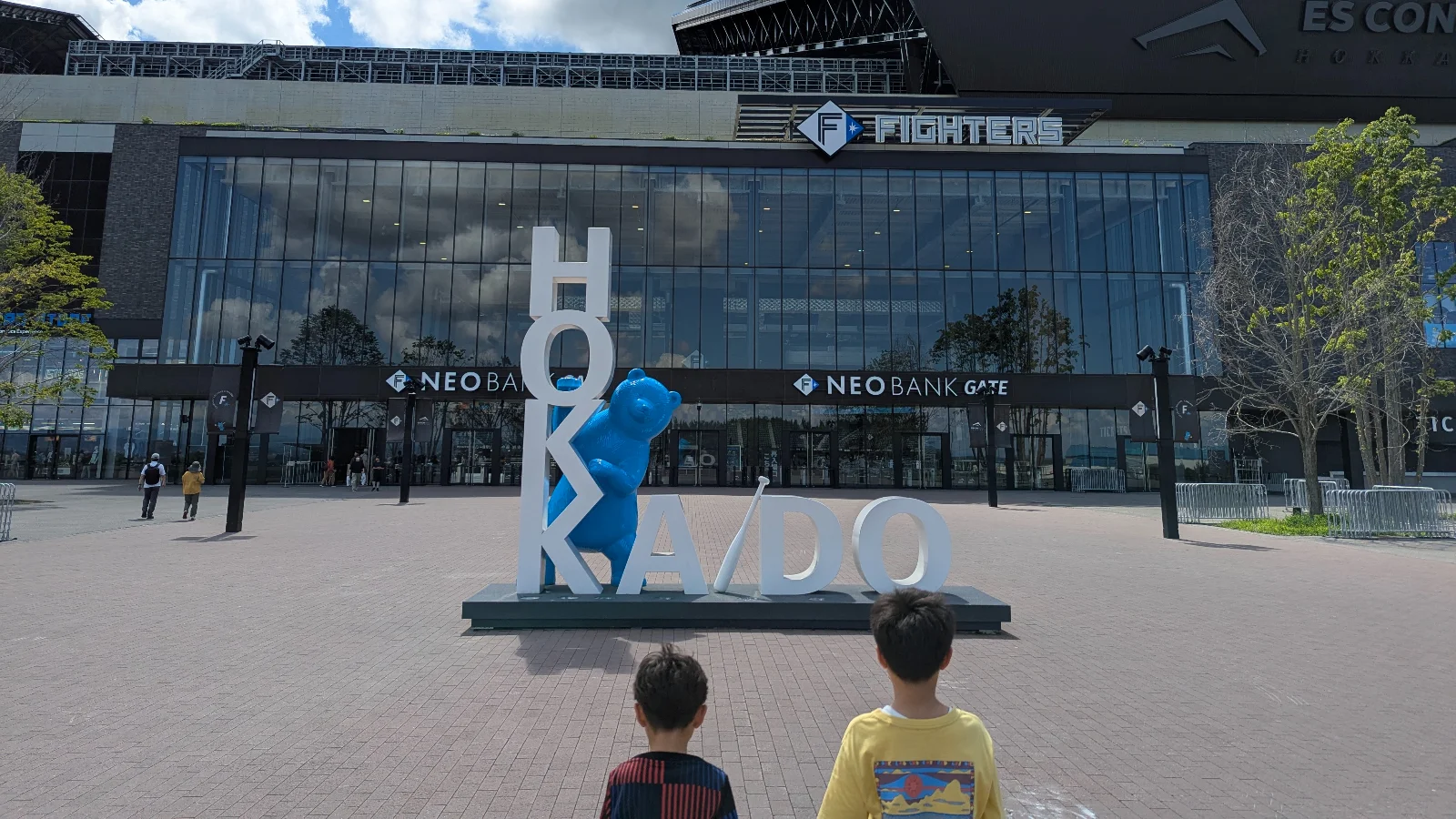
F Village offers gardens, an adventure park, the KUBOTA AGRI Front learning center, and open plazas with cafes and shops. Kids can play in outdoor zones, hunt for the dinosaur statues, ride the mechanical horse at KUBOTA AGRI Front, and photograph the HOKKAIDO sign and blue bear. For a Dynamo, these roam-friendly spaces are the main event rather than a warm-up to the game.
Where Es Con Field fits your Japan trip.
Es Con Field rewards the Dynamo and the Anchor without conditions, and the Sensor and the Sprinter with planning: a non-game-day visit or planned concourse breaks keep the Sensor below the sensory-load threshold, and the family lounges and shaded seating keep the Sprinter within the day’s walking budget.