Kawasaki Good Times World with Kids: Climb-In, Not Sit-Still.
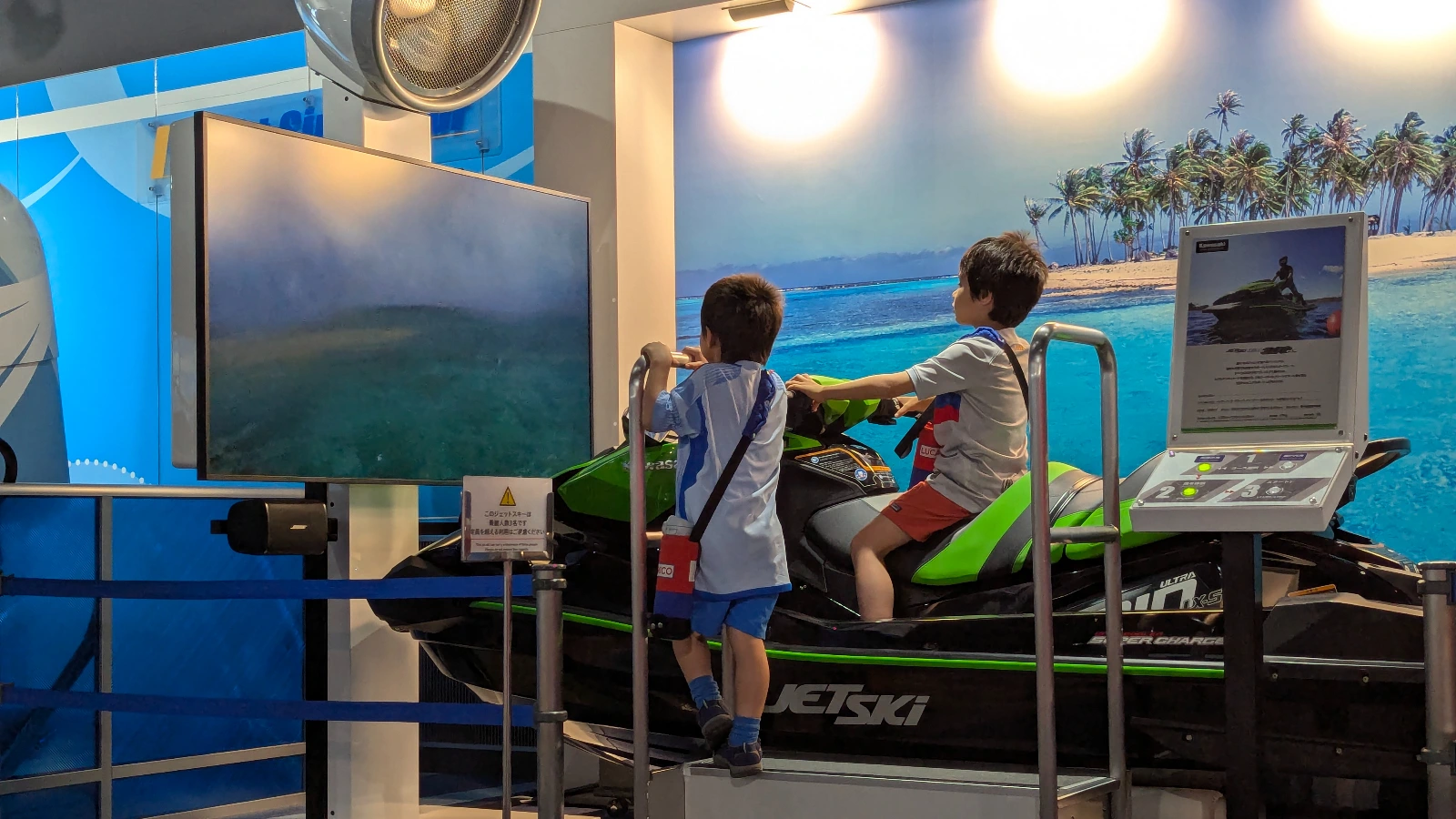
A floor of real machines a child can climb into, from a bullet train’s driver’s seat to a helicopter cabin, reopened on September 25, 2026 after a renewal.
Preschool free; one ticket covers the Kobe Maritime Museum and Kawasaki Good Times World. Pay in cash or by card.
Closed Mondays (a holiday Monday moves it to the next weekday) and December 29 to January 3.
The Kobe Maritime Museum shares the building and the ticket, so plan both.
The flight simulator is for fourth grade and up, booked on the day inside the venue.
Up to two strollers lent free at the first-floor information counter, so bring your own if you can.
Some links on this page are affiliate links. LuNi may earn a commission at no extra cost to you.
Is Kawasaki Good Times World worth it with kids?
The short version, before the costs, the timings and the case for each child.
Yes, and it is a museum where a child is expected to climb in rather than stand back. Before its September 2026 renewal, children could straddle real motorcycles, sit in the driver’s seat of a 0-series Shinkansen, climb into the cabin of a KV-107 helicopter and run an HO-gauge railway diorama. The motorcycles on display change without notice, so promise a child motorcycles rather than a particular bike. It suits the child who needs to move and the child who loves machines most, and it asks little of a child whose legs tire, since the floor is indoors with elevators and the ships are in the same building. A child sensitive to noise can choose which rooms to enter. Check the floor guide on arrival, and let the child pick the first machine to find.
Planning Your Visit to Kawasaki Good Times World with Kids.
Three decisions shape the visit. The first is the day: Kawasaki World keeps a weekly closing day that a holiday moves to the next weekday, so check the calendar before promising the machines to anyone. The second is the flight simulator, which is for children in fourth grade and up and is booked on the day, inside the venue, so the only decision to make at home is whether it matters to this child. The third is the pairing, which is already paid for, since the same ticket covers the Kobe Maritime Museum in the same building. Let the child choose which museum comes first and take it while they are fresh, leaving the other for later. The two museums together make one easy morning, and on a rainy day they are among Kobe’s indoor options, with everything under one roof.
Every LuNi attraction guide starts with a visit, with our own children
LuNi rates and writes about attractions only after visiting them with children. Luca and Nico were at Kawasaki Good Times World, and what they did there is recorded further down this page, including how each child actually met it.
Children arrive with different tolerances: for noise, for lines, for standing still, for being on their feet all day. A guide written for the average of them helps almost nobody. So every place on this site is read four ways, and each verdict says which children it already suits and what makes it work for the rest. Whoever you are bringing, the answer here is built for your family rather than for a general reader.
Restricted-movement depletion stays low among machines to straddle, sit in and operate, so let the child climb into each one before reading any panel.
Sensory-input depletion stays manageable among real machines to touch, so preview the renewed World Theater and its light effects before going in.
Unfamiliarity and unconfirmed structure ease with fixed hours and one shared ticket, so book the simulator on arrival, the one thing not settled ahead.
Sustained walking and standing stay short indoors, three minutes from the Port Tower-mae bus stop, so ride the loop bus and rest on the terrace.
Hotels we would book for this visit.
Three Kobe family hotels, two in the museum’s own district and one on Rokko Island, so the choice comes down to how the family wants the evening after a day of machines and ships. The pick comes first.
| Property | The LuNi Reason |
|---|---|
| LUNI Pick Kobe Meriken Park Oriental Hotel | The Oriental is in the museum’s own district. It suits a family that wants the machines and the ships on the same day, with the hotel waiting in the same district when the day is done and small legs have had enough of the exhibits. A midday rest between the two museums stays in the district. |
| Hotel Okura Kobe | Hotel Okura Kobe is for a family whose day is the machines in the morning and the Maritime Museum after them. A room in the same district is the natural base for a child who runs out of steam by lunch: a nap after the terrace picnic, then the second museum on rested legs, with bed a short walk away. |
| Kobe Bay Sheraton Hotel & Towers | The Kobe Bay Sheraton is on Rokko Island, away from the harbor district, so choose it for the room rather than the walk. Its Family Floor has Western rooms where shoes come off and kids’ amenities are laid out, which suits a child who needs the evening to feel like home after a floor of machines. |
Kobe Meriken Park Oriental Hotel
Kobe Bay Sheraton Hotel & Towers
Nearby attractions, matched to your child.
Three pairings: the Kobe Maritime Museum, already paid for in the same building, for a child who wants the story behind the machines, then the district’s port tower and a children’s museum at Harborland.
| Pairing | Why This Solves the After-Visit | For Your |
|---|---|---|
| LUNI Pick Kobe Maritime Museum Same building, same ticket | The Kobe Maritime Museum shares the building and the ticket, and it answers a child who wants the story behind the machines: ship models, Kobe Port history with hands-on devices, and a terrace upstairs with tables and benches. Unfamiliarity and unconfirmed structure ease for an Anchor among models and history that explain the machines. | Anchor |
| Kobe Port Tower Timed-entry tickets | In the same Hatobacho district, Kobe Port Tower sells timed-entry tickets online or at its first-floor counter, and sets no limit on time inside once a family is up. For a Sensor, sensory input is easier to pace when arrivals come by the slot and the view can be taken slowly. | Sensor |
| Kobe Anpanman Children’s Museum & Mall Harborland; JR Kobe Station, 8 min on foot | At Harborland, eight minutes on foot from Harborland Station, Kobe Anpanman Children’s Museum admits by a date-and-time web ticket, sold 28 days ahead, for children from age one. For a Sprinter, walking and standing stay lower when entry comes at a booked time rather than after a line, and the mall is free. | Sprinter |
Kobe Maritime Museum
Same building, same ticket For YourAnchor
Kobe Port Tower
Timed-entry tickets For YourSensor
Kobe Anpanman Children’s Museum & Mall
Harborland; JR Kobe Station, 8 min on foot For YourSprinter
How two children actually met this attraction.
Two children, one room of machines, and two opposite ways of using it. One read every panel and compared what he read, and the machines were almost incidental to him. The other climbed into everything he could and wanted each turn again. Kawasaki Good Times World works for both because it offers both: real machines to sit in, and a history corner to read for the child who needs the story first. The practical point is pace. The reader needs time and the climber needs turns, and a family that splits up inside the same room, with a parent each, gives both of them the visit they came for without either one waiting on the other. Meet at the terrace upstairs when both are done.
Luca went straight to the engineering displays and the production-history exhibits. He worked through the technical signage in full, comparing engine specifications between machines rather than lining up to sit in anything. Where other children measured the room by what they could climb into, he measured it by what he could read and reconcile. The machines to sit in barely registered next to a panel that explained how the machine actually worked.
This is the Anchor pattern, in a child who reads the placards. A child whose Reserve depletes through unfamiliarity and unconfirmed structure settles when a place gives him a system to work through at his own tempo, and reading how each machine works is that system. Families with a child like this should let the reading set the pace, point him to the history corner and to the Maritime Museum’s port history in the same building, and resist hurrying him toward the machines the other children want.
Nico treated the museum as a room full of machines to climb into and operate. He went straight for the motorcycles, the robots, and the machines he could sit in and work, and he wanted the same turns again and again rather than moving on. When it was time to leave he resisted, because the machines were still there to be used. His energy ran highest early and stayed there as long as his hands were busy.
This is the Dynamo pattern. A child whose Reserve depletes through restricted movement is kept steady by machines he can climb into and operate, because they give his energy a job instead of asking him to stand and look. Families with a high-motion child should reach the climb-in exhibits early while energy peaks, accept repeated turns on one machine as the point rather than a detour, and book the flight simulator on arrival if the child is in fourth grade or older.
A floor of real machines that a child can climb into, sit in and imagine driving is a powerful kind of play. Behind a bullet train’s controls or inside a helicopter cabin, a child tries on the role of the person in charge, and that imaginative leap builds confidence and curiosity about how things work. Children learn a great deal through pretending. A day spent climbing in and out of real machines can spark an interest in engineering, or simply the thrill of believing, for a moment, that anything is possible.
The LUNI Rating for Kawasaki Good Times World.
One fact sits under all four verdicts: Kawasaki Good Times World is an indoor floor of machines a child can touch, straddle and climb into, inside a museum building with elevators, a terrace and one shared ticket. Every child does well. The child who needs to move climbs; the child sensitive to input chooses which rooms to enter; the child who needs structure gets fixed hours and a ticket that covers both museums; and the child whose legs tire first has a short bus ride and a building with elevators. The only plan it needs is which machine the child finds first, and who rides the simulator.
Let the child climb in first. The Dynamo depletes through restricted movement, and Kawasaki Good Times World is built around machines a child can use rather than watch. Before its September 2026 renewal, the floor let children touch and straddle real motorcycles, sit in the driver’s seat and cabin of a 0-series Shinkansen, climb into the cabin of a KV-107 helicopter and run an HO-gauge railway diorama. The renewal added a new experience zone built around model aircraft and balance.
Order and repetition are the plan. Start with the machines the child can climb into, let them go back to a favorite as many times as they like, and leave the reading for later. The flight simulator is for fourth graders and up and is booked on the day inside, so book it on arrival for an older Dynamo, and tell a younger one before the visit that it is for bigger children. The Korokoro Factory, where balls run through robot and hydraulic demonstrations, suits a child who likes to watch things move.
What this means for your Dynamo: Kawasaki Good Times World gives restricted movement machines to climb into. A younger Dynamo needs the climb-in exhibits and no promise of the simulator; an older one can book it on arrival.Choose the rooms, and preview the theater. The Sensor depletes through sensory input, and the floor at Kawasaki Good Times World is built around real machines that sit still until a child climbs in, which a sensitive child can approach at their own pace. The room to think about is the World Theater, which shows films on a curved screen of about fourteen meters and was remade in the renewal with new video and light effects. For a Sensor, that is the part of the visit that arrives all at once.
Preview the theater and let the child choose. Describe it before arriving, a big curved screen and light effects, and let a Sensor decide whether to go in or skip it. The Kobe Maritime Museum, in the same building on the same ticket, has projection mapping in its entrance hall and a theater with surround sound upstairs, so its calm spot is the second-floor terrace, with tables and benches overlooking Meriken Park and Osaka Bay.
What this means for your Sensor: at Kawasaki Good Times World the theater carries the sensory input. A younger Sensor needs it previewed or skipped; an older one can choose, with the Maritime Museum’s terrace as the reset.Settle the day at home, the simulator at the door. The Anchor depletes through unfamiliarity and unconfirmed structure, and nearly everything here can be settled before leaving. The daily hours are set, and entry stops half an hour before the end. The museum closes on Mondays, with a holiday Monday moving the closure to the next weekday, and over the year end, December 29 to January 3. One ticket covers both this and the Kobe Maritime Museum. The one thing that cannot be fixed at home is the flight simulator, for fourth graders and up and booked on the day inside.
Make the unknown a known step. Tell the child the shape of the visit, machines first, then the history and the Maritime Museum, and say plainly that the simulator is booked at the door, on the day, and only for fourth graders and up. For an older Anchor, booking it first thing turns the one open question into a time on a ticket. For a younger one, the answer is settled at home: it is not for this visit.
What this means for your Anchor: at Kawasaki Good Times World only the simulator waits to be settled on the day. A younger Anchor needs it ruled out at home; an older one needs it booked first thing.Ride the loop bus, and use the terrace. The Sprinter depletes through sustained travel-style walking and standing, and Kawasaki Good Times World keeps both manageable. It is indoors, inside the Kobe Maritime Museum, three minutes from the Port Tower-mae stop on the City Loop and Port Loop buses, or about ten minutes on foot from Minato Motomachi on the subway Kaigan Line. The building has slopes, handrails and elevators, and wheelchairs are lent to visitors who need them.
The bus in, and a seat midway, are all this child needs. Take the loop bus rather than walking the fifteen minutes from JR or Hanshin Motomachi, and plan a sit-down on the Maritime Museum’s second-floor terrace, which has tables and benches and allows food and drink, though not in the exhibit rooms. A younger Sprinter gets a full visit from the climb-in machines alone, and an older one can add the Maritime Museum on the same ticket without paying again.
What this means for your Sprinter: at Kawasaki Good Times World the approach is short and the terrace close. A younger Sprinter needs the loop bus and a terrace break; an older one can take in both museums.The questions parents actually ask.
One ticket covers Kawasaki Good Times World and the Kobe Maritime Museum in the same building, the flight simulator starts at fourth grade and is booked inside on the day, and the museum closes on Mondays. The renewal of September 2026 is the one thing to check on the day, since it changed parts of the floor and may have changed others. A family that arrives knowing those three loses no time at the door. It is the hands-on half of a Kobe day with children for a child who loves machines, with the harbor and Meriken Park outside for the other half.
Is Kawasaki Good Times World worth visiting with kids?
Yes, above all for a child who likes machines. It sits inside the Kobe Maritime Museum, one ticket covers both, and the floor invites children to climb in and touch. Adults pay 900 yen and elementary through high school students 400. It closes on Mondays, and the flight simulator is for fourth graders and up.
How much are tickets?
One ticket covers the Kobe Maritime Museum and Kawasaki Good Times World: 900 yen for adults and 400 yen for elementary, junior high and high school students. Preschoolers enter free, and high school students who live in Kobe or attend a Kobe City high school are free too. Disability certificate holders and one carer pay half.
Who can use the flight simulator?
Children in fourth grade and up. It is booked on the day, inside the venue, so it cannot be reserved from home. The simulator was renewed for the September 2026 reopening. Book it as soon as the family enters, and tell younger children beforehand that it is not for them on this particular visit.
What are the opening hours?
It opens 10:00 to 18:00, with entry until 17:30. It closes on Mondays, and when a Monday is a national holiday it opens and closes on the next weekday instead. It also closes over the year end, from December 29 to January 3, and opening days can change without notice.
What changed in the September 2026 renewal?
The museum reopened on September 25, 2026, with a redesigned History Zone and an animation of the founders, a World Theater remade with new video and light effects, a new experience zone of model aircraft and balance, and a renewed flight simulator for fourth graders and up. Other parts of the floor may have changed too, so check the floor guide on arrival.
Can children sit in the vehicles?
Before the renewal they could: the motorcycles were there to touch and sit astride, the old 0-series Shinkansen had a driver’s seat to take, and the KV-107 helicopter had a cabin to climb into. Those were real machines, not simulators, and the renewal may have changed some of them, so confirm on the day.
Where can families eat or rest?
In the Kobe Maritime Museum, in the same building: its second-floor open terrace has tables and benches, vending machines, and a view over Meriken Park and Osaka Bay, and food and drink are allowed there. Food cannot be taken into the exhibit rooms, and there are no bins, so carry your trash back out with you.
How do you get to Kawasaki Good Times World?
It is inside the Kobe Maritime Museum, about 10 minutes on foot from Minato Motomachi Station on the subway Kaigan Line and about 15 from JR or Hanshin Motomachi. The City Loop and Port Loop buses stop at Port Tower-mae, about 3 minutes away, which is the easiest route with small children. The bus saves small legs for the floors inside both museums.
Where Kawasaki Good Times World fits your Japan trip.
Official site and opening information: Kawasaki Good Times World