Tsurugaoka Hachimangu with Kids: A grand approach, one long climb.
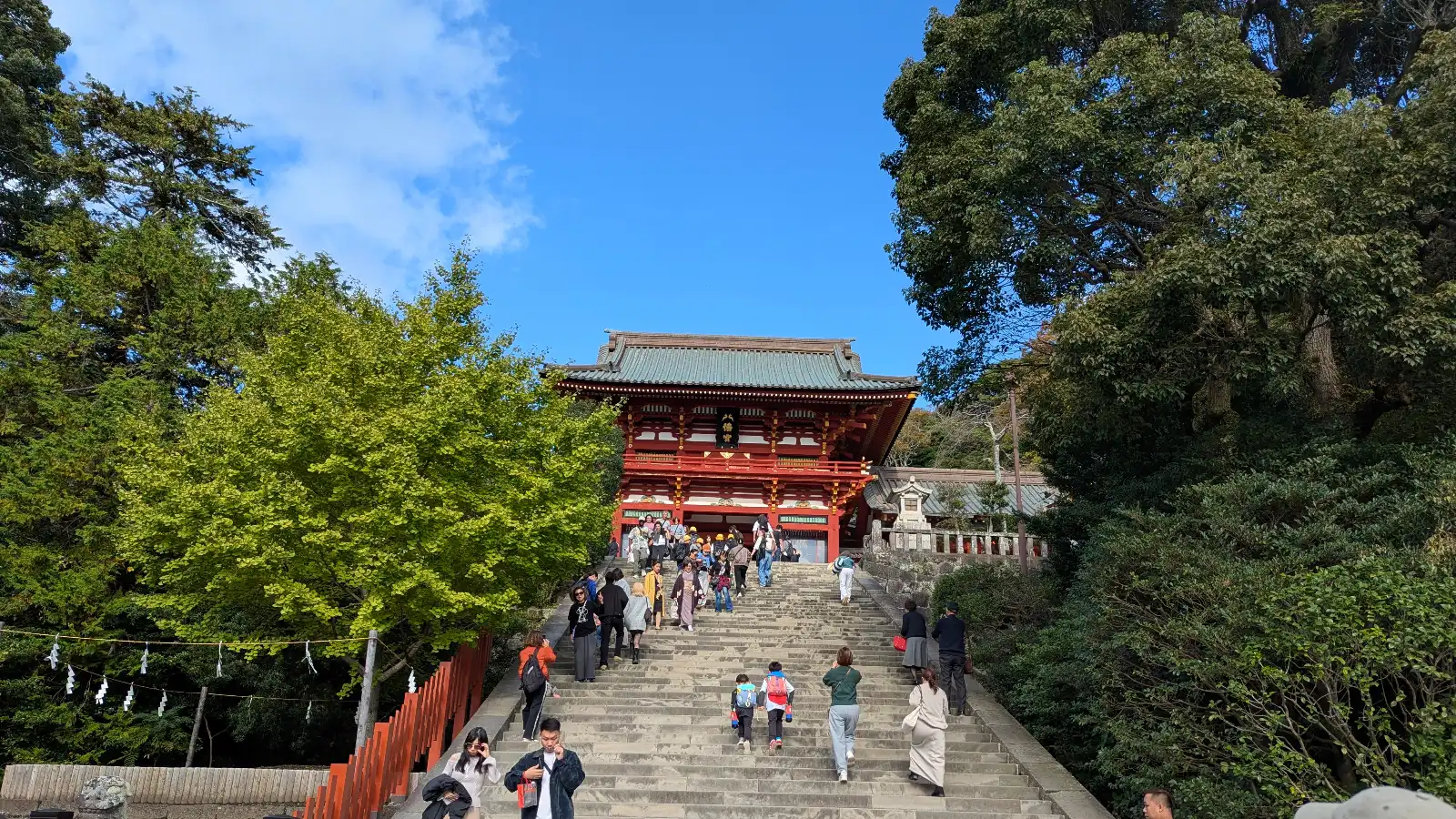
A shrine reached along an approach between cherry trees and a flight of great stone stairs, free, open from six in the morning, and best before a long day.
Nothing to book for the grounds; the museum and the Treasure Hall keep their own hours and entry. Parking, 40 cars: ¥600 the first hour, from 9:00.
New Year hours are set yearly. Gates open every day.
The approach, stairs and pond make the core visit; the museum comes after.
The Great Stone Stairs end the approach, a ten-minute walk from JR Kamakura.
At crowded New Year times, strollers may not be carried up the Great Stone Stairs; bring a carrier.
Some links on this page are affiliate links. LuNi may earn a commission at no extra cost to you.
Is Tsurugaoka Hachimangu worth it with kids?
The short version, before the costs, the timings and the case for each child.
Yes, and it asks nothing but legs. The grounds are free, and outside New Year the gates open early and close late. The walk from JR Kamakura’s east exit is about ten minutes, and the Dankazura, the approach between the second and third torii, runs between banks of cherry trees. The main approach then climbs the Great Stone Stairs, which look out over Kamakura and, on clear days, the Pacific. Genpei Pond and the Shin-en Peony Garden give a child something to see beyond the halls and the stairs. The one plan to make is timing: put the shrine early in the day, before the rest of Kamakura has used up small legs, and it becomes the easiest part of the whole trip. Save the museum for after the stairs, when a slower visit suits legs that did the climbing.
Planning Your Visit to Tsurugaoka Hachimangu with Kids.
Three decisions make this an easy visit. The first is the hour, and it matters more here than anywhere else in Kamakura, because the gates open early and the approach costs far less to fresh legs than tired ones. The second is the stairs: the Great Stone Stairs are the one real climb, and at crowded times at New Year strollers may not be carried up them, so bring a carrier and decide who carries it before reaching the bottom of the stairs. The third is the rules, since the shrine allows no eating or resting in its plazas and plantings and no ball games, so eat at the museum cafe or outside. Take the train to Kamakura and walk from the station, since the parking opens later than the gates and the early hour is the point of the whole visit.
Every LuNi attraction guide starts with a visit, with our own children
LuNi rates and writes about attractions only after visiting them with children. Luca and Nico were at Tsurugaoka Hachimangu, and what they did there is recorded further down this page, including how each child actually met it.
Children arrive with different tolerances: for noise, for lines, for standing still, for being on their feet all day. A guide written for the average of them helps almost nobody. So every place on this site is read four ways, and each verdict says which children it already suits and what makes it work for the rest. Whoever you are bringing, the answer here is built for your family rather than for a general reader.
Restricted-movement depletion stays low on an approach that ends in a great flight of stone stairs, so let the child set the pace uphill.
Sensory-input depletion stays low along an open approach of cherry trees, a pond and a peony garden, so walk it slowly and stop by the water.
Unfamiliarity and unconfirmed structure ease with fixed gate hours outside New Year and a simple ritual, two bows, two claps, one bow, so teach it first.
Sustained walking and standing build from the station walk to the great stone stairs, so put the shrine early in the day, before other stops.

Hotels we would book for this visit.
Three family hotels for a Kamakura stay, so the shrine can be the first stop of a morning, when the gates have long been open and the approach meets fresh legs.
| Property | The LuNi Reason |
|---|---|
| LUNI Pick Hotel Metropolitan Kamakura In Kamakura | In Kamakura, for a family that wants Tsurugaoka Hachimangu as the fresh first stop of a Kamakura morning rather than the tired last one. The walk from JR Kamakura’s east exit is about ten minutes, so the shrine is reached on foot before the day has asked anything else of the children. Walk it after breakfast, while legs are new. |
| Kamakura Prince Hotel | On the coast west of Hase, Kamakura Prince Hotel suits a family whose Kamakura days lean toward the sea and the Great Buddha, with the shrine as one early morning among them. Its Kamakura Suite takes four on two sofa beds, and a nursing room and a kids’ room serve the youngest. |
| LACER SUITES KAMAKURA | LACER SUITES KAMAKURA stands a three-minute walk from the west exit of JR Kamakura, and the shrine’s walk begins at the same station, about ten minutes from the east exit, so the early gates ask only a short walk through town. Its Deluxe Twin takes four in two queen beds, and with no parking, it suits a family on foot. |
Nearby attractions, matched to your child.
Three visits for what the shrine asks of legs and nerves: in Hase, the Great Buddha, reached by bus to its door, and Hasedera, laid out in a clear order, plus Hokokuji in Jomyoji, with set hours.
| Pairing | Why This Solves the After-Visit | For Your |
|---|---|---|
| LUNI Pick Kamakura Great Buddha Hase: bus to Daibutsu-mae, or Enoden Hase Station, 7 minutes | After the stone stairs, the Kamakura Great Buddha is kind to tired legs: a bus from Kamakura Station’s east exit stops right at the temple, and the grounds have slopes that take a stroller. Walking and standing stay short for a Sprinter, with one statue to see and an interior to step into. | Sprinter |
| Hasedera Temple Hase: Enoden Hase Station, 5 minutes’ walk | In Hase, Hasedera Temple lays itself out in order: a pond and a carved cave in the lower precinct, then stairs with the Jizo-do halfway up. Unfamiliarity and unconfirmed structure ease for an Anchor who can hear the whole sequence before the gate, with fixed admission hours. | Anchor |
| Hokokuji Jomyoji, Kamakura; closed at year end | East of the shrine, in Jomyoji, Hokokuji keeps set visiting hours, 9:00 to 16:00, and closes from December 29 to January 3. For a Sensor, sensory input is easier to manage when the second stop’s hours are known and the family can pick its moment, and weather can close it. | Sensor |
Kamakura Great Buddha
Hase: bus to Daibutsu-mae, or Enoden Hase Station, 7 minutes For YourSprinter
Hasedera Temple
Hase: Enoden Hase Station, 5 minutes’ walk For YourAnchor
Hokokuji
Jomyoji, Kamakura; closed at year end For YourSensor
How two children actually met this attraction.
Two children climbed the same stairs on the same day and had opposite experiences, and the difference had nothing to do with the stairs. One had been told in advance what was coming, braced for it, and found it easier than the warning. The other met the stairs at the end of a long day of other places and had nothing left, however much he liked what was at the top. For a parent, that is the whole lesson of this shrine. Describe the climb before it arrives, so the careful child can pace it, and put the shrine early, when every child still has something to spend. The stairs are the same at nine in the morning and at four in the afternoon; the child is not, and that is the part a parent controls.
Luca had been told before arriving that the way up to the main hall was a long flight of stairs, and he carried that warning up the approach, bracing for a hard climb. What he expected turned out to feel shorter than the warning had made it sound, and he said so at the top. Because he had been handed the shape of the challenge in advance, he spent none of the climb wondering how much of it was left.
This is the Anchor pattern: a climb described beforehand is a climb that no longer worries anyone. A child whose Reserve depletes through unfamiliarity and unconfirmed structure pays for every unknown, so telling the child exactly what is coming, a known and finite climb, turns an open question into a measured task. Families with an Anchor should preview the hardest part of a visit before it arrives, because the warning does the regulating that the climb itself cannot do, and it costs nothing but a sentence.
Nico reached the top of the staircase already carrying the weight of a full day behind him, and he said plainly that he had been to too many places and was tired. He liked looking at the building in front of him, but the long walk to the shrine and the climb at the end had landed when his energy was already running low. He was glad he had made it, and he was also finished.
This is the Sprinter pattern, and it arrived at the end of a long day. A child whose Reserve depletes through sustained travel-style walking and standing pays far more for the same approach late than early. Nico’s verdict, glad he came and finished afterward, is the signal families with a low-stamina child should plan around: put Tsurugaoka Hachimangu early in the Kamakura day, or shorten what comes before it, so the approach and the stairs meet a full Reserve rather than the last of it.
A long approach between trees, a flight of great stone stairs and a shrine at the top make the act of arriving feel important, and children sense that. Walking up with purpose, then bowing and clapping in the right order, a child takes part in a tradition rather than watching it from outside. Rituals give children a way to show respect with their bodies before they can explain it in words. A morning that begins with a climb and a moment of stillness teaches that some places ask us to slow down.
The LUNI Rating for Tsurugaoka Hachimangu.
One fact sits under all four verdicts: Tsurugaoka Hachimangu is a free shrine reached on foot, along an approach and up a great flight of stone stairs, with the same gate hours outside New Year. A child who needs to move, one who is sensitive to input and one who needs structure all do well on that shape, so three of the four are served without conditions. The Sprinter needs a plan because the approach and the stairs come at the end of a walk, and their cost depends on when in the day they arrive, so make it the day’s first stop, while legs are still fresh.
Give the approach to the child. The Dynamo depletes through restricted movement, and Tsurugaoka Hachimangu is a place to be walked into. The Dankazura, the approach between the second and third torii, runs between banks of cherry trees, and the main approach climbs the Great Stone Stairs toward the shrine, with a view over Kamakura from the steps and, on clear days, the Pacific and Izu Oshima. For a child who needs to move, that is a real destination with a climb at the end.
Let the child lead the approach and the stairs, then give them a reason to keep exploring: Genpei Pond, the peony garden, the rest house down the west stairs. Ball games are not allowed in the grounds, and eating or resting in the plazas and plantings is not allowed either, so a child who needs to burn energy does it walking and climbing, not playing games. Bow twice, clap twice, bow once at the shrine, and move on.
What this means for your Dynamo: Tsurugaoka Hachimangu gives restricted movement an approach and a climb. A younger Dynamo needs a target on the stairs; an older one can lead the whole walk from the station.Walk it slowly, and stop by the water. The Sensor depletes through sensory input, and the shrine is one of the easier big sights in Kamakura for this child. The walk is outdoors from the approach to the top: the Dankazura between its cherry trees, the Great Stone Stairs with their view, Genpei Pond, and the Shin-en Peony Garden beside the Genji pond. The grounds are free, so there is nothing to buy at a gate, and the pace belongs to the family.
Slow down on purpose. Walk the approach at the child’s own speed, stop for a while at the pond rather than hurrying to the main shrine, and time the whole visit for the morning, since the gates open at six and an early visit gives the child the most room. At New Year, when crowds grow so large that strollers may not be carried up the stone stairs, a Sensor is better served by a different day, or by the pond alone.
What this means for your Sensor: Tsurugaoka Hachimangu keeps sensory input low in the open air. A younger Sensor needs the pond and a slow pace; an older one can take the stairs and the view.Teach the ritual, then walk the route. The Anchor depletes through unfamiliarity and unconfirmed structure, and this shrine is easy to confirm. Outside New Year, the gates keep the same hours every day, from six in the morning until eight at night. The route has a clear shape: the approach, the Great Stone Stairs, the main shrine. And the etiquette fits in a sentence, two bows, two claps, one bow. For a child who needs to know what happens next, a place with this little left open is a comfortable place to be.
Rehearse the ritual at breakfast and name the route in order. Tell the child where the walk starts, how long the approach runs, where the stairs are, and what to do at the top, then add the rule that matters most for a hungry or restless child: no eating or resting in the plazas and plantings, and no bins, so snacks happen before or after. With the day described, the shrine holds no surprises for this child at all, from the gate to the top.
What this means for your Anchor: Tsurugaoka Hachimangu’s fixed hours and short ritual leave unfamiliarity little to work on. A younger Anchor needs the ritual practiced; an older one can lead it.Put the shrine first. The Sprinter depletes through sustained travel-style walking and standing, and the cost here is the walk in. The shrine is about ten minutes on foot from JR Kamakura’s east exit or the Enoden’s Kamakura Station, and the main approach ends with the Great Stone Stairs. Two rest houses, real places to sit, stand by the Genji and Yanagihara ponds, and parking for 40 cars opens from nine, but most families walk the approach, and that walk is the cost.
Timing does almost all the work here. The same approach costs a tired child far more at the end of a Kamakura day than at the start, so put the shrine first, from six in the morning if the family is up. Keep the Great Stone Stairs as the one climb of the visit, rest at a pond-side rest house before heading back, and leave the museum and the Treasure Hall for an older child with energy to spare after the climb.
What this means for your Sprinter: the walk in and the stone stairs are where Tsurugaoka Hachimangu gathers its walking and standing. A younger Sprinter needs the shrine first in the day; an older one can add the museum.The questions parents actually ask.
Tsurugaoka Hachimangu is free, open from six to eight outside New Year, and about ten minutes on foot from JR Kamakura, and the approach ends in one real climb, the Great Stone Stairs. What families forget is the shrine’s own rules about food and play: no eating or resting in the plazas and plantings, and no ball games, so a ball stays at the hotel. Go early, and the Great Stone Stairs meet fresh legs while the approach is still quiet. The shrine is the natural first stop of a Kamakura day, with the Great Buddha and Hasedera a bus ride away in Hase for the afternoon.
Is Tsurugaoka Hachimangu worth visiting with kids?
Yes. The grounds are free, the gates open from six in the morning to eight at night outside New Year, and the walk from JR Kamakura is about ten minutes. Children get an approach between cherry trees, the Great Stone Stairs with a view over Kamakura, Genpei Pond and a peony garden. Visit early, before a long day of other stops tires small legs.
Is Tsurugaoka Hachimangu free?
Yes, the grounds are free to enter. The Kamakura Bunkakan Tsurugaoka Museum and the Treasure Hall are separate facilities with their own hours, set out in the next answer, and their own entry, so check each on the day if an older child wants to go in. Neither is needed for a good visit with younger children, who do best outdoors anyway.
What are the opening hours?
The gates open 06:00 to 20:00 through the year, and New Year hours are set each winter: for 2026 the gates stayed open around the clock from December 31 to January 3. The museum opens 10:00 to 16:30, closed Mondays except holidays, during exhibition changes and at the year end, and the Treasure Hall opens an hour earlier, to 16:00.
How long is the approach, and are there many stairs?
The shrine sits about a ten-minute walk from the east exit of JR Kamakura; the Dankazura runs between the second and third torii, and the main approach ends with the Great Stone Stairs. Treat the stairs as the one real climb of the visit, and note that at crowded times at New Year, strollers may not be carried up them, so a carrier helps with a toddler.
How do you get to Tsurugaoka Hachimangu?
It is about 10 minutes on foot from the east exit of JR Kamakura Station or from the Enoden’s Kamakura Station. Parking for 40 cars costs 600 yen for the first hour and opens later than the gates. With children, walking from the station is simplest, and it makes an early start possible before the parking opens.
What are the shrine’s rules for children?
Under the shrine’s guidance for visiting groups, eating and resting in the plazas and plantings are not allowed, ball games are not allowed in the grounds, and there are no bins, so snacks and play happen elsewhere. At the shrine itself, the etiquette is to remove a hat, bow twice, clap twice and bow once, which children pick up quickly with practice.
What is there to see besides the main shrine?
Genpei Pond, the Shin-en Peony Garden beside the Genji pond with its New Year and spring peonies, the Great Stone Stairs with their view over Kamakura and, on clear days, the Pacific and Izu Oshima, and a rest house down the west stairs of the main shrine. The museum and the Treasure Hall suit older children with energy left.
Is it good for a toddler?
Yes, with a plan for the stairs. The approach is free and walkable, but the Great Stone Stairs are the one climb, and at crowded times at New Year strollers may not be carried up them. Bring a carrier for the stairs, and let a toddler spend time at Genpei Pond rather than climbing the whole way.
Where Tsurugaoka Hachimangu fits your Japan trip.
Official site and opening information: Tsurugaoka Hachimangu