Hasedera Temple with Kids: The Climb Is a Choice.
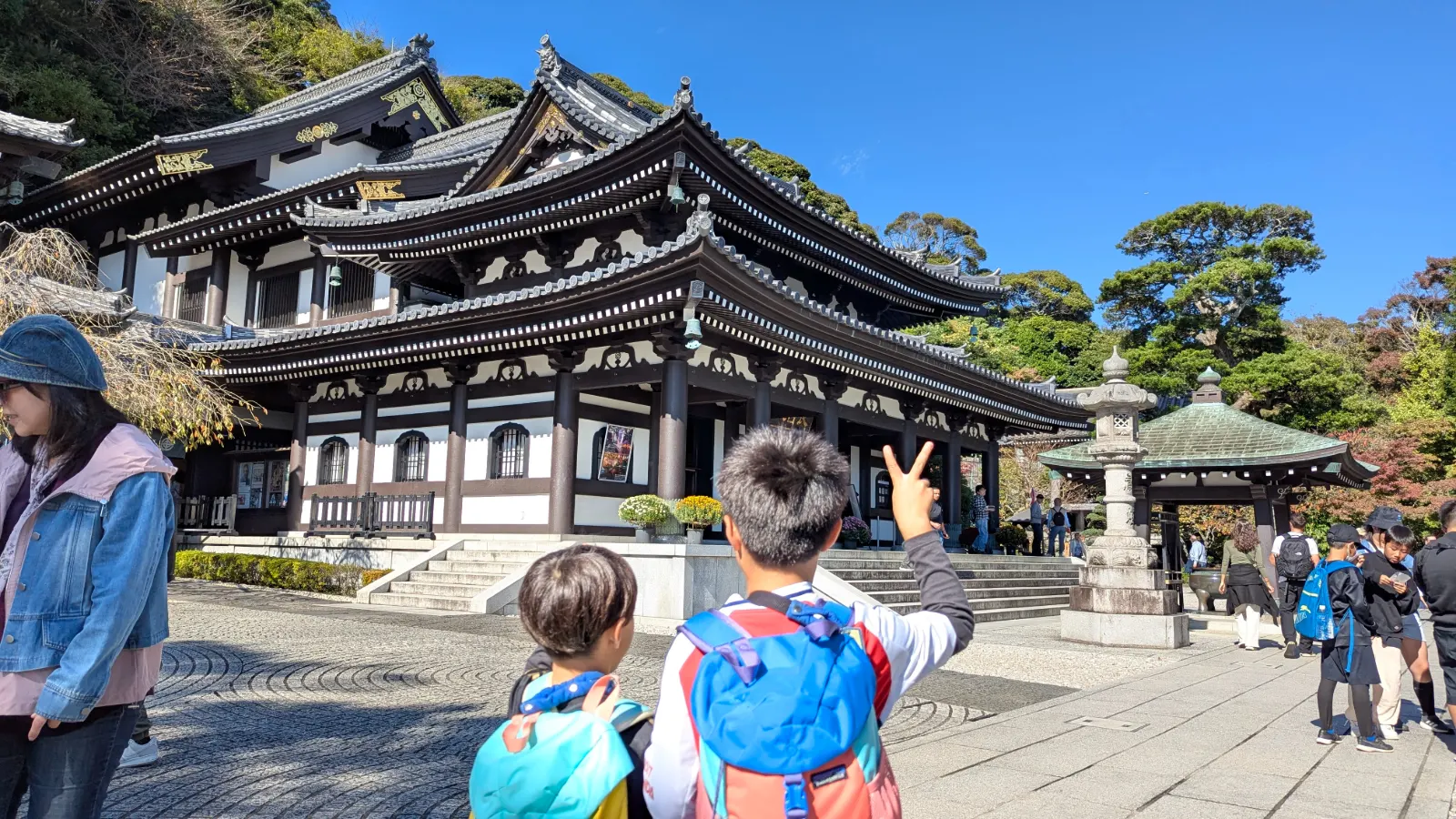
A temple built in stages up a hillside, with a carved cave at the bottom, a nine-meter wooden Kannon, and a stair a tired child can stop halfway up.
Junior high and high school also pay the adult ¥400. No booking needed; the Hydrangea Path takes its own ticket. Parking, 30 cars / ¥350 per 30 minutes, cannot be booked.
April to June, admission to 17:00 and the grounds to 17:30. No set closing day.
The lower precinct alone is a visit; the stairs add to it.
The pond and the cave suit the youngest; the stairs suit legs that want a climb.
Stroller parking under the main gate, on the right; crows take belongings left in them.
Some links on this page are affiliate links. LuNi may earn a commission at no extra cost to you.
Is Hasedera Temple worth it with kids?
The short version, before the costs, the timings and the case for each child.
Yes, and it is a temple with a great deal for children to find. The lower precinct holds Benten-kutsu, a cave whose walls are carved with Benzaiten and sixteen attendants, past the Hojo-ike pond. Stairs climb from there toward the Kaiko Terrace, which looks out over the sea. The principal image, an Eleven-faced Kannon carved from wood and 9.18 meters tall, is among the largest wooden statues in Japan. The Great Buddha is about five minutes away on foot, which makes the two an easy pair for one morning. Come early, since admission stops half an hour before the gates close, and a child with time for both the cave and the stairs gets the best of the place. Treat the terrace as the reward at the top, not the reason to come, so a child who stops lower has had the visit.
Planning Your Visit to Hasedera Temple with Kids.
Three decisions shape the visit. The first is the order: begin in the lower precinct, with the pond and the cave, before any climbing, so the child has had the temple’s best discovery before the legs are asked for anything. The second is the stairs, the one real effort of the visit, so settle in advance which child is likely to want them and which is happy with the pond and the cave, and agree before the first step that turning back is allowed. The third is the clock, since admission stops half an hour before the grounds close, earlier than families expect. Among Japan’s temples and shrines for children, few pair as neatly with a neighbor as this one does with the Great Buddha, five minutes away on foot. Settle these three at breakfast and the rest of the morning can belong to the child.
Every LuNi attraction guide starts with a visit, with our own children
LuNi rates and writes about attractions only after visiting them with children. Luca and Nico were at Hasedera Temple, and what they did there is recorded further down this page, including how each child actually met it.
Children arrive with different tolerances: for noise, for lines, for standing still, for being on their feet all day. A guide written for the average of them helps almost nobody. So every place on this site is read four ways, and each verdict says which children it already suits and what makes it work for the rest. Whoever you are bringing, the answer here is built for your family rather than for a general reader.
Restricted-movement depletion stays low on a hillside of precincts, stairs, a pond and a cave to explore, so let the child lead from bottom to top.
Sensory-input depletion builds inside the enclosed, carved cave of Benten-kutsu and before a Kannon over nine meters tall, so preview both first.
Unfamiliarity and unconfirmed structure ease with fixed hours and a layout that runs from pond to cave to stairs, so walk it in that order.
Sustained walking and standing build on the stairs up from the lower precinct, so stop at the Jizo-do halfway and decide there whether to go on.
Hotels we would book for this visit.
Three hotels in and around Kamakura, chosen for a family that makes the city a base for a night or two rather than a single long day of temples, so the temple can come early.
| Property | The LuNi Reason |
|---|---|
| LUNI Pick Hotel Metropolitan Kamakura In Kamakura | In Kamakura, for a family giving the city a night or two rather than a single day. From Hasedera, the Enoden runs back toward Kamakura from Hase Station, about five minutes’ walk from the temple, which keeps the end of a temple day simple for tired legs. Let the train carry tired legs back. |
| Kamakura Prince Hotel | Kamakura Prince Hotel sits on the coast west of Hase, along the Enoden line, and its Kamakura Suite sleeps four on two sofa beds, with a nursing room and a kids’ room among the hotel’s facilities. For a family pairing Hasedera with the sea, it keeps the temple and the shore on the same stretch of line. |
| LACER SUITES KAMAKURA | LACER SUITES KAMAKURA is three minutes on foot from JR Kamakura’s west exit, and its Deluxe Twin sleeps four in two queen beds, spacious enough for a family with children. There is no TV in the rooms and no parking, so it suits a family arriving by train, taking the Enoden to Hase from the same station. |
Nearby attractions, matched to your child.
Three visits for what the temple asks most of: the Great Buddha, five minutes on foot, with slopes a stroller can use, Tsurugaoka Hachimangu, whose gates keep fixed hours outside New Year, and an aquarium along the Enoden.
| Pairing | Why This Solves the After-Visit | For Your |
|---|---|---|
| LUNI Pick Kamakura Great Buddha About 5 minutes on foot from Hasedera | About five minutes on foot from the temple, the Kamakura Great Buddha stands in grounds with slopes that take a stroller, though some level changes need an adult’s hands. After Hasedera’s stairs, walking and standing stay short for a Sprinter, and the statue is taken in at a glance. | Sprinter |
| Tsurugaoka Hachimangu JR Kamakura East Exit, 10 minutes’ walk | At Tsurugaoka Hachimangu the gates open at six in the morning and close at eight at night outside New Year, the approach from JR Kamakura is a ten-minute walk, and the etiquette is simple to teach: bow twice, clap twice, bow once. Unfamiliarity and unconfirmed structure ease where the rules fit in one sentence. | Anchor |
| Enoshima Aquarium Enoden Enoshima Station, 10 min on foot | For a Sensor, Enoshima Aquarium is a separate outing along the Enoden, ten minutes on foot from Enoshima Station, open 9:00 to 17:00 through November. Sensory input is easier to manage when the family chooses the hour to suit the child, and with no parking, the train sets an easy pace. | Sensor |
Kamakura Great Buddha
About 5 minutes on foot from Hasedera For YourSprinter
Tsurugaoka Hachimangu
JR Kamakura East Exit, 10 minutes’ walk For YourAnchor
Enoshima Aquarium
Enoden Enoshima Station, 10 min on foot For YourSensor
How two children actually met this attraction.
Both children fixed on the same statues and took away completely different things, and each is a useful preview for a parent. One measured them, first by size and then by the rules around them, and treated a boundary he met as part of the building rather than a disappointment. The other asked a question nobody answered on the spot and carried it around the grounds for the rest of the visit. Neither needed the temple explained in full. One needed its limits stated plainly, the other needed room to wonder, and a parent who can give each of them that has done most of the work before reaching the gate. It is also why the temple suits a family with two such different children, with a boundary for the one who needs it and a mystery for the one who wants it.
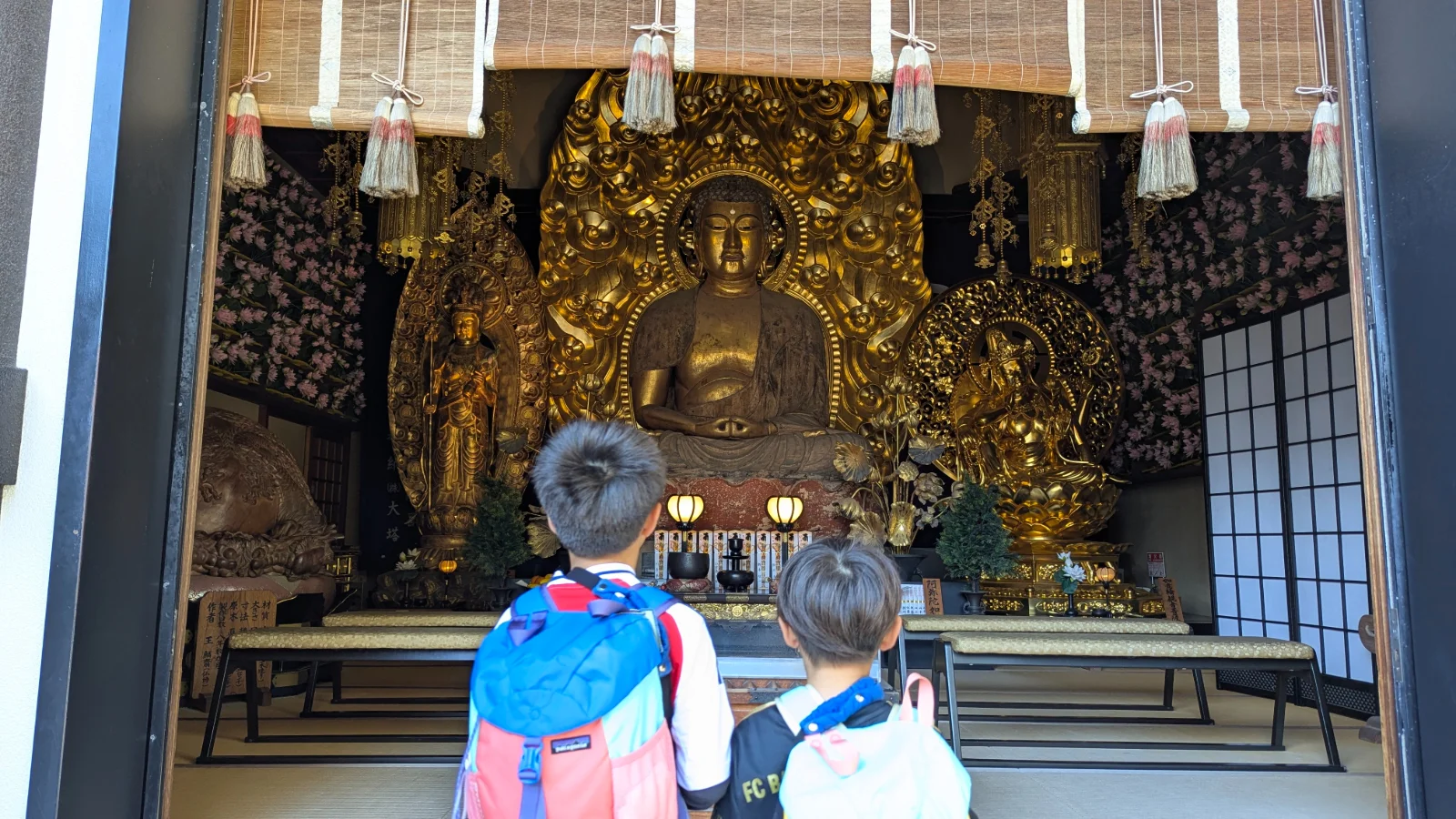
Luca fixed on the golden Buddhas, and the first thing he reported afterward was scale: how big and how tall they were, in that order. The second thing he reported was the rule. Photography is not permitted inside the Kannon hall where the large statue stands, or in the temple’s Kannon Museum, and he registered the boundary as a stated fact rather than a disappointment.
This is the Anchor pattern with an analytical hook. A child whose Reserve depletes through unfamiliarity and unconfirmed structure settles fastest when a rule is plain and has a clear edge, and Luca took the boundary he met as part of the building’s structure rather than a setback. Families with a similar child should name each rule before it is met, because a rule confirmed in advance costs nothing, while the same rule delivered as a correction feels like the place behaving unpredictably.
Nico saw the same golden Buddhas and went somewhere else with them. He wanted to know whether the gold was real gold or just gold-colored metal, and he was not satisfied by being told. He turned the question over on the move, revisiting it as the family walked the grounds and offering competing theories for each. The figures themselves held him for a short time. The unresolved question held him longer, and it was still running when the family left.
This is the Dynamo pattern. A child whose Reserve depletes through restricted movement keeps working even when the body is asked to be still, and an open question is what Nico moved through instead. Families with a similar child should leave the question open rather than settle it, and let it travel with the child down the stairs and around the pond, because a question carried on the move is a Dynamo’s way of taking in a place that asks for quiet.
Hasedera rises in stages up its hillside, and a child climbing it learns something about effort and reward at every level. A cave to explore, a towering Kannon and a view over the sea are discoveries earned step by step, and a child who stops halfway has still seen a great deal. That is a gentle lesson in knowing one’s own limits. A temple that lets a child choose how far to go teaches that a visit is not measured by reaching the top, but by what was noticed on the way up.
The LUNI Rating for Hasedera Temple.
One fact sits under all four verdicts: Hasedera is built in stages, a lower precinct with a pond and a cave, then stairs with the Jizo-do at their middle level, and a terrace that looks over the sea. The child who needs to move and the child who needs structure both do well on that shape. The Sensor needs care for the enclosed cave and the scale of the Kannon, and the Sprinter needs a plan for the stairs, eased by the stop at the Jizo-do. Anyone planning a family trip to Japan around Kamakura will find it an easy first temple.
Let the child lead from the pond up. The Dynamo depletes through restricted movement, and Hasedera is built for a child who needs somewhere to go. The lower precinct holds the Hojo-ike pond and, past it, Benten-kutsu, a cave whose walls carry carved figures of Benzaiten and sixteen attendants. From there, stairs climb the hillside, with the Jizo-do at the middle level, and the hydrangea path climbs further still. Every stage has a next stage above it, which is exactly the shape that keeps this child moving and interested.
Let the child own the route. Start at the pond, let the cave be the first discovery, then climb to the Jizo-do and decide together whether the top comes next. Keep time inside the halls short, since parts of a temple ask for quiet and stillness, and let the moving parts carry the visit. The Great Buddha is about five minutes away on foot for a child who still has energy after the top, and it makes a good second half to the morning.
What this means for your Dynamo: Hasedera gives restricted movement a hillside of stages. A younger Dynamo needs the pond, the cave and the Jizo-do; an older one can take the stairs and the hydrangea path beyond them.Preview the cave and the Kannon. The Sensor depletes through sensory input, and Hasedera’s two strongest moments are both about intensity. Benten-kutsu is a cave, enclosed, with carvings of Benzaiten and sixteen attendants on its walls. The principal image is an Eleven-faced Kannon carved from wood and 9.18 meters tall, among the largest wooden statues in Japan. For a child who is sensitive to input, an enclosed space and a figure of that scale are the parts that can overwhelm.
Describe both before arriving, and let the child decide. Tell a Sensor what the cave is like, that it is carved and enclosed, and that stepping back out is always fine. Say how tall the Kannon is, so the size arrives as a fact rather than a shock. Then use the Kaiko Terrace, which looks out over the sea, as the place to recover, and keep the visit to the parts the child chose, which is a full visit in itself.
What this means for your Sensor: at Hasedera the enclosed cave and the Kannon’s scale carry the sensory input. A younger Sensor needs both described first and the terrace after; an older one can choose which to see.Walk it in its own order. The Anchor depletes through unfamiliarity and unconfirmed structure, and Hasedera lays itself out in a sequence a child can hold: the lower precinct with the pond and the cave, the stairs with the Jizo-do at their middle, and the terrace over the sea. The hours are fixed, with admission ending half an hour before the grounds close and a longer day from April to June, and the main prices are simple, 400 yen for adults and 200 for elementary students.
Name the order before the gate, and the rules with it. In the sutra hall, photography, phones and talking are not allowed, so a child who knows that in advance meets no surprise at the door. Say where the visit ends, at the top of the stairs or at the Jizo-do, and whether the Great Buddha comes next, five minutes on foot, so the afternoon has a known shape from the start, and nothing about it arrives unannounced.
What this means for your Anchor: Hasedera’s fixed sequence leaves unfamiliarity little room. A younger Anchor needs the order said at the gate; an older one can set it, from the pond to the terrace.Make the Jizo-do the decision point. The Sprinter depletes through sustained travel-style walking and standing, and Hasedera asks for both. The approach is short, five minutes on foot from Hase Station on the Enoden or from the Hase Kannon bus stop, but inside, the temple climbs: stairs rise from the lower precinct, and the hydrangea path climbs further above. The Jizo-do stands at the middle level of those stairs, which gives a tired child a real stopping point rather than an unbroken ascent.
The decision belongs at the middle of the climb. Park a stroller under the main gate, on the right inside the entrance, and empty it first, since crows take what is left. Walk the lower precinct, where the pond and the cave need no climbing, then climb to the Jizo-do and stop. From there, go on only if the child’s legs agree, and keep the hydrangea path for an older child with energy left. Driving helps less than it seems, since the temple’s thirty parking spaces cannot be reserved, so the Enoden to Hase is usually the easier arrival.
What this means for your Sprinter: at Hasedera the walking and standing are mostly on the stairs. A younger Sprinter needs the lower precinct and the Jizo-do; an older one can take the top and the hydrangea path.The questions parents actually ask.
Hasedera is simple once its shape is clear: a lower precinct with the pond and the cave, stairs with a halfway stop, and a terrace over the sea. The climb, the hours and the price all follow from that shape, and none of them is hard. The one detail families miss is the time, since admission closes half an hour before the grounds do. After that, the question is what comes next, and getting around Japan by train with children covers the Enoden ride that links Hase with Kamakura Station. The price is simple too: junior high and up pay as adults, and only the preschool rate needs confirming.
Is Hasedera Temple worth visiting with kids?
Yes. Its lower precinct holds a pond and a carved cave, the stairs have the Jizo-do as a halfway stop, a terrace looks out over the sea, and the wooden Kannon stands 9.18 meters tall. Adults pay 400 yen and elementary students 200, and the Great Buddha is about five minutes away on foot, an easy and welcome second stop.
What are Hasedera’s opening hours?
Admission runs from 8:00 to 16:30, and the grounds close half an hour later. From April to June the hours extend, with admission until 17:00 and the grounds open until 17:30. Arrive well before the last admission, since the full climb takes real time and admission stops half an hour before the gates close.
How much does Hasedera cost?
Adults pay 400 yen and elementary school students 200 yen, and holders of Kamakura’s fukuju senior card also pay 200 yen. Junior high and high school students pay the adult rate; for preschoolers, check the rate at the gate before assuming one. Parking, if driving, is 350 yen per 30 minutes, and it cannot be booked ahead.
Is there a lot of climbing at Hasedera?
Stairs rise from the lower precinct, with the Jizo-do at their middle level, so there is a natural place to stop partway up. The hydrangea path climbs further above. The pond and Benten-kutsu, the cave, sit in the lower precinct, so a family that stops at the Jizo-do has still seen a good part of the temple, and nothing essential is missed.
What is Benten-kutsu?
A cave in the lower precinct, past the Hojo-ike pond, whose walls are carved with figures of Benzaiten and sixteen attendants. It is enclosed, so describe it to a child who is sensitive to confined spaces before going in, and let them decide whether to enter. It needs no climbing, which makes it an easy first stop before anyone tackles the long stairs.
How far is the Great Buddha from Hasedera?
About five minutes on foot. The two temples sit close together in Hase, so they pair easily in one visit: Hasedera for the climb and the cave, the Great Buddha for one enormous figure standing in open grounds under the sky. Both are within about five to seven minutes on foot of Hase Station on the Enoden.
How do you get to Hasedera?
From JR Kamakura, take the Enoden to Hase Station and walk about 5 minutes, or take a bus to the Hase Kannon stop and walk about 5 minutes. The temple has parking for 30 cars at 350 yen per 30 minutes, with no reservations, so the Enoden is usually the easier choice with children, especially on a weekend.
What is the Kannon at Hasedera?
The principal image is an Eleven-faced Kannon carved from wood, 9.18 meters tall and among the largest wooden statues in Japan. Tell a child how tall it is before they see it, so the size lands as a fact to marvel at rather than a surprise, and let them take it in from wherever they feel comfortable, near or far, and at their own pace.
Where Hasedera Temple fits your Japan trip.
Official site and opening information: Hasedera