Nagasaki Lantern Festival with Kids: Timing the Crowd.

A city lit by thousands of lanterns is the best night of the trip for a child who loves a crowd, and the hardest for a child whom a crowd wears down.
Nothing to book for the street lanterns. The Confucius Shrine venue charges ¥880 adults and ¥440 elementary and junior high.
A dragon dance every day; the Confucius Shrine venue runs 9:30 to 18:00, last entry 17:30.
One evening, one or two areas, with the tram between them.
Old enough to stay close in a crowd, to be carried when tired, and to walk between two areas.
No stroller rules at a street festival; a carried child moves through the crowd more easily.
Some links on this page are affiliate links. LuNi may earn a commission at no extra cost to you.
Is Nagasaki Lantern Festival worth it with kids?
The short version, before the costs, the timings and the case for each child.
Yes, for the right child, and with the right plan for the others. For 17 days each February, about 15,000 Chinese lanterns fill the center of Nagasaki, with a dragon dance every day and parades on set dates, and the lanterns in the streets cost nothing. A child who feeds on noise, color and movement will call it the best night of the trip. A child who is worn down by crowds, or who needs to know what comes next, will find it the hardest, because the festival is spread across several districts and the crowd sets the pace. The answer is not to skip it but to shrink it: one area, a day without a parade, a fixed end time and the tram between stops. Plan it that way and even a cautious child gets a lantern night worth remembering.
Planning Your Visit to Nagasaki Lantern Festival with Kids.
Three decisions decide the evening. The first is the day. The Emperor’s Parade and the Maso Procession fall on four named dates, and a child who struggles in crowds should go on a different one, while a child who loves a spectacle should go on exactly those. The second is the area. The lanterns run through Shinchi Chinatown, Hamaichi, the Kanko-dori arcade and the city center, and trying to see all of them in one night turns a festival into a march; choose one or two, and use the tram between them. The third is the end. Agree on it before leaving the hotel, whether that is a time or a place, so that leaving is part of the plan and not a defeat. A child who knows the end in advance leaves far more willingly.
Every LuNi attraction guide starts with a visit, with our own children
LuNi rates and writes about attractions only after visiting them with children. Luca and Nico were at the Nagasaki Lantern Festival, and what they did there is recorded further down this page, including how each child actually met it.
Children arrive with different tolerances: for noise, for lines, for standing still, for being on their feet all day. A guide written for the average of them helps almost nobody. So every place on this site is read four ways, and each verdict says which children it already suits and what makes it work for the rest. Whoever you are bringing, the answer here is built for your family rather than for a general reader.
Restricted-movement depletion stays low on open streets with a dragon dance every day, so give the child a route between areas and let them move.
Sensory-input depletion runs high in dense crowds among thousands of lanterns and dances, so keep the visit short, choose a quiet day, and plan the exit.
Unfamiliarity and unconfirmed structure run high across several districts with a program that changes by date, so pick one area and one end time beforehand.
Sustained walking and standing build across venues spread through the city center, so choose one area, ride the tram between stops, and carry the youngest.
Hotels we would book for this visit.
Three family hotels in Nagasaki chosen for the ride home after a festival night, when a tired child needs the shortest trip back. All three are on or near the tram line to Shinchi Chinatown.
| Property | The LuNi Reason |
|---|---|
| LUNI Pick Nagasaki Marriott Hotel At Nagasaki Station, on the tram stop side | On the side of the station where the trams stop, so the tram from Shinchi Chinatown brings a festival family almost to the door with no change. On a night of crowds, that is what matters. Ask for connecting rooms, so the child who dozed off on the tram can be put to bed while a sibling unwinds next door. |
| Hilton Nagasaki At Nagasaki Station’s west exit | Joined to the station’s west exit by a pedestrian deck, with a nursing space and a changing table for a baby on a cold February night. The tram stop is on the other side of the station, so the walk back through the concourse is part of the return, which is manageable with a carried child. |
| Stadium City Hotel Nagasaki About 10 minutes’ walk from Nagasaki Station | Three minutes from a tram stop on the line that runs straight to Shinchi Chinatown, so the festival is one ride away with no change. The indoor pool and hot-spring baths are a warm way to end a February evening outdoors, night after night for a family staying through festival week. |
Nearby attractions, matched to your child.
The festival is an evening in winter, so these pairings fill the daylight hours around it, each for the child who finds the lanterns hardest: a fixed walk before the crowd, open ground to recover, and an easy hour indoors.
| Pairing | Why This Solves the After-Visit | For Your |
|---|---|---|
| LUNI Pick Dejima About 4 minutes’ walk from the Shinchi Chinatown stop | Before the lanterns, Dejima gives a child a historic street with a free staff-led walk and a clear order, a short walk from the festival. Unfamiliarity and unconfirmed structure cost least when the fixed part of the day comes first and the crowd comes after, with a known end. | Anchor |
| Nagasaki Peace Park About 20 minutes by tram from Shinchi Chinatown | The day after the lanterns, Nagasaki Peace Park, the city’s memorial to the atomic bombing, is open ground walked at a slow pace among statues and a fountain. For a child whose sensory input ran high in the crowds, an outdoor morning at a slow pace is the recovery, taken seriously. | Sensor |
| Nagasaki Penguin Aquarium About 30 minutes by taxi from Nagasaki Station | On the day of the festival, Nagasaki Penguin Aquarium takes about an hour indoors, step-free inside and served by two elevators, with strollers lent at no charge. The walking and standing reserve the evening will need is barely touched in the afternoon. | Sprinter |
Dejima
About 4 minutes’ walk from the Shinchi Chinatown stop For YourAnchor
Nagasaki Peace Park
About 20 minutes by tram from Shinchi Chinatown For YourSensor
Nagasaki Penguin Aquarium
About 30 minutes by taxi from Nagasaki Station For YourSprinter
How two children actually met this attraction.
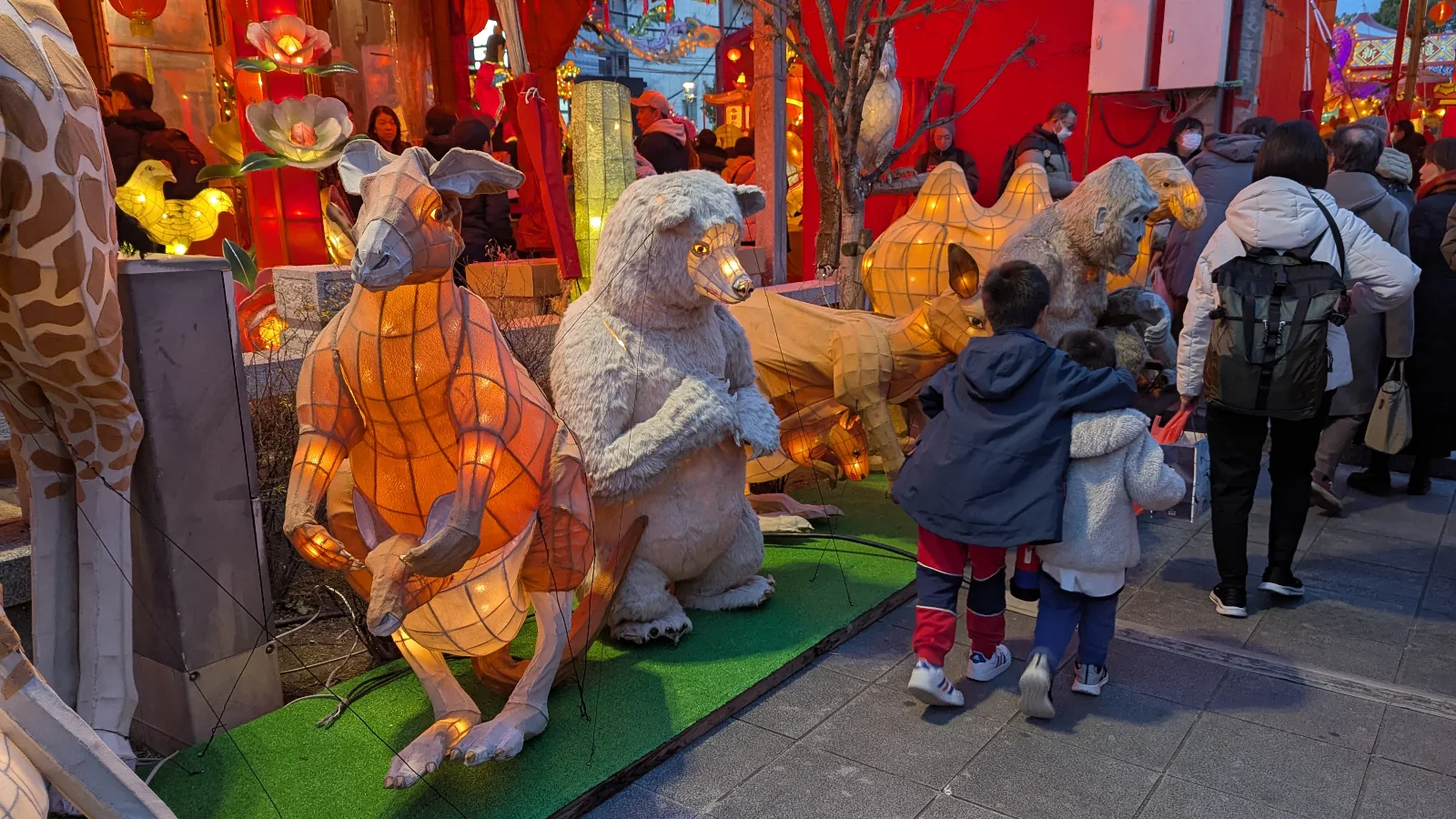
Two children walked into the same lit streets and met two different festivals. One needed to understand what he was looking at, and he wanted to stand still and do it, which a moving crowd does not allow; he was at his best when the family found a spot and let him study a single display. The other was carried along by everything, the color, the food, the dancing and the noise, and for the first part of the evening nothing could tire him. Then, as the hour grew late and the streets grew fuller, his energy ran out. Both children loved the lanterns, every one of them. What decided their evening was not the festival itself but how well the family handled the crowd and the clock.
Luca wanted to know what every lantern figure depicted, stopping at each display to work out which zodiac animal it was and why it had been made that way. What he did not want was to keep moving through the press. He was steadiest with a fixed spot to stand and study a display from, and visibly less settled when the crowd pushed the family along before he had finished reading a scene.
This is the Anchor holding onto structure in a place that offers very little. A child whose Reserve depletes through unfamiliarity and unconfirmed structure relies on a fixed sequence, and a drifting crowd removes it. A child who plants himself at one display and studies it is building the structure the event will not supply. Families with a similar child should give them a fixed viewing spot and one thing to work out there, rather than asking them to take in the festival on the move.
Nico was fully in it: the crowds, the color, the food stalls, the dragon dances, the noise, the motion. He moved toward every performance and narrated what he saw, feeding on the activity rather than being tired by it. The limit was not his interest but his stamina. In the earlier part of the evening he was unstoppable, and as the density built and the hour ran later, the same energy that had powered him started to sag.
This is the Sprinter thriving at full charge and then fading on schedule. A child whose Reserve depletes through sustained travel-style walking and standing meets a late festival on foot just as that Reserve runs low. A child who is euphoric early and tired later is not losing interest; he is reaching the bottom of a short tank. Families with a similar child should spend the strong early part of the evening on what matters most and leave before the fade.
A city lit by thousands of lanterns turns an ordinary winter evening into a festival a child will remember for years. Color, shape and light fill the streets with a wonder that belongs to the whole community, and a child feels part of a celebration far bigger than their own family. For a sensitive child, taking it in small doses is its own victory. Festivals teach children that people mark time together, and that joining in, even briefly, is a way of belonging somewhere new.
The LUNI Rating for Nagasaki Lantern Festival.
One fact sits under all four verdicts: the Lantern Festival is a crowded evening spread across several districts of the city center, with no gate and a program that changes by date. For a child who needs to move, that is freedom, with open streets and a dragon dance to find every day. For a child who takes in everything, it is the heaviest sensory evening Nagasaki offers. For a child who needs the plan fixed, the crowd and the changing program remove the structure they rely on. And tired legs pay for every district a family adds to the evening’s route.
Give the child a route and let them go. The Dynamo depletes through restricted movement, and the Lantern Festival asks almost no stillness of a child. It is a set of open, lit streets across several districts, with no gate to pass, and a dragon dance is staged every day of the festival for a moving child to head toward. Food stalls, color and constant motion keep a child who needs to act busy from the first lantern to the last. For this child the crowd is part of the fun.
Give that energy a shape. Choose two areas and the tram ride between them, so the child has somewhere to go next rather than a crowd to push through. On a parade day, the Emperor’s Parade or the Maso Procession makes a natural target to walk toward. Stay close in the busiest streets, agree on a meeting point, and let the child set the pace between displays. A moving child here tends to fade from tiredness, not boredom, so end on a high.
What this means for your Dynamo: restricted movement is rare on open, lit streets. A younger Dynamo needs a short route and a hand to hold in the crowd; an older one can navigate the tram between two areas and lead.Shrink the festival to a size the child can hold. The Sensor depletes through sensory input, and the Lantern Festival is sensory input in every direction. About 15,000 lanterns light the city center, the dragon dance runs every day, parades bring about 150 people in costume through the streets on set dates, and areas such as Megane Bridge are much busier than usual. None of it is optional once the family is inside a crowd, because the crowd decides the pace and the distance. That is the whole difficulty.
The consequence is a smaller festival, not no festival. Go on a day without a parade or procession. Choose one area and stay at its edge, where stepping out of the crowd is a few steps rather than a struggle. Set an end time before leaving the hotel and hold to it even if the child seems fine, because the load builds faster than it shows. For many Sensors, twenty minutes of lanterns and a clear exit will be the best version of this night.
What this means for your Sensor: sensory input runs high in the crowd and the lights. A younger Sensor needs one area, the edge of the crowd and a fixed end; an older one can choose the day and call the exit themselves.Decide the area and the end before you leave. The Anchor depletes through unfamiliarity and unconfirmed structure, and the Lantern Festival has little of the structure this child relies on. It is not a place with a gate and a route but a set of districts, from Shinchi Chinatown to the Kanko-dori arcade, with parades on some dates, processions on others, and a crowd that moves the family along whether it is ready or not. A child who needs to know what comes next finds the festival rearranging itself around them.
The consequence is to build the structure the festival will not provide. Pick one area and name it in advance. Choose a day and say what happens on it, parade or not. Agree on a fixed spot to stand and one display to study, and an end time that does not move. Starting the day at a fixed place, such as a guided walk at Dejima before the lanterns, helps too. With the frame set by the family, the festival becomes something the child can hold.
What this means for your Anchor: unconfirmed structure runs high across districts and changing dates. A younger Anchor needs one area, one spot and one end time; an older one can plan the route and the day themselves.Choose one area, and carry the youngest. The Sprinter depletes through sustained travel-style walking and standing, and the Lantern Festival is almost all of both. The lanterns run across several districts of the city center, and watching a dragon dance or a parade means standing in a crowd. The festival is also an evening event in February, arriving at the end of a day when a tired child has already used some of their Reserve. It stays manageable because the tram serves the festival area and the route can be cut to fit.
Keep the scale small. Choose one or two areas, and use the Shinchi Chinatown, Kanko-dori, Shianbashi and Meganebashi tram stops to move between them instead of walking the whole city center. Plan an easy afternoon, not a full day of sightseeing, before the evening. Carry a young child rather than pushing a stroller through the crowds, and leave while the child is still enjoying it, because the walk back to the tram is part of the evening too.
What this means for your Sprinter: walking and standing build across districts and crowds. A younger Sprinter needs one area and to be carried; an older one can manage two areas with the tram between them.The questions parents actually ask.
The Lantern Festival’s parades and processions fall on four named days, set well in advance, which makes the choice of day the most useful decision a family can make. Most of the festival is free, and the lanterns spread across several districts. Settle the day, the area and the end before you leave the hotel, and hold the whole family to all three, whatever the night brings. The lanterns change color by area, which gives a child something to look for in each district. A February trip can pair the lanterns with Nagasaki’s family stops by day, keeping the crowd for one evening.
Is Nagasaki Lantern Festival worth visiting with kids?
Yes, for a child who loves a crowd, and with a careful plan for one who does not. About 15,000 Chinese lanterns fill central Nagasaki for 17 days, with a dragon dance every day, and the lanterns in the streets are free. For a child overwhelmed by crowds or unsettled by a changing plan, keep the visit short and choose the day.
When is the Nagasaki Lantern Festival in 2027?
From Friday, February 5 to Sunday, February 21, 2027, 17 days, as currently planned. It began as Shinchi Chinatown’s Spring Festival for the Lunar New Year and grew into the city-wide Lantern Festival from 1994. The lanterns spread across the city center, with some large figures standing up to about 10 meters tall.
Is the Nagasaki Lantern Festival free?
The lanterns in the streets are free to see. The Confucius Shrine, one of the decorated venues, charges its own admission of 880 yen for adults, 550 for high school students and 440 for elementary and junior high students, and stages its own face-changing shows; it is open 9:30 to 18:00, with last entry at 17:30.
When are the Lantern Festival parades?
The Emperor’s Parade, with about 150 people in costume, runs on Saturday, February 13 and Saturday, February 20, 2027. The Maso Procession runs on Sunday, February 7 and Sunday, February 14. The dragon dance is staged every day of the festival. For a child who struggles in crowds, choose a day without a parade or procession.
Where are the main lantern areas?
The festival runs through Shinchi Chinatown, where the Doza River is lit in pink, Hamaichi, the Kanko-dori arcade and the city center, and the lanterns change color by area, with yellow around Megane Bridge. The Shinchi Chinatown, Kanko-dori, Shianbashi and Meganebashi tram stops serve the festival area.
How should a family with young children handle the crowds?
Choose one area rather than touring them all, go on a day without a parade or procession, and agree on an end time before leaving the hotel. Carry a young child rather than pushing a stroller through the streets, pick a meeting point in case you are separated, and use the tram between areas instead of walking the whole route.
Can you see Dejima and the Lantern Festival on the same day?
Yes. Dejima is about 4 minutes’ walk from the Shinchi Chinatown tram stop and stays open until 21:00, so a family can spend the afternoon on its historic street and walk to the lanterns afterward. For a child who needs a settled plan, that order puts the fixed, predictable part of the day first.
What is the red-thread charm at the Lantern Festival?
At the Bernard Kanko-dori venue, a stall for Gekka Rojin, the matchmaking deity, sells a red-thread charm for 100 yen. It is a small, cheap souvenir a child can choose and buy themselves, which gives a crowded evening a clear, happy ending. Decide where the charm stop falls in the route before you set out.
Where the Nagasaki Lantern Festival fits your Japan trip.
Official site and opening information: Nagasaki Lantern Festival