Nagasaki Penguin Aquarium with Kids: Penguins Beyond the Glass.
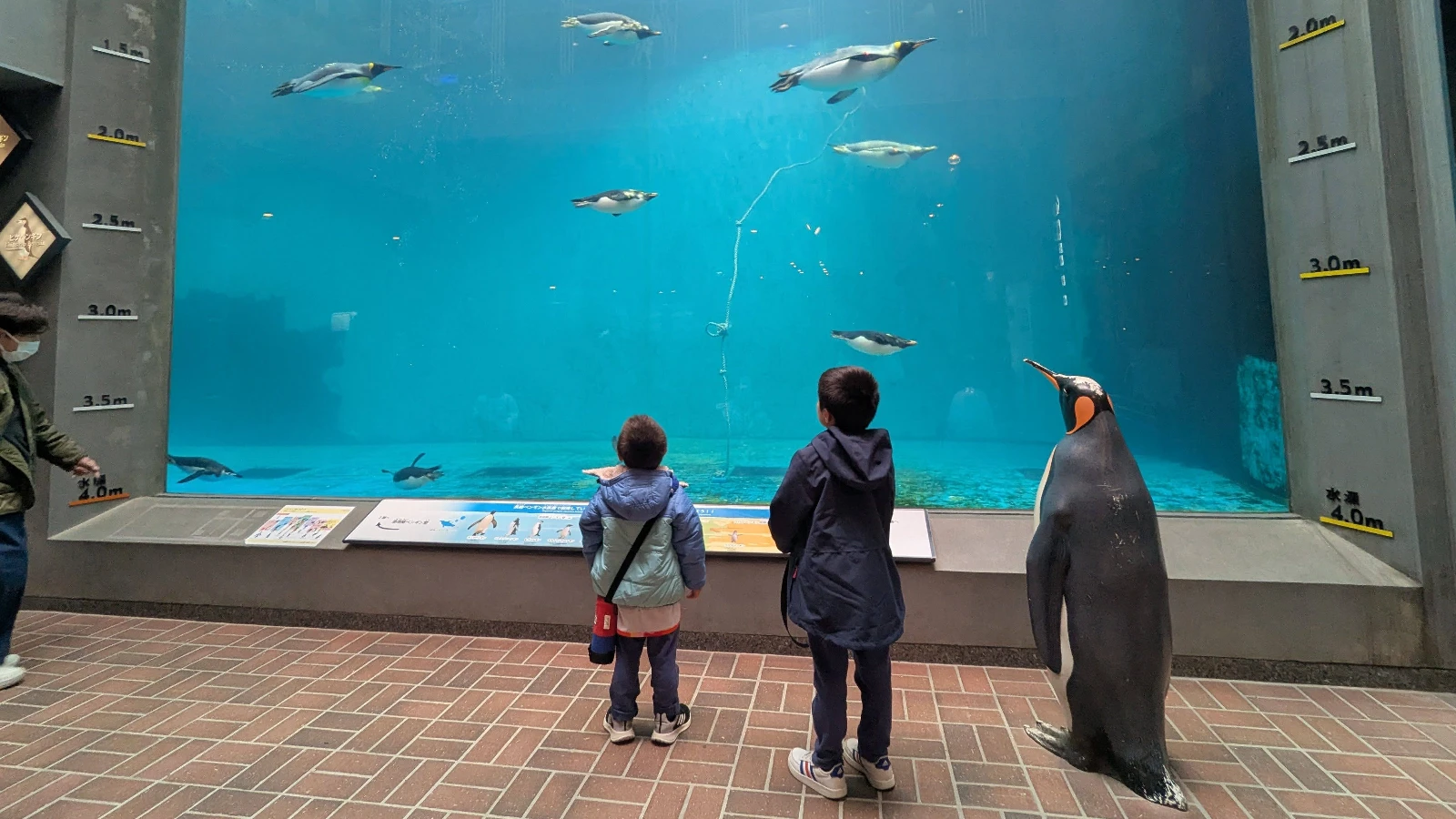
An hour of penguin tanks is a perfect morning for a child who loves to watch, and a long stretch at the glass for a child who needs to move.
Preschoolers enter free. No booking needed: tickets at the counter or machines, cards accepted.
Open every day of the year.
Same-day re-entry is unlimited, so a break on the lawn outside does not end the visit.
The touch pool and kids room suit the youngest; kayaking takes children from age 4 with a guardian.
Barrier-free inside with two elevators; loans are few, first come, no booking.
Some links on this page are affiliate links. LuNi may earn a commission at no extra cost to you.
Is Nagasaki Penguin Aquarium worth it with kids?
The short version, before the costs, the timings and the case for each child.
Yes, for a young child especially, because the whole visit is built at a small child’s scale: about an hour of penguins, a touch pool and a kids room, in a building a stroller can cross. The one thing to know before choosing a day is that the famous part, penguins swimming in the open sea at Fureai Penguin Beach, happens on weekends and holidays only, and not during the molt. Go on one of those days if the beach is the draw. Go on any day if the tanks are enough, and use the outdoor lawn and same-day re-entry to give a restless child a break, since a child who needs to move is the one it asks the most of.
Planning Your Visit to Nagasaki Penguin Aquarium with Kids.
Three decisions shape the morning. The first is the day. Fureai Penguin Beach, where the penguins go out into the sea, runs on weekends and holidays only, and not in the molt or a bird-flu outbreak, so a family set on the beach should pick a weekend and check the aquarium’s news first. The second is how to get there. The aquarium is east of the city, reached by a prefectural bus or a taxi from Nagasaki Station, and the return bus leaves from a different stop, so note it on the way in. The third is the rhythm of the visit. It takes about an hour, and re-entry is unlimited, so plan a break outside on the lawn for a child who needs to move, then go back in.
Every LuNi attraction guide starts with a visit, with our own children
LuNi rates and writes about attractions only after visiting them with children. Luca and Nico were at Nagasaki Penguin Aquarium, and what they did there is recorded further down this page, including how each child actually met it.
Children arrive with different tolerances: for noise, for lines, for standing still, for being on their feet all day. A guide written for the average of them helps almost nobody. So every place on this site is read four ways, and each verdict says which children it already suits and what makes it work for the rest. Whoever you are bringing, the answer here is built for your family rather than for a general reader.
Restricted-movement depletion builds over an hour watching tanks at the glass, so plan a break on the outdoor lawn and use the free same-day re-entry.
Sensory-input depletion stays low in a short, one-hour visit with a lawn outside, so let the child linger at the tanks they choose.
Unfamiliarity and unconfirmed structure ease in an aquarium open every day with a clear one-hour shape, so walk the child through the map beforehand.
Sustained walking and standing stay low in a barrier-free building with elevators and free strollers, so borrow one early and take the full hour.
Hotels we would book for this visit.
Three Nagasaki family hotels as city bases for a morning east of town, chosen for how easily a family gets to the bus or a taxi at the station and back.
| Property | The LuNi Reason |
|---|---|
| LUNI Pick Hilton Nagasaki At Nagasaki Station’s west exit | A minute from the station along a pedestrian deck, so the bus or a taxi east to the aquarium starts close to the room. For a family with a baby it suits an aquarium that has its own nursing and baby care rooms: the Hilton has a nursing space and a changing table too. |
| Nagasaki Marriott Hotel At Nagasaki Station, on the tram stop side | In the Amu Plaza complex a minute from the station, with large partnered parking garages, which suits a family renting a car for the short drive from the Hokozuka interchange. Connecting rooms are available for two children who want different evenings after a morning of penguins. |
| Stadium City Hotel Nagasaki About 10 minutes’ walk from Nagasaki Station | Ten minutes’ walk north of the station, with guest parking and an indoor pool and hot-spring baths. A family that likes water will find the pool a natural afternoon after the aquarium, once the morning’s bus or taxi has brought the whole family back to the hotel. |
Nearby attractions, matched to your child.
The aquarium is a morning, so these pairings are for the rest of the day, back in the city: a hillside to walk down for a child who needs to move, a fixed evening ride, and a historic street to settle into.
| Pairing | Why This Solves the After-Visit | For Your |
|---|---|---|
| LUNI Pick Glover Garden Tram from Nagasaki Station, changing at Shinchi Chinatown | After an hour at the glass, Glover Garden is a hillside walked downhill from the top gate, with heart-shaped stones set in the paving to hunt. A child whose restricted-movement reserve ran down at the tanks gets an afternoon that is almost all walking, with a search to power it. | Dynamo |
| Mount Inasa Bus 3 or 4 from Nagasaki Station | The same operator runs the ropeway at Mount Inasa, and its evening runs on fixed hours, with a last car up at 21:00. For a child whose unfamiliarity and unconfirmed structure ease when the whole plan can be told in advance, it makes a settled end to the day. | Anchor |
| Dejima About 5 minutes by tram from Nagasaki Station | Back in the city, Dejima is a historic street of reconstructed buildings, entered by the tram and walked at the family’s own pace. For a child who spends sensory input quickly, an unhurried afternoon of old rooms is a gentle second half to a morning of tanks. | Sensor |
Glover Garden
Tram from Nagasaki Station, changing at Shinchi Chinatown For YourDynamo
Mount Inasa
Bus 3 or 4 from Nagasaki Station For YourAnchor
Dejima
About 5 minutes by tram from Nagasaki Station For YourSensor
How two children actually met this attraction.
Two children walked into the same aquarium and wanted opposite things from it. One wanted to stand at the glass for as long as it took to sort every penguin from every other, and he would have stayed there all day. The other wanted to be wherever he could move: outside with the penguins, at the touch pool, reaching in, then off again. The same building gave both of them what they wanted, because it holds deep tanks to study and places to do something with the hands, and because the visit is short enough that neither child had to wait long for the other. That is the real strength of this aquarium: a short visit that each child gets to shape in their own way.
Luca settled in at the underwater viewing panels and stayed. He worked along the glass methodically, sorting one kind of penguin from another and counting the species on show, and he repeated what he learned to anyone within reach all day. He read the panels in full, tracked individual birds through the water rather than scanning the whole tank, and had to be steered toward the outdoor beach because the indoor detail had absorbed him completely.
This is the Sensor pattern. A child whose Reserve depletes through sensory input is often the one whose close attention lets them sink into fine detail and hold it, sorting species and reading every panel while others drift past. Families with a similar child should let the underwater panels and the touch pool be the heart of the visit, give the child time at the glass, and step outside to the lawn whenever the room around them fills up.
Nico went straight for the parts of the visit that let him move. He wanted the outdoor penguin beach, the touch pools, and the feeding sessions, and on the beach walk he tried to keep pace alongside the penguins, matching their waddle down the shoreline and turning it into his own event. He reached into the touch pool more than once, but the indoor glass held him only briefly before he was angling back toward the open beach.
This is the Dynamo pattern. A child whose Reserve depletes through restricted movement meets an aquarium through what it lets him do, and every one of Nico’s favorites involved his hands or his feet. Families with a similar child should build the visit around the outdoor areas and the touch pool, treat the tanks as short stops between them, and on a weekday, when the beach does not run, use the lawn and the free re-entry to keep him moving.
An hour of watching penguins swim, dive and jostle gives a child the chance to observe animal behavior closely and at their own pace. Noticing how each penguin moves, which ones stay together and how they react to one another builds attention and empathy in equal measure. Children who learn to watch patiently discover a whole world of small dramas that a hurried glance would miss. A morning at the glass can teach a child that close attention to another living thing is its own reward.
The LUNI Rating for Nagasaki Penguin Aquarium.
One fact sits under all four verdicts: Nagasaki Penguin Aquarium is a barrier-free building that takes about an hour, with an outdoor lawn, same-day re-entry and a penguin beach on weekends and holidays. That makes it easy for tired legs, easy for a child who needs a known shape, and gentle for a child who takes in everything, since the visit is short and a quieter lawn is outside. It asks more of a child who needs to move, because most of the hour is spent standing and watching tanks through the glass, and the outdoor outlets that help most run only on some days.
Plan the break before the tanks. The Dynamo depletes through restricted movement, and most of an hour at the Penguin Aquarium is spent at the glass, watching penguins and fish in tanks. The touch pool, with starfish, sea cucumbers and urchins, and the kids room give a moving child something to do with the hands, but the building is a set of tanks to look into. For a child whose Reserve drains whenever the body is asked to hold still, that is enough to make the visit harder than it looks.
The outdoors is the answer, and it is there every day. Food and drink are allowed on the lawn and at the penguin plaza, and re-entry on the same day is unlimited, so plan a break outside halfway through, run it off, then go back in. On weekends and holidays the penguin beach adds a real outlet, and from late April to late September a weekend kayak adds another. On a weekday, the lawn and the free re-entry do the work.
What this means for your Dynamo: restricted movement builds over an hour at the glass. A younger Dynamo needs a planned run on the lawn halfway through; an older one can take a weekend kayak or follow the penguin beach.Let the child choose the tanks. The Sensor depletes through sensory input, and the Penguin Aquarium keeps that input in proportion. The visit is short, about an hour, and the lawn outside is there to step out to at any point. The deepest tank, the subantarctic penguin pool, is four meters deep and draws the eye, and the touch pool invites a closer, gentler kind of attention. A child who takes in everything can spend the hour at the tanks they choose and skip the rest.
Freedom to linger, and freedom to leave, carry this child. Let the child stay at one tank for as long as it holds them, and step outside to the lawn whenever the room fills. Re-entry is unlimited on the same day, so a break outside costs nothing. If the penguin beach runs on your day, watch from the edge rather than the front. It works because the visit is short and the exit is always close.
What this means for your Sensor: sensory input stays in proportion over a short visit. A younger Sensor needs time at one tank and the lawn as a retreat; an older one can choose the tanks and the moment to step out.Walk the child through the map first. The Anchor depletes through unfamiliarity and unconfirmed structure, and the Penguin Aquarium has a shape that can be told in full. It is open every day of the year, it takes about an hour, and its guide map names every area, from the anchovy ring tank to the penguin pools, the touch pool and the kids room. Tickets are bought at the counter or the machines, with no timed entry. There is very little here that a child cannot be told in advance.
The one variable is the beach. Fureai Penguin Beach runs on weekends and holidays only and can be canceled, so a child told to expect it on the wrong day may feel the plan has broken. Say plainly which day it runs and check the news the evening before. Then walk the child through the map, name the order of the visit and the break on the lawn, and the hour runs on confirmed ground.
What this means for your Anchor: unconfirmed structure eases in a short visit with a clear map. A younger Anchor needs the beach’s days explained and the order named; an older one can hold the map and lead the route.Borrow a stroller early, and take the full hour. The Sprinter depletes through sustained travel-style walking and standing, and the Penguin Aquarium is one of the easiest visits in the city on tired legs. It takes about an hour, the building is barrier-free inside with two elevators, and it lends strollers and wheelchairs free. There are baby care and nursing rooms, and the lawn outside is a place to sit down and eat. For a child whose legs tire first, it is a complete outing that asks very little walking.
Take what is offered, and take it early. The free strollers are few and lent first come with no reservations, so ask at arrival rather than when the child starts to fade. Use the elevators, sit on the lawn for the break, and keep standing at the tanks short. The one real cost is the journey: the aquarium is east of the city by bus or taxi, so plan the ride home before the visit rather than after it.
What this means for your Sprinter: walking and standing stay low in a barrier-free building. A younger Sprinter needs a borrowed stroller from the start; an older one can walk the whole hour with a sit on the lawn.The questions parents actually ask.
Fureai Penguin Beach runs on weekends and holidays only and stops in the molt, and it is the part that catches families out. The rest is easy: about an hour, cheap tickets, free for preschoolers, same-day re-entry and a barrier-free building. Settle the day and the ride before leaving the city, and the visit itself takes care of the rest. It is a morning, which leaves the afternoon for Nagasaki’s other family stops back in the city, by bus or taxi. A child set on the beach should hear the calendar well before the trip, so a quiet weekday is not a letdown.
Is Nagasaki Penguin Aquarium worth visiting with kids?
Yes. It keeps 9 of the world’s 18 penguin species, has a touch pool and a deep subantarctic penguin pool, and takes about an hour, which suits young children well. On weekends and holidays the penguins also swim in the open sea at Fureai Penguin Beach, so choose one of those days if the beach is the point.
How much does Nagasaki Penguin Aquarium cost for a family?
Admission is 800 yen for adults and 400 yen for elementary through high school students, and preschool children enter free, so two adults and two elementary children pay 2,400 yen. An annual pass costs 2,000 and 1,000 yen. The counter and ticket machines take cards, e-money and QR code payments as well as cash.
How do you get to Nagasaki Penguin Aquarium from Nagasaki Station?
Take the Nagasaki Prefectural Bus from the Nagasaki Ekimae transport plaza, bound for Amaba or Kasuga Shako-mae, to the Penguin Suizokukan-mae stop; for the return, board at the Himi Koen-mae stop. A taxi from the station takes about 30 minutes and costs about 2,500 yen. By car it is about 5 minutes from Nagasaki Hokozuka IC, with lots open 8:00 to 18:00.
When do the penguins go on the beach at Nagasaki Penguin Aquarium?
Fureai Penguin Beach, where the penguins swim in the natural sea and rest on the sand, runs on weekends and holidays only. It does not run during the penguins’ molt or during a bird-flu outbreak, and it has been canceled on announced days, so check the aquarium’s news before promising it to a child.
How long does Nagasaki Penguin Aquarium take?
About an hour. Food and drink are allowed outdoors at the penguin plaza and on the lawn, though not inside, and re-entry on the same day is unlimited on showing your ticket. That makes it easy to split the visit: the tanks, a picnic or a run on the lawn, then back inside for a second look.
Is Nagasaki Penguin Aquarium stroller-friendly?
Yes. The inside is barrier-free, with two elevators, and the aquarium lends wheelchairs and strollers free, though there are only a few, first come, with no reservations. There is a nursing room on the first floor, baby seats in the multipurpose restrooms, and a baby care room on the second floor beside the kids room.
Can you go kayaking at Nagasaki Penguin Aquarium?
Yes, from late April to late September, on weekends and holidays. A single kayak costs 730 yen an hour and a double 1,090 yen, and children from age 4 through elementary school ride with a guardian. Kayaking is canceled for rain, wind or low tide, so treat it as a bonus on a fine weekend rather than a plan.
Is the Penguin Aquarium or Nagasaki Bio Park better for kids?
They suit different days. The aquarium is about an hour, close to the city and easy on small legs. Nagasaki Bio Park is a full day about 80 minutes away by bus, with animals to feed and a paved loop that climbs, and preschool children may not enter its capybara enclosure.
Where Nagasaki Penguin Aquarium fits your Japan trip.
Official site and opening information: Nagasaki Penguin Aquarium