Best Beaches in Fukuoka With Kids:and which ones need a car.

- Without a Car
- Fukae, about twelve minutes from the station
- In the City
- Momochi, a subway ride and a short walk
- Watched Water
- Three of the eight; the rest are unwatched
- Do Not Swim
- Futamigaura: drop-offs and rip currents
- A Bus to the Sand
- Shikanoshima, with its bus stop on the beach
Some links on this page are affiliate links. LuNi may earn a commission at no extra cost to you.
The best beaches in Fukuoka with kids are separated less by the sand than by the getting there. Fukae is the easiest to reach without a car, about twelve minutes on foot from Chikuzen-Fukae Station; Momochi is a subway ride and a short walk inside the city; Shikanoshima has its bus stop on the sand. Hatsu, Wakita and Keya are each a train, then a bus, then a walk of a few minutes. Only three of the eight have watched water, and Futamigaura, with its sudden drop-offs and rip currents, is a viewpoint rather than a beach day.
What a beach day in Fukuoka actually asks for.
Family travel runs on three currencies, not two. Money and time, plus the child’s Reserve: their finite capacity to absorb what travel asks of them. On this coast almost none of it goes on the water. It goes on the getting there and the getting clean.
Three you reach on a train or a bus, and step straight onto.
The last leg is the part of a beach day that gets paid for twice, once on the way out and once in damp clothes on the way back. These three are the shores where that leg is short enough not to count.
Shallow a Long Way Out, and Nobody Watching: Fukae Beach, Itoshima.
Chikuzen-Fukae Station is twelve minutes away on foot, which no other designated beach on this coast manages without a bus leg, and short enough to walk a second time with a tired child and a bag of wet towels. The sand runs 700 meters and the water stays shallow a long way out, so the depth a small child wants sits close to where you put the bags down. Set against that is one fact to plan the whole day around: there are no lifeguards and no jellyfish net, so the watching is yours from the moment you arrive, and the free parking holds about twenty cars, which is the smallest on this coast and goes early.
Swim Only While the Lifeguard Is There: Momochi Seaside Park, Fukuoka.
Swimming here is a permission rather than a season. It runs in the eastern half of Momochihama and only while lifeguards are on duty, roughly from early July to early September, and outside that the limit is wading to knee depth. What Momochi has that the designated beaches do not is permanent infrastructure: heated showers and changing rooms that exist all year rather than for two months, coin lockers, and a city across the road, so the exit is a subway ride instead of a bus and a wait. The catch is the geography of the place, because the showers sit at the western end and the water you may swim in is at the eastern one, so every rinse is the length of the sand and back again.
250 Meters of Shore, and the Bus Stops on It: Shikanoshima Beach, Fukuoka.
The bus sets a family down at the sand, so neither the arrival nor the exit is walked, and on a coast where nearly everything else is a bus leg plus a walk that is the largest single saving on offer. The water is shallow and suited to small children, it grades in the top band in season, and lifeguards are on it at weekends in July and then every day in August, which leaves a July weekday as the gap worth knowing about. The honest limit is the size. A 250 meter shoreline and thirty meters of sand is a corridor rather than a field, and on an August weekend it is a corridor with everybody in it, so a child who runs down when they cannot move runs out of room here well before they run out of day.
Three worth the three legs, for three different reasons.
None of these has a station near it and all three are reachable without driving, at the cost of a transfer in each direction. What you are buying with that transfer is different at each one: calm water, a free shower, or a day somebody else supplies.
Calm Enough for a Child Who Cannot Swim: Hatsu Beach, Okagaki.
White sand curving in a gentle bow, and waves calm enough that small children can be in them with confidence, which on the open Genkai Sea is not the ordinary condition and is why this shore carries a national bathing-beach selection. Behind it sits a coin shower at the tourism station at 100 yen for three minutes, the cheapest rinse anywhere on this coast, and 150 parking spaces for anyone who does drive. What it costs is the approach and the calendar: about twenty minutes by bus from JR Ebitsu and then three on foot, and a season that shuts in the middle of August rather than at the end of it, so this is a beach a trip is planned around rather than fitted into.
A Free Shower, Inside a Step-Free Toilet: Wakita Beach, Kitakyushu.
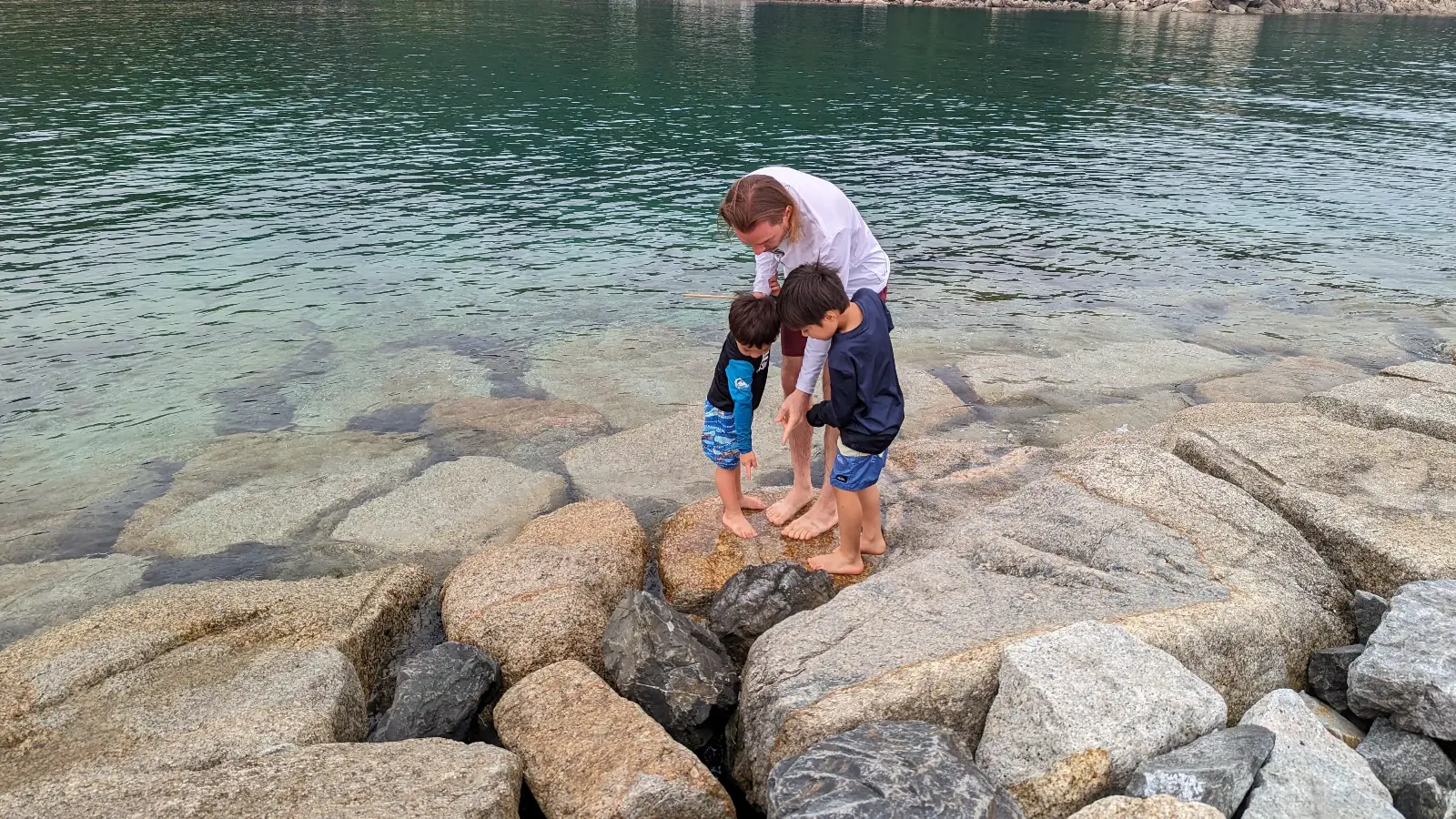
The toilets are barrier-free and the showers are inside them and free to use, the only rinse on this coast that costs nothing, and that is worth more than it sounds at the end of a day with two sandy children and a train to catch. Six hundred meters of shoreline leaves room to sit well away from the next family, and the season runs to the end of August rather than the middle of it, which puts it among the last here to close. Two things to settle before the children are in the water: the watching is entirely yours, and a charged fishing pier runs out from the same site, so walk the boundary first and give it to them rather than leaving it to be discovered.
Everything You Need Is Inside a Beach House: Keya Beach, Itoshima.
The bay cuts deep enough into the land to hold the waves down, and three beach houses hold the toilets, the showers and the changing rooms, so the day works from end to end provided you buy into one of them for the afternoon. Two hundred free parking spaces sit behind the sand and the water is clean enough to carry a national selection for it. The approach is the longest of these three, about twenty-six minutes by bus from Chikuzen-Maebaru and then a short walk. Nobody watches this water and there is no jellyfish net, so go in with the children the first time rather than watching from the sand, and do not assume the bottom shelves gently.
Two built around the drive, and one you cannot walk into.
Both of these sit in the far north of the prefecture rather than out along the Itoshima coast, and both are organized around arriving in a car. One of them is watched from the first day of its season to the last, which nowhere else on this coast manages. The other holds the only shade there is, and almost nothing besides.
Watched All Season, Reached by Road: Ashiya Beach, Ashiya.
Lifeguards are on this beach for the whole of its season with no weekday gap, which is the longest continuous cover on this coast and the reason a family that cannot settle on an unwatched shore should come here rather than somewhere closer. The place is built around the drive: a thousand spaces, more than six times the next largest, at 500 yen for an ordinary car, with bus routes from Orio and from Ongagawa for anyone arriving by train. What you pay for the cover is the calendar and the distance. The season shuts in the middle of August, earlier than most of this coast, and Ashiya sits in the far north of the prefecture rather than a short hop out of the city.
The Pines Are the Only Thing Provided: Miyajihama Beach, Fukutsu.
A pine belt stands behind the sand, and it is the one confirmed shade on this coast, which in a Kyushu August is worth more than most facilities are. Forty free spaces sit at the beach and no bus stops on it, so a family without a car walks in from Miyajidake Shrine, about 1.3 kilometers and a quarter of an hour, carrying the day in with them. Everything after the shade is carried too. The toilets, the showers and the changing rooms belong to the beach houses and come behind a flat fee, the opening is given only as early July with no closing date attached to it, and the watching is yours, so a child who needs the shape of a day confirmed before it starts will get very little of it here.
The most photographed shore on this coast, and the one to keep children out of.
Futamigaura is the picture that brings families to Itoshima in the first place: two rocks joined by a rope, a white torii on the sand, the sun going down between them. It is not a swimming beach and it is not close to being one.
The depth increases suddenly there, rip currents run, and accidents needing rescue have happened repeatedly. Swimming at Futamigaura is very dangerous. It is not a designated swimming beach, it appears on no register of watched water, and there is nobody on the sand to notice a child going out further than they meant to. A rip current does not look like anything from the beach, which is exactly why a shore that photographs this calmly can be the one that catches a family out.
Take it as a stop rather than a day, and it is a good one. Park, walk down to the rocks, let the children get close to the torii, and put the swimming somewhere else on the same peninsula: Fukae is twelve minutes from a train and shallow far out, and Keya is a bus away with beach houses behind it. Both are twenty minutes from Futamigaura by road, so the picture and the beach day fit inside one afternoon without the water ever being a question.
You cannot book any of it. You can only get the week right.
Every one of these shores is free to walk onto and not one of them holds anything for you, so the two decisions that carry any weight are which week you come and which bus you are on at the end of the day.
What every shore here leaves to you.
Three things are thin across this entire coast, and each is either carried in or judged on the day. Almost nothing behind the sand is public: the toilet, the shower and the changing room usually sit inside a beach house and come with a fee attached, and Wakita is the only shore where a rinse costs nothing. Shade exists at one beach and nowhere else, so a parasol is not optional in a Kyushu August. And several of these open without ever fixing a closing date, which is why a Fukuoka beach day is confirmed in the week you travel rather than in the month you book.
The questions parents actually ask.
What is the best beach in Fukuoka for families with kids?
It depends on the child, and on whether you are driving. Fukae is twelve minutes on foot from a train and shallow a long way out, which suits a small child who is not yet swimming. Shikanoshima puts the bus stop on the sand itself and keeps lifeguards on it every day in August. Wakita hands you a free shower at the end of it.
Do Fukuoka beaches have lifeguards?
Some do, and here it genuinely separates them. Shikanoshima keeps lifeguards at weekends in July and then every day in August. Ashiya keeps them for the whole of its season with no weekday gap. Momochi permits swimming only while they are on duty, and only in the eastern half. Fukae and Keya have none, and elsewhere the watching is yours.
Can you swim at Momochi Beach in Fukuoka?
Yes, under two conditions. Momochi is a city marine park rather than a designated swimming beach, and swimming is allowed only in the eastern Momochihama area and only while lifeguards are on duty, roughly early July to early September. Outside that the limit is wading to knee depth. Note that the heated showers sit at the opposite, western end of the sand.
Is Futamigaura safe for swimming with children?
No. Swimming at Futamigaura is very dangerous. The depth increases suddenly, rip currents run there, and accidents needing rescue have happened repeatedly. It is not a designated swimming beach, it appears on no register of watched water, and nobody is on the sand. Go for the twin rocks and the torii, and keep children out of the sea entirely.
When is beach season in Fukuoka?
Every town sets its own and they do not line up. Openings run from the end of June through the middle of July, and closings from the middle of August to the end of it, with Ashiya and Hatsu among the first to shut. Several beaches never fix a closing date at all, so confirm the one you want in the week you travel.
Which Fukuoka beach is easiest to reach without a car?
Fukae, at about twelve minutes on foot from Chikuzen-Fukae Station, which no other designated beach here manages without a bus leg. Momochi is a subway ride and a short walk inside the city itself. Shikanoshima has the bus stop on the sand. Hatsu, Wakita and Keya are each a train, then a bus, and then a walk of a few minutes.