The 14-Day Japan Itinerarywith kids, three cities.
- The Two-Week Split
- Tokyo Days 0 to 5, Kyoto 6 to 9, Osaka 10 to 14
- Two-Week Cost
- $5,500 and up, family of four, mid-range
- Rail Pass
- Skip it; buy point-to-point tickets
- Hotel Bases
- Three, one apartment-style stay per city
- Why Two Weeks
- Room for rest days, not a city a day
Some links on this page are affiliate links. LuNi may earn a commission at no extra cost to you.
Two weeks in Japan with kids works best as three cities with rest built in: Tokyo from Day 0 to Day 5, Kyoto from Day 6 to Day 9, and Osaka from Day 10 to Day 14. The plan counts arrival, travel and departure as real days, not filler, follows high-input days with open-space days, and groups the cities so transit stays short. Two weeks is long enough for rest days rather than a city a day. Book one apartment-style base per city, buy point-to-point Shinkansen tickets rather than the Japan Rail Pass, and budget from $5,500 for a family of four at mid-range.
A trip planned in three currencies.
Most family itineraries balance two currencies: money and time. The LUNI Framework tracks a third, and over fourteen days it is the one that decides whether the trip holds.
Every parent already plans around two budgets. The framework names a third: your child’s Reserve, their specific, finite capacity to absorb noise, crowds, walking, and the unfamiliar. On a long trip, Reserve does not reset each morning. It compounds. A route that looks balanced on paper can still empty a child by the second week, because it never built recovery into the sequence.
The baseline, then your child’s version.
This is the optimal starting point for most families, arrival and departure included. Below it, the framework tells you exactly what to change for your child’s profile.
Tokyo (Day 0 to Day 5).
| Day | Plan | Reserve Note |
|---|---|---|
| Day 0Arrival | Land, check in, low-demand evening walk near your base. Base: MIMARU Tokyo Ueno North | Jet lag and unfamiliarity, the Anchor’s hardest day |
| Day 1Tokyo | Skytree, Sumida Aquarium, gentle evening | Easy first full day, indoor backup |
| Day 2Tokyo | Ueno Zoo, Nature and Science Museum, Ueno Park | Movement plus shade |
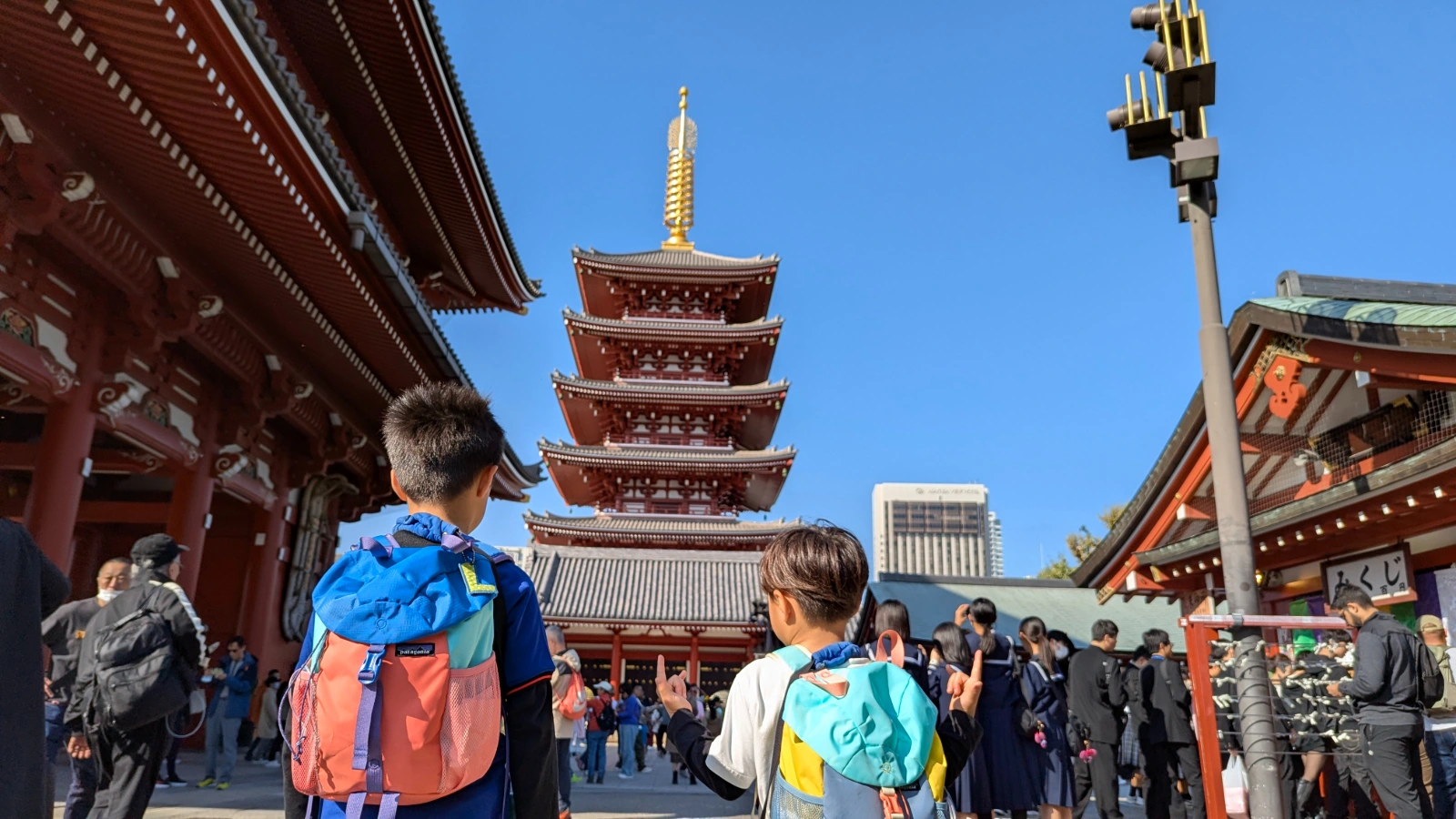
| Day 3Tokyo | Asakusa, Senso-ji early, Sumida River walk | Morning-only temple, calm afternoon |
| Day 4Tokyo | teamLab Planets in the morning, then Odaiba: Miraikan or Legoland | High input early, open-air recovery after |
| Day 5Tokyo | Shibuya Sky, Harajuku, Meiji Shrine forest, Yoyogi Park | Sensor pinch point, see adjustments below |
Day 0 Arrival
Day 1 Tokyo
Day 2 Tokyo
Day 3 Tokyo
Day 4 Tokyo
Day 5 Tokyo
Kyoto (Day 6 to Day 9).
| Day | Plan | Reserve Note |
|---|---|---|
| Day 6Travel: Tokyo to Kyoto | Shinkansen mid-morning, then Nishiki Market and a gentle Gion stroll. Base: MIMARU Kyoto Station | Transit day doubles as a Reserve breather |
| Day 7Kyoto | Fushimi Inari, Kiyomizu-dera, Higashiyama | Sprinter pinch point, see adjustments below |
| Day 8Kyoto | Arashiyama Bamboo Forest, Monkey Park or flat Katsura River walk | Dynamo pinch point: walk the Forest early |
| Day 9Kyoto | Nijo Castle, Kyoto Railway Museum or Toei Studio Park | Flat, lower-load close to Kyoto |
Day 6 Travel: Tokyo to Kyoto
Day 7 Kyoto
Day 8 Kyoto
Day 9 Kyoto
Osaka and Departure (Day 10 to Day 14).
| Day | Plan | Reserve Note |
|---|---|---|
| Day 10Travel: Kyoto to Osaka | Under 30 minutes to Osaka Station, then Osaka Castle and Park, Dotonbori in the evening. Base: MIMARU Osaka Namba Station | Shortest move of the trip |
| Day 11Osaka | Osaka Aquarium Kaiyukan, Tempozan Harbor and Ferris Wheel | Indoor calm, then open bay air |
| Day 12Osaka | Universal Studios Japan (a full day), or Kids Plaza Osaka | High input, a full day, plan recovery the next day |
| Day 13Day Trip | Nara Park and the deer, Todaiji and the Great Buddha | Open lawns and short flat walking, a gentle day |
| Day 14Departure | Shinkansen back to Tokyo, easy souvenirs, airport transfer | Built-in downtime to land the trip |
Day 10 Travel: Kyoto to Osaka
Day 11 Osaka
Day 12 Osaka
Day 13 Day Trip
Day 14 Departure
How your child’s profile changes this plan.
Each adjustment is tied to the attraction’s profile rating in The LUNI Rating, pairs a younger-child version with an older-child version, and names the exact days it touches.
Give the Dynamo room to move on the days the route asks them to stand still. The Dynamo depletes through restricted movement, and across two weeks the pressure points are the slow, hemmed-in stretches: the Day 8 Bamboo Forest, temple queues, crowded trains on the Day 6 and Day 10 travel days. The route already supplies release valves, the Day 0 arrival walk, Yoyogi Park on Day 5, Osaka Castle and Park on Day 10, and Nara’s open lawns on Day 13.
Younger Dynamo: open each city day with an unstructured run in a park or plaza before the first fixed stop, and walk the Bamboo Forest first thing, before the day-trip crowds arrive and the path slows to a shuffle. Older Dynamo: hand them the active versions of each day, the Iwatayama monkey climb on Day 8, the stairs at Fushimi and Shibuya Sky, the deer trails at Nara, so movement becomes the point rather than the thing being suppressed.
What this means for your Dynamo: the restricted-movement threshold stays clear when each day front-loads open space and the still moments stay short.Spread the trip’s high-input moments out, and protect the Sensor’s recovery time. The Sensor depletes through sensory input, and this route concentrates it: teamLab on Day 4, Shibuya Sky and Takeshita Street on Day 5, Dotonbori on Day 10, Tempozan on Day 11, Universal on Day 12. The plan already pairs those with quiet, the Meiji Shrine forest and Yoyogi on Day 5, the bay air on Day 11, Nara’s calm on Day 13.
Younger Sensor: take the loudest rooms first thing when they are freshest, and treat the afternoon green spaces as the real second half of the day, not an afterthought. Older Sensor: give them the tools to self-regulate, such as a quiet meeting point, and let them set the pace through Takeshita and Dotonbori rather than being pulled through.
What this means for your Sensor: the sensory-load threshold holds when high-input stops stay in the mornings and recovery time is treated as fixed, not optional.Make the unfamiliar familiar before the Anchor has to face it. The Anchor depletes through unfamiliarity and unconfirmed structure, so the hardest moments are not the attractions but the transitions: the Day 0 arrival and the Day 6 and Day 10 city moves. The route helps by keeping the same apartment-style base in each city and moving in a steady, predictable order.
Younger Anchor: keep a consistent morning rhythm across all three cities, and preview tomorrow the night before with photos of the first stop. Older Anchor: give them the day’s transit plan to hold and the next hotel pulled up on a map, turning each unconfirmed move into something they can see coming and control.
What this means for your Anchor: unfamiliarity stops draining Reserve once arrival and travel days come with a visible, confirmed plan.Pace the walking days and bank seated recovery before the Sprinter runs out. The Sprinter depletes through sustained walking and standing, and the route’s long-effort days stack up: Fushimi Inari and Kiyomizu on Day 7, Osaka Castle on Day 10, Universal on Day 12, plenty of ground at Nara on Day 13. The plan softens this with early starts and flat riverside alternatives.
Younger Sprinter: choose the shorter loops, the lower Fushimi gates, the taxi or train to Kiyomizu, the flat Katsura path, and keep a stroller in reserve for late afternoons. Older Sprinter: let them set the turnaround points and build in deliberate sit-down breaks, a long lunch in Higashiyama, bench time at Castle Park, so the walking becomes a series of manageable sprints rather than one unbroken march.
What this means for your Sprinter: the walking-and-standing threshold stretches when long days are broken into short efforts with seated recovery between them.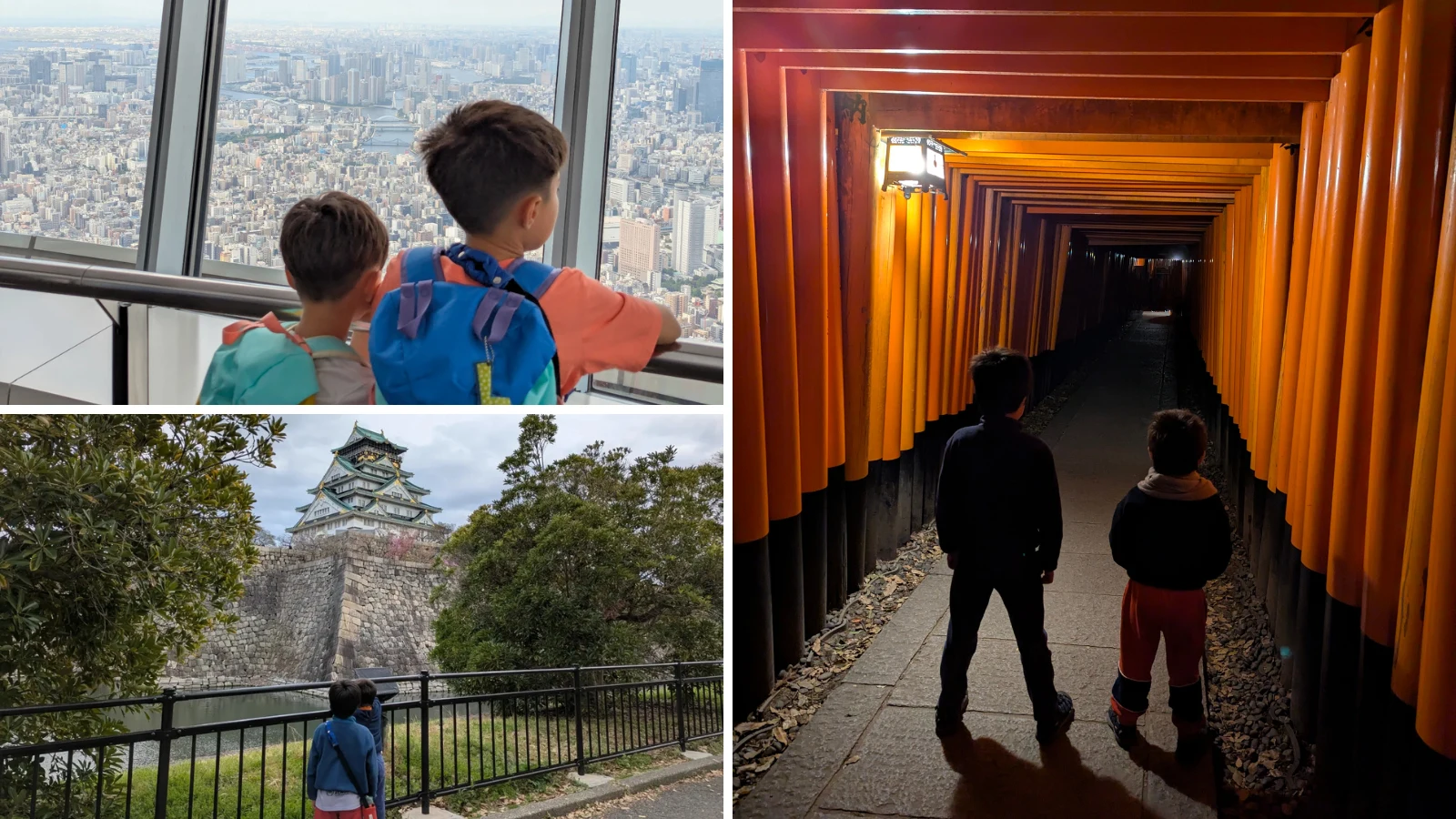
Shorter trips, and where to base.
Ten or seven days instead of fourteen, plus one reserve-aware home base per city.
| Short Version | Family Highlights | Bases |
|---|---|---|
| 10 Days | Tokyo 4, Kyoto 3, Osaka 3 | 3 cities |
| 7 Days | Tokyo 3, then a single Kyoto base with an Osaka or Nara day trip | 2 cities |
10 Days
7 Days
Shorter window? Each compression keeps the Reserve logic intact rather than cramming the same stops into fewer days. See the full Japan 10-Day Itinerary with Kids for the three-city version with built-in rest, or the Japan 7-Day Itinerary with Kids for a two-city highlights route that stays gentle for toddlers and first-timers.
One home base per city.
Apartment-style rooms give every family room to spread out and reset between days. One pick per city below. Deeper options live in each city hotel guide.
| Property | The LuNi Reason | City |
|---|---|---|
| MIMARU Tokyo Ueno NorthApartment-style, family rooms | Space to spread out and reset after high-input Tokyo days. | Tokyo |
| MIMARU Kyoto StationSteps from the Shinkansen | Drops transit friction on the Day 6 arrival and the Day 10 hop, protecting Reserve on travel days. | Kyoto |
| MIMARU Osaka Namba StationWalkable to Dotonbori | The same trusted layout, central enough to keep evenings short and low-stimulation. | Osaka |
MIMARU Tokyo Ueno North Tokyo
MIMARU Kyoto Station Kyoto
MIMARU Osaka Namba Station Osaka
What two weeks actually costs.
What a family of four should budget across two weeks, broken down by trip length so you can see the cost before you commit to the dates.
| Trip Length | Budget-Friendly | Mid-Range |
|---|---|---|
| 7 days | $1,600 to 2,250 approx. €1,500 to 2,100 | $2,700 to 3,600 approx. €2,500 to 3,300 |
| 10 days | $2,100 to 3,000 approx. €1,950 to 2,800 | $3,900 to 5,500 approx. €3,600 to 5,100 |
| 14 days | $2,900 to 4,200 approx. €2,700 to 3,900 | $5,500 to 7,800 approx. €5,100 to 7,200 |
7 Days
10 Days
14 Days
The questions parents actually ask.
Is a 2-week Japan itinerary enough time for families with kids?
Yes. Two weeks is long enough to see Tokyo, Kyoto, and Osaka without rushing, and the extra room is what lets you build in arrival, travel, and rest days. That recovery time is what keeps younger children steady across the whole trip rather than fading by the second week.
Should families buy the Japan Rail Pass for this 14-day itinerary?
For the classic Tokyo, Kyoto, and Osaka route, individual Shinkansen tickets are usually cheaper and simpler than the Japan Rail Pass. The pass starts to pay off only if you add long-distance legs well beyond these three cities.
How much walking should families expect on a 2-week Japan itinerary?
Active days are long on foot. A stroller still suits much of the route, and choosing short loops at Fushimi Inari and flat riverside walks keeps the load manageable for younger children and for any child whose Reserve depletes through sustained walking and standing.
What is the best time of year for a 2-week Japan trip with kids?
Spring and autumn give the mildest weather and the most comfortable outdoor days. Summer heat acts as a depletion multiplier: it shortens walking windows and lowers every child’s tolerance for crowds and lines, so it asks more of your child’s Reserve.
How many cities should families visit in two weeks in Japan?
Three is the sweet spot: Tokyo, Kyoto, and Osaka. It keeps hotel changes low, cuts transit drain, and still gives kids a full mix of modern energy, historic sights, and open space, with enough days left for rest.
Is this Japan itinerary suitable for toddlers as well as older kids?
Yes. The baseline route works from toddler to teen, and each profile adjustment pairs a younger-child version with an older-child version. The plan tells you exactly which stops to shorten, swap, or cap depending on your child’s age and how they deplete.