Mount Inasa with Kids: The Ropeway That Skips the Climb.
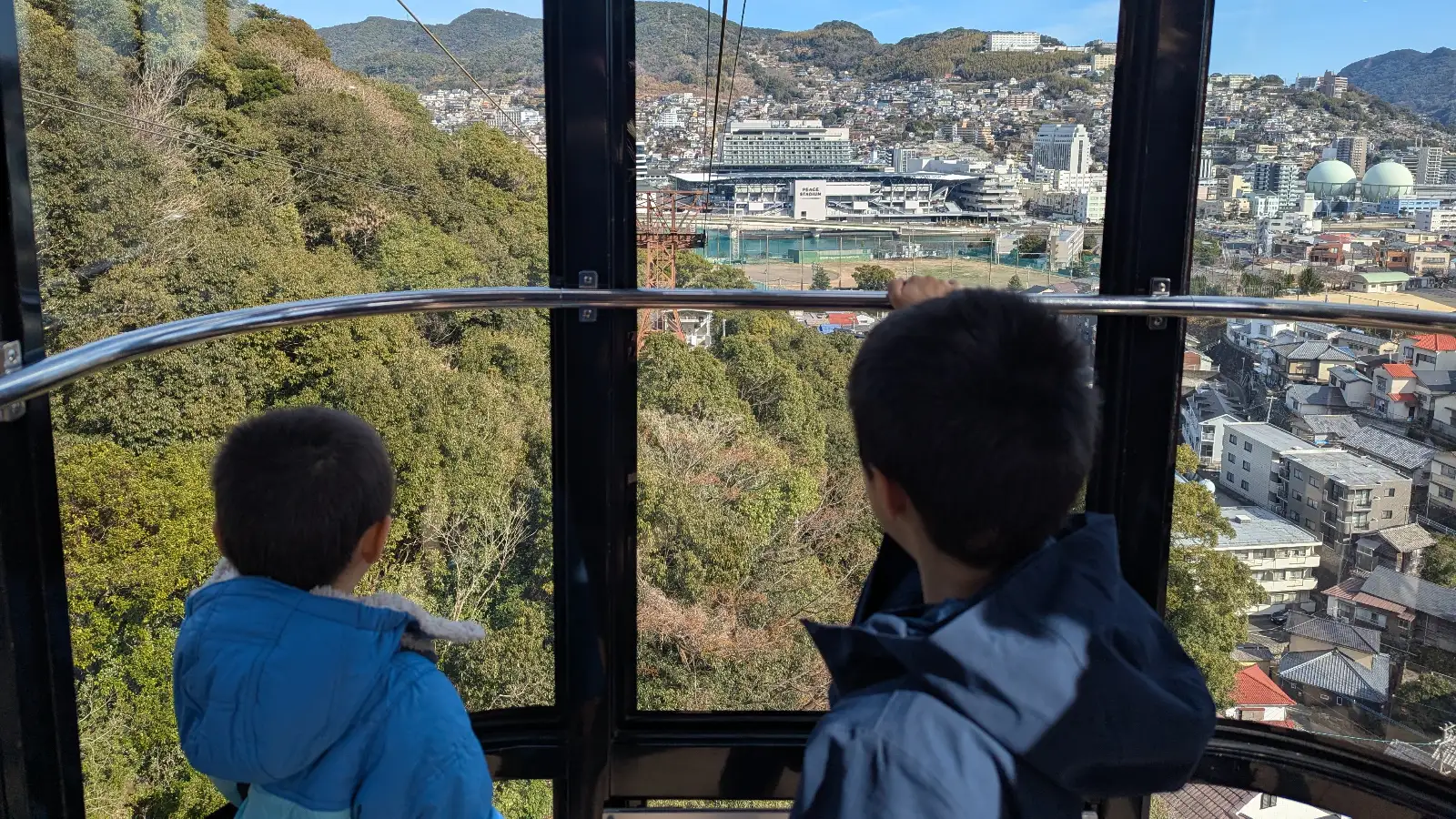
A five-minute ride up a mountain feels like the whole adventure to a child who loves machines, and the wait to board it at night is where a tired child comes undone.
Up and back; below elementary school rides free. No booking needed; one way costs ¥1,040 and ¥520.
Last ascent 21:00. The ropeway stops each year from mid-June for maintenance, and in strong wind.
The ride is about 5 minutes each way, with cars every 15 to 20 minutes; evening waits to board run long.
Younger children ride free, and the cabin asks for no rocking and no hands out of the windows.
Many steps around the boarding area and a spiral stair to the rooftop; the step-free slope car runs from the mid-slope lot.
Some links on this page are affiliate links. LuNi may earn a commission at no extra cost to you.
Is Mount Inasa worth it with kids?
The short version, before the costs, the timings and the case for each child.
Yes, and the ropeway is the reason. Mount Inasa rises 333 meters above Nagasaki, and a cable car does the whole climb in about five minutes, delivering the family to an observatory with a view all the way around. The view at night is the famous one, counted among the world’s new three great night views, and the ride itself is half the point for most children. The rest of the effort is easy to miss: the boarding station has a lot of steps, the rooftop terrace is up a spiral stair, and the evening lines to board can run long. So ride up while it is still light, watch the city switch on from the top, and come down before the late rush. That order gives a family the view without the worst of the wait.
Planning Your Visit to Mount Inasa with Kids.
Three decisions shape the evening. The first is the time you ride up. Cars run every fifteen to twenty minutes until late, but the waits to board grow long from the evening, so aim to be in a car before the crowd and let the lights come on while you are at the top. The second is how you get to the station. The ropeway is reached by bus from Nagasaki Station, and a free evening bus runs from the city center by reservation, which suits a family that wants the way back settled. The third is the steps. The boarding area and the rooftop both involve stairs, and the step-free slope car leaves from the mid-slope lot, not the ropeway station, so a family coming up by ropeway should carry the smallest child rather than bring the stroller. Glover Garden gives the same harbor by daylight, for a child who will not stay up.
Every LuNi attraction guide starts with a visit, with our own children
LuNi rates and writes about attractions only after visiting them with children. Luca and Nico were at Mount Inasa, and what they did there is recorded further down this page, including how each child actually met it.
Children arrive with different tolerances: for noise, for lines, for standing still, for being on their feet all day. A guide written for the average of them helps almost nobody. So every place on this site is read four ways, and each verdict says which children it already suits and what makes it work for the rest. Whoever you are bringing, the answer here is built for your family rather than for a general reader.
Restricted-movement depletion stays brief in a five-minute cabin with open space at the top, so let the child lead the way around the summit.
Sensory-input depletion stays low if you board ahead of the evening lines, so ride up in daylight and watch the lights come on from the top.
Unfamiliarity and unconfirmed structure ease on a ropeway with fixed hours and a 21:00 last car up, so settle the ride home first.
Sustained walking and standing stay short when the ropeway does the climbing, so budget the station steps and use the summit’s free rest area.
Hotels we would book for this visit.
Three family hotels in Nagasaki chosen for the evening, when the question is how simply a family gets from the mountain to bed. Two sit at the station the ropeway bus leaves from.
| Property | The LuNi Reason |
|---|---|
| LUNI Pick Hilton Nagasaki At Nagasaki Station’s west exit | A minute from the station’s west exit by a pedestrian deck, which is exactly what a family wants at ten at night with a sleeping child: back from the mountain by bus, and a short walk to bed. It also has a nursing space and a changing table for the smallest traveler. |
| Nagasaki Marriott Hotel At Nagasaki Station, on the tram stop side | Inside the Amu Plaza complex, a minute from the station, so the late return from the mountain ends close to the bus. Connecting rooms are available, which lets a child who fell asleep on the bus be put straight to bed without waking a sibling who is still wide awake from the view. |
| Stadium City Hotel Nagasaki About 10 minutes’ walk from Nagasaki Station | North of the station, three minutes from a tram stop, with an indoor pool and hot-spring baths. It suits the family doing the mountain on a day that starts north, at the museums or the memorial, and wants a swim before the evening ride rather than another walk. |
Nearby attractions, matched to your child.
Mount Inasa is an evening, so these pairings fill the day before it: an afternoon of hands-on movement, an open memorial ground to walk slowly, and a history stop close to the station, each chosen for a different child.
| Pairing | Why This Solves the After-Visit | For Your |
|---|---|---|
| LUNI Pick Nagasaki Science Museum Bus 3 or 4, the ropeway’s own routes | An afternoon of hands-on zones and a play tower at Nagasaki Science Museum spends a moving child’s energy before a five-minute cabin asks them to hold still, and routes 3 and 4 serve both. Restricted movement then arrives at the end of the day, when the child is ready for it. | Dynamo |
| Nagasaki Peace Park Tram to Stadium City South, then bus 3 or 4 | The city’s memorial to the atomic bombing, Nagasaki Peace Park, is walked outdoors on open ground among statues and a fountain. For a child who takes in everything it is a slow, serious afternoon, and its outdoor pace keeps sensory input low before the crowds of the evening ride. | Sensor |
| Dejima Tram to Nagasaki Station, then bus 3 or 4 | A staff-led walk sets the order of the afternoon at Dejima, five minutes by tram from the station where the ropeway bus leaves. For a child whose unfamiliarity and unconfirmed structure ease when somebody else sets the route, it is a steady run-up to a night on a mountain. | Anchor |
Nagasaki Science Museum
Bus 3 or 4, the ropeway’s own routes For YourDynamo
Nagasaki Peace Park
Tram to Stadium City South, then bus 3 or 4 For YourSensor
Dejima
Tram to Nagasaki Station, then bus 3 or 4 For YourAnchor
How two children actually met this attraction.
Two children rode the same cabin up the same mountain and came off it with opposite evenings. One wanted to understand the machine before he would look at anything else, and only once it made sense did he turn to the view, which he then set about naming piece by piece. The other met the ride with his whole body, pressed to the window from the moment the doors closed, and at the top he could not stand still at all. His energy was huge at the start and gone before the evening was. That is the mountain in short, and it is why the timing matters: a place that rewards the child who has questions and the child who has energy, as long as the family times the energy.
Luca wanted the mechanics before the scenery. Before the cabin moved he was working out how the cable pulled it up the slope, how far the drop below the window was, and how many people the car was rated to hold, and he asked until he had answers. At the summit he did not simply look out; he set about identifying what he was seeing, matching the bridges and the port and the far islands to places he knew.
This is the Anchor pattern. A child whose Reserve depletes through unfamiliarity and unconfirmed structure settles fastest when they can work out how a place runs before committing to it, and Luca closed every question about the ropeway before he let the view in. Families with a similar child should treat those questions as the visit working, not as a delay: answer them at the station, and the ride and the summit then run on confirmed ground.
Nico met the ropeway with his whole body. He pressed against the cabin glass for the entire ride, tracking the ground dropping away and narrating it the whole time. At the top he did not settle at the rail; he ran the perimeter of the observation deck, looped back, and ran it again. The visit was in the evening, and his engagement, high and loud when the doors opened, thinned noticeably as the hour ran on.
This is the Dynamo pattern. A child whose Reserve depletes through restricted movement will turn a viewing space into a circuit, because it is the only movement on offer, and the excitement at the glass is the same need. Families with a similar child should read the looping as the meter running rather than endless fuel: the energy is real but front-loaded. Ride up early in the evening, before it fades, and let the child move rather than asking them to stand at the rail.
Riding a ropeway up a mountain and watching a city switch on below turns an evening into a memory a child will keep. The ride is an adventure for a child who loves machines, and the view from the top gives a sense of how a whole city lives, light by light, as darkness falls. Arriving early and letting the night come to you is a quiet lesson in patience. Some of the best moments in travel are the ones a family waits for together, and this is one of them.
The LUNI Rating for Mount Inasa.
One fact sits under all four verdicts: at Mount Inasa, a ropeway does the climbing. A five-minute ride replaces the whole mountain, and the effort left for the family is the station’s steps, the wait to board and whatever the child wants to do at the top. That suits a child who needs to move, because the cabin is short, and a child who needs the evening fixed, because the ropeway keeps set hours. It suits a child who takes in everything if the family boards before the evening lines, and it suits tired legs if the family budgets the steps.
Let the child lead the way around the top. The Dynamo depletes through restricted movement, and the ropeway cabin is the only real restriction on the mountain, a ride of about five minutes with rules against rocking the car and putting hands out of the windows. At the summit the observatory building and the rooftop terrace give a moving child somewhere to go, and a view on every side to go around. For a child who needs to move, five minutes of stillness followed by a summit to explore is a fair trade.
Timing is everything on the mountain. Ride up while the child still has energy to spend, rather than waiting for full dark, and let the child set the route around the top rather than asking them to stand at a single spot. If the family arrives by car on a weekend evening, the mid-slope lot and the footpath to the summit turn the arrival into a walk, which a Dynamo will count as part of the fun.
What this means for your Dynamo: restricted movement is limited to a five-minute cabin. A younger Dynamo needs to ride early and move freely at the top; an older one can take on the footpath from the mid-slope lot.Board before the lines, stay for the lights. The Sensor depletes through sensory input, and the input at Mount Inasa is concentrated in one place: the wait and the ride in the evening. Lines to board grow long from the evening, and a full car is a crowd at close quarters. The summit itself is open air, and the observatory has a free rest area indoors for a child who needs a break from the crowd.
Turn the evening around. Ride up before dark, when the lines are shorter, and let the city light up around you rather than riding up after dark with everyone else. Use the indoor rest area as the place to step back to, and plan to come down before the last-car rush. It works because a family can put its own evening ahead of the crowd’s, and the view does not care what time you arrived.
What this means for your Sensor: sensory input peaks in the evening lines. A younger Sensor needs to board before dark with the rest area as a retreat; an older one can choose when to go up and when to leave.Fix the ride home before the ride up. The Anchor depletes through unfamiliarity and unconfirmed structure, and the ropeway runs on a published structure that can be stated in full. Cars leave every fifteen to twenty minutes from morning until late, the last car up is at 21:00, and the trip takes about five minutes each way. The free evening bus runs on fixed times and must be booked. Almost everything about the visit can be known before the family leaves the hotel.
The one real unknown is the wait. Lines can run long in the evening, and a child who has been told the ride takes five minutes may not have been told the wait could take far longer. Say so in advance, and give the evening a fixed shape: the bus there, the ride up, a set time at the top, the ride down, the bus back. Name the last car down as the end of the plan. For this child, knowing how the evening ends is what lets them enjoy the middle.
What this means for your Anchor: unconfirmed structure eases on a ropeway with fixed hours. A younger Anchor needs the wait and the way home explained in advance; an older one can hold the schedule and time the evening.Let the machine do the mountain. The Sprinter depletes through sustained travel-style walking and standing, and on foot Mount Inasa would be one of the hardest things in the city. The ropeway takes that away: about five minutes in a cabin replaces the climb. What remains is real, though. The boarding area has many steps, the rooftop terrace is reached by an outside spiral staircase, and the evening wait to board is standing time. The step-free slope car, which wheelchairs can ride, leaves from the mid-slope lot instead.
Budget the steps rather than pretending they are not there. Ride up before the evening lines so the standing happens in a car and not in a line, use the free rest area inside the observatory as the place to sit, and treat the rooftop as optional. Carry the youngest child up the station steps instead of pushing a stroller. Handled that way, the machine does the mountain and the child’s legs pay only for the steps, which is why it stays easy.
What this means for your Sprinter: walking and standing come down to the station steps and the wait. A younger Sprinter needs to be carried on the stairs and seated at the top; an older one can take the spiral stair if they want the roof.The questions parents actually ask.
Mount Inasa is an evening decision more than a daytime one, and the line to board is the thing to plan around, since it grows from the evening. Access is the other half, and the honest answer there is that the mountain is easier for a walking child than for a stroller or a wheelchair, unless the family rides the slope car up from the mid-slope lot. Settle the time you board and the way home before leaving the hotel, and the rest of the evening looks after itself. Give the daytime to Nagasaki’s family stops on the ground, and keep the mountain for the lights after dark.
Is Mount Inasa worth visiting with kids?
Yes. A ropeway lifts the family up the 333-meter mountain in about five minutes, and the summit observatory has a 360-degree view, a free indoor rest area and a rooftop terrace. The city’s night view from here is counted among the world’s new three great night views. Plan around the evening lines to board and the steps at the station.
How much is the Mount Inasa Ropeway for a family?
A round trip is 1,900 yen from junior high school up and 950 yen for elementary school children, and children below elementary school ride free. One way costs 1,040 and 520 yen. Fares go by school year, not age, so a sixth grader pays the child fare. Two adults and two elementary children pay 5,700 yen round trip.
What are the Mount Inasa Ropeway’s hours?
The ropeway runs from 9:00 to 22:00 every day of the year, New Year included. The last car up leaves at 21:00 and the last down at 22:00, with cars every 15 to 20 minutes. It can stop in strong wind, and it closes each year for maintenance from mid-June; in 2026 that ran from June 8 to July 10.
How do you get to the Mount Inasa Ropeway from Nagasaki Station?
Take Nagasaki Bus route 3 or 4 from the Nagasaki Ekimae stop to the Ropeway-mae stop and walk about 2 minutes to Fuchi Jinja Station. The ropeway is reached by bus, not tram. In the evening a free bus runs from six central stops, including JR Nagasaki Station at 19:17, by reservation only. By car it is about 8 minutes.
Is Mount Inasa stroller- or wheelchair-friendly?
Not easily by ropeway. The ropeway boarding area has many steps, and a wheelchair needs several helpers; the rooftop terrace is up an outside spiral staircase. The step-free route is the slope car up from the mid-slope lot; wheelchairs ride it, and it lends them.
Can you drive up Mount Inasa?
Yes, with limits. The small summit lot costs 1,000 yen for 24 hours. On weekends, holidays and busy days it is closed to general cars from 18:00 to 22:00. Then the free mid-slope lot, locked at 22:00, is the option, with the slope car or an 800-meter footpath, about 15 minutes, to the top.
Is there a long wait for the ropeway at night?
There can be. Waits to board can run long from the evening, and each car’s load is limited by weight, so a crowd takes several cars to clear. Ride up in daylight or early evening, watch the sunset and the lights come on from the top, and come down before the late rush. Inside the car, no rocking and no hands out of the windows.
What is at the top of Mount Inasa?
An observatory on the summit, open the same hours as the ropeway, with a view in every direction, a free rest area inside and a restaurant that opened in September 2026. The rooftop terrace is open all day and night and is reached by an outside spiral staircase, so carry a small child up and take the view from there.
Where Mount Inasa fits your Japan trip.
Official site and opening information: Nagasaki Ropeway