Tempozan Giant Ferris Wheel with Kids: decide before the door shuts.
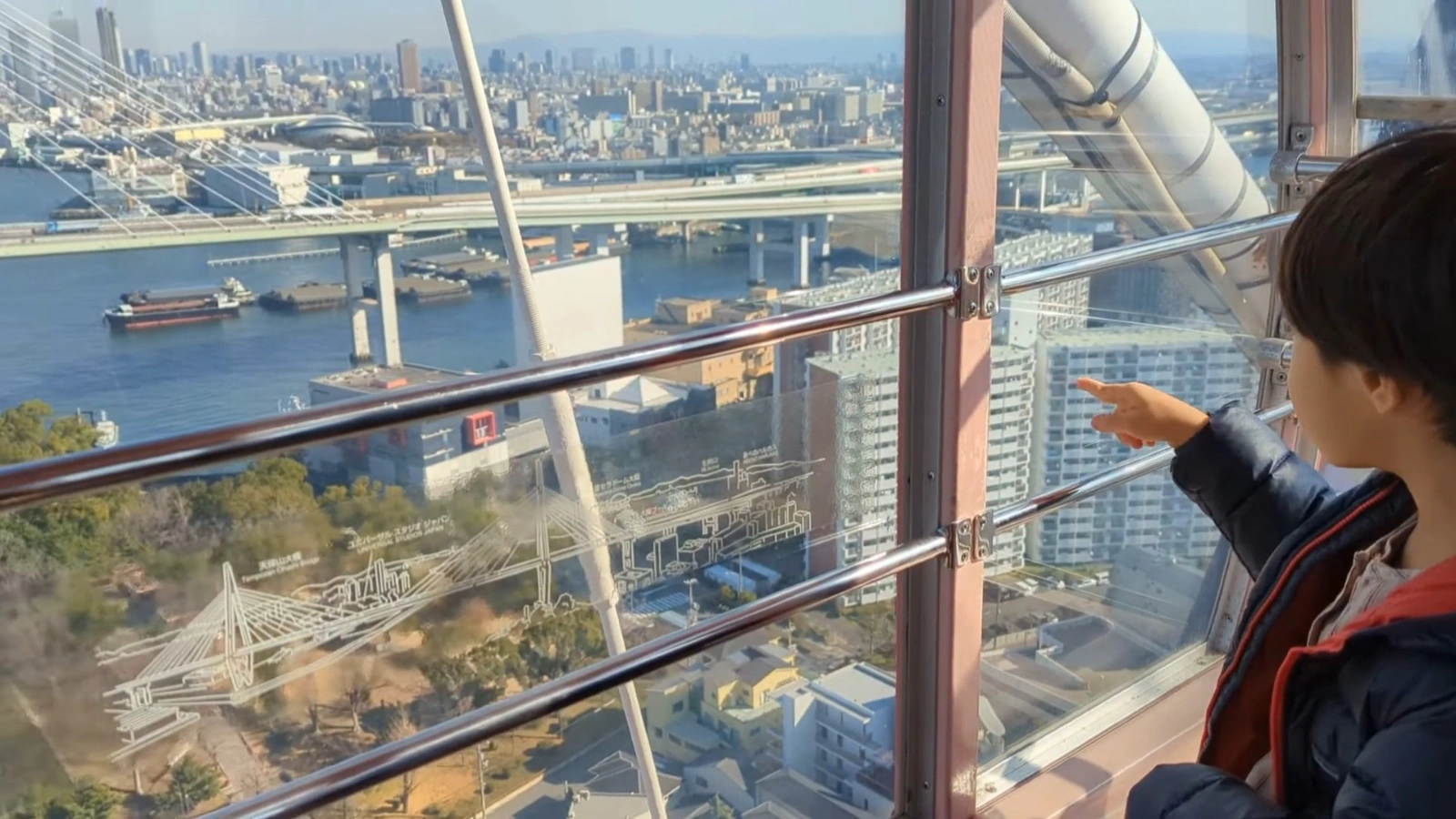
A seated ride of about fifteen minutes gives a tired child a rest, and gives a child afraid of heights nowhere to go until the gondola comes back down.
Under 3 free; the Osaka Amazing Pass covers it. No booking needed; web advance tickets are offered.
Sales end 15 minutes before closing; hours change without notice for weather. Closing days are irregular, following Tempozan Marketplace.
An enclosed gondola for up to eight; once the door shuts, the ride runs its course.
Elementary students may ride alone; younger children need a paying companion aged 16 or over.
Elevators reach the second-floor ticket desk and third-floor boarding, with a ramp at the gondola; three gondolas take wheelchairs, and the wheel stops for them.
Some links on this page are affiliate links. LuNi may earn a commission at no extra cost to you.
Is the Tempozan Giant Ferris Wheel worth it with kids?
The short version, before the costs, the timings and the case for each child.
Yes, for a child who likes heights and a child who needs to sit down, and no for a child who fears them. The wheel is 100 meters across, a ride of about fifteen minutes in a small, enclosed gondola for up to eight people, and eight of its gondolas have see-through seats and floors. Every rider aged 3 and over pays the same fare, and the Osaka Amazing Pass covers it. Two rules decide more than the view does: a preschool child cannot ride without a paying older companion, and nothing may be eaten or drunk in the gondola. Decide on the ground who rides, because once the door shuts, the ride runs its course.
Planning Your Visit to the Tempozan Giant Ferris Wheel with Kids.
Three decisions come before the ticket. The first is who rides. A preschool child needs a companion aged 16 or over, who pays the full fare, so settle which adult goes up, and whether a child sensitive to heights goes at all. The second is the weather: the hours can change without notice for weather, and ticket sales end 15 minutes before closing, so a windy evening is the wrong time to promise it. The third is food and drink. Nothing may be eaten or drunk in the gondola, so feed everyone and finish the drinks before you line up, and treat the ride as the rest between meals, not a meal of its own. The wheel is included in the Osaka Amazing Pass, which makes the ride free on a pass day at the bay.
Every LuNi attraction guide starts with a visit, with our own children
LuNi rates and writes about attractions only after visiting them with children. Luca and Nico were at the Tempozan Giant Ferris Wheel, and what they did there is recorded further down this page, including how each child actually met it.
Children arrive with different tolerances: for noise, for lines, for standing still, for being on their feet all day. A guide written for the average of them helps almost nobody. So every place on this site is read four ways, and each verdict says which children it already suits and what makes it work for the rest. Whoever you are bringing, the answer here is built for your family rather than for a general reader.
Restricted-movement depletion builds in a small gondola for about fifteen minutes with little to do, so ride after a run and let the talk flow.
Sensory-input depletion peaks at 112.5 meters, with eight gondolas see-through underfoot, so decide on the ground whether this child boards at all.
Unfamiliarity and unconfirmed structure ease on one loop of about fifteen minutes back to the same platform, so describe the whole circle before boarding.
Sustained walking and standing stop for a seated ride of about fifteen minutes, with wheelchair boarding, so use it as the rest between walks.
- Cost
- ¥1,000 per person aged 3 and overUnder 3 free; the Osaka Amazing Pass covers it. No booking needed; web advance tickets are offered.
- Booking
- Osaka Amazing Pass acceptedA set ticket with the Santa Maria cruise is also sold at the wheel.
Hotels we would book for this visit.
Two Osaka family hotels for a family whose stay centers on the bay, one on its south shore and one on the Universal City side, and a third away from the water for a family that comes to the wheel for a single day.
| Property | The LuNi Reason |
|---|---|
| LUNI Pick Grand Prince Hotel Osaka Bay | Grand Prince Hotel Osaka Bay sits on the bay’s south shore, for a family whose whole stay centers on the water. For a child who loved the view from the gondola, the bay is outside the door from breakfast to bedtime, so the stay keeps returning to what the child liked best. |
| Hotel Universal Port | Hotel Universal Port is for a family splitting its days between the two sides of the water. The Captain Line crosses from Universal City Port to Kaiyukan West Pier in about ten minutes, so a child reaches the wheel’s side of the bay by boat rather than by another train. |
| OMO7 Osaka by Hoshino Resorts | OMO7 Osaka is for a family basing itself away from the water and treating the bay as one day out among several. That is how most families with young children should treat a Ferris wheel anyway: a ride of about fifteen minutes is a stop within a day, not the reason for one. |
Nearby attractions, matched to your child.
Three pairings for what the wheel leaves unmet: a child who wants a longer visit with a plan to follow, a child who needs open ground after sitting still, and a tired child who needs a roof and a seat.
| Pairing | Why This Solves the After-Visit | For Your |
|---|---|---|
| LUNI Pick Osaka Aquarium Kaiyukan Kaiyukan West Pier is a minute away | For an Anchor, Osaka Aquarium Kaiyukan sets out the whole day: a timed entry slot, a route with a start and an end, and feeding times for each floor. Unfamiliarity eases on that structure; book the e-ticket, since same-day slots run short on weekends. | Anchor |
| Tennoji Zoo Open from 9:30; last entry 16:00 | After fifteen minutes in a gondola, Tennoji Zoo gives a Dynamo open-air ground to cover on foot. Restricted-movement depletion needs that release, but the zoo closes on Mondays and admits no one after 16:00, so a late ride on the wheel rules it out that day. | Dynamo |
| Kids Plaza Osaka Ogimachi; last entry 16:15 | For a tired child on another day, Kids Plaza Osaka offers lunch rooms, lockers and same-day re-entry through its third-floor exit. Sustained walking and standing ease in one indoor building; go after 14:30 on a school-trip-season weekday, when the groups have gone. | Sprinter |
Osaka Aquarium Kaiyukan
Kaiyukan West Pier is a minute away For YourAnchor
Tennoji Zoo
Open from 9:30; last entry 16:00 For YourDynamo
Kids Plaza Osaka
Ogimachi; last entry 16:15 For YourSprinter
How two children actually met this attraction.
Two children rode in the same small gondola and had opposite rides. One braced against the height and spent the first half taking in as little as he could; the other forgot the height entirely and filled the gondola with a story. That is the honest shape of the wheel with siblings: the same fifteen minutes can be the best part of the day for one child and the hardest for another, and nothing in the ride can change that once it starts. The decision belongs on the ground, child by child. It also means a parent should sit beside the child who needs them most, not beside the one who asks loudest, and should say so out loud before anyone boards, so nobody feels passed over at the top.
Luca was uneasy from the moment the cabin lifted off the platform. He chose a seat away from the window, kept his eyes off the harbor for the first several minutes, and held still in a way that read as bracing rather than calm. Only past the halfway point, once the motion had proven steady, did he begin to glance out and eventually lean toward the glass to test how the view felt from closer in.
This is the Sensor pattern: brace, then settle. A child whose Reserve depletes through sensory input meets a load he cannot leave, here height and slow, continuous motion, by taking in less of it first, which is why Luca sat back from the glass. For families with a similar child, let the bracing run rather than coaxing them to the window: sit them facing inward, promise nothing about the view, and let them come to the glass in their own time, or not at all.
Nico lasted roughly two minutes of stillness before the cabin became a stage. He narrated the imaginary lives of the dock workers far below, with one crane operator earning a detailed backstory, and covered the full floor space of the small cabin while doing it. The talking never stopped, because for Nico talking is its own form of movement. The doors opened before he ran out of material, but only just.
This is the Dynamo pattern under a lid. A child whose Reserve depletes through restricted movement will turn to talk and invention when a small space holds his body still, which is what Nico’s commentary was doing. For families with a similar child, let the talk run, and do not ask for quiet admiration of the view. Fifteen minutes is manageable on those terms, and a run or a climb straight after the ride settles the account before the next stop begins.
A slow ride high above the water gives a child a rare chance to see a whole landscape unfold without walking anywhere. Ships, bridges and the city spread out below become a map to point at and narrate, and a shared gondola turns a short ride into a small, private adventure with the people they love. For a child wary of heights, even deciding not to ride is a lesson in knowing oneself. Travel is full of big days, and sometimes the quiet minutes in a small cabin are the ones that stay.
The LUNI Rating for the Tempozan Giant Ferris Wheel.
One fact sits under all four verdicts: the wheel is a seated circle of about fifteen minutes in a small gondola, high above the ground, and once the door shuts it runs its course. A child who likes certainty finds comfort in that fixed shape, and a child who needs to sit is simply glad of the seat. A child who needs to move pays for the stillness, so that child needs a plan. A child sensitive to height and motion pays the most, because the ride cannot be cut short. Let that child see a full turn from the ground before deciding, since there is no getting off.
Put the ride between two runs. The Dynamo depletes through restricted movement, and a Ferris wheel is movement held still: a gondola for up to eight people, a ride of about fifteen minutes, and no eating or drinking inside. There is little a child can do in it but look, listen to the commentary and talk. For a child built to move, a quarter of an hour in a small space is a real cost, not a rest, and the moment of boarding is the moment to have spent their energy already.
So place it between two active stretches, never at the start of a day. Let the child run first, board, and then let the talk flow: narrating the city below is movement of a kind, and the commentary, in Japanese and English, gives them something to answer back to. Plan open ground straight after, or the aquarium’s second circuit, so the ride ends in movement rather than in another line.
What this means for your Dynamo: restricted movement builds in a small gondola. A younger Dynamo needs a run before boarding and talk allowed inside; an older one can treat the fifteen minutes as the quiet middle of an active day.Decide on the ground, not at the top. The Sensor depletes through sensory input, and here the input is height and slow, continuous motion. The wheel is 100 meters across and about 112.5 meters at its highest, and eight of its gondolas have see-through seats and floors. Once the door shuts, the ride runs for about fifteen minutes, and a child who hates it has to sit through the rest. The hours can also change without notice for weather, so the wind on the day is part of the ride.
So make it an individual decision before buying, not a family default. For a younger child, the companion rule helps: they ride with someone aged 16 or over, so an adult is always beside them. Ask at boarding about an ordinary gondola, sit the child facing inward, and describe the full circle before the door shuts. For a child with a known fear of heights, the better choice is to watch the wheel turn from the ground and spend the saved time elsewhere.
What this means for your Sensor: sensory input peaks at the top of a ride that cannot be cut short. A younger Sensor needs the ride decided on the ground and an adult beside them; an older one can choose to sit it out.Describe the whole circle first. The Anchor depletes through unfamiliarity and unconfirmed structure, and a Ferris wheel is about as legible as an attraction gets: one circle, from one platform back to the same platform, in about fifteen minutes. The rules are stated in advance too. A ticket is 1,000 yen per person aged 3 and over, elementary students may ride alone, younger children ride with a paying companion, and nothing is eaten or drunk inside.
Turn that into a script the child can hold: we buy the tickets, we wait our turn, we step in, we go up one side and down the other, and the door opens where we started. Let an older child time it. The commentary in Japanese and English gives the ride a second structure, a voice saying what is below. If the weather changes the hours, tell the child that the plan was always weather permitting, and have a second plan ready.
What this means for your Anchor: unfamiliarity eases on a single circle with a known length. A younger Anchor needs the ride told as a short script before boarding; an older one can time the circle and call out the top.Use it as the rest, not the outing. The Sprinter depletes through sustained travel-style walking and standing, and once the child is inside, the wheel asks for neither. The gondolas have seats, the ride lasts about fifteen minutes, and three gondolas take wheelchairs, with the wheel stopped for boarding and a companion allowed to ride along. For a child whose legs are finished, that is a quarter of an hour of rest with a view attached, and a family can plan around it.
The cost is whatever wait there is to board, and the walk to the wheel itself. So place the ride after the longest walk of the day rather than before it, and keep the next stop short. There is no eating or drinking in the gondola, so feed the child first and have water ready for the walk off the platform.
What this means for your Sprinter: walking and standing stop for the length of the ride. A younger Sprinter needs it placed after the day’s longest walk; an older one can use it as a seated break between two outings.The questions parents actually ask.
Price and small children settle this ride before the view does. The fare is 1,000 yen per person aged 3 and over, as of April 2026, and older figures in circulation are out of date. A preschool child cannot ride without a paying companion aged 16 or over, which decides the family’s order of turns before anyone lines up. Height, food and weather come next, and each of them changes whether the ride suits a particular child on a particular day. A family choosing between the Amazing Pass and the e-Pass should check which one covers the wheel before buying either.
Is the Tempozan Giant Ferris Wheel worth visiting with kids?
Yes for a child who likes heights or needs to sit, and no for a child afraid of them. The ride lasts about fifteen minutes in a gondola for up to eight people, and eight gondolas have see-through seats and floors. Decide on the ground who rides, because once the door shuts the circle runs its full course.
How much does the Tempozan Giant Ferris Wheel cost?
It costs 1,000 yen per person aged 3 and over since April 1, 2026, so a family of four pays 4,000 yen, and children under 3 ride free. A set ticket with the Santa Maria cruise is also sold at the wheel. The Osaka Amazing Pass covers the wheel.
Can young children ride the Tempozan Giant Ferris Wheel?
Yes. Elementary school students may ride alone, and children below elementary school age must ride with a companion aged 16 or over, who pays the normal fare. Children under 3 ride free. A gondola holds up to eight people, so a family can ride together, with the companion beside the youngest.
How long is the ride on the Tempozan Giant Ferris Wheel?
About fifteen minutes. Ticket sales end 15 minutes before closing, and the hours can change without notice for weather, so on a windy day check before making the trip for it. The wheel is 100 meters in diameter and about 112.5 meters at its highest point, which is worth saying aloud to a child before buying.
Are there see-through gondolas on the Tempozan Giant Ferris Wheel?
Yes, eight gondolas have transparent seats and floors. For a child who loves heights they are the reason to ride; for a child sensitive to height they are the reason to ask at boarding for an ordinary gondola, or to sit the ride out and watch the wheel turn from the ground.
Is the Tempozan Giant Ferris Wheel wheelchair accessible?
Yes. Three gondolas take wheelchairs, the wheel stops for boarding, and a companion may ride along. For a stroller, ask at the platform before buying tickets. With a tired child, that stop for boarding is worth knowing about, since it means nobody is hurried into a moving gondola while carrying a sleeping passenger.
Can you eat or drink on the Tempozan Giant Ferris Wheel?
No. Eating, drinking and smoking are not allowed in the gondola, and pets may not ride apart from assistance dogs. Feed a small child before joining the line and keep water for afterward, since the ride runs about fifteen minutes and nobody can eat until the door opens where it began.
Does the Osaka Amazing Pass cover the Tempozan Giant Ferris Wheel?
Yes, the wheel is on the Osaka Amazing Pass, and its closing days follow those of Tempozan Marketplace. Without the pass, a family of four pays 4,000 yen, so the wheel alone rarely decides whether the pass pays for itself; the other days of the trip do that.
Where the Tempozan Giant Ferris Wheel fits your Japan trip.
Official site and opening information: Tempozan Giant Ferris Wheel (Senyo Kogyo)