teamLab Planets Tokyo with Kids: Where movement meets sensory load.
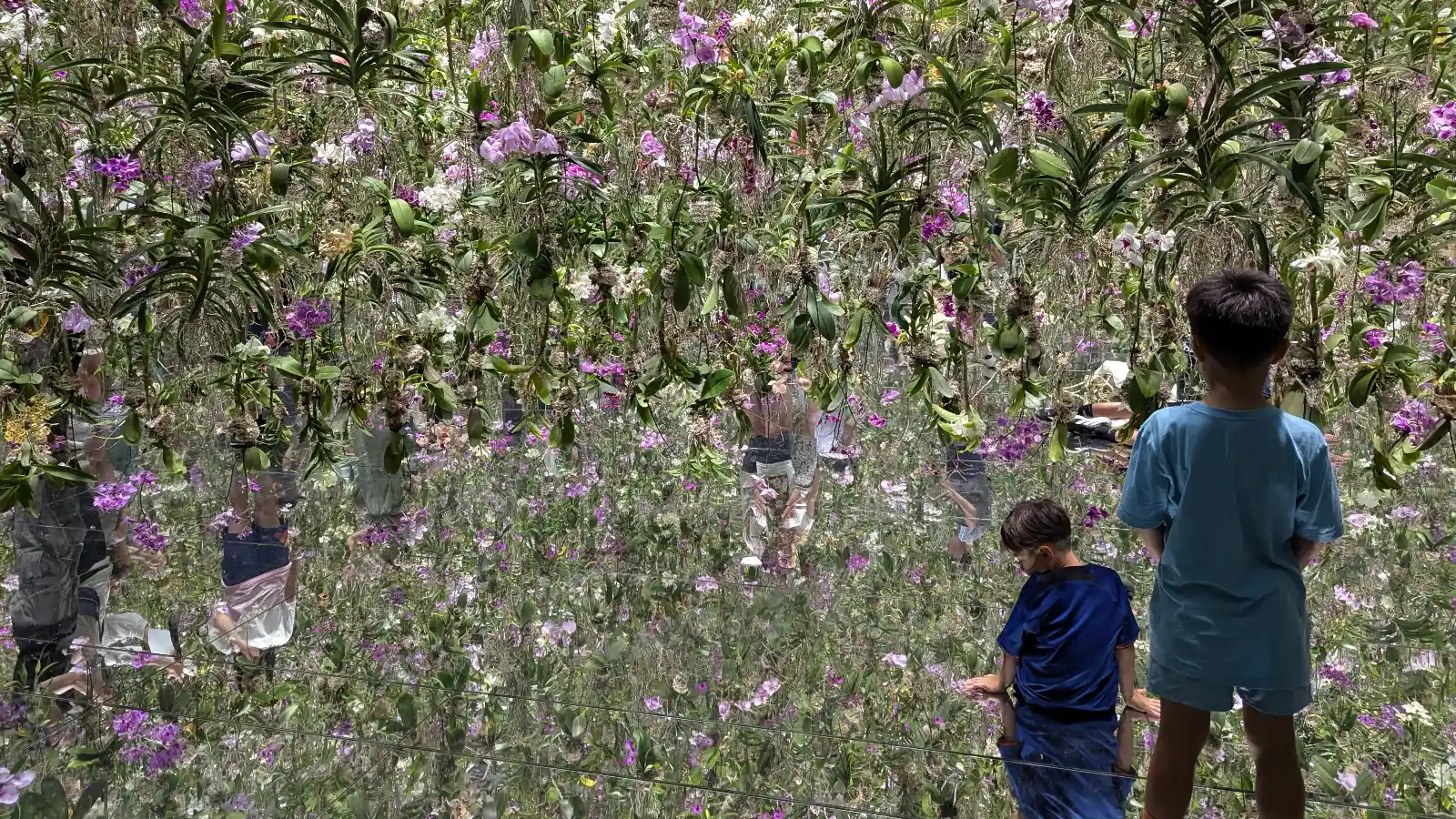
teamLab Planets sends a family barefoot through light and knee-deep water, a joy for a child who moves and a test for one sensitive to light, eased by a bypass route.
Junior and senior high ¥2,800; 3 and under free; prices vary by date. Required: tickets are sold online only.
No weekly closing day; the museum runs until the end of 2027.
One pass through the works: there is no re-entry after the exit gate.
Under 13 comes with a guardian of 18 or over; under 40 cm inseam, a child is carried through the works.
Strollers stay in a set place; infants may go in a front baby carrier.
Some links on this page are affiliate links. LuNi may earn a commission at no extra cost to you.
Is teamLab Planets Tokyo worth it with kids?
The short version, before the costs, the timings and the case for each child.
Yes, and for a child who moves it is the best visit in Tokyo, because the whole body is invited in: bare feet, water to wade through and rooms to walk into rather than look at. The condition is the child who takes in everything at once. Strong light and dark rooms are hard on that child, and there is no re-entry once you leave, so the visit turns on the bypass route. The staff will guide a family around any work they want to skip, which turns the hardest rooms into a choice rather than a trap. Book ahead, carry the smallest child, and ask about the bypass before you begin, so the choice is made calmly rather than in a dark room.
Planning Your Visit to teamLab Planets Tokyo with Kids.
Three decisions shape the visit, all made before the day, and the first is the pass, which has to be bought ahead: nothing is sold at the venue, and a date chosen at home can still be changed if a child wakes up unwell. The second is the smallest child: a child under 40 cm inseam is carried through the works by a guardian, so a carrier helps, and strollers stay in a set place outside the works. The third is the route. There is a bypass for anyone who wants to skip works, and a family with a sensitive child should ask staff about it at the start, before the first dark room. A child who has waded through a morning of light wants something slower afterward, and Odaiba across the bay holds the afternoon.
Every LuNi attraction guide starts with a visit, with our own children
LuNi rates and writes about attractions only after visiting them with children. Luca and Nico were at teamLab Planets Tokyo, and what they did there is recorded further down this page, including how each child actually met it.
Children arrive with different tolerances: for noise, for lines, for standing still, for being on their feet all day. A guide written for the average of them helps almost nobody. So every place on this site is read four ways, and each verdict says which children it already suits and what makes it work for the rest. Whoever you are bringing, the answer here is built for your family rather than for a general reader.
Restricted-movement depletion finds an outlet wading barefoot through water and light, so let a moving child set the pace from work to work.
Sensory-input depletion peaks in strong light and dark rooms with no re-entry, so ask staff for the bypass route and skip the hardest works.
Unfamiliarity runs high barefoot, in water and in dark rooms, so describe each work at home and agree on which to skip with the bypass route.
Walking and standing stay modest on a route through works a minute from the station, with free lockers, so carry the smallest child through.
- Cost
- ¥3,800 adult / ¥1,500 age 4 to 12Junior and senior high ¥2,800; 3 and under free; prices vary by date. Required: tickets are sold online only.
- Booking
- Bought online, aheadNo tickets are sold at the venue; web tickets can be changed up to three times, until two hours before.
Hotels we would book for this visit.
A visit in bare feet and bright light is easiest on a fresh child, so the early slot picks the room. Two rooms in the museum’s own district, then one of Odaiba’s family hotels for an Odaiba day.
| Property | The LuNi Reason |
|---|---|
| LUNI Pick La Vista Tokyo Bay | La Vista Tokyo Bay, in the museum’s own district, suits an early booked slot. A morning in bare feet and knee-deep water is best started fresh, and a room in the district lets a child go straight from breakfast to the first work, then come back to change and rest before the afternoon asks anything more. |
| Hotel JAL City Tokyo Toyosu | Hotel JAL City Tokyo Toyosu is the room for a child who will need the afternoon to settle: an early slot, wet feet and bright rooms, then back to a quiet room in the same district while the light wears off, with nothing more asked of the day. |
| Hilton Tokyo Odaiba | Hilton Tokyo Odaiba is for a family pairing Planets with a day on Odaiba. After a morning of light and water, a child’s evening goes better on the island the family will explore next, with the next day’s first stop close at hand rather than a morning journey back across the bay. |
Nearby attractions, matched to your child.
Three pairings for what the museum leaves unmet: a city of jobs reached from the same Toyosu Station, a building day on a schedule for a child who wants a plan, and an indoor park of rides.
| Pairing | Why This Solves the After-Visit | For Your |
|---|---|---|
| LUNI Pick KidZania Tokyo Toyosu Station, Exit 2, about 8 min | Reached from the same Toyosu Station, KidZania Tokyo gives a Dynamo a city of about 100 jobs to walk between and work alone. Restricted movement has a whole day to spend itself there, though a child cannot step out once the session starts, so choose its length well. | Dynamo |
| Legoland Discovery Center Tokyo Decks Tokyo Beach, Odaiba; tickets online | For an Anchor unsettled by dark, watery rooms, Legoland Discovery Center Tokyo runs on a dated ticket bought online, with its 4D cinema and workshops on a set schedule. Unfamiliarity eases when the day follows a plan the child already knows, after a museum built on surprise. | Anchor |
| Tokyo Joypolis Decks Tokyo Beach, Odaiba; indoor rides | For an older Dynamo still full of energy, Tokyo Joypolis on Odaiba is an indoor park of rides and games, each with a posted price and height limit, and free re-entry on the day’s ticket. Restricted movement is spent in speed rather than in water and light. | Dynamo |
KidZania Tokyo
Toyosu Station, Exit 2, about 8 min For YourDynamo
Legoland Discovery Center Tokyo
Decks Tokyo Beach, Odaiba; tickets online For YourAnchor
Tokyo Joypolis
Decks Tokyo Beach, Odaiba; indoor rides For YourDynamo
How two children actually met this attraction.
Two children walked the same rooms barefoot and wanted opposite things from them. One slowed right down, looking for the rooms that rewarded stillness, and found a floor he could lie on and a garden he could stand still in; the other sped up, looking for anything that answered movement, and found water, soft floors and space to play. Both left happy, which is the real case for Planets with children. It gives the still child and the moving child each their own rooms. Let each of them find their own rooms, at their own pace. Ask staff about the bypass at the start, so a room that is too much for either child can be skipped rather than sat through, and neither has to be carried out in tears.
Luca slowed down. In the Floating Flower Garden he tried to stand completely still so the petals would rise and fall around him without his moving disturbing them. In the mirrored Crystal Universe room he lay down on the floor and looked up, saying he could have stayed there forever because he could not tell where the floor ended. He was drawn to the rooms that asked for stillness.
This is the Anchor pattern. A child whose Reserve depletes through unfamiliarity and unconfirmed structure finds calm in a room that behaves predictably, and a garden that responds to stillness gives him a rule he can hold. For a similar child, describe the museum before you go, the water, the barefoot walking, the dark rooms, and agree with him which works to skip on the bypass route, so nothing inside comes as a shock and every choice is his own.
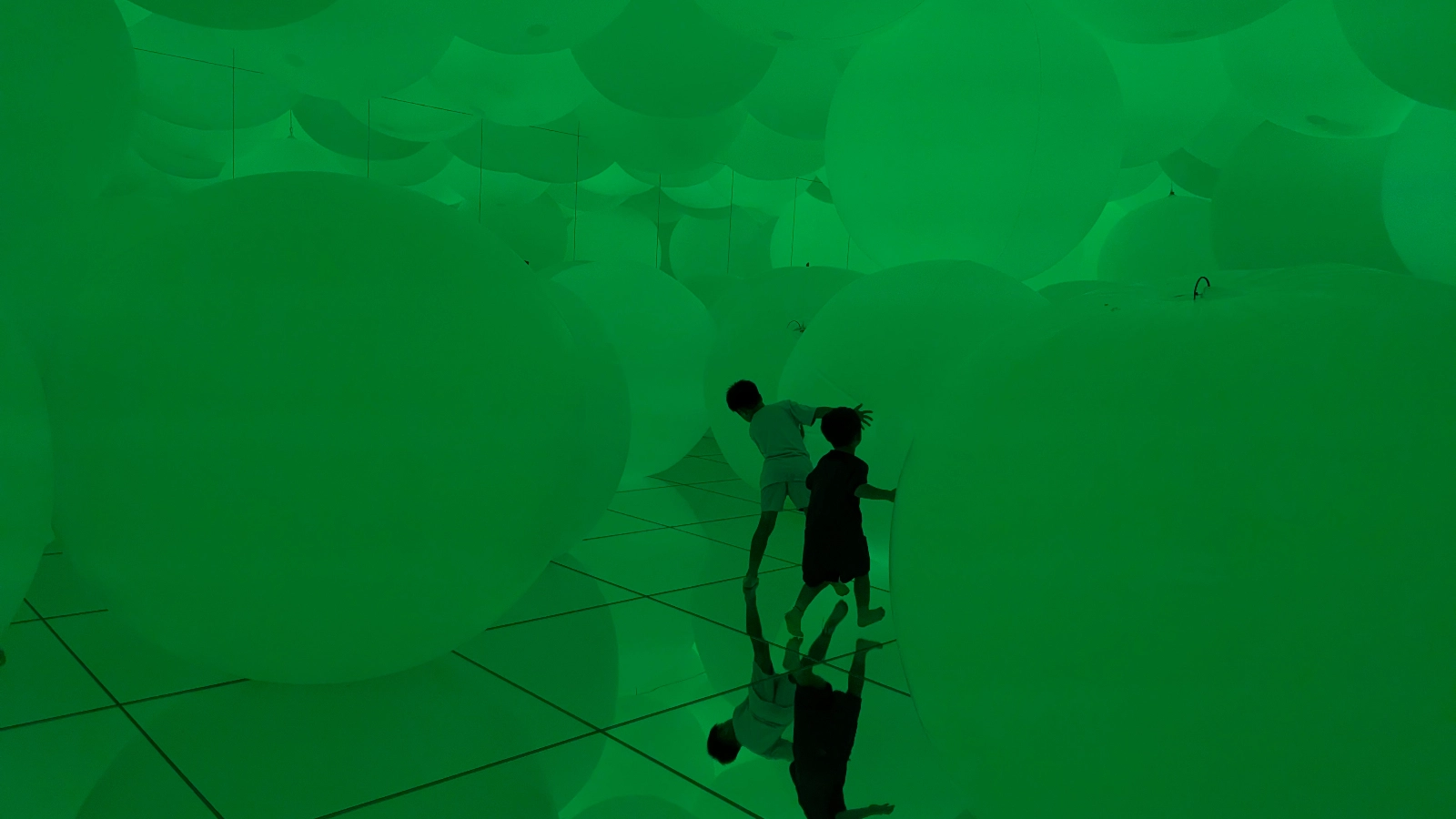
Nico moved constantly. He jumped on the soft springy floor to hear the noises it made, waded into the knee-deep water to chase the glowing fish and tried to catch them, and in the balloon room he ran, bounced off the giant spheres, and tried to hide before being found. He described it as a museum where running, splashing, and being silly were finally allowed.
This is the Dynamo pattern. A child whose Reserve depletes through restricted movement is at his happiest where a place lets his body in, and a museum of water and light to wade through does exactly that. For a similar child, let him set the pace from work to work, roll up his clothes or take the free half-pants for the water, and keep a hand close in the dark rooms, where footing matters most.
Walking barefoot through water in the dark asks a child to trust their own body in an unfamiliar place, and that is a quiet kind of courage. Sensation comes first here, before explanation, so a child meets the works through their feet and skin rather than their eyes alone. Some children plunge in and some hesitate at every door, and both responses are honest. What matters is that skipping a room is always allowed, because learning to say what is too much is as valuable as learning to go on.
The LUNI Rating for teamLab Planets Tokyo.
The verdicts split on light and water. For a child who needs to move, wading barefoot through water and light is a delight, which is why the Dynamo is in its element, and the Sprinter is well served too, on a route a minute from the station. The Sensor pays most, for strong light, dark rooms and no re-entry, and the Anchor needs a plan for a place so unlike anything familiar. The bypass route is the answer for both, and it is there for the asking, so ask at the start. Neither child needs to see every work to have had the visit.
Let the child wade, and set the pace. The Dynamo depletes through restricted movement, and teamLab Planets lets a moving child in with their whole body. Visitors go barefoot, and in the water works the water reaches an adult’s knee, so a child wades rather than watches. Free half-pants are lent for the water, so a child can wade in without a change of clothes, and nothing about the visit asks them to stay dry or still.
So let the child lead from work to work at their own pace. A younger Dynamo under 40 cm inseam is carried through the works, so part of the visit is spent in a parent’s arms, which is exactly the restriction this child minds most; let them walk every stretch they are allowed. Keep a hand close in the dark rooms, where the museum asks visitors to take care, and let an older child go ahead within sight.
What this means for your Dynamo: wading barefoot through water and light gives restricted movement a real outlet. A younger Dynamo needs a hand in the dark and a carry where required; an older one can set the pace between works.Ask for the bypass before the first work. The Sensor depletes through sensory input, and the works include places with strong light and places that are dark. Add water to the knee, bare feet and mirrored rooms, and there is a great deal for this child to take in at once. There is no re-entry after the exit gate, so a child who reaches the limit cannot step outside and come back.
That is also why the bypass route matters so much. The museum keeps a way around any work a visitor wants to skip, offered to families with small children among others: ask a nearby staff member at the start. Decide in advance which rooms to skip, keep the visit short, and plan somewhere calm and green for afterward, so the day ends quietly.
What this means for your Sensor: input peaks in strong light and dark rooms with no re-entry. A younger Sensor needs the bypass route and the hardest works skipped; an older one can choose which rooms to try.Describe every work before you arrive. The Anchor depletes through unfamiliarity and unconfirmed structure, and teamLab Planets is about as unfamiliar as a museum can be. Visitors take off their shoes and socks, wade through water, and walk into rooms that are dark or mirrored. For a child who likes the next step settled, that is a lot of new at once.
The fix is preparation, and the museum gives a family what it needs. The pass is timed, so the start is fixed. Tell the child about the barefoot walk, the knee-deep water, the half-pants and the dark rooms before the day. Then agree on which works to skip on the bypass route. An Anchor who knows every step in advance can enjoy the strangeness rather than fear it, and may even ask to go again.
What this means for your Anchor: unfamiliarity runs high in water and dark rooms, barefoot. A younger Anchor needs every work described at home; an older one can choose the works to skip with the bypass route.Carry the smallest child, and travel light. The Sprinter depletes through sustained travel-style walking and standing, and teamLab Planets asks for less of both than a day in the city. Shin-Toyosu Station is about a minute from the North Exit, lockers are free, and the visit is a route through works rather than a long walk between buildings, with water underfoot in places.
The one thing to plan is the smallest child. Strollers are left in a set place, and a child under 40 cm inseam is carried through the works, so bring a carrier. Leave bags in the free lockers and go barefoot as the museum asks. For a Sprinter, this is a short, easy visit, as long as the family arrives by train and not after a long walk across the bay district first.
What this means for your Sprinter: a route through works a minute from the station keeps walking and standing modest. A younger Sprinter needs a carrier; an older one can manage the visit barefoot with ease.The questions parents actually ask.
There is no re-entry once a family passes the exit gate, and the bypass route is the way through for a child who needs to skip a work; plan around both before the first room. The pass is priced by date. A child under 40 cm inseam is carried through the works. The water reaches an adult’s knee, and half-pants are lent free. The bypass is offered to anyone who asks, such as a family with a small child, and nearby staff will show it. At teamLab Borderless, the mapless sister museum, a Sensor’s sensory input runs as high, so plan it as short.
Is teamLab Planets Tokyo worth visiting with kids?
For most children, yes: it is a walk-through museum of light and water where visitors go barefoot, with water up to an adult’s knee in places. It is hard for a child sensitive to strong light and dark rooms, and there is no re-entry. The staff offer a bypass route to skip works, which makes it workable for that child too.
How much are teamLab Planets tickets for children?
The timed Entrance Pass starts at 3,800 yen for an adult, on prices that move by date; junior and senior high students pay 2,800 yen, a child from 4 to 12 pays 1,500 yen, and those of 3 and under go free. A Premium Pass, with no time slot and priority entry, costs 12,000 yen for anyone of 4 and over.
Can small children do teamLab Planets?
Yes, with limits. Children under 40 cm inseam cannot take part in the works on their own, so a guardian of 18 or over carries them, and children under 13 must come with a guardian. Water reaches an adult’s knee in places, and free half-pants are lent in sizes XS to 6L, so smaller children can wade too.
Is there a way to skip parts of teamLab Planets?
Yes. The museum keeps a bypass route for visitors who want to skip works, including families with small children and visitors with limited mobility; ask any nearby staff member. That makes it possible to avoid a room that would overwhelm a child without leaving the museum, since there is no re-entry once you pass the exit gate.
What should you bring to teamLab Planets?
Very little. Visitors go barefoot in the water works, and socks come off in the locker area, where lockers are free. Free half-pants are lent for the water, so shorts are not essential. Food is not allowed inside. Strollers are left in a set place, so bring a carrier for a small child.
When is teamLab Planets open?
It opens from 8:00 to 22:00, with last entry an hour before closing, and it is planned to run until the end of 2027. The store and the Sketch Factory open from 8:30, and the restaurants, for entrants only, from 10:30 to 21:30. A booked slot fixes the time of entry.
How do you get to teamLab Planets Tokyo?
Shin-Toyosu Station on the Yurikamome Line is about a minute away from its North Exit, Shijo-mae and Toyosu Market about five minutes, and Toyosu Station about ten from Exit 7. A paid shuttle bus runs from GINZA SIX. The museum asks visitors to avoid the crowded To 05-2 bus.
Can you take photos at teamLab Planets?
Yes, you may photograph and film, but not with flash, and sticks or tripods over 30 cm stay out. In the water works, keep a phone in a hand or a zipped pocket, and for a child carried through a work, the museum asks the carrying adult to take care, as it does for anyone uneasy in dark or high places.
Where teamLab Planets Tokyo fits your Japan trip.
Official site and opening information: teamLab Planets Tokyo