A 3-Day Tokyo ItineraryThat Adapts to Your Child.
- The Three Days
- Old Tokyo, the bay, then modern Tokyo
- Is 3 Days Enough?
- Yes, for one base with no day trips
- A Fourth Day
- Disney or Hakone
- With Teens
- Day 3 in Shibuya and Harajuku, teen-led
- With Toddlers
- Park time in place of one busy stop
How a family spends a long weekend in Japan’s capital, and which of its neighborhoods carry each part of it.
Some links on this page are affiliate links. LuNi may earn a commission at no extra cost to you.
Three days in Tokyo with kids covers the city’s core from one base with no day trips: old Tokyo, the bay and modern Tokyo, one cluster a day. Most Tokyo days with children fall apart at the same hour, in the early afternoon, and the fix is not a better list of sights but a day sequenced around how the child tires. A teenager can lead Day 3, a self-directed Shibuya and Harajuku day with the transit legs to navigate; a toddler follows the same route with park time in place of one high-input stop. A fourth day unlocks Disney or Hakone.
Why the day breaks when it breaks.
Family travel runs on three currencies, not two. Money and time are the ones parents already watch. The third is the child’s Reserve, their finite capacity to absorb what a travel day asks of them. The early-afternoon collapse is what running out of Reserve looks like, and it feels random only because most itineraries are built around attractions rather than around depletion. The LUNI Framework builds the day back around the child instead.
This guide does that in two moves. First, one strong three-day Tokyo route: the backbone we would hand any family. Then the profile layer, where the framework shows what to move, cap, or swap depending on how your particular child runs down, because the right Tokyo day for a child who depletes through stillness is not the right day for a child who depletes through walking. The route stays the same. How you run it is the whole game.
Three days, one cluster a day.
The backbone we would hand any family. Each day is a single transit cluster, so energy goes into the city rather than the trains.
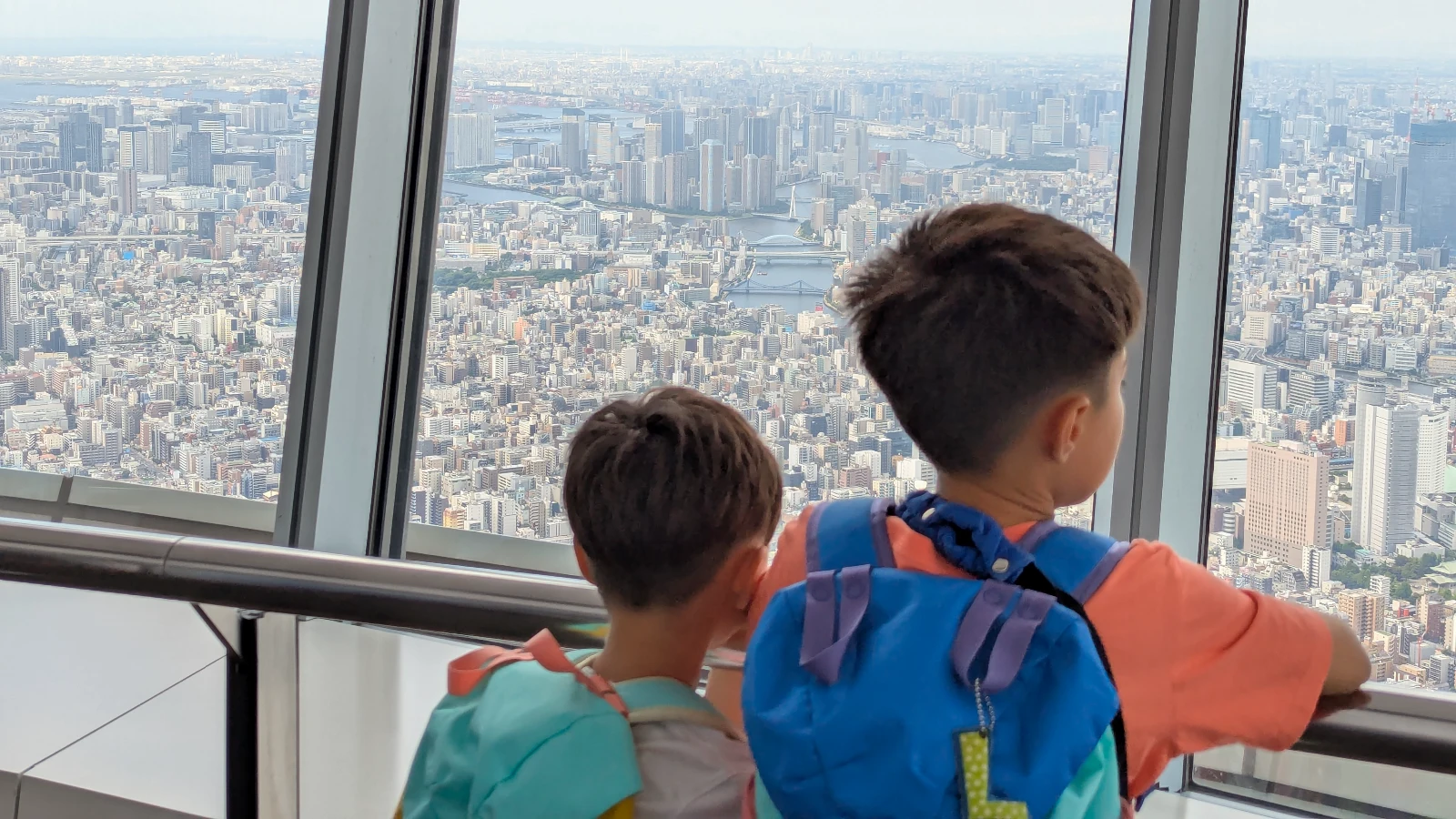
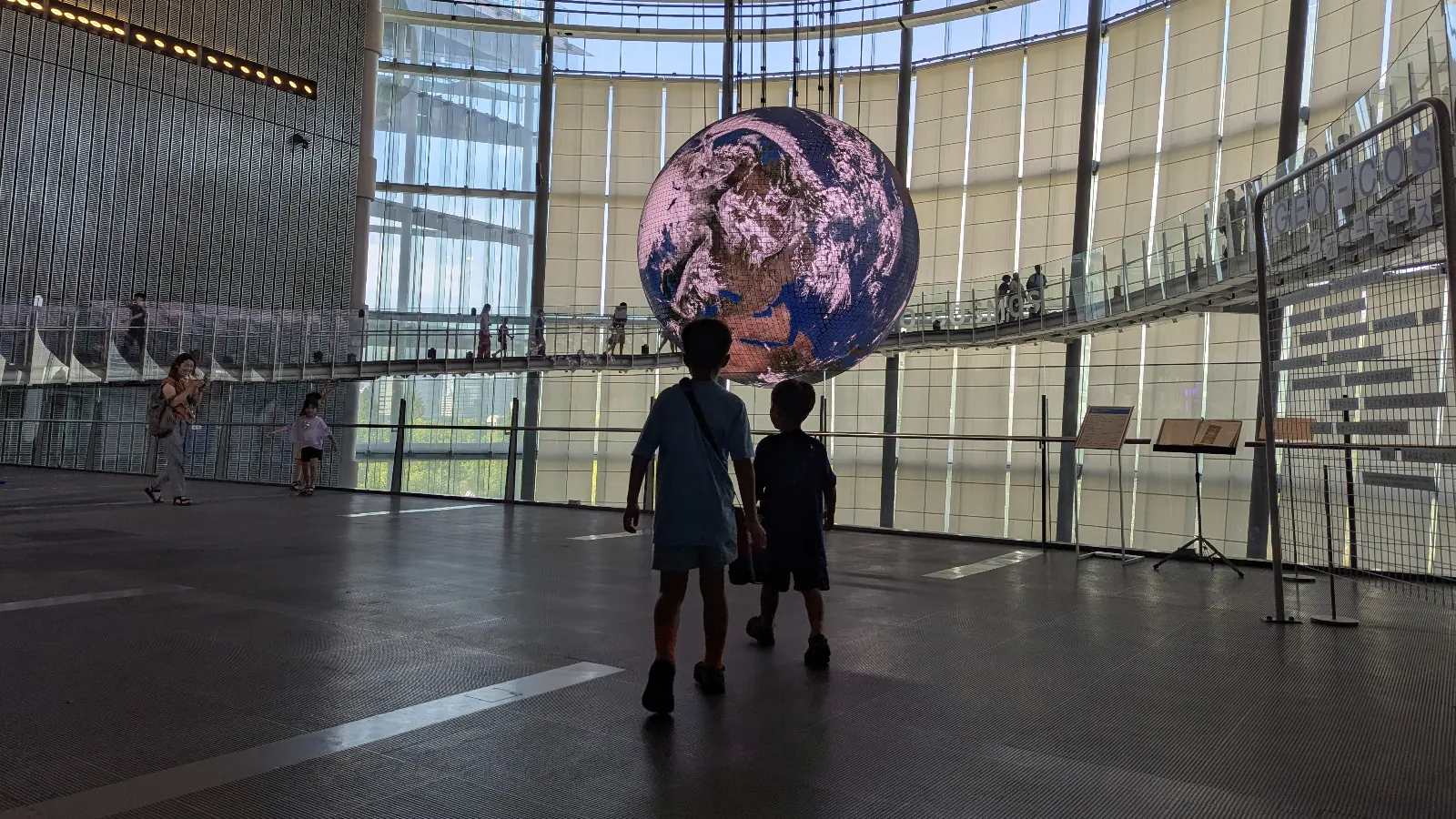
The route groups Tokyo into three neighborhoods that each sit close enough to walk, so no day is spent doubling back across the city. Day 1 stays in old Tokyo, around Asakusa and Ueno, a gentle and orienting start for a family still carrying jet lag. Day 2 crosses to Odaiba and the bay for teamLab Planets and Miraikan, the trip’s big set-piece day, with wide waterfront space to move and rest between the two indoor stops. Day 3 closes in modern Tokyo, from the calm of Meiji Shrine through Harajuku to Shibuya Sky at golden hour, a day built for a child ready to lead.
Treat it as a backbone, not a rulebook. Follow it as written and you have a strong first visit. The profile layer below is what turns a strong visit into the right one for the children you are actually traveling with.
The one change your child needs.
The baseline is a good three days for most families. For yours, one profile is quietly deciding whether it holds. Find yours, make the one change, and the day stops fighting you.
The change: run Day 1 backward, and give every morning a discharge window before its first indoor stop. The Dynamo’s Reserve depletes through restricted movement, so the baseline order, Senso-ji first, is exactly wrong: it opens the trip inside a slow, packed, do-not-touch crowd on the Nakamise approach, and the Reserve is gone before lunch. Start Day 1 at Ueno instead. Take the park exit and walk the length of Ueno Park before you enter the zoo, past Shinobazu Pond and the open promenades, at the child’s pace rather than the crowd’s. The walk itself is the discharge, and the zoo that follows keeps it going: it is open-air and self-paced, which is exactly the kind of movement a Dynamo needs, so a slow loop through the enclosures spends the restlessness the temple will later demand the child suppress.
Only after that, in the afternoon, take the train to Asakusa for Senso-ji, when the morning’s movement has already been paid out and a slower, confined stop no longer sits on a full tank of unspent energy. Carry the same order into every day of the trip: the open, physical thing comes before the queue or the deck, never after. On the transit legs, where a Dynamo’s restlessness builds fastest, hand the child a real job, holding the pocket Wi-Fi and leading the group to the right platform, so the movement pressure has somewhere to go between stops.
The change: treat Day 2 and Day 3 as two separate sensory peaks, and never let them run back to back. The Sensor’s Reserve depletes through sensory input, and both halves of this trip carry a genuine high-risk stop for that profile. teamLab Planets on Day 2 is intense by design: low ceilings, mirrored floors, dark rooms, and water underfoot, and a sensory-loaded child can reach a cascade before the most rewarding rooms. Day 3 concentrates a different kind of load, sustained and unbroken: Meiji Shrine is calm, but Takeshita Street is a narrow, packed, loud corridor of competing sound and smell, the Shibuya scramble is one of the densest crowds on earth, and Shibuya Sky adds a wall of people at altitude. Neither day is the safe one. The danger is running them at full intensity in sequence, with no recovery between.
So protect both days, not just Day 3. On Day 2, book the first teamLab Planets slot before 10:00 a.m., when lower density gives a sensory-loaded child the room the later crowds take away. On Day 3, go to Meiji Shrine and Yoyogi Park early, while both are quiet, and treat that calm morning as the day’s anchor. Keep Takeshita Street short and optional, see the scramble once from the second-floor window above it rather than standing in it, and book the earliest Shibuya Sky slot before the rooftop fills. Above all, do not run Day 2 and Day 3 at full intensity back to back. Put the calmest half-day the itinerary allows between them, an unhurried morning or an afternoon back at base, so the Sensor comes into the Shibuya day with room to spend rather than already drained from the bay.
The change: keep one Tokyo base for all three nights, and bookend every day with a spoken preview. The Anchor’s Reserve depletes through unfamiliarity and unconfirmed structure, so for this profile the itinerary decision that matters most is the one the baseline already makes: one hotel, no mid-trip move. Do not split the three nights between two areas to sit closer to Day 2’s bay, because the disorientation of a new room costs an Anchor more than the transit time it saves. The stable base is the single most protective choice on the whole trip, and it is made once, at booking, before the child ever sets foot in Tokyo.
Then add the beat that does the daily work. Each morning before leaving the room, say the day in order out loud: “Ueno first, then the zoo, lunch in the park, the temple after, back here by four.” Each night before bed, do the same for tomorrow, because an Anchor sleeps more securely when the next morning is already confirmed. The order of the stops matters too. Senso-ji’s fixed rituals, drawing a fortune, the set path through the gate, settle an Anchor, where the open-ended churn of Takeshita Street can unsettle one, so lead each day with the confirmed, structured stop and leave the free-for-all for when the child is steadiest.
The change: build a real seated meal into the middle of each day, and keep the hardest-walking day off the end. The Sprinter’s Reserve depletes through sustained travel-style walking and standing on hard surfaces, and the tell is the request to go back to the hotel: that is the legs talking, and only sitting answers it. The mistake most families make is treating lunch as a moving snack, a crepe on Takeshita Street, something eaten standing between stops, which spends the one natural chance in the day to take the load off the legs. On Odaiba’s Day 2, the malls sit right on the route, so plan a proper 45-minute sit-down meal inside one rather than grazing while you walk; the seated block is not a luxury for a Sprinter, it is the recovery that buys the afternoon.
Then watch the order of Day 3. Meiji Shrine’s long gravel approach, the crush of Takeshita Street, and the Shibuya scramble are almost entirely standing and slow shuffling, and the baseline lands them last, when a Sprinter’s legs are already three days spent. If the child faded on Day 2, do not push through it: swap Day 3 into a calmer, more seated shape and save the shrine walk for a fresher morning. The point is to keep the walking spread evenly across the three days rather than loading the heaviest standing onto the last one, so the trip stays whole instead of losing its final day to spent legs.
Most families travel with more than one child, and the profiles rarely match. When they collide, the more structurally constraining profile drives the day and the other is protected around it. A Sensor traveling with a Dynamo means the trip calibrates to the Sensor’s input ceiling, with the Dynamo’s discharge windows built into the gaps, never the reverse. In practice, pick the child whose limit lands earliest, build the day’s shape to them, and layer the second child’s needs into the room that leaves: the Dynamo’s walk through Ueno Park while the Sensor eases into the morning, the Sprinter’s seated lunch while the Anchor hears tomorrow previewed. Read the child who limits the day most, build to them, and the siblings travel as one family rather than two itineraries fighting for the same hours.
The questions parents actually ask.
Is 3 days in Tokyo enough with kids?
Yes, for the city’s core. Three days covers one base with no day trips: old Tokyo, the bay, and modern Tokyo, one cluster a day. A fourth day is what unlocks a Disney park or a Hakone day trip without compressing the rest.
What is the best Tokyo itinerary by age?
The route stays the same from ages 3 to 16; what changes is the adaptation. A toddler gets more park time and a split high-input day, while a teen leads the self-directed Shibuya day and navigates transit. Age sets the stamina ceiling, not the plan.
Can toddlers and teens follow the same plan?
Yes, on the same baseline route. Where siblings differ, the more constraining child sets the day’s structure and the other’s needs layer into the gaps, so one plan holds for a mixed-age family rather than splitting the group.
How much walking should families expect in Tokyo?
Expect a lot of walking on active days, most of it on hard station and sidewalk surfaces. Day 3 around Meiji Shrine, Harajuku, and Shibuya carries the most sustained standing, so a child whose Reserve drains through walking needs a genuine seated meal built into the middle of each day.
Which Tokyo neighborhoods should a 3-day itinerary cover?
Cover them in three single-neighborhood days: Asakusa and Ueno, then Odaiba and the bay, then Shibuya and Harajuku. The point is not just short transit; it is that one cluster a day lets a child return to rest without crossing the city, and because the three clusters carry very different loads, which one you place where depends on how your child depletes rather than on a fixed order.
What is the best time of year to visit Tokyo with kids?
Spring and autumn are easiest on a child’s Reserve: mild days mean the outdoor stretches at Ueno Park and Meiji Shrine cost far less to get through. Summer heat is a depletion multiplier, shortening how long any child lasts on the Day 3 standing and the open walks, so in July and August shift those outdoor stops to early morning and lean harder on indoor anchors like teamLab and Miraikan.
What is the most common mistake families make in Tokyo?
Over-scheduling a single day, usually by stacking teamLab Planets, Miraikan, and a mall into one block. For most children that is the afternoon the day falls apart. Keeping one major attraction as the anchor per day, with real rest around it, is what keeps three days enjoyable.