Chusonji Temple with Kids: the climb the gold is worth.
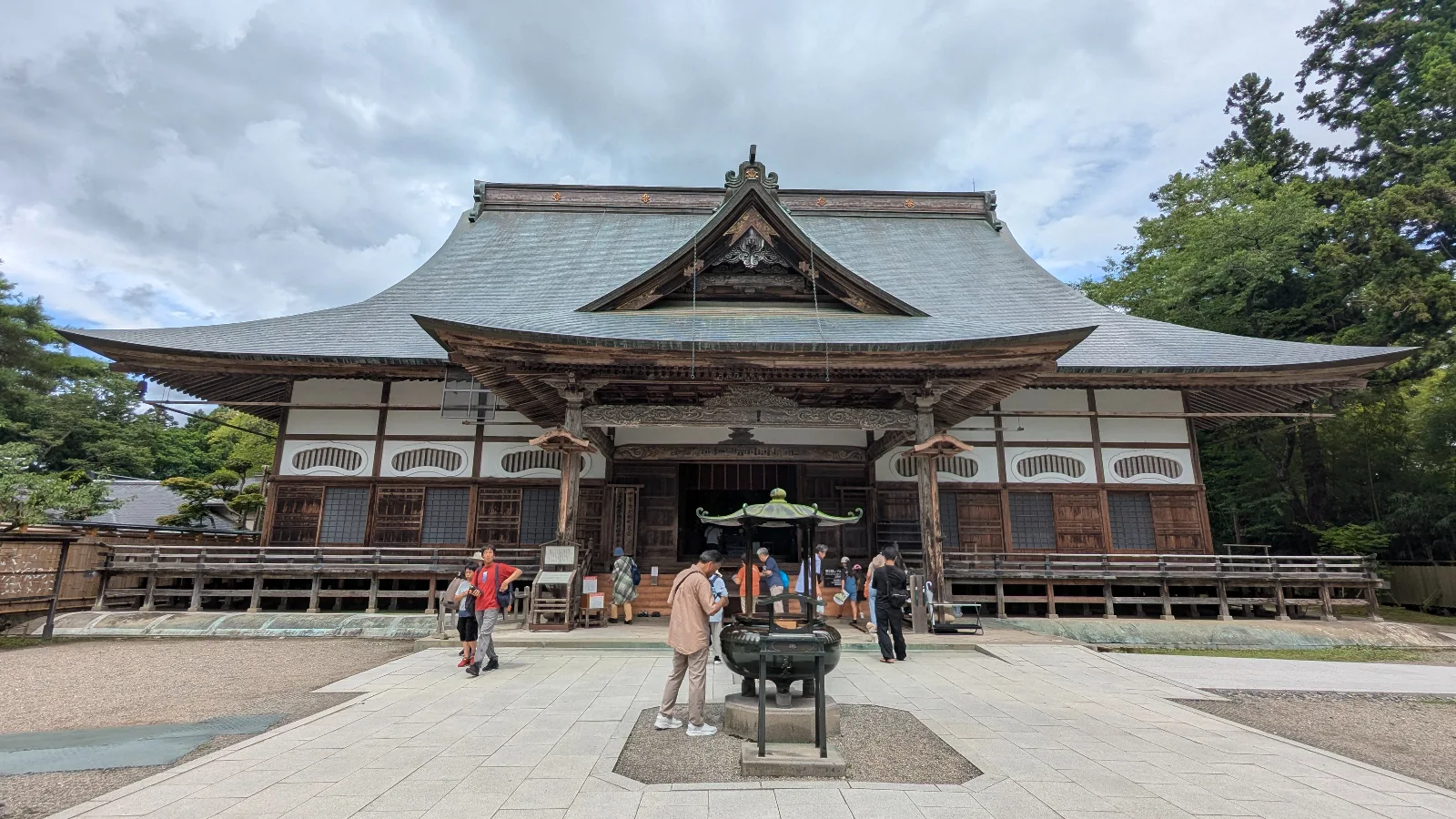
The same cedar approach that hands one child an unbroken outlet costs another the whole morning, and which of those a family gets is decided in the parking lot.
One ticket covers the Konjikido, the Sankozo, the Sutra Repository and the former shelter hall; until November 15, 2026, the combined ticket with the anniversary unveiling is ¥1,600 for an adult. Tickets are also sold online; booking is not required.
8:30 to 16:30 from November 4 to the end of February; ticket sales stop 10 minutes before closing. The precinct is open all year.
The walk climbs from the foot of Tsukimizaka to the Konjikido.
Younger children take the climb and leave the history behind.
Tsukimizaka, the main approach, climbs steeply to the East Lookout, then levels; for less mobile visitors, the private Sakanoue lot parks closest.
Some links on this page are affiliate links. LuNi may earn a commission at no extra cost to you.
Is Chusonji Temple worth it with kids?
The short version, before the costs, the timings and the case for each child.
Yes, and more comfortably than its reputation allows. Chusonji is a hillside precinct rather than a single building, and the gold hall everyone arrives for is a few minutes inside a morning that is otherwise spent walking under cedars. So the question a family answers here is not whether to come. It is where to start from, because the approach is sold three ways at three prices, and the cheapest of them is the one that costs a child the most. Settle that in the hotel and this is a temple that pays a child back for effort they have already spent. Leave it to the moment and the gold arrives after everything has gone, which is the only way this visit really fails.
Planning Your Visit to Chusonji Temple with Kids.
Three things are worth settling before the day starts, and all three are about arriving rather than admission. The first is how high up the hill you begin, because the three parking lots sit at very different distances below the main hall, and the nearest charges a little more than the others. The second is the window you are traveling in: this autumn’s 900th anniversary unveiling puts a second, pricier ticket at the same counter, so a family that budgeted from an older guide comes up short at the window. The third is what everybody carries, because there are no lockers here at all. The ones to use are back at Hiraizumi Station, which makes the bags a decision taken before boarding, or a reason to send them ahead.
Every LuNi attraction guide starts with a visit, with our own children
LuNi rates and writes about attractions only after visiting them with children. Luca and Nico were at Chusonji Temple, and what they did there is recorded further down this page, including how each child actually met it.
Children arrive with different tolerances: for noise, for lines, for standing still, for being on their feet all day. A guide written for the average of them helps almost nobody. So every place on this site is read four ways, and each verdict says which children it already suits and what makes it work for the rest. Whoever you are bringing, the answer here is built for your family rather than for a general reader.
Restricted-movement depletion is answered by a self-paced climb and a hillside of separate halls, so start from the lower lots and let the approach spend it.
Sensory-input depletion stays low across an open precinct where the visit is looking and walking, so the enclosed gold hall is the one stretch to pace.
Unfamiliarity and unconfirmed structure are answered by one ticket, four named buildings and a posted closing cut-off, so name all three before the gate.
Sustained walking and standing are charged most of a kilometer uphill from the ordinary lots, so the hilltop lot is the entire plan.
- Cost
- ¥1,000 adult / ¥700 high school / ¥500 junior high / ¥300 elementaryOne ticket covers the Konjikido, the Sankozo, the Sutra Repository and the former shelter hall; until November 15, 2026, the combined ticket with the anniversary unveiling is ¥1,600 for an adult. Tickets are also sold online; booking is not required.
- Booking
- Online, or at the ticket windowWindow sales stop 10 minutes before closing.

Hotels we would book for this visit.
Nothing sleeps at the temple gate, so all three are a transfer, and the transfer is what they are chosen on: how a family without a car reaches an 8:30 opening in another town, and how much the rail leg has already taken.
| Property | The LuNi Reason |
|---|---|
| LUNI Pick KAMENOI HOTEL Ichinoseki Genbi, 20 minutes by car from the temple | It is the one address here with a free pick-up from Ichinoseki Station, about twenty minutes, so a family arriving by train is not negotiating a taxi rank at breakfast. For a child whose walking is already spoken for by the approach, a morning that starts seated is the part of the Reserve worth protecting. |
| Bellino Hotel Ichinoseki About 5 minutes by taxi from Ichinoseki Station | A city hotel five minutes from the Shinkansen platforms, by taxi rather than on foot, which is the distinction that matters when legs are the constrained currency. It is the easiest night to place either side of a long rail day, and the simplest to book around one. |
| Naruko Kanko Hotel Naruko Onsen, 2 minutes on foot from Naruko-Onsen Station | This is the one base that belongs to a night in an onsen town rather than to this morning, and a long transfer in front of a climb is the wrong order for a child spending legs. Book it after Hiraizumi, not before it; the hotel is two minutes on foot from Naruko-Onsen Station. |
Nearby attractions, matched to your child.
Three stops, two in Hiraizumi itself and one in Ichinoseki, chosen for what each repairs after a climb and a still hall: flat ground, a room that tells the story, and open garden paths.
| Pairing | Why This Solves the After-Visit | For Your |
|---|---|---|
| LUNI Pick Motsuji Temple The other World Heritage site in the same town | Chusonji charges a low-stamina child on the way in, before anything has been seen. Motsuji, in the same town, has no steep slopes, so the second half of the day asks for looking rather than climbing, and a child who paid the first bill is not asked to pay it twice. | Sprinter |
| Hiraizumi Cultural Heritage Center Hanadate, between Motsuji and Chusonji | A child who settles once a place can be explained leaves this hill holding four buildings and one family name and no way to fit them together. An indoor room that sets the same story out in a fixed order finishes the job the precinct started, indoors and free. | Anchor |
| Michinoku Hydrangea Garden Open late June to late July only | The temple gives a moving child a climb, then asks for stillness at the top. Open garden paths hand the movement back with no hall at the end and nothing to be quiet for, which is the discharge the precinct only half allows. | Dynamo |
Motsuji Temple
The other World Heritage site in the same town For YourSprinter
Hiraizumi Cultural Heritage Center
Hanadate, between Motsuji and Chusonji For YourAnchor
Michinoku Hydrangea Garden
Open late June to late July only For YourDynamo
How two children actually met this attraction.
Two children walked the same slope on the same morning and came out having been to two different places. One had asked to come and arrived with the visit already meaning something, so the walk was the last part of a plan rather than the first part of an unknown. The other had not, and met the hill as a hill. The ticket is the same for both of them and so is the slope, and what differs is whether the walk was the first part of the visit or the price of it. Both readings are accurate readings of Chusonji, which is the awkward thing about it: the approach is the best part of the visit for one kind of child and the whole price of it for another, and the family pays both bills on one ticket.
Luca had wanted to come to Chusonji specifically because it is a World Heritage Site, so he arrived already invested rather than needing to warm up. Inside the Golden Hall he was absorbed by the gold, tracing how far the leaf and the detail carried. The one thing that deflated him was being told he could not photograph it. He had assumed he would get a picture of himself there, and that was the disappointment he carried out.
This is the Anchor pattern. A child whose Reserve depletes through unfamiliarity and unconfirmed structure settles fastest when the shape of a visit is known before it starts, which is why arriving for a reason he chose himself removed the usual warm-up. What cost him was a condition he met at the door rather than in the plan. Families with an Anchor should settle the order of the buildings in advance and ask at the window what each one asks of visitors, so the conditions arrive in the parking lot.
Nico’s verdict was short and physical: the gold inside was cool, but the walk all the way up was not so fun. He was engaged once he had reached the top, and the sustained climb was the part he registered and objected to. It was plainly the stretch that drew his morning down, and it happened before the hall itself had any chance at him.
This is the Sprinter pattern. A child whose Reserve depletes through sustained walking and standing meets a continuous ascent first and hardest, well before the thing at the top can pay for it, and the interest he showed at the hall is real but arrives after the cost. Families with a low-stamina child should decide the arrival point rather than the pace: a younger one rides the last stretch, an older one is told at the bottom what the climb buys and given the number of meters.
A temple on a hill where one small golden hall has survived since the twelfth century gives a child a vivid sense of how rare it is for anything to last. Climbing past newer buildings toward the one true survivor turns the visit into a search, and the reward is a glimpse of something far older than everything around it. Children understand history best through a single, striking object. A child who finds the survivor learns that some things endure because people cared for them across centuries.
The LUNI Rating for Chusonji Temple.
One piece of geometry drives all four verdicts, and it is not the gold. Chusonji sits on a hill above Hiraizumi, and the distance a family walks up it is chosen at the parking lot: most of a kilometer from either of the two lower lots, or only a short walk from the small Sakanoue lot on the hilltop, which costs a hundred yen more. Four ticketed buildings are spread across the ground at the top. So the same site is a long outdoor circuit or a short one, and the family settles which before anybody gets out of the car.
Start at the bottom and the approach is the outlet. The Dynamo depletes through restricted movement, and Chusonji charges less for it than almost any temple of its rank. The Tsukimizaka runs up from the town between cedars planted three or four centuries ago, and it is a slope rather than a procession: nobody sets the pace and there is no line to hold. At the top the ticketed buildings are separate buildings on separate ground, the Konjikido and the Sankozo and the Sutra Repository and the former shelter hall, with the precinct open around them, so the ground itself keeps giving a moving child somewhere to be.
The trap is the fix written for a different child. A family that drives to the hilltop lot to protect a low-stamina sibling hands the Dynamo a short walk where the lower lots would have handed over the whole approach, and the outlet disappears into a parking lot. On a day carrying both children the answer is to split the direction rather than the distance: park high, then walk the approach downhill and back, which spends movement where it costs a Sprinter least. Goshuin are given at three points year-round, which gives the crossing a reason beyond the walking.
What this means for your Dynamo: restricted movement is cheap here, and only the parking lot can make it expensive. A younger Dynamo needs the approach walked in at least one direction; an older one will take the spread of buildings as a circuit to complete and outlast the adults on it.The load is one building, and it is the one everyone stops in. The Sensor depletes through sensory input, and what this site asks of a child is looking and walking, outdoors, under trees. The Konjikido is the exception in kind rather than in degree: it is enclosed, it is small, it is where the whole precinct converges, and a child who needs the option of stepping back has less of it there than anywhere else on the hill. That stretch is short, and it can be taken early or taken last.
The anniversary window changes the arithmetic rather than the site. The unveiling runs into November, and a dated event at a World Heritage temple puts more people on the same ground, in front of the same hall. So inside that window the quiet is a function of the hour: be there when the gate opens, because the first hour is worth more than it usually is. A child who would rather not be shoulder to shoulder in the gold can be walked to the Sankozo first and brought back.
What this means for your Sensor: sensory input costs little on this hill, and the enclosed hall is where it is spent. A younger Sensor should meet the Konjikido in the first hour or not at all; an older one can use the low outdoor load to hold one case in the Sankozo as long as they want.One ticket, four buildings, and a cut-off worth naming out loud. The Anchor depletes through unfamiliarity and unconfirmed structure, and this visit is unusually easy to hand over whole before it starts. The ticket covers the Konjikido, the Sankozo, the Sutra Repository and the former shelter hall, which is a list a child can hold and tick, and it is a list rather than a guess. The precinct around them is open all year and free, so nothing else on the hill has a gate that might or might not let the family in.
Two conditions belong in the plan rather than at the door. Arrive well before closing, because the window stops selling just before the gate shuts, and a late family can end up with the Konjikido alone, which is the sort of reversal this profile pays for longest. This autumn, choose the ticket at breakfast: the anniversary puts a second one at the counter, and a choice left to the window becomes an argument in line. And for a child who settles when somebody else holds the order, book a local guide in advance, which turns the order of the hill into somebody’s job.
What this means for your Anchor: unfamiliarity is paid before the gate, not on the hill. A younger Anchor settles once the four buildings are named in order; an older one settles once the dates check out against what is standing, which is why 1124 and 1337 are worth saying early.The ascent can be avoided, and how you avoid it is the whole verdict. The Sprinter depletes through sustained travel-style walking and standing, and from the ordinary lots Chusonji charges both before anything is seen: most of a kilometer uphill, then a visit spent on the feet in front of four buildings. A child whose legs go first has spent the morning before the gold is in sight. But the ascent is not compulsory. The Sakanoue lot sits on the hilltop, a short walk from the main hall, and it is the nearest parking for a child who cannot manage the climb.
The verdict holds because that mitigation carries three conditions and a family can fail any of them. It needs a car, or a taxi fare on top of the Shinkansen-and-local-line fares most families have already paid. A lot that small is not a reservation at a World Heritage site inside an anniversary window. And it still leaves the walking at the top, which is where the standing is. So the plan has to be deliberate: arrive by car, arrive early enough that a space is still free, and leave the bags in a locker at Hiraizumi Station, because there are none at the temple.
What this means for your Sprinter: the ascent is the bill and it is payable in meters, not minutes. A younger Sprinter should be carried from whichever lot the family reaches; an older one manages when the hilltop lot is chosen deliberately rather than discovered from the bottom of the slope.The questions parents actually ask.
Three things decide a Chusonji morning, and all three of them are settled off the hill rather than up on it. The first is the arrival point, because the cheaper lots save a hundred yen and cost most of the climb. The second is the calendar, because this autumn there are two tickets at the counter rather than one and the more expensive of them buys something that will not be visible again for years. The third is the bags, because the temple has no lockers of any kind and the nearest ones are at the station you have already left.
Is Chusonji Temple worth visiting with kids?
Yes, and the climb is not the reason to skip it. The precinct sits above Hiraizumi, and the gold hall everybody comes for is a short, still stretch inside a visit that is otherwise walking under cedars. An adult ticket is 1,000 yen and elementary is 300. What decides the morning is which parking lot the family starts from.
How long do you need at Chusonji Temple with kids?
One to two hours covers the approach, the Konjikido, the Sankozo and the two smaller buildings on the same ticket at a school-age pace. Add the walk in and out at each end, and add more for a child who works the Sankozo cases. Ticket sales stop ten minutes before closing, and arriving inside that window can mean the Konjikido alone.
What age is Chusonji Temple best for?
Five to twelve, once a child can hold a date and check it against what is standing. Younger children take the climb happily and leave the history behind; older ones do the opposite and will stay in the Sankozo long after the gold. A child who takes to the story here will want Zuihoden in Sendai, Date Masamune’s mausoleum, on another day.
How much does Chusonji Temple cost, and what is the 900th anniversary ticket?
An adult is 1,000 yen, high school 700, junior high 500 and elementary 300. From July 17 to November 15, 2026, a combined ticket adds the 900th anniversary unveiling of the hidden images at 1,600 yen for an adult. There is also an unveiling-only ticket at 700 yen, which does not admit you to the Konjikido or the Sankozo.
Can you avoid the walk up to Chusonji Temple?
Largely, by car. The Sakanoue hilltop lot is about 240 meters from the main hall, costs 500 yen and holds thirty vehicles, and it is the nearest parking for a visitor who cannot manage the climb. The other two lots sit 700 and 850 meters below the hall at 400 yen. Without a car, that shortcut costs a taxi fare instead.
How do you get to Chusonji Temple from Sendai with kids?
The Tohoku Shinkansen covers Sendai to Ichinoseki in 32 minutes and the local line runs Ichinoseki to Hiraizumi in nine. By road it is 99.4 kilometers from Sendai IC to the Hiraizumi-Maesawa interchange, about an hour and ten. A bus also runs from Sendai Airport through Matsushima to Hiraizumi, which skips Sendai Station altogether.
Are there lockers at Chusonji Temple, and what else is on site?
There are no coin lockers at the temple at all, and the ones to use are back at Hiraizumi Station, which makes the bags a decision taken before boarding rather than on arrival. Goshuin are given at three points year-round, eleven counting the sub-temples. Pets may be walked in the precinct but not at the Konjikido or the Sankozo, or in the areas around them.
What is Chusonji Temple famous for?
The Konjikido, completed in 1124, covered in gold leaf inside and out apart from the roof, and the first structure in Japan ever designated a National Treasure. The temple itself was founded in 850 by Ennin. It was Fujiwara no Kiyohira who began the enormous complex in the early twelfth century, more than forty halls of it.
Where Chusonji Temple fits your Japan trip.
Official site and opening information: Chusonji Temple