Japan by Train with Kids:IC Cards, Fares, and Stations.
- Child Fares on Any Train
- Under 6 free, 6 to 11 half
- Ages 12 and Up
- The full adult fare
- The Rush Hours
- 7:30 to 9:30 and 5 to 7:30; avoid both
- One Card to Tap
- Suica or PASMO
- Child IC Cards
- Issued at a staffed counter, with a passport
Some links on this page are affiliate links. LuNi may earn a commission at no extra cost to you.
Children under 6 ride Japan’s trains free with a paying adult, children aged 6 to 11 pay half, and from 12 every child pays the full adult fare. One IC card, Suica or PASMO, taps each traveler through the gates; a child card is issued at a staffed counter with a passport. Avoid the rush hours, 7:30 to 9:30 in the morning and 5 to 7:30 in the evening, and ride mid-morning or early afternoon instead. At Shinjuku, Shibuya and Umeda, check the exit before boarding. The rail network sets the rhythm of a family trip, and these few choices decide how it feels.
What a child pays, and the card that carries it.
Japan’s age-based fares are precise and consistent nationwide, and the single most efficient pre-trip decision is loading an IC card. Together they remove most of the daily friction of moving a family through the system.
A Suica or PASMO card turns every transit moment, train, subway, bus, and convenience-store purchase, into a single tap. For a parent managing multiple children, bags, and unfamiliar signage at once, removing the step of buying tickets at a machine is not a minor convenience. It is a meaningful reduction in daily friction.
| Age Band | Fare | What They Get |
|---|---|---|
| Child (0 to 5) | Free | Rides free with a paying adult. |
| Child (6 to 11) | Half the adult fare | A discounted child IC card or child ticket. The child taps in and out themselves. |
| Adult (12 and over) | Full fare | A standard adult IC card or ticket. |
Child (0 to 5)
Child (6 to 11)
Adult (12 and over)
Getting and reloading the cards.
IC cards are sold and reloaded at station vending machines across the country, including at Narita, Haneda, and Kansai International airports. The most important operational detail for families: a child IC card, for ages 6 to 11 and eligible for the half-fare discount, must be issued at a staffed ticket counter, not a machine. Bring your child and their passport. Children under 6 ride free with a paying adult and do not need their own card.
Reloading takes under a minute at any station machine. Keep a buffer of around 2,000 to 3,000 yen per adult card at the start of each day to avoid a declined gate tap during a transfer.
Many families now skip the plastic entirely. A Suica or PASMO can be added to Apple Wallet on an iPhone or Apple Watch, and Google Wallet supports a mobile Suica on many Android phones, so an adult taps the phone at the gate and reloads it in seconds from the same device. It is the lightest option for a parent already holding a child’s hand and a bag. One caveat worth knowing: the half-fare child IC card is still issued as a physical card at a staffed counter, so a child aged 6 to 11 needs the plastic version even when the adults are running phones.
The credit-card fallback.
Major stations on several JR and Tokyo Metro lines now accept contactless credit-card payment directly at the fare gate, including Visa, Mastercard, and American Express cards with tap capability. For a family that arrives without time to buy an IC card, or that empties a card balance on a final transit day, this is a genuine fallback. It is not a full replacement. Credit-card tap at the fare gate does not yet extend to most private rail lines, regional buses, or smaller stations outside major urban corridors, so for families moving between cities or using local transit in Kyoto, Osaka, or smaller destinations, an IC card or mobile Suica remains the more reliable choice across the full trip.
A Reserve tool, not a schedule.
A train day looks like a logistics problem, money and minutes. The LUNI Framework adds a third line: a draw on your child’s Reserve, the finite capacity each child brings to what travel asks of them. Which child runs low first, and where, depends on how they deplete.
The Dynamo depletes through restricted movement, and a long seated leg is exactly the still, confined stretch this child has no channel to discharge. The planning consequence is to spend the platform wait moving on purpose rather than queuing early, book an end-of-car or bulkhead seat with room to shift, and plan one walk to the vending car before the restlessness arrives rather than after.
The Sensor depletes through sensory input, and a packed rush-hour car stacks noise, crowding, and unfamiliar smells faster than this child can filter them. The planning consequence is to ride the calm windows rather than the rush, board toward the quieter ends of the platform where carriages fill last, and keep a familiar comfort item and headphones within reach so the per-minute load stays under threshold.
The Anchor depletes through unfamiliarity and unconfirmed structure, and a 200-exit mega-station like Shinjuku is unconfirmed structure at its most overwhelming. The planning consequence is to confirm the route out loud before leaving the hotel, the line, the platform, and the exit number screenshotted in advance, so the day’s shape is known rather than discovered at the gate. A single tap-and-go IC card helps here too, because it removes the repeated uncertainty of working out each fare.
The Sprinter depletes through sustained travel-style walking and standing, and on a rail day that cost is paid in the station, not the seat: the long transfers and stairs at Shinjuku, Umeda, and the Shinkansen platforms, multiplied by every bag dragged. The planning consequence is to ship the bags ahead by takuhaibin so the longest walk of the day stops counting against the child, and to treat a seated train leg as the recovery it is rather than rushing the connection at both ends.
The windows to ride, and the ones to skip.
Rush hour on Japanese commuter trains is genuinely intense, and qualitatively different from anything most Western families have met. On major urban lines at peak times, trains run full to capacity, with physical compression at platform edges and no room to maneuver a stroller, adjust a child, or reach into a bag.
- Avoid the morning rush, roughly 7:30 to 9:30 a.m., and the evening rush, roughly 5:00 to 7:30 p.m., on busy corridors.
- Travel the calm windows instead. Mid-morning from 9:30 to 11:30 a.m. or early afternoon from 1:30 to 4:30 p.m. changes the entire character of moving through a busy station with children.
- Wait for the next train when peak hour is unavoidable. Urban trains in Tokyo and Osaka arrive every two to five minutes, and a less-crowded car materially lowers the risk of a stressful platform moment.
Women-only cars and peak-hour options.
Select commuter lines, including several JR and Tokyo Metro services, run women-only cars during rush hours, and these typically permit accompanying young children regardless of gender. Look for the pink signage on platform-floor indicators and train doors. Adult men traveling with the family board standard cars. For Shinkansen travel during peak holiday periods, always book reserved seats: unreserved cars on popular departures fill at the platform and leave families standing for long-distance rides.
A child who has been waiting for a moment they find exciting, a bullet train, a famous station, tends to spend that excitement in the queue and on the platform before the train even arrives. Factoring platform time into the day’s pacing, especially for a child who tires quickly or is sensitive to crowded environments, keeps the train itself from becoming the stress point rather than the highlight.
Plan the route, then choose the pass.
Japan’s network covers more than 30,000 kilometers and links every major destination a family itinerary is likely to include. The work is not whether the trains can get you there. It is choosing the right tools and the right pass structure before arrival.
Route-planning apps.
Google Maps handles the overwhelming majority of family routing: platform numbers, exit guidance, walking times between transfers, and live fare estimates. Japan Travel by Navitime is the strongest secondary option for families who want fare comparisons across train types and operators on a single screen. Both apps work reliably in underground stations on a local SIM or pocket Wi-Fi.
The pass decision that matters.
The Japan Rail Pass is the most misunderstood purchase in Japan family-travel planning. After its 2023 price increase, the nationwide pass represents genuine savings only for itineraries built around multiple long-distance Shinkansen journeys in a compressed window, routes like Tokyo to Kyoto to Hiroshima to Osaka inside seven days. For families spending most of their trip in one or two cities with limited intercity travel, point-to-point tickets or a regional pass are almost always cheaper. The table below matches the most common family patterns to a pass type. Always calculate the break-even against point-to-point ticket costs for your specific route before buying.
| Pass | Best For |
|---|---|
| Japan Rail (JR) Pass | Families taking multiple long-distance Shinkansen rides in under 7 days: Tokyo, Kyoto, Hiroshima, and Osaka in sequence. |
| Hokkaido Rail Pass | Families exploring Hokkaido, where the long distances between destinations make individual tickets accumulate quickly. |
| Tokyo Wide Pass | Tokyo-based families planning day trips to Nikko, Karuizawa, Mt. Fuji, or the Izu Peninsula. |
Find the elevator, and the right exit.
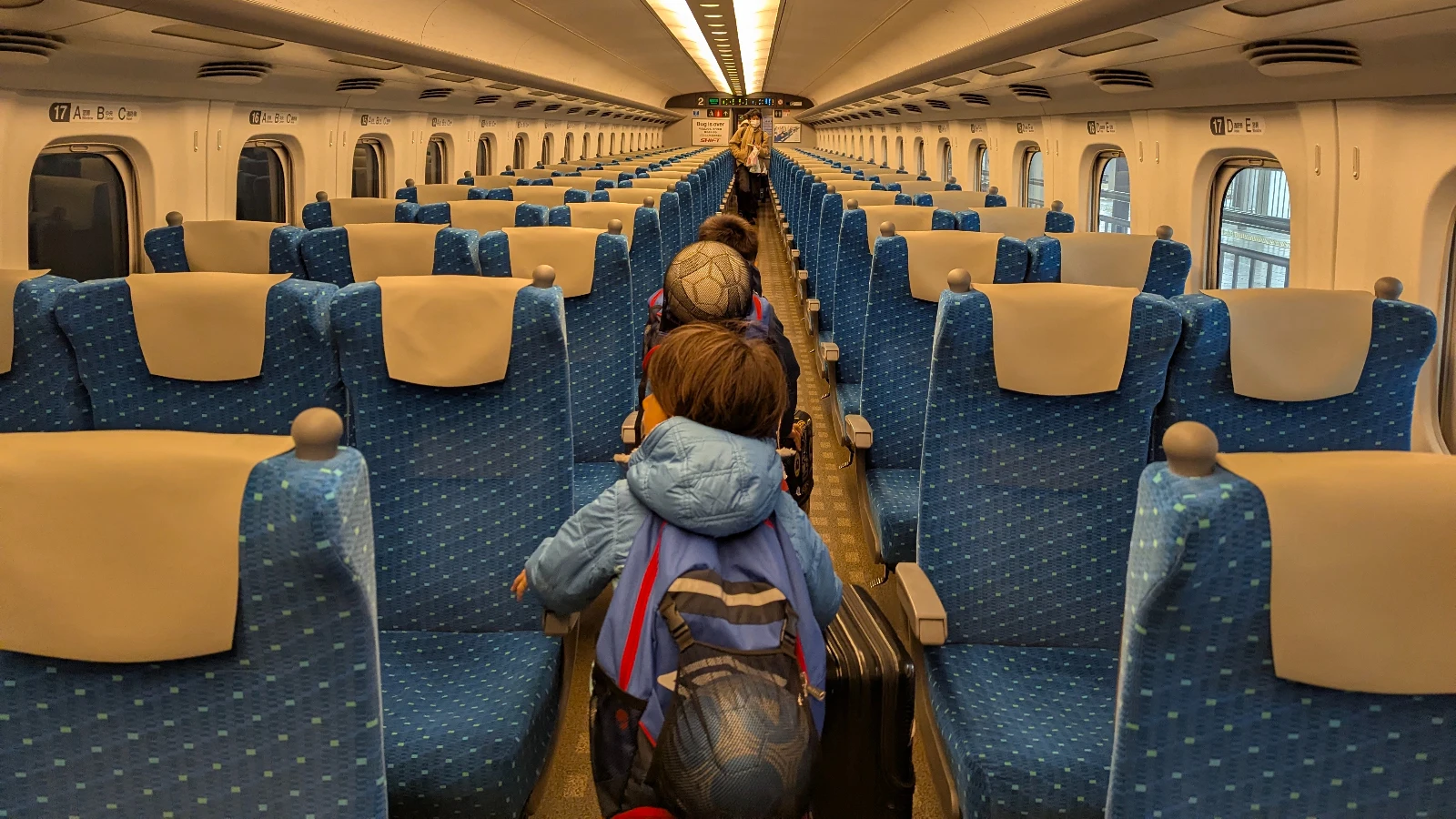
Major Japanese stations are fully accessible in principle, but the path to an elevator is frequently not the obvious one. At large stations like Shinjuku, Shibuya, and Osaka’s Umeda complex, the elevator often sits at the far end of a platform or is reachable only from a specific gate, so a family that enters at the wrong point can face a ten-minute detour to find accessible access.
The most reliable step is checking the station layout in Google Maps before leaving your accommodation. Search the station name and look for the accessibility route overlay: it shows elevator positions, wide-gate locations, and the exit numbers that give step-free access to street level. Doing this for major transfer stations the night before a travel day removes the most common source of in-station confusion. Japanese stations often have dozens of numbered exits, and the wrong one can add a five- to ten-minute walk at street level, so the exit number matters as much as the train line. Screenshot the platform and exit before going underground, where connectivity can be unreliable.
| Station | What to Know | For Families |
|---|---|---|
| ShinjukuTokyo | The world’s busiest station, with 200-plus exits and widely distributed elevators. Use the South or West Gate for the most direct accessible routes. | Plan ahead |
| ShibuyaTokyo | Ongoing redevelopment has shifted elevator and exit routes repeatedly. Verify the current layout before arrival. | Plan ahead |
| Umeda / OsakaOsaka | A multi-operator complex linking JR, Hankyu, Hanshin, and subway lines. Operator transfers require exiting and re-entering paid areas. JR Osaka and subway Umeda are adjacent but not connected within paid areas. | Plan ahead |
| KamakuraKanagawa | Charming and manageable for older children, with elevators from the ticket gates to the platform. | Plan ahead |
| Shinagawa & KyotoTokyo / Kyoto | Linear layouts, clearly signposted elevator access in English, and a manageable number of gates. | Genuinely easier |
ShinjukuTokyo
ShibuyaTokyo
Umeda / OsakaOsaka
KamakuraKanagawa
Shinagawa & KyotoTokyo / Kyoto
If completely disoriented at a large station, follow the signs for taxi stands. They reliably lead to a main street-level exit.
Where to stand, where to sit, and how to stay safe.
Where to stand on a commuter train.
Boarding position is one of the few decisions that cannot be corrected once the doors close. A family managing a stroller, a backpack, and two young children has no room to reposition inside a moving car, so the choice made on the platform shapes the whole ride and exit.
- Near the doors, which shortens exit time and keeps children close to a solid surface.
- Along the interior panel walls at the end of the car, a stable standing point away from the central aisle.
- Keep door openings clear. A stroller or large bag placed centrally creates a bottleneck and makes your own exit harder. Keep bags against the wall or on overhead racks, and set the stroller parallel to the interior panel rather than perpendicular to it.
Seating for families.
Every Japanese train car has priority seating, marked with clear color signage, for elderly passengers, people with disabilities, pregnant riders, and families with young children. Families may use these seats when they are free and should offer them promptly if a qualifying passenger boards. On the Shinkansen, the last row of a car, against the rear bulkhead, or the first row, against the front bulkhead, gives extra floor space that standard seats do not: room for a compact stroller, a large bag, or a toddler who will not stay seated for two hours. Book bulkhead or end-of-car seats through the JR reservation system or the Smartex online service. On commuter trains, bench seating near the doors allows quicker, less disruptive exits across a day of multiple stops.
Platform safety children can learn.
Japan’s trains are safe and reliable, but busy platforms move fast and doors close on a fixed schedule. Teaching the core rules before the first ride, and practicing them at home, produces calmer, more confident behavior at the real station.
- Stay behind the yellow tactile line until the train has fully stopped and the doors have opened.
- Hold hands in crowded concourses and at platform edges.
- Let passengers exit first, standing to either side of the door rather than in front of it.
- Never rush a closing door. The next urban train is typically two to five minutes away.
The most practical preparation is a daily photo: a quick shot of each child at the start of every travel day, showing their outfit, so station staff can assist immediately if a child is separated in a large station. Pair that photo with a two-step plan a child can actually hold onto. First, find a station worker, identifiable by a navy jacket and cap, and say “Eigo onegaishimasu” (English, please). Second, if no station worker is visible, look for a koban, the small police box marked by a blue lamp, found inside or at the entrance of most large stations.
The sequence is what matters. A child given a single instruction freezes when that target is not in front of them. A child given two targets in order keeps moving toward help. This is Reserve protection in miniature: the Anchor depletes through unfamiliarity and unconfirmed structure, and a rehearsed sequence hands even a separated child a confirmed structure to follow, whether that is a younger child who needs the exact words or an older child who needs only the order of the two steps.
Keeping the second half as good as the first.
The Shinkansen genuinely engages most children for the first thirty to forty-five minutes: the speed, the scenery, the bento ritual. A family traveling with a child who tires quickly, who needs predictable structure to stay regulated, or who is under five should treat the second half of a long ride as its own phase, with quiet activities ready to deploy before restlessness sets in rather than retrieved in response to it.
Quiet activities that work.
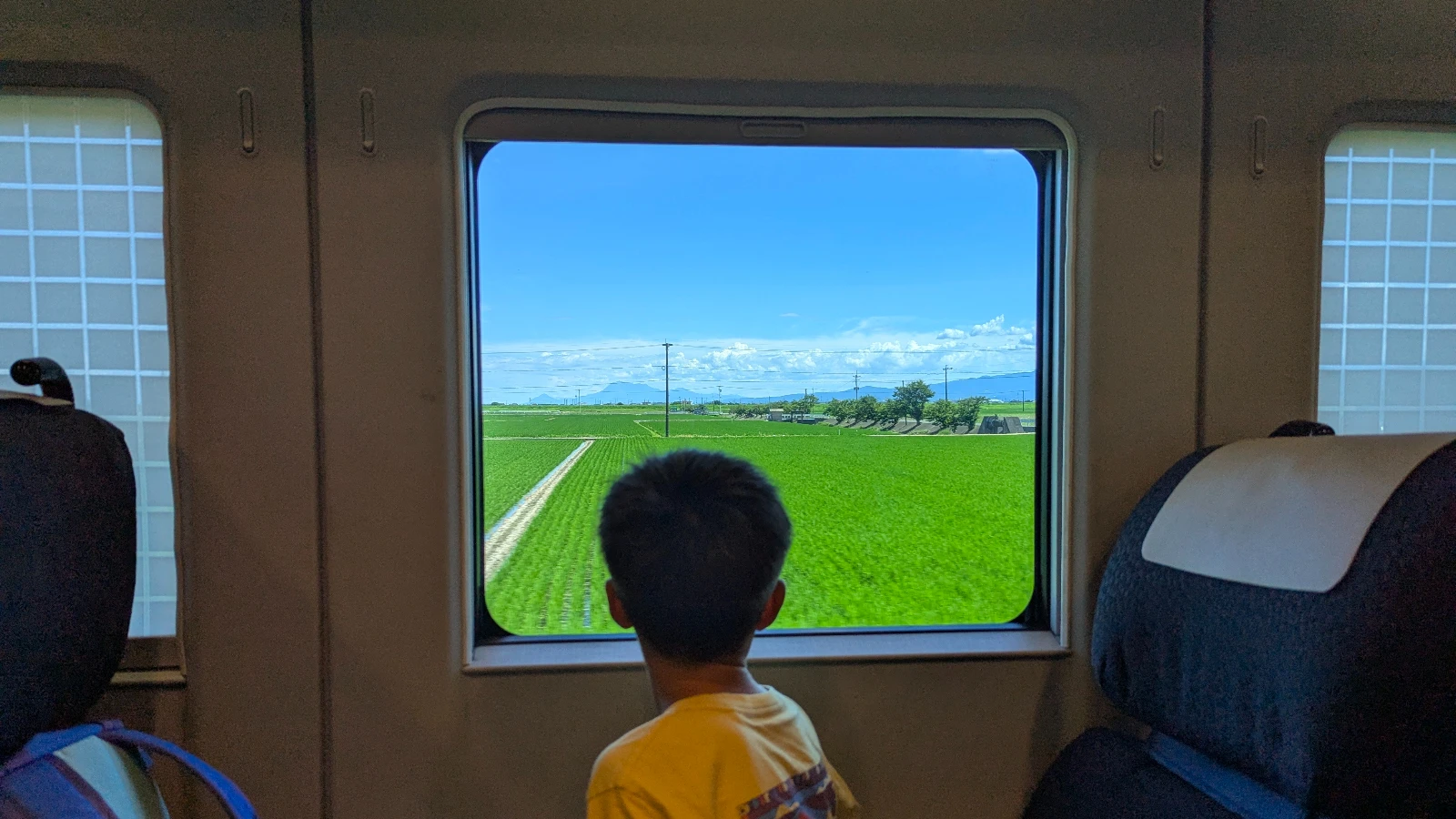
Japanese trains are calm environments. Loud toys, games with audio, and video without headphones are not appropriate on commuter lines and are strongly discouraged on the Shinkansen. The activities that work best are also the lightest to carry: magnetic travel games, sticker books, age-appropriate chapter books, and origami paper. A small pack of origami is one of the highest-value, lowest-weight additions to any family day bag in Japan. Window-watching structured as a game, counting rice fields, spotting a particular color of train, holds a young child’s attention with no equipment at all, and a platform ekiben turns the meal itself into an activity. The combination of a reserved seat, an ekiben, and a window view is one of the most reliably successful thirty-minute intervals of a Japan family trip.
Etiquette the family observes together.
A child who breaks Japan’s transit norms draws more visible attention than they would in most Western systems, not because passengers are unwelcoming to families, but because the baseline noise level is genuinely lower. Framing etiquette as a set of rules the whole family is keeping together, rather than restrictions placed on children, tends to produce better compliance and less friction.
- Voices. Conversations at normal room volume attract attention. Lowered voices are the standard.
- Phone calls. Not made on trains. Silent messaging is fine; calls are taken at the ends of Shinkansen cars or off the train.
- Eating. Standard on the Shinkansen and long-distance limited express trains, discouraged on commuter lines, particularly at rush hour.
- Space. Bags on laps or overhead racks, not on seats. Strollers against walls, not in aisles.
The questions parents actually ask.
Do children need train tickets in Japan?
On JR trains, children under 6 ride free, up to two with each ticket holder aged 6 or over; a third, or one given its own reserved seat, pays the child fare. Children aged 6 to 11 pay half the adult fare, and children 12 and over pay the full adult price. For IC card users, child cards must be issued at a staffed counter.
How do children use Suica or PASMO IC cards in Japan?
Children aged 6 to 11 can use discounted child Suica or PASMO cards, issued at staffed JR ticket counters with the child present for age verification. Children under 6 ride free with an adult and do not need their own card. Once issued, child IC cards work identically to adult cards: tap in, tap out, and reload at any station machine.
Can families bring a stroller on Japanese trains?
Yes, strollers are permitted on all trains in Japan. Position the stroller near the train doors, parallel to the car’s interior wall, not perpendicular in the aisle. Most major stations have elevators. Check Google Maps for accessible route guidance at large stations before traveling, since elevator locations are not always immediately obvious.
Which Japan trains are most engaging for children?
The Shinkansen resonates most strongly with children: the speed, the ekiben culture, and the visible scale of the journey make it memorable. The Hello Kitty Shinkansen on the Sanyo line between Shin-Osaka and Hakata is a specific draw for younger children. For Tokyo-based families, the Yamanote Line loop passes major landmarks and works for a low-pressure sightseeing hour. The seasonal Thomas the Tank Engine train on the Oigawa Railway in Shizuoka requires advance booking.
Is eating allowed on Japanese trains with kids?
Eating on Shinkansen and long-distance limited express trains is standard and expected, and station ekiben are designed for it. On commuter and local lines, eating is generally discouraged. Small, contained snacks are tolerated, but messy or strong-smelling food is not appropriate. Keep this distinction in mind when planning a travel day that mixes Shinkansen and local transit.
Are there bathrooms on Japanese trains?
Shinkansen and limited express trains have onboard restrooms, and most include baby changing facilities. Standard commuter trains do not. Plan toilet stops at major stations before boarding commuter lines with young children. Major stations universally have family restrooms and baby rooms at accessible locations within the paid area.
What should families do if they miss a reserved Shinkansen in Japan?
Go immediately to the nearest staffed JR counter. For reserved seat tickets, station staff can generally rebook the family on the next available departure at no additional charge, subject to seat availability. IC card users on commuter lines face no penalty for missing a train: simply re-enter the gate when ready.
What happens if a child gets lost in a Japanese train station?
Teach children to identify station staff by their navy uniform and cap, and to use the phrase Eigo onegaishimasu (English, please) to signal the need for assistance. Take a daily photo of each child before setting out so staff can assist with identification quickly if needed.