Riding the Shinkansen with Kids:Fares, Seats, and Family Cars.
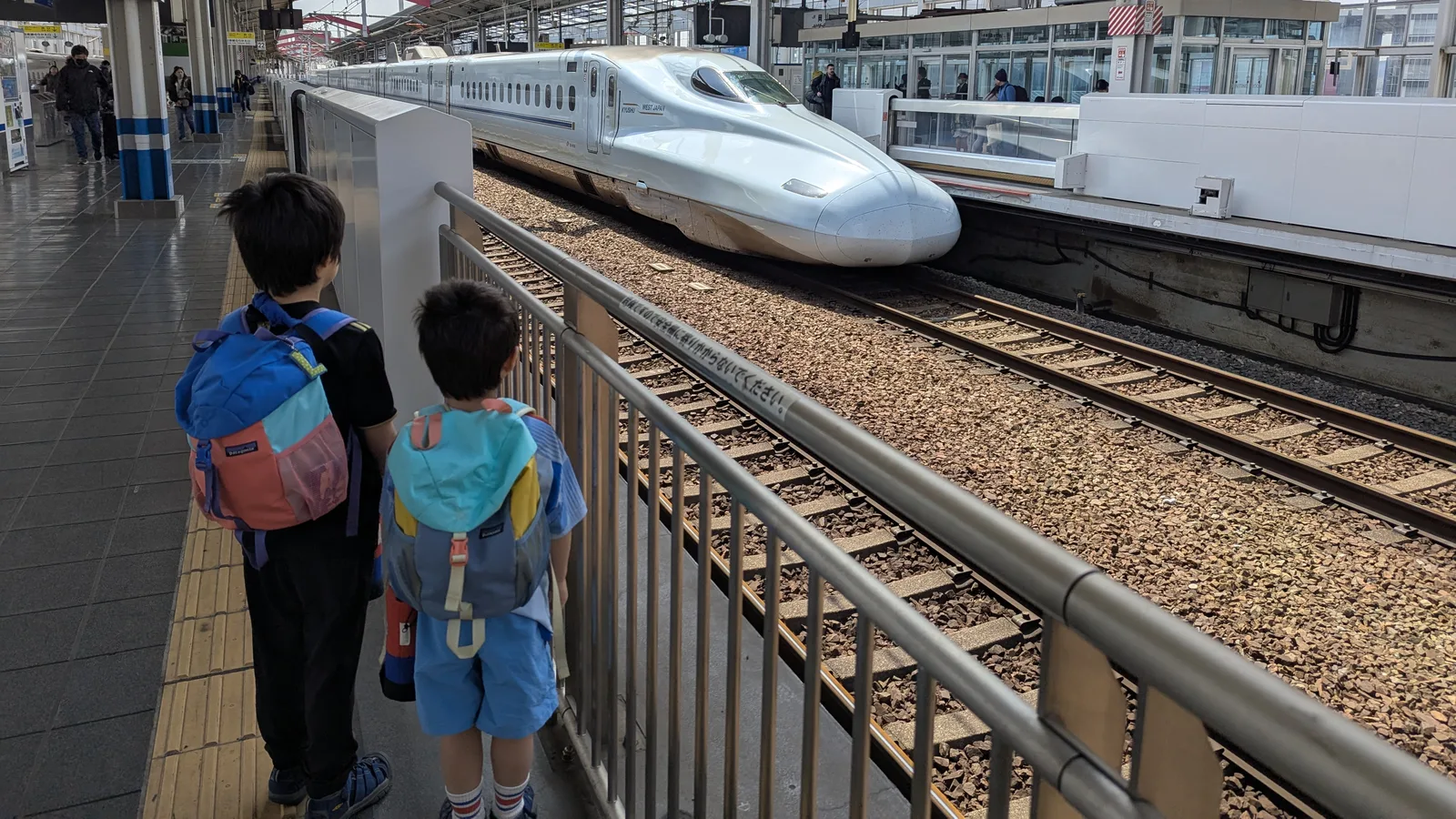
- Child Ticket Age
- Under 6 free; 6 to 11 child; 12 and up adult
- Under 6
- On a parent’s lap, two per ticket holder
- An Own Seat for an Under-6
- Buy a child fare on a long journey
- Family Car
- Announced holiday dates; book 30 days out
- Kids Fare
- Half the adult fare, with a reserved seat
How a family books bullet train seats together from Tokyo to Kyoto, which side of the train faces Mt. Fuji, and when a baby rides free.
Some links on this page are affiliate links. LuNi may earn a commission at no extra cost to you.
On the Shinkansen, children under 6 ride free on a parent’s lap, up to two per ticket holder aged 6 or over; a child aged 6 to 11 rides at half fare with a reserved seat; from 12, every child pays the full adult fare. On a long journey, a child fare buys an under-6 a seat of their own. JR Central sets a car for families with children on some Tokaido Shinkansen Nozomi on holiday dates it announces, booked from 30 days ahead. On a JR Pass, the Hikari is the train to take.
What a child pays, and what they get.
| Age Band | Fare | Seat Rule |
|---|---|---|
| Child (0 to 5) | Free | Parent’s lap, up to two per ticket holder aged 6 or over. Buy a child fare for an own seat on long trips. |
| Child (6 to 11) | 50% of adult fare | Gets their own reserved seat. |
| Adult (12 and over) | Full fare | Gets their own reserved seat. |
Child (0 to 5)
Free
Child (6 to 11)
50% of adult fare
Adult (12 and over)
Full fare
Yes, there is a car only for families with children.
JR Central sets a car for families with children (お子さま連れ車両) on some Tokaido Shinkansen Nozomi between Tokyo and Shin-Osaka, on announced holiday dates. It is an ordinary car set aside for families with children, though other passengers may also be seated in it.
- A judgment-free environment, where a crying infant or a restless toddler generates no friction from surrounding passengers.
- Positioning near restrooms and multipurpose baby-care rooms, with additional stroller storage space.
- Limited seasonal availability. Family Cars run only on the holiday dates JR Central announces in advance.
How to book one.
When reserving online or at station machines during holiday periods, look for the Family Car (お子さま連れ車両) label. These cars sell out extremely quickly. If you are traveling during a holiday, check availability the moment reservations open, typically 30 days in advance.
The booking method matters as much as the timing.
Families have three booking options, and for most international families the method matters as much as when you book. Families who wait until they arrive routinely find the train running but the adjacent seats gone, scattering parents from children. Booking reserved seats around 30 days ahead secures the block, the oversized-baggage area, and the faster Nozomi services before availability closes.
| Method | Pros | Cons | LuNi Verdict |
|---|---|---|---|
| Recommended Klook |
English interface. Accepts Apple Pay, Google Pay, and foreign credit cards. QR code scans at the gate. | Small service fee per ticket. | Best for most families. Minimal friction from start to boarding gate. |
| SmartEX AppOfficial JR | No fees. Choose exact seats on a map. | High failure rate with foreign cards. Registration is complex. | Strong if setup goes smoothly. Frustrating for time-pressed families. |
| Station Ticket Machines | Cash accepted. No advance booking required. | Long queues at peak times. Can overwhelm unfamiliar users. | A reliable backup for last-minute bookings only. |
Best for most families. Minimal friction from start to boarding gate.
SmartEX AppOfficial JR
Strong if setup goes smoothly. Frustrating for time-pressed families.
Station Ticket Machines
A reliable backup for last-minute bookings only.
With Klook, families receive a QR code that scans directly at the gate or exchanges for physical tickets at station machines, bypassing the standard queue.
Check Shinkansen Availability→Which carriage earns its fare for a family.
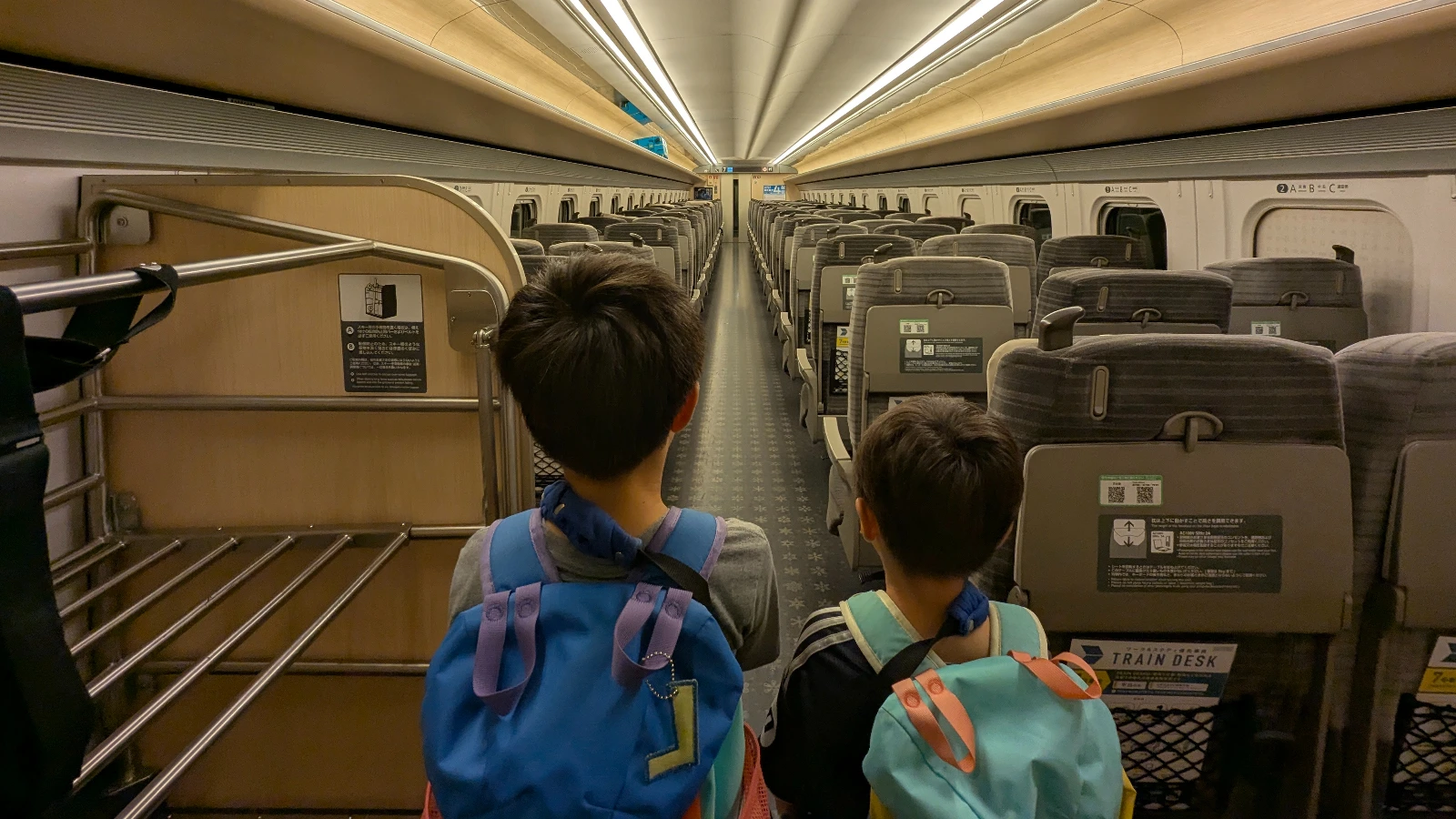
Most Ordinary Cars use a 2+3 layout, two seats on one side of the aisle and three on the other. Green Cars use a wider, quieter 2+2 layout. Gran Class offers 2+1 luxury seating on the Tohoku line, rarely necessary for families.
- Facing seats. Some rows rotate so a family sits facing each other, which works for games, snacks, or a younger child who needs visual contact. Request it at the counter when reserving.
- End-of-car rows. Slightly more space for strollers or bulky carry-ons, and closest to the oversized-baggage area behind the final row.
- Seats near facilities. Placement close to restrooms, vending, or the multipurpose baby-care room, especially practical with infants or toddlers.
| Seat Type | Layout | Best For | Cost |
|---|---|---|---|
| Ordinary CarReserved | 2+3 seats | Most families. The best balance of comfort and cost. | ¥¥ |
| Green Car | 2+2 seats | Longer routes and peak periods. Quieter, wider aisles. | ¥¥¥ |
| Non-Reserved Car | 2+3 seats | Short off-peak trips only. Seating together is not guaranteed. | ¥ |
| Gran Class | 2+1 seats | Parents seeking full comfort on the Tohoku line. | ¥¥¥¥ |
Ordinary CarReserved
Cost ¥¥
Green Car
Cost ¥¥¥
Non-Reserved Car
Cost ¥
Gran Class
Cost ¥¥¥¥
Book seats D or E and start watching about forty minutes after Tokyo. On a clear morning, Mt. Fuji arrives without announcement and is gone within seconds. It registers differently on every child, and it depends entirely on which side of the train you reserved.
Nozomi, Hikari, or Kodama, and what each costs you.
Not all Shinkansen services run the same way, and the distinction matters for JR Pass holders and for families managing a child’s stamina.
| Train Type | Speed | JR Pass | Best For Families |
|---|---|---|---|
| Nozomi | Fastest | Not covered | Families buying individual tickets who need the shortest travel time. |
| Hikari | Very fast | Covered | The best balance of speed, value, and pass compatibility for most families. |
| Kodama | Slowest | Covered | Families who prefer a quieter, less crowded car and have a flexible schedule. |
Nozomi
Shortest travel time, for families buying individual tickets.
Hikari
The best balance of speed, value, and pass compatibility.
Kodama
A quieter, less crowded car for flexible schedules.
For families on a JR Pass, the Hikari is the default on the Tokaido line. The Nozomi is faster but sits outside the pass and needs a supplemental upgrade ticket.
The legs families actually ride.
Flagship adult fares run roughly ¥13,000 to ¥16,500. Ages 6 to 11 pay half; under 6 ride free on a lap. JR Pass holders ride most lines at no extra cost, except Nozomi and Mizuho, which need a supplemental upgrade ticket.
| Route | Train & Time | Adult Fare | Why Families Take It |
|---|---|---|---|
| Tokyo to Kyoto / OsakaTokaido | Hikari, ~2h40 to Kyoto, ~2h55 to Osaka | ¥13,500 to ¥14,500 | The primary family route. Mt. Fuji from seats D and E, right side, about 40 minutes out. |
| Kyoto to HiroshimaSanyo | Nozomi, ~1h40 | ¥11,000 to ¥12,000 | Quieter and less crowded than the Tokaido, a lower-input transit day. |
| Osaka to FukuokaSanyo | Nozomi / Sakura, ~2h30 | ¥15,000 to ¥16,500 | Connects western Japan’s two family hubs, with stops possible at Okayama and Hiroshima. |
| Tokyo to NaganoHokuriku | Kagayaki, ~1h30 | ¥8,000 to ¥9,000 | Short enough to be a day-trip leg from a Tokyo base. |
| Tokyo to KanazawaHokuriku | Kagayaki, ~2h30 | ¥14,000 to ¥15,000 | Lower crowd density on arrival than the Kyoto corridor. |
| Tokyo to SendaiTohoku | Hayabusa, ~1h30 | ¥11,000 to ¥12,000 | The northern gateway. Green Class is available for families who want the extra space and quiet. |
Tokyo to Kyoto / OsakaTokaido
The primary family route.
Kyoto to HiroshimaSanyo
A lower-input transit day.
Osaka to FukuokaSanyo
Western Japan’s two family hubs.
Tokyo to NaganoHokuriku
A day-trip leg from a Tokyo base.
Tokyo to KanazawaHokuriku
Lower crowd density on arrival.
Tokyo to SendaiTohoku
The northern gateway.
When the JR Pass pays off, and when it does not.
The Japan Rail Pass gives unlimited rides on JR trains, including most Shinkansen, across 7, 14, or 21 consecutive days. It does not cover Nozomi or Mizuho. Whether it pays off depends on how far beyond the core legs the network gets used.
| Travel Pattern | Detail | LuNi Verdict |
|---|---|---|
| RecommendedMultiple cities, active itinerary | Unlimited long-distance rides plus local JR lines and day trips, with no per-journey booking decisions. | The JR Pass. Best for families covering real ground. |
| One or two Shinkansen trips | Cheaper and more flexible for a simple route. | Point-to-point tickets. |
| Nozomi trains required | The pass is not valid on Nozomi or Mizuho services. | Point-to-point tickets. |
Multiple cities, active itinerary
The JR Pass. Best for families covering real ground.
One or two Shinkansen trips
Point-to-point tickets.
Nozomi trains required
Point-to-point tickets.
A family of four on a Tokyo to Kyoto to Hiroshima to Osaka route spends roughly ¥112,000 on point-to-point Nozomi tickets. Fourteen-day passes for the same family, two adults and two children between 6 and 11, cost ¥240,000 bought online or ¥252,000 from an overseas agency: more than double the tickets, though the passes also cover every Hikari and Kodama segment, local JR lines, and the unplanned route changes that happen on every family trip.
Etiquette, timing, and the Mt. Fuji window.
Etiquette for families.
The Shinkansen is calm by design, and families are genuinely welcome. Children do not need adult silence, but a few norms apply.
- Voices. Children can talk and ask questions. Encourage indoor voices rather than raised play, and most children adapt quickly.
- Devices. Headphones for any audio. Take phone calls in the vestibule between cars, not from a seat.
- Eating. Eating on board is fully accepted and part of the experience. Ekiben, the regional bento sold at major departure stations, are worth arriving early for. Retain packaging in the bag provided, since onboard bins can be limited.
- Luggage. Store large bags overhead or in the oversized-baggage area behind the last row, with a reservation if a bag exceeds 160 cm in total dimensions. Keep aisles clear.
- Movement breaks. A walk to the vending area works well for a restless child on a long leg. Accompany younger children through the heavy inter-car doors.
The quiet conventions create an unusual opportunity. A child who understands why a space works the way it does, rather than simply being told to behave, tends to choose consideration on their own. A short explanation before boarding, framed around respect for the people around them, often does more than correction during the journey.
Best time to ride.
The most family-friendly window is mid-morning, roughly 9:00 to 11:00 a.m.: calmer trains, less rushed boarding, and the best light for Mt. Fuji on westbound routes. Avoid the 7:00 to 9:00 a.m. and 5:00 to 7:00 p.m. rush on busy corridors. Spring and autumn are the most comfortable seasons. During Golden Week, Obon (mid-August), and New Year, book the moment reservations open.
Where and when to see Mt. Fuji.
Spotting Mt. Fuji is a defining moment of the Tokaido route, and weather is never guaranteed. Knowing the side and the timing removes the uncertainty. Seat letters matter more than car numbers: request D or E.
- Which side. Tokyo to Kyoto / Osaka: right side, seats D and E. Kyoto / Osaka to Tokyo: left side, seats D and E.
- Westbound timing. Nozomi and Hikari: 40 to 45 minutes after Tokyo, after the Shizuoka area. Kodama: about 50 minutes, usually after Atami.
- Eastbound timing. Nozomi: 95 to 105 minutes after Shin-Osaka, shortly after Nagoya. Hikari: 100 to 110 minutes. Kodama: 135 to 150 minutes, usually after Shizuoka.
The questions parents actually ask.
Do kids ride the Shinkansen for free?
Children under 6 ride free without a seat of their own, up to two with each ticket holder aged 6 or over; a third pays the child fare. A child under 6 who needs an own seat can be given one by buying a child fare ticket. Ages 6 to 11 pay half the adult fare, and 12 and over pay full price.
What age is a child for Shinkansen tickets?
Japan uses three bands. Infants and children aged 0 to 5 are free on a lap, 6 to 11 are charged a child fare at half the adult price with their own reserved seat, and 12 and over pay the full adult fare.
Is there a Shinkansen car only for families with children?
Yes. JR Central sets a car for families with children on some Tokaido Shinkansen Nozomi between Tokyo and Shin-Osaka, only on the holiday dates it announces in advance. Look for the Family Car (お子さま連れ車両) label when booking, and reserve the moment availability opens, around 30 days ahead.
Can I bring a stroller on the Shinkansen?
Yes. Strollers must be folded before boarding and stored behind the last row of seats or in the oversized-baggage area. Reserve seats near the rear of the car, where this space is most accessible.
Which Shinkansen is best for families using the JR Pass?
The Hikari on the Tokaido line and the Sakura on the Sanyo and Kyushu lines are the strongest choices. Both are fast, comfortable, and fully covered by the pass. Nozomi and Mizuho services are not included: to ride them on the pass, buy the pass-only NOZOMI MIZUHO Ticket before boarding, for each ride.
Should families upgrade to Green Car seats?
Ordinary Car reserved seats are sufficient for most journeys. Green Car is worth considering for routes over two hours, during peak periods, or for a Sensor-profile child who benefits from the quieter carriage, wider seats, and lower passenger density, since the Sensor depletes through sensory input.
How do I book a seat to see Mt. Fuji?
Reserve a window seat in position D or E traveling westbound from Tokyo, and the same letters for the eastbound return. If booking at a counter, mention the Mt. Fuji view directly and confirm the seat letter, not just the window designation.