Castles in Japan With Kids:what each one asks for.
- Five Under Repair
- Nagoya, Hirosaki, Maruoka, Marugame, Kumamoto
- Outside Only
- Hirosaki: the keep is shut inside until 2033
- Elevators in the Keep
- Kumamoto, strollers included
- Go at Opening
- Himeji Castle, Hyogo
- No Car Gets You There
- Bitchu Matsuyama, Takahashi, Okayama
Some links on this page are affiliate links. LuNi may earn a commission at no extra cost to you.
Fifteen castles across fourteen prefectures are worth a family’s day in Japan, eleven of the twelve original keeps plus four a family is likelier to know, and what separates them is not architecture but state. Five are shut inside, wrapped in sheeting, off their foundations or being put back together after an earthquake: Nagoya, Hirosaki, Maruoka, Marugame and Kumamoto. At those five the building is no longer the thing to see, so settle first whether the day is about getting inside a keep or about being in the place. Kumamoto’s keep has elevators; Himeji is a visit for opening time.
What you will actually find there, this year.
Family travel runs on three currencies, not two. Money and time, plus the child’s Reserve: their finite capacity to absorb what travel asks of them. What separates these fifteen is not architecture. It is state.
One, and you cannot go inside it.
The only Edo keep north of Kanto, standing in a public park in Aomori at the far end of the country. It is shut inside until 2033, and what is left is an outdoor visit on a countdown.
Outside Only, Until 2033: Hirosaki, Aomori.
The keep interior has been closed since November 2025 and stays closed until March 2033, so there is no inside to plan for and no stairs to worry about. What there is instead is rare: the keep stands out in the open with no shed over it while it is returned to its original stone base, and a viewing deck looks straight at the works, with the next two weeks of work set out in advance so a family knows what will be going on that day. The route into the Honmaru is a temporary staircase until about March 2027, so nothing here is step-free, and after the 2028 blossom festival the exterior goes behind a shed with a picture of itself printed on the front.
Four, and they are the four that argue with each other.
Two sit in the same prefecture and could not be less alike: one has lost its keep altogether and the other can have a long line to get into the oldest one in Japan. Of the other two, one will never be adapted for anybody, and one is only open some months.
Ground Floor, Gold Walls, No Phones: Nagoya, Aichi.
The keep is closed on seismic grounds with no reopening date anywhere, so the visit is the Honmaru Goten palace instead: one story, no stairs, shoes off at the door and slippers waiting for anyone in bare feet. It is kept deliberately dim, there is no heating, no cooling and no toilet inside, and phones may not be used, which removes the usual way of occupying a child in a quiet room. Strollers and wheelchairs are both lent at the two gates, which happens nowhere else in Japan, and on Sundays a free hall on the grounds opens with a full-size model of one flight of the lost keep’s front staircase in it, the only part of that building anybody can still climb.
The Wait Is the Visit: Inuyama, Aichi.
Thirty to forty minutes inside the oldest surviving keep in the country, and up to two hours outside it, standing in a poled queue with no booking and no way round. The wait is at least knowable before you leave the hotel, because a live counter and a crowd calendar both run. Inside is six levels once the two basements are counted, and there is no toilet and nowhere to sit down anywhere in the tower.
Nothing Here Will Ever Be Made Easier: Matsumoto, Nagano.
Five connected National Treasure buildings, the oldest six-story keep in the country, and a flat refusal to alter any of it: no lift, no escalator and no barrier-free route will ever be put in, because the keep is protected as it stands. That is the honest frame for the climb, which is about 140 steps at up to 61 degrees with a bag of shoes in one hand, and for the stroller, which is taken at the keep door and held for you. One of the five buildings, the Inui Small Keep, has been shut since 2017 on seismic grounds with no end date, and routine lacquer and wall maintenance runs across the outside of the keep into late autumn 2026.
A Few Weeks Open at a Time: Maruoka, Sakai, Fukui.
A repair running to late 2027 has turned this into the one castle in Japan you cannot assume is open: the interior opens in windows of a few weeks, the windows are set a month ahead and move, there have been stretches with the top floor alone closed, and scaffolding and sheeting go up for spells, so even the photograph from the ground is not guaranteed. It is worth the trouble because it is the only one of the twelve survivors put back together after collapsing completely, and because of the roof, six thousand tiles with a fifth of them stone, 120 metric tons sitting on a three-story building. When the inside is open it holds the steepest stairs in the country, 65 degrees to the second floor and 67 to the third, so the hardest flight is the last one.
Four, and three of them are on everyone’s list already.
The three castles a family has already heard of all sit on the same rail line between Kyoto and Himeji, and at all three the building is not the variable: the hour, the crowd and the ground around it are. The fourth, up on Lake Biwa, is the most completely open castle in Japan, which turns out to be its own kind of demand.

Floors That Give You Away: Nijo Castle, Kyoto.
The palace corridors chirp underfoot, and the noise is the point, because they were built to make a silent approach impossible. A child who meets that as a puzzle to solve gets the best indoor half hour in Kyoto, and a child who meets it unwarned braces for the next sound the whole way along, because the pitch and the timing never settle into anything predictable. The grounds outside are wide and flat, so the running belongs before the palace rather than in it.

The Park Is the Long Part: Osaka Castle, Osaka.
The tower is the photograph and the park is the work, because the walk in from the station is long, open and almost entirely without a bench. For a child with energy to spend, that approach is the best thing about the day and the reason the climb afterwards holds. For a child whose legs are the limit, it is the entire budget gone before the ticket gate, and the road train and the electric car that cross the grounds are the difference between a hard visit and an ordinary one.
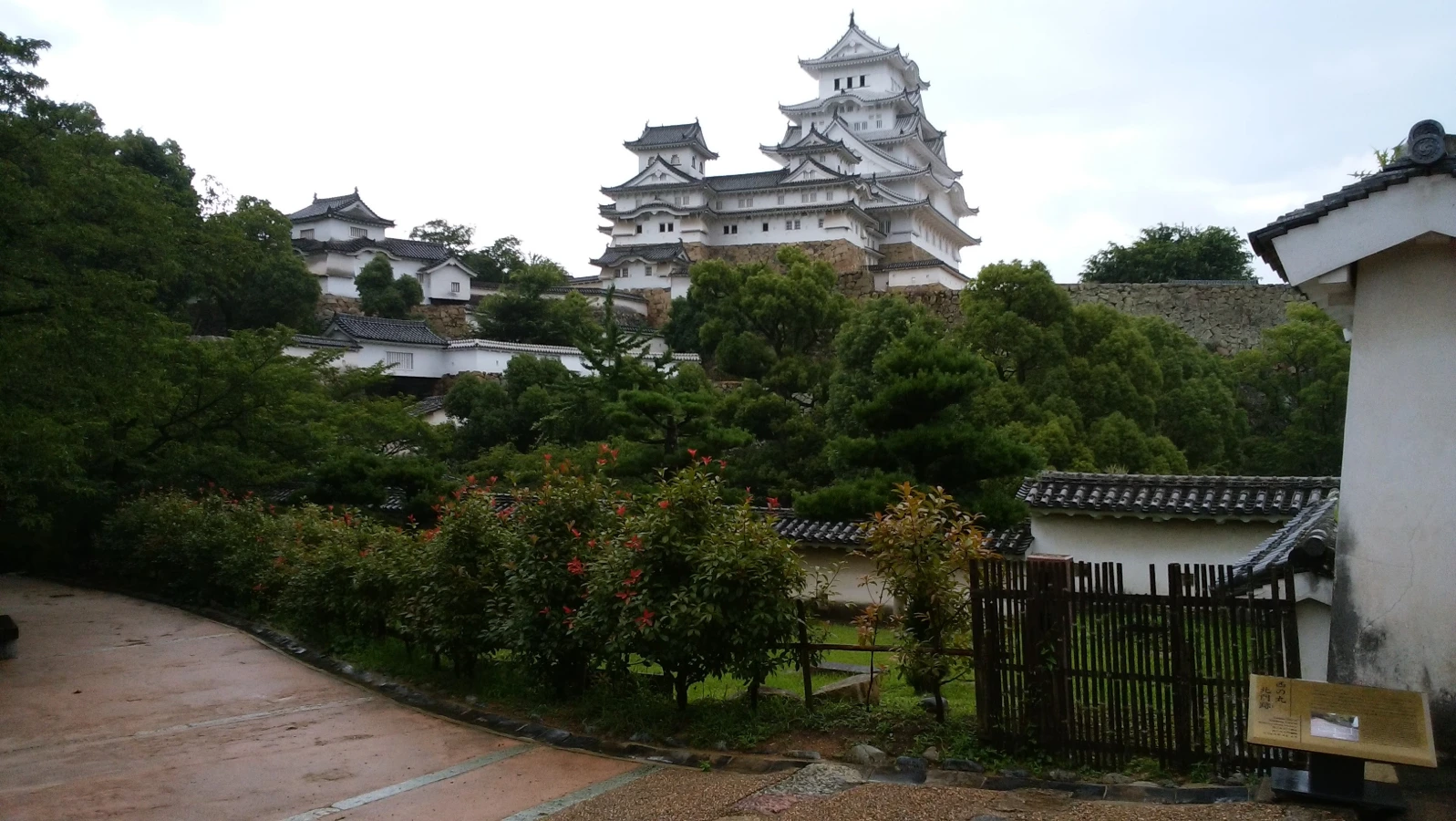
Go at Opening or Not at All: Himeji Castle, Hyogo.
The one castle here where the hour decides everything else. The keep is a fixed route up and back down again, which is exactly the confirmed shape a child who needs the day settled travels best inside, but the ascent narrows to single file and the queue that builds behind it is where the afternoon goes. Arrive at opening and it is a fortress to be figured out; arrive after lunch and it is a stairwell full of strangers, with the standing rather than the climbing doing the damage.
The Whole Castle Is Open, and That Is the Cost: Hikone, Shiga.
Nothing here is scaffolded and nothing is shut: the National Treasure keep, three separate turrets and the stable are all open inside, and each one is entered on its own, so the day is five buildings rather than one. That completeness is what a family underestimates, because on top of the five there is a fifty meter climb up deliberately irregular stone steps that no child can find a stride on, and the tower at the end of it is small and quickly done. Pick two of the five and treat the rest as scenery, or the Reserve is gone before the keep.
Five, and this is where the surviving keeps actually are.
Five castles spread from the Japan Sea coast across the Inland Sea into Shikoku, and not one of them is on a standard first itinerary. One is waiting for a repair that has not begun, one has been rebuilding a collapsed wall since 2018, one has termites, and the other two are as open as they have ever been.
The Repair That Has Not Started Yet: Matsue, Shimane.
Every level of this National Treasure keep is open and nothing is covered, but a large repair to the outside of it is coming and no start date exists yet, which makes the next year or two the window rather than the wait. Admission changed in the summer of 2026 to pay for it, and the change that matters to a family is that primary and middle school children now go in free. Inside, the paulownia stairs are wide enough for an adult and a child to climb together, which is true nowhere else here, and there is a well in the keep, the only one left in a surviving keep in the country.
No Car Gets You There: Bitchu Matsuyama, Takahashi, Okayama.
The highest castle in Japan with its keep still standing, at 430 meters, and the last stretch is a mountain path of loose stone that no vehicle covers. Twenty to thirty minutes of it from the highest parking area, about fifty from the bottom, with sneakers or hiking boots asked for rather than suggested, and a shuttle bus that may simply not run in rain. The keep itself is the smallest of the twelve survivors, two floors, open with nothing covering it, so the whole cost of this castle is the walk in, and the one toilet on the mountain is partway up it.
A Deck Above the Stonemasons: Marugame, Kagawa.
A stone wall came down in 2018 and the rebuild now runs to 2031, which sounds like a reason to skip it and is the opposite: on the flat, free, open every day, there is a hall of stonemasons’ tools and salvaged stones whose roof is a deck looking down on the work itself. A family that never leaves that deck has had a better afternoon than most castle visits deliver, and the keep above is optional. If you do go up, it is twenty minutes on a tree-shaded slope rather than a staircase, with a toilet at the bottom, halfway and at the top.
An 1854 Keep in a 1968 Ring: Matsuyama, Ehime.
The keep is original, the last complete castle building of the Edo period, and every structure joined to it is a 1968 reconstruction, walked through as one continuous interior with an open courtyard in the middle of the ring, which is somewhere to sit down that no other castle here has. Nothing is closed except one day a year for the big clean, so the only real gate is the way up: a ropeway and an open chairlift run side by side on one ticket, the chairlift is for primary school age and above, and neither machine reaches the top. They stop ten minutes short, and those ten minutes are cobbles, a switchback and three raised gate sills, with the chairlift stopping altogether in rain and pushing everybody into one queue.
Keep and Palace, Both Still Standing: Kochi, Kochi Prefecture.
Nowhere else in Japan did the lord’s palace survive beside its keep, and both are open, which gives a family two endings instead of one: the palace at the top is level and original, so a child who has done the climb but will not do the last flight indoors is still inside a real Edo building. Termite work on two of the gates is closing part of the route into the autumn of 2026, though the keep, the palace and the way up from the Ninomaru all stay open through it. The nearest toilet is on the level below the keep rather than at the bottom of the hill, and there is a staffed room at the foot of the climb showing a film about the castle, offered as somewhere to sit and wait.
One, and it is the easiest castle in Japan.
The only castle on this list in Kyushu, and the only one anywhere that a child who cannot climb stairs can get to the top of. It is also still a disaster site, a decade after the earthquake, and that is not an apology.
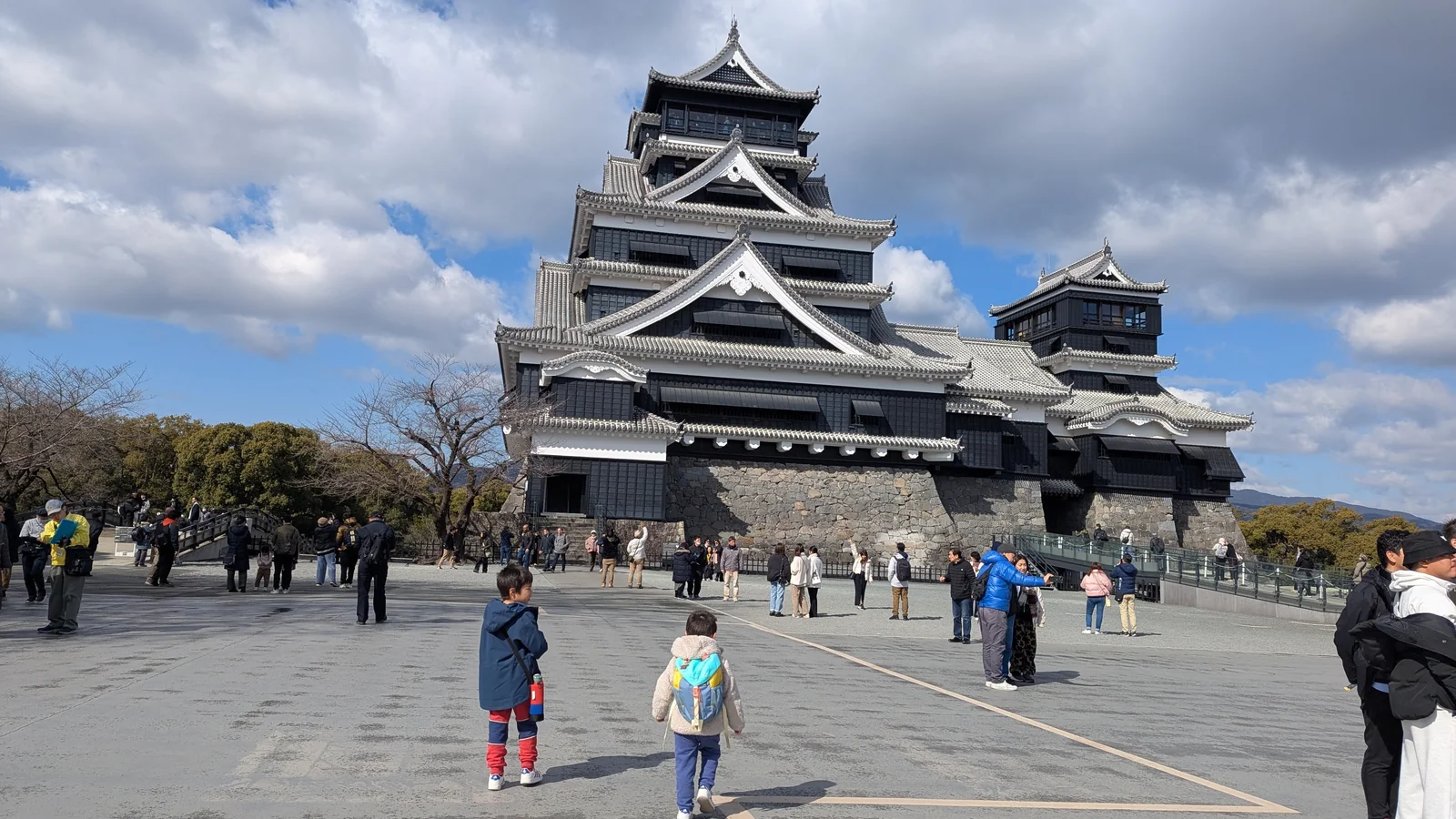
The Only Keep in Japan With a Lift: Kumamoto, Kumamoto Prefecture.
Three elevators run inside the keep and a stroller user is named as eligible to use them, along with whoever is with them, which exists at no other castle in the country. They are inside the keep rather than signposted from the approach, so ask at the door on the way in. The approach is a raised walkway built this century rather than a hill of original stone, the recovery runs to 2052, and the damage is the exhibit: the free children’s leaflets here are about how a stone wall falls down and how it gets put back.
What has to be settled before you go.
Four things will end a castle day before it starts, and none of them is a ticket. A repair calendar that moves, a queue nobody can jump, a shuttle that stops running when it rains, and a piece of help that has to be asked for in advance.
Not whether it is original, but what state it is in.
Castle lists sort by whether the tower is original, and eleven of these fifteen are, which settles nothing a family needs. What decides the day is the condition the castle is in when you get there: whether there is an interior to go into, whether the outside is behind sheeting, whether a repair has put something else in the building’s place, and whether that something is on the flat. Sorted that way the order turns over. The two castles with no keep to climb, Nagoya and Marugame, give a young child the most to do, because a gold palace at ground level and a roof deck over working stonemasons are both easier to be five years old in than any tower. Kumamoto, still a disaster site and still one until 2052, is the most generous castle in Japan for a child, and none of that shows up in a list sorted by age.
The questions parents actually ask.
What are the best castles in Japan to visit with kids?
Start from what is actually open on your dates, because a third of them are not. Kumamoto has elevators inside the keep and is the only one that does. Nagoya has lost its keep, so the visit is a gold palace on the flat. Marugame lost a wall and gained a deck over the stonemasons. Matsue and Hikone are open and complete right now.
Which Japanese castle is best for a child who cannot manage stairs?
Kumamoto, and it is not close. Three elevators run inside the keep, and a stroller user may ride them along with whoever is with them, which is true at no other castle in Japan. The approach is a raised walkway rather than a hill of stone. Nagoya is the flat alternative: the keep is shut and the palace replacing it is one story.
How steep are the stairs inside a Japanese castle?
Steeper than a ladder is comfortable at. Maruoka runs 65 degrees to the second floor and 67 to the third, Hikone 62 degrees on the first flight, and Matsumoto about 61 degrees over roughly 140 steps. A house staircase sits nearer 35 degrees. The rise of each step is large as well as the angle, and that is the part that defeats a short child.
Which castles in Japan are closed or under restoration?
Five of the fifteen, and none is a wasted trip. Nagoya’s keep is shut with no reopening date, so the palace is the visit. Hirosaki’s keep interior is closed until March 2033, with the outside in view until the 2028 blossom festival. Maruoka opens in windows of a few weeks until late 2027. Marugame’s wall repair runs to 2031 and Kumamoto’s recovery to 2052.
Do you have to take your shoes off in a Japanese castle?
At most of the original keeps, yes, and the difference is what you do with them. Matsumoto and Inuyama hand you a bag to carry up the stairs in one hand. Hikone gives you an open rack instead, so your hands stay free. At Matsue the thing to bring is a bag you can wear. At Nagoya’s palace, slippers wait at the door.
How many castles should you visit on one trip to Japan?
Two is plenty, and put a week between them. Fourteen prefectures hold these fifteen and almost none is near another, so the ceiling is set by the map, not by enthusiasm. Repetition is the other half: a child who has climbed one keep reads the next as the same afternoon over again. Take whichever your route already passes and let the rest go.