Best City Views in Japan With Kids:what decides each one.
- Nothing to Buy
- Tokyo Metropolitan Government Building
- The Way Down Is a Slide
- Tsutenkaku
- No Glass Floor
- Fukuoka Tower, enclosed
- A Bypass Around the Glass
- Umeda Sky: Tower East’s elevator instead
- Ask Before You Go Up
- Kobe Port Tower
Japan’s famous landmarks seen from above, from a city deck to a mountain ropeway, and how the way up treats a child on a day trip.
Some links on this page are affiliate links. LuNi may earn a commission at no extra cost to you.
Japan’s best city views for kids are decided less by height than by the way up. Fourteen viewpoints in eight prefectures, nothing ranked and nothing left out, differ in how a family gets up and whether that can fail, what is underfoot at the top, whether the deck has a roof, and small rules about hats, strollers, restrooms and coming back in. Tokyo Tower’s glass floor cannot be avoided; Fukuoka Tower has no glass floor at all; Yokohama Landmark Tower’s Sky Garden is shut until 2028; and at Tsutenkaku the way down is a slide.
Fourteen viewpoints, and the one thing that decides each of them.
Family travel runs on three currencies, not two. Money and time, plus the child’s Reserve: their finite capacity to absorb what travel asks of them. A view from the top is the category where the third one is spent almost entirely on the way up, on a queue, a lift, an escalator or a rule nobody mentioned at the gate.
One thing is worth settling before you start. Decide whether your child can be inside a transparent thing, because the answer changes which of these fourteen are candidates at all. A glass floor, a see-through lift, an escalator crossing open air and a rooftop with no roof are four different exposures rather than four versions of one, and a child who is fine with one of them will refuse another. Settle that once and most of this list sorts itself.
Five, and no two of them ask the same thing.
Four sit inside Tokyo and one is half an hour south at Yokohama. Between them they cover a glass floor you cannot avoid, a glass lift you cannot skip, a roof that bans hats, a free room with a queue, and a deck that is shut.
The Second Lift Is See-Through: Tokyo Skytree, Tokyo.
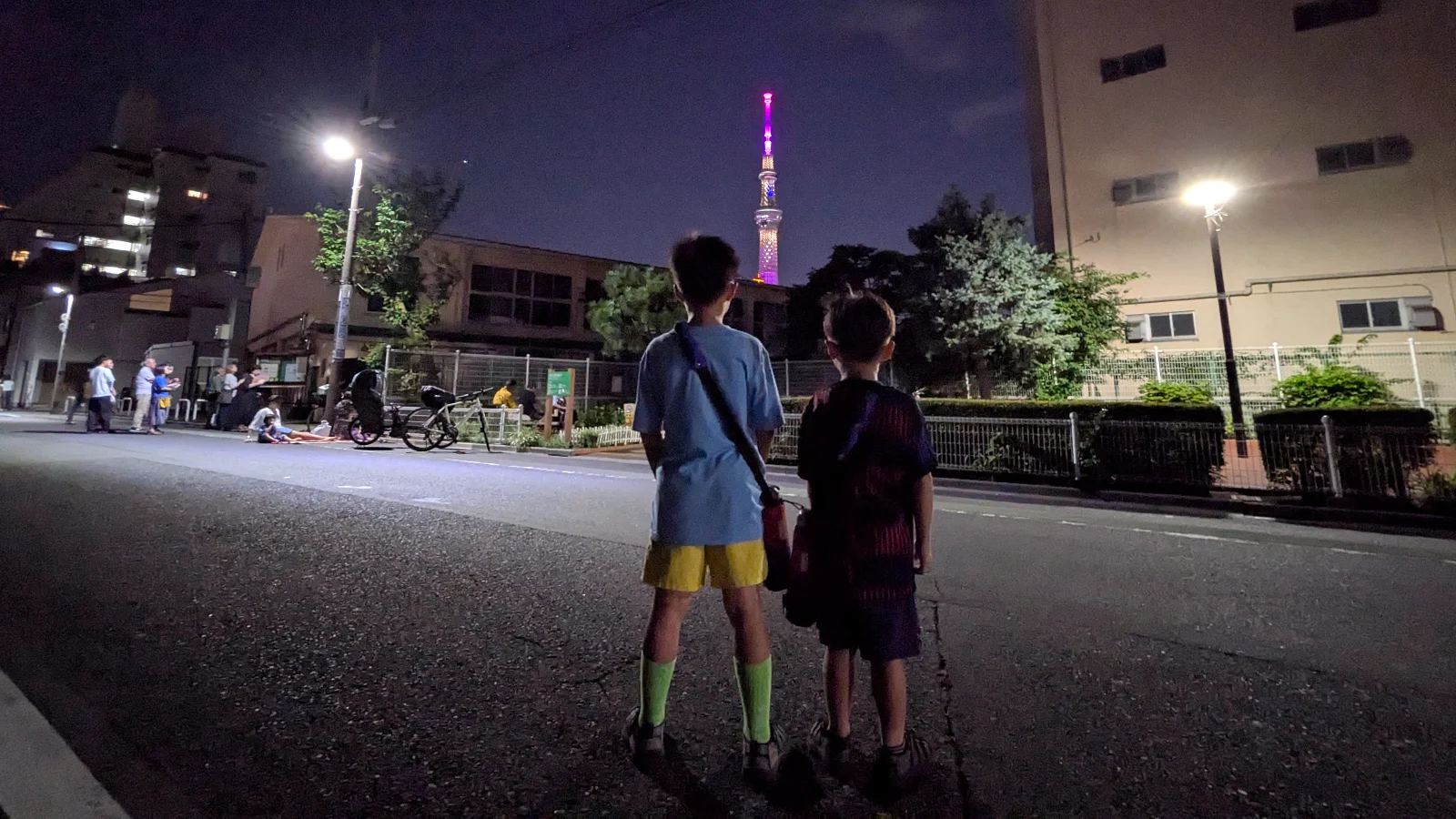
Two lifts, and the second one is glass. The shuttle from the ground to the Tembo Deck at 350 meters takes about fifty seconds behind solid walls, but the only way on to the Galleria at 445 is a see-through cabin, so a child who refuses it stops at 350 and that is the end of it. The upper ticket is bought once you are already up there and can stop being sold while you stand in front of the machine, which makes it the one thing not to promise in advance.
No Way Around the Glass Floor: Tokyo Tower, Tokyo.
The Skywalk Window is a pane of floor you look straight down through, and it sits on the same level as the down lift, so every visitor crosses it on the way out. The alternative to the lift is the 600-step open-air staircase, which closes in rain, in severe weather and whenever a heatstroke alert is issued, so a clear hot day can shut the stairs while the lifts run normally. Walking down is available far more often than walking up, which is the out for a child who will not get back into a lift.
The One With Nothing to Buy: the Tokyo Metropolitan Government Building, Tokyo.
Two observatories at 202 meters, no ticket, no reservation and nothing to forfeit, so a family that lasts four minutes has lost nothing at all. The queue is the price instead: twenty to thirty minutes is the standing wait, and there is no ticket to buy your way past it. The North and South towers close on alternating days of the month, so settle which one you are going to before a child is promised a particular side of the city.
Leave the Hat Downstairs: Shibuya Sky, Tokyo.
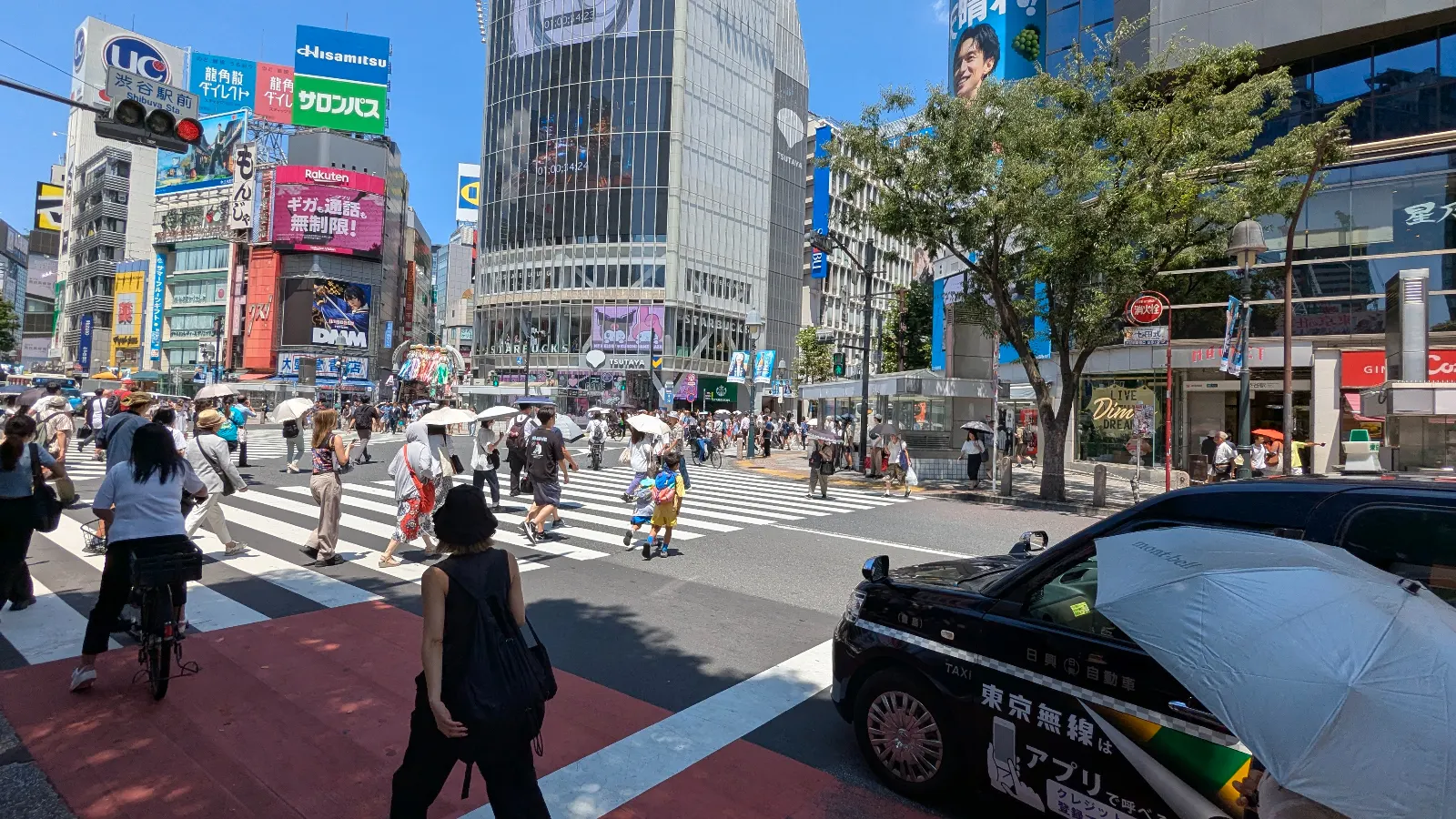
The rooftop at 229 meters is open to the sky, and hats are not allowed up there, knit caps included, because anything loose leaves a roof that high. The roof itself closes without warning in rain, thunder or strong wind, with no refund, and what a family gets instead is the indoor gallery one floor below on the same ticket. Tickets are tied to a single date and released at midnight a fortnight ahead, which rewards a parent who books the moment the window opens.
Shut Until 2028: Yokohama Landmark Tower, Kanagawa.
The Sky Garden on the sixty-ninth floor is closed while the building is refurbished, and the hotel in the same tower is closed alongside it. Nothing firmer than 2028 at the earliest exists for a reopening. It is named here rather than quietly dropped, because it still sits on almost every list of Japanese observation decks and a family that builds a Yokohama afternoon around it finds out in the lobby.
Five, and three of them are in one city.
Osaka holds three, at 300 meters, 173 and 94, and they are nothing like each other. Kyoto has the plainest room in the country at 100 meters, and Kobe has the narrowest tower, with a staircase where the lift should be.
The One You Can Walk Out Of: Abeno Harukas, Osaka.
Three stacked floors at 300 meters: a corridor glazed from floor to ceiling on all four sides, a shop floor with almost nothing to look at, and an outdoor plaza of wooden decking open to the sky through the building’s crown. The one-day ticket allows as many re-entries as you want on the day, which nothing else at this height offers, so a child who has to go down and reset has somewhere to go and a way back. The harnessed edge walk on the outside starts at 145 centimeters, which rules out most children under about eleven.
A Bypass Around the Glass Escalator: Umeda Sky Building, Osaka.
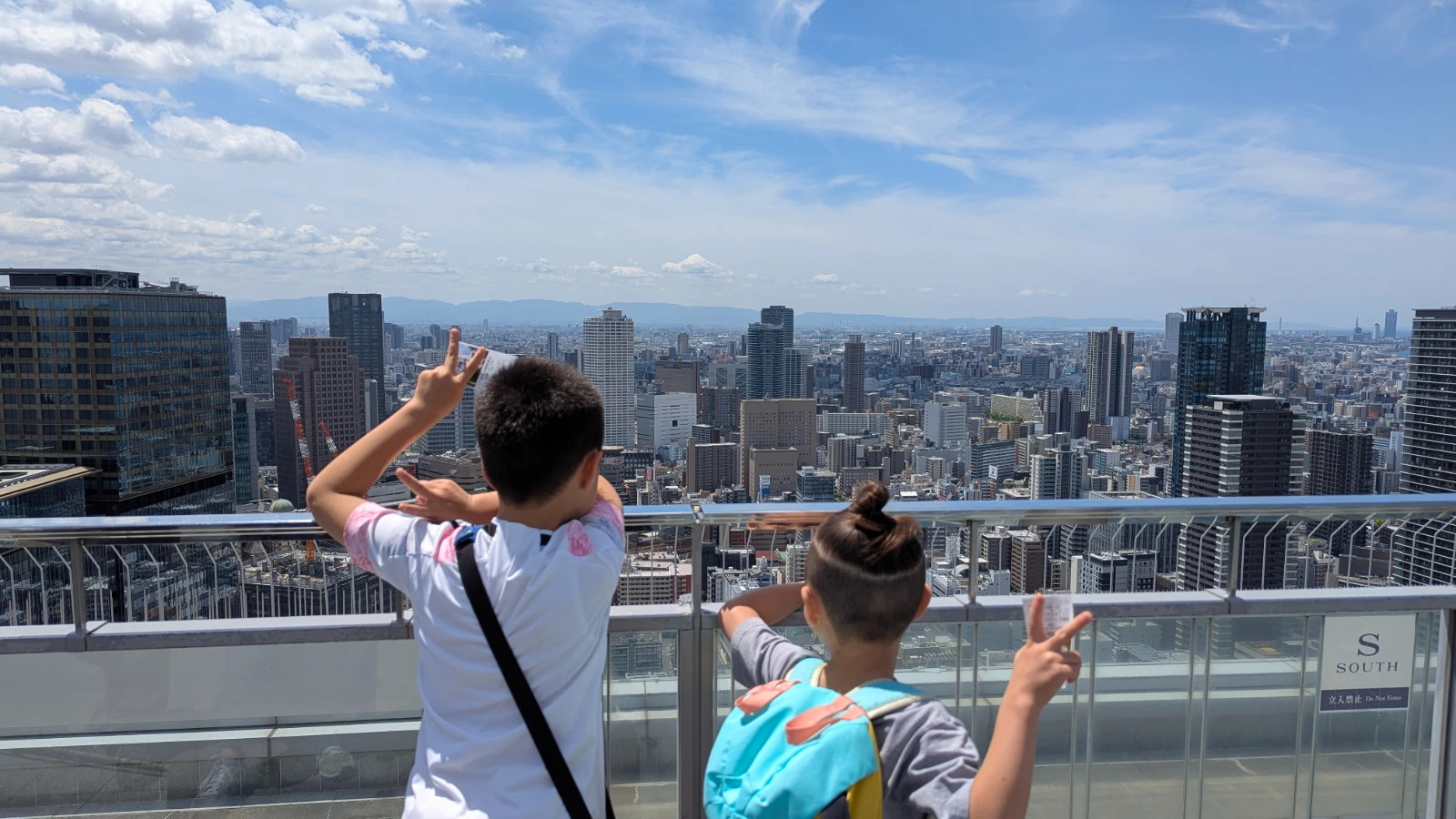
The famous part is the ascent rather than the deck: a forty-five meter see-through escalator crossing open air between the two towers, and it is narrow and steeply inclined. A child who freezes at the foot of it does not have to be carried up, because the high-rise lift in Tower East runs straight to the thirty-ninth floor instead, and that floor is free to reach without a ticket, so the height can be tested before anybody pays. The walkway at 173 meters above it is uncovered, which is why umbrellas are banned up there and the shop sells raincoats.
The Way Down Is a Slide: Tsutenkaku, Osaka.
A sixty meter stainless tube spirals one and a half turns around the outside of the lift shaft, from the third floor to the basement, in about ten seconds. It is barred to anyone under 120 centimeters and to children of six and under, a guardian has to ride for a seven to twelve year old, and everything including a hat goes into a locker first. The floor you pass on the way out becomes a mirror ball and hard lighting after dark, and that one is not optional.
One Toilet at the Top: Kyoto Tower, Kyoto.
The observation room holds about 400 people and has a single unisex toilet, so the toilet stop belongs downstairs, before the lift rather than after it. Everything else here is unusually forgiving: nothing to book, no timed entry, no limit on how long you stay, and most families are finished in fifteen to thirty minutes. It is an enclosed round room at 100 meters with free telescopes, and a tannoy that reaches the whole floor if a child wanders off in it.
Ask Before You Go Up: Kobe Port Tower, Hyogo.
The lift runs between the ground and the decks and nothing else, so the five observation floors are walked down a staircase and the rooftop above them cannot be reached any other way. Strollers, buggies and suitcases are barred from those floors because the walkways are very narrow, which means a child who still needs wheels is carried through the whole tower. Anyone who cannot manage the stairs can have staff switch the lift to manual operation, but that has to be arranged on the ground floor, before you go up.
Two, and one of them is a mountain.
One is a seaside tower with no glass floor, no open deck and a bed beside the lift. The other is a city mountain where the view is free and only the machines charge, and one of those machines is currently out.

No Glass Floor and No Open Air: Fukuoka Tower, Fukuoka.
For the child who wants to know before they get into the lift, the answer at Fukuoka Tower is no: there is no glass floor, and all three observation levels, at 116, 120 and 123 meters, are enclosed. A member of staff rides up with you and there is no change halfway, and a first aid room with a bed sits beside the boarding point, available to anyone who asks and needs to lie down. There is no toilet in the observatory and no re-entry, so the ground floor is the last stop before the lift.
Eight Hundred Meters on Foot: Mount Inasa, Nagasaki.
The ropeway from the foot of the mountain is running and takes about five minutes, in a thirty-one person cabin whose glazing carries up into the ceiling on the mountain side. The slope car from the mid-slope parking lot is a different machine going to a different place, and a family that drives to that parking lot can ride it or take an 800 meter path, about fifteen minutes on foot. The view costs nothing, the rooftop terrace is open around the clock, and the mid-slope parking lot is locked at ten at night, which is the trap.
Two, and the cold is part of the queue.
The lowest deck in this guide and the one with the longest wait, three hours apart by train. In both places the thing to plan around is where a family is standing while it waits, not what it sees at the end.
Two Visits, One Ticket: Sapporo TV Tower, Hokkaido.
Re-entry is refused, and the answer to that is a day-and-night ticket that buys two separate ascents in one purchase, which is how to attempt a short first visit with a child who may not last. The deck sits at 90 meters, one lift, about sixty seconds, and it is the lowest viewpoint of the fourteen. There is no toilet on the deck and no accessible toilet anywhere in the building, so the third floor is where a family sorts itself out before going up.
Past Twenty Minutes You Wait Outside: Mount Hakodate, Hokkaido.
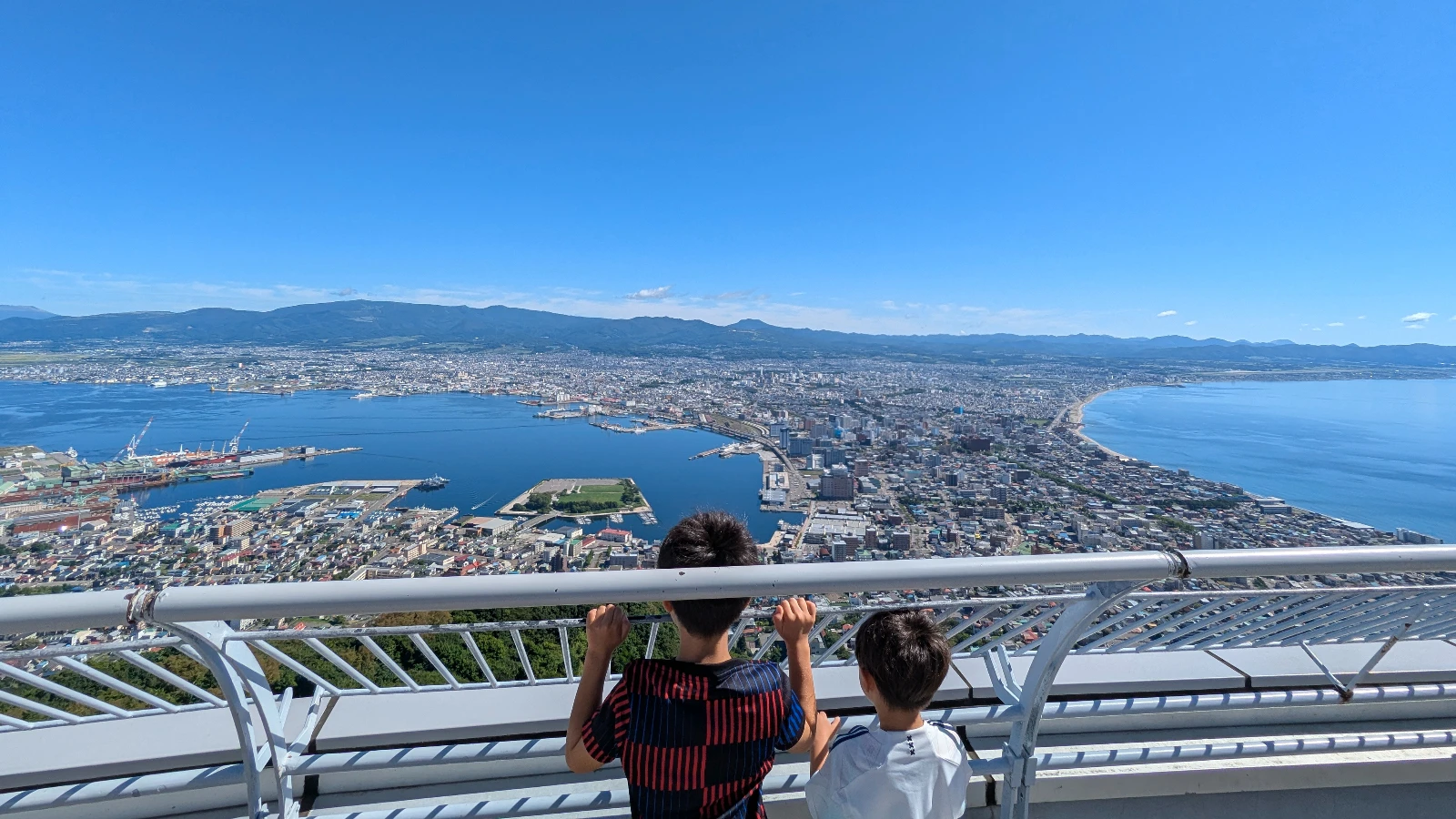
Once the boarding queue passes twenty minutes it moves outdoors, at the bottom going up and at the summit coming down, on a Hokkaido mountain top after dark. At peak the wait up runs beyond half an hour and the wait down can reach an hour, and the peak is the hour either side of the night view arriving. The summit is reachable by road as well as by cable, so the view does not depend on one machine, though the mountain road itself shuts to vehicles from mid-November to mid-April.
What has to be settled before you go.
These fourteen sit at four completely different points on the booking scale, from nothing to buy at all to a fifteen-minute window you forfeit by being late. Knowing which one you are dealing with is most of the planning.
Not height, not the view, and not what the ticket costs.
Towers are sorted by how tall they are and how famous they are, and neither predicts the hour a family actually has. What decides it is the ascent and the transparency: whether the way up can fail, and whether there is something a child can see through that they cannot walk around. A lift queues but rarely stops, a ropeway stops in wind, an open roof closes without warning, and a slope car can be out for months. Sorted that way the tallest stop winning, and a free room in Shinjuku with a twenty minute queue turns out to be one of the easiest afternoons in the country.
The questions parents actually ask.
What is the best city view in Japan with kids?
Which one is best depends entirely on the child, so each of the fourteen here carries the single fact that decides it. The Tokyo Metropolitan Government Building is free, with nothing to forfeit. Abeno Harukas is the one you can walk out of and come back into. Fukuoka Tower has no glass floor. Shibuya Sky is an open roof that closes without warning.
Which Japanese observation deck has a glass floor?
Tokyo Tower and Tokyo Skytree, and they are not the same problem. Skytree’s panel is two meters by three on Floor 340, and it can be avoided by staying on 345 or 350 instead. Tokyo Tower’s Skywalk Window sits on the same floor as the down elevator, so every visitor crosses it on the way out. Fukuoka Tower has none at all.
Is there a free observation deck in Japan?
Yes, two of them. The Tokyo Metropolitan Government Building has two observatories at 202 meters with no ticket and no reservation, and the trade is a standing twenty to thirty minute wait. Mount Inasa in Nagasaki charges only for the ropeway: the summit, the observatory and the rooftop terrace that stays open around the clock cost nothing to anyone who walks or drives up.
Can you take a stroller up a Japanese tower?
It varies more than parents expect. Fukuoka Tower takes a stroller onto the deck and will also mind it for you. The Tokyo Metropolitan Government Building lets a stroller and a suitcase stay with you. Kobe Port Tower bans wheels from the observation floors, because the walkways are very narrow, and there are five floors of stairs above the elevator.
Which observation decks in Japan are open to the sky?
Five of the towers here, and both mountain summits. Shibuya Sky’s rooftop at 229 meters, the Umeda Sky Building’s uncovered walkway at 173, the wooden-decked plaza at Abeno Harukas, Tsutenkaku’s outdoor ring with its cantilevered glass tip, and Kobe Port Tower’s glass-sided crown. Umbrellas are banned on two of them, for the plain reason that a dropped one falls a long way.
How long does a tower visit take with children?
Between fifteen minutes and half an afternoon, and the line decides it rather than the deck. Kyoto Tower runs fifteen to thirty minutes, Fukuoka Tower about forty-five, and Tokyo Skytree about an hour, or an hour and a half if you add the upper deck. At Mount Hakodate at sunset the descent alone can take an hour, standing outdoors.