Japan Rail Pass for Families:Official 2026 Prices and Worth.

- 7-Day Ordinary Price
- ¥50,000 adult, ¥25,000 child aged 6 to 11
- 14 and 21 Days
- ¥80,000 and ¥100,000 adult; child half
- Child Rule
- 6 to 11 half; under 6 free if no reserved seat
- Green Car
- ¥70,000, ¥110,000, ¥140,000 for an adult
- Worth It for a Family
- Not on Tokyo, Kyoto and Osaka; buy tickets
Some links on this page are affiliate links. LuNi may earn a commission at no extra cost to you.
An adult Ordinary Japan Rail Pass costs ¥50,000 for seven days, ¥80,000 for fourteen and ¥100,000 for twenty-one. Children aged 6 to 11 pay half, and up to two under-6s per ticket holder aged 6 or over ride free unless given their own reserved seat. For most families the math no longer works in the pass’s favor. On the classic Tokyo, Kyoto and Osaka route, separate Shinkansen tickets cost less and can use the faster Nozomi, which the pass does not cover; on JR’s own fares, the pass won 1 of 20 model trips. Book seats the day reservations open, one month ahead.
The official 2026 prices, adult and child.
| Pass | Adult (12+) | Child (6 to 11) | Green Car (Adult / Child) |
|---|---|---|---|
| 7-Day Pass | ¥50,000 | ¥25,000 | ¥70,000 / ¥35,000 |
| 14-Day Pass | ¥80,000 | ¥40,000 | ¥110,000 / ¥55,000 |
| 21-Day Pass | ¥100,000 | ¥50,000 | ¥140,000 / ¥70,000 |
7-Day Pass
14-Day Pass
21-Day Pass
What the pass covers, and what it does not.
The Japan Rail Pass is available only to international travelers entering Japan on a Temporary Visitor visa. Coverage is broad but not unlimited, and coverage confusion is one of the most common reasons families overpay. Many arrive assuming the pass works everywhere, then discover that city subways, private rail lines, and the fastest Shinkansen services all require separate tickets.
What it covers.
- Unlimited rides on most JR-operated trains, including Shinkansen (Hikari, Sakura, and Kodama), limited express, rapid, and local JR lines.
- Select JR buses and the Miyajima Ferry.
- The Narita Express from Narita Airport and the Tokyo Monorail from Haneda to Hamamatsucho.
What it does not cover.
- Tokyo Metro, Osaka Metro, and other city subways, plus most city bus networks.
- Private railway lines commonly used for popular day trips.
- The Nozomi and Mizuho services, the fastest trains on the Tokaido and Sanyo lines. Using them with a pass requires the pass-only NOZOMI MIZUHO Ticket, bought before boarding for each ride.
One rule trips up families more than any other: the pass cannot be shared. Each traveler aged 6 or over, a child of 6 to 11 included, requires their own pass, and JR staff may request passports to verify ownership. For all city subway travel, load an IC card (Suica, Pasmo, or ICOCA) instead.
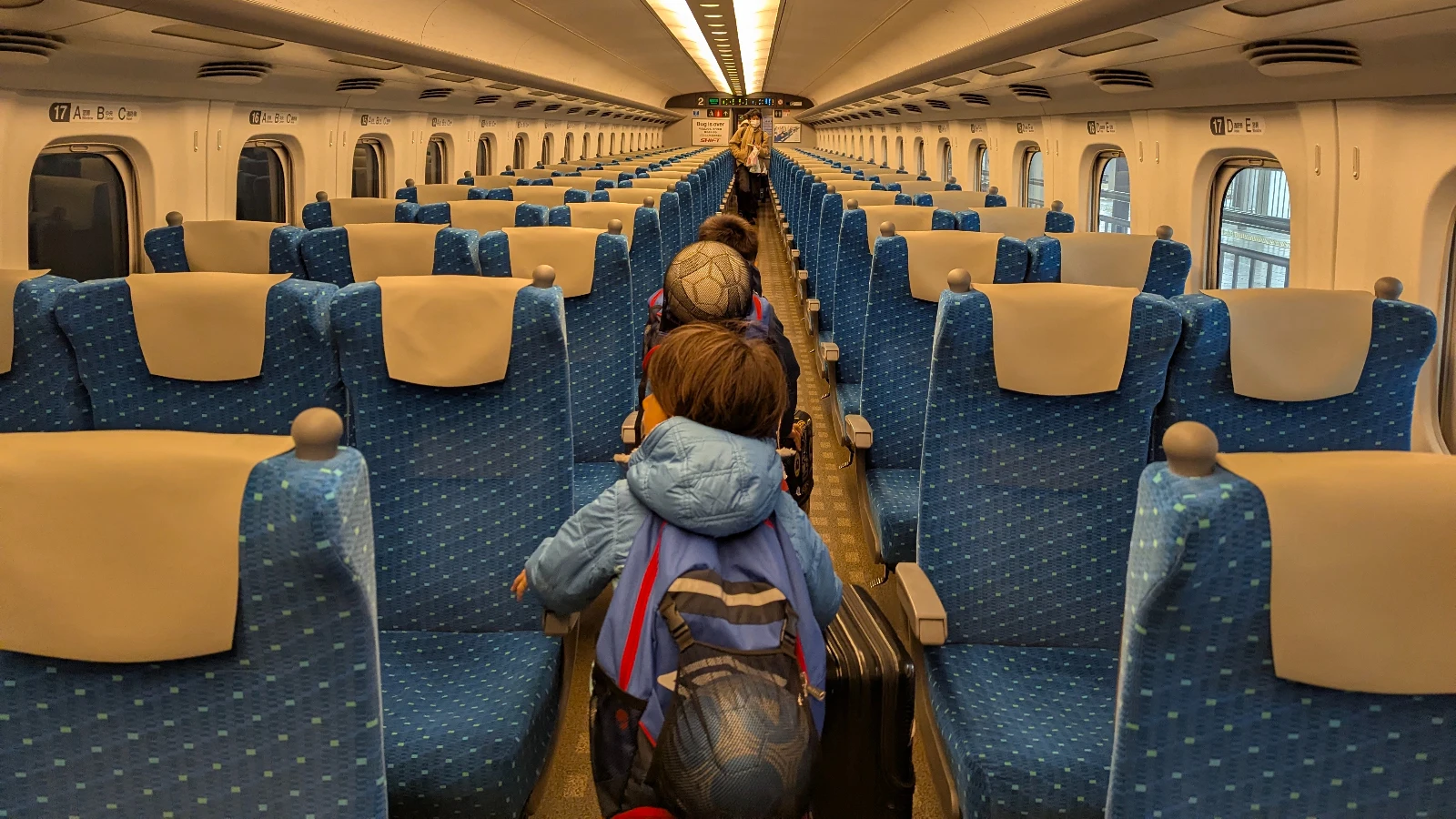
Shinkansen seat reservations open exactly one month before travel, and on popular routes the rows of three and four adjacent seats are the first to go. Book the moment they open. A family that waits until arrival often finds the only choice is sitting apart from young children for a two-hour journey or waiting for a later train, an avoidable strain on everyone.
The math first, then the pacing.
For most families the honest answer is no. The nationwide pass is now poor value for standard itineraries built around Tokyo, Kyoto, and Osaka, and the reason is not only the fare.
Consider a family of four (two adults and two children, ages 8 and 12) traveling the classic loop: Tokyo to Kyoto to Hiroshima to Osaka and back to Tokyo. Individual tickets for that route cost roughly ¥178,000. The equivalent 14-day pass for the same family runs about ¥280,000, a difference of around ¥102,000 in favor of individual tickets, and those tickets also allow the faster Nozomi services the pass does not cover.
The nationwide pass earns its price in one scenario: long distances across several regions inside one pass window. Of 20 model trips costed on October 2026 JR fares, it won only on a 14-day loop of eight stops from Narita to Himeji and back, and a four-city trip of seven or ten days cost less in separate tickets. On every other model trip, the pass cost more. For the standard Tokyo-Kyoto-Osaka trip, point-to-point Shinkansen tickets are the cheaper choice, and they include the faster Nozomi services the pass does not cover.
Check Shinkansen Ticket Availability→The choice is also a pacing decision, and this is where the third currency of travel comes in. Money and time are the two currencies parents already track. The third is the child’s Reserve, their finite capacity to absorb what travel asks of them. A pass that saves nothing but encourages a family to keep moving to justify it spends that Reserve fast. The LUNI Framework reads the decision through how a child depletes.
The Dynamo depletes through restricted movement. A nationwide pass rewards long seated transit legs and tight city-to-city hops, exactly the still, confined hours this child has no channel to discharge. The planning consequence is to favor a slower, regional-pass itinerary with fewer transfer days and more open, high-movement ground between them, whether that is a younger Dynamo who needs a park before lunch or an older one who needs a real walk, not another platform wait.
The Sensor depletes through sensory input. More long-distance legs mean more crowded concourses, more packed platforms, and more time in the densest, loudest parts of the rail system before the day’s real plan even begins. The planning consequence is to limit transfer-heavy days and build in quiet recovery: a reserved Green Car on a long leg for a younger Sensor near threshold, or a planned low-stimulation afternoon after a travel morning for an older one.
The Anchor depletes through unfamiliarity and unconfirmed structure. Frequent base changes, the pattern a nationwide pass quietly encourages, mean a new station, a new hotel, and a new routine every few days, which is precisely what unsettles this child. The planning consequence is to anchor on two or three cities and confirm the route out loud in advance, so a younger Anchor knows where they sleep tonight and an older one can see the shape of the whole trip before it starts.
The Sprinter depletes through sustained travel-style walking and standing. The hidden cost of any unlimited pass is that it tempts a family into one more city because the transit is already paid for, and every added city is more station walking, more standing in line, more luggage hauled across concourses. The planning consequence is to count walking legs rather than fares: keep transfer days few for a younger Sprinter who tires on the platform, and give an older one seated recovery built into the route rather than a fourth stop nobody’s legs asked for.
The regional passes worth a family’s money.
Regional passes are built around how families actually travel: anchored in one area, taking day trips, moving at a pace that keeps everyone comfortable. Start with the travel pattern, then match the pass.
| Your Family’s Travel Pattern | Why | LuNi Verdict |
|---|---|---|
| RecommendedBased in one or two cities with day trips | Covers the day-trip radius most first-time families actually use, at a fraction of the nationwide price. | A JR Regional Pass. Best value for the standard first visit. |
| Staying within one regionKansai, Kyushu, Hokkaido | One coverage zone, one pass, no nationwide premium. | A JR Regional Pass. |
| Multiple regions in 7 to 21 consecutive days | Across 20 model trips, it came out cheaper than separate tickets once: 14 days, eight stops. | Usually individual tickets. Price the nationwide pass against your route. |
| A direct run, Tokyo to Kyoto | Cheaper as point-to-point, and includes the faster Nozomi the pass does not cover. | Individual tickets. |
Based in one or two cities with day trips
A JR Regional Pass. Best value for the standard first visit.
Staying within one regionKansai, Kyushu, Hokkaido
A JR Regional Pass.
Multiple regions in 7 to 21 days
Usually individual tickets. Price the nationwide pass against your route.
A direct run, Tokyo to Kyoto
Individual tickets.
Kansai, Hiroshima, and Central Japan.
Kansai anchors the majority of first-time family itineraries, and these passes are built around its day-trip patterns. For a direct Tokyo-to-Kyoto run, individual tickets are cheaper and add the Nozomi the pass does not cover.
| Pass | Main Areas Covered | Duration | From (Adult) |
|---|---|---|---|
| JR West Kansai-Hiroshima Pass | Kansai plus Hiroshima, Miyajima, Okayama, Kurashiki | 5 days | ¥17,000 |
| JR Kansai-Hokuriku Area Pass | Kansai plus Kanazawa, Fukui, Toyama, Wakura Onsen | 7 days | ¥19,000+ |
| JR Setouchi Area Pass | Osaka, Okayama, Hiroshima, Onomichi, Takamatsu, Shimanami Kaido | 7 days | ¥22,000 |
| JR West All Area Pass | Osaka, Kyoto, Hiroshima, Okayama, Kanazawa, Hakata | 7 days | ¥26,000+ |
| JR Takayama-Hokuriku Area Pass | Nagoya, Takayama, Kanazawa, Toyama, Shirakawa-go | 5 days | ¥19,800+ |
JR Takayama-Hokuriku Area Pass
¥19,800+Tokyo and Eastern Japan.
For families based in Tokyo, these passes unlock the most popular day-trip destinations without a full nationwide commitment.
| Pass | Main Areas Covered | Duration | From (Adult) |
|---|---|---|---|
| JR Tokyo Wide Pass | Tokyo, Nikko, Karuizawa, Mt. Fuji, Gala Yuzawa | 3 days | ¥16,000 |
| JR EAST PASS | Sendai, Aomori, Nagano, Niigata, and Nikko on some Tobu trains | 5 consecutive days | ¥35,000 |
| JR Hokuriku Arch Pass | Tokyo to Osaka via Kanazawa, Kyoto, Toyama, Nagano | 7 days | ¥35,000 |
Kyushu, Hokkaido, and Shikoku.
Kyushu pairs volcanic landscapes, historic cities, and some of Japan’s best onsen towns within a compact rail network. Hokkaido and Shikoku reward families willing to venture beyond the standard circuit, with wide-open landscapes and lower crowds. The JR Kyushu Rail Pass (All Kyushu) price below is the counter and travel-agency price; booked on JR Kyushu’s official online site, it costs ¥1,000 less.
| Pass | Main Areas Covered | Duration | From (Adult) |
|---|---|---|---|
| JR Kyushu Rail Pass (All Kyushu) | Fukuoka, Beppu, Kumamoto, Kagoshima, Nagasaki | 3, 5, or 7 days | ¥22,000+ |
| JR Sanyo-San’in Area Pass | Osaka to Hakata, Okayama, Tottori, Yamaguchi | 7 days | ¥23,000 |
| Hokkaido Rail Pass | Sapporo, Hakodate, Furano, Asahikawa, Wakkanai | 5 or 7 days | ¥22,000+ |
| JR All Shikoku Rail Pass | All of Shikoku Island | 3 to 7 days | ¥12,000+ |
JR Kyushu Rail Pass (All Kyushu)
¥22,000+Three questions that decide the right pass.
Once the travel pattern points to a regional pass, three questions confirm which one.
- Does your itinerary fit inside the coverage zone? Most regional passes operate within a defined geographic boundary. Confirm every stop on your route falls inside it before purchasing.
- Does the pass duration match your actual travel days? Regional passes come in 3, 4, 5, or 7-day forms, and some use a flexible activation window rather than consecutive days. Choose based on how many active travel days your itinerary genuinely requires.
- Which train types are included? Coverage varies. Some passes include Shinkansen (excluding Nozomi and Mizuho), limited express, and rapid trains; others add select buses or ferries. Verify before buying, especially for scenic routes where a limited express is the only practical option.
A regional pass or point-to-point tickets will deliver better value and more scheduling flexibility for most first-time family visits. Choose the pass based on how your family actually travels, not on how much ground a pass could theoretically let you cover. The most efficient itinerary is the one your children can still be present for on the final day, not the one that technically used every yen of the pass.
The questions parents actually ask.
Is the Japan Rail Pass worth it for families in 2026?
For standard family itineraries covering Tokyo, Kyoto, and Osaka, the nationwide pass is not cost-effective. Individual tickets or a targeted regional pass are significantly cheaper for most families and include the faster Nozomi Shinkansen services the pass cannot cover. Priced at JR’s own fares in October 2026, the pass beat point-to-point tickets for two adults and two children aged 6 to 11 on only 1 of 20 model trips, a 14-day loop from Narita through Nikko, Kanazawa, Kyoto, Nara, Hiroshima, Osaka and Himeji, while four cities in seven or in ten days fell short of it.
Do children need their own Japan Rail Pass?
Children ages 6 to 11 pay half the adult fare for their own pass, and children under 6 ride free under JR’s fare rules, up to two with each ticket holder aged 6 or over; one given its own reserved seat pays the child fare. Children 12 and over pay the full adult fare. The pass cannot be shared, and JR staff may check passports to verify ownership.
Does the Japan Rail Pass cover Tokyo Metro or Osaka Metro?
No. The pass covers only JR-operated lines. City subway networks, including Tokyo Metro, Toei Subway, and Osaka Metro, are not included. Families should load an IC card (Suica, Pasmo, or ICOCA) for all city subway travel.
Can I use the Japan Rail Pass from Narita or Haneda Airport?
Yes. From Narita, the Narita Express to central Tokyo is JR-operated and fully covered. From Haneda, the Tokyo Monorail to Hamamatsucho is included, where families can transfer to JR lines. Both routes are comfortable and manageable with luggage.
Where can families exchange a JR Pass voucher in Japan?
Vouchers are exchanged at JR ticket offices (Midori-no-Madoguchi) in major airports and stations, including Narita, Haneda, Kansai Airport, Tokyo Station, Kyoto Station, and Shin-Osaka. A passport is required at the time of exchange.
How early should families buy the Japan Rail Pass?
Buy at least 2 to 3 months before travel, especially for peak seasons (cherry blossom in March and April, summer school vacations, and New Year). This ensures the voucher arrives before departure and leaves time to resolve any issues. Online prices are often lower than buying in Japan, and purchasing ahead removes one logistical step on arrival day with children.