Miyazaki With Kids:which stop is for which child.

- Family Hotels
- By Miyazaki Station or on the Aoshima coast
- With Kids
- Twelve stops: coast, city, mountain
- Family Rooms
- Phoenix Seagaia and Holiday Inn Resort
- How Long to Stay
- Three to four days
- A Day Inland
- Takachiho Gorge
Things to do on Japan’s southern shore with children, from an island shrine to the hills and valleys inland.
Some links on this page are affiliate links. LuNi may earn a commission at no extra cost to you.
Family hotels in Miyazaki cluster by Miyazaki Station and along the Aoshima coast, with family rooms at Phoenix Seagaia and the Holiday Inn Resort. Plan three to four days: two for the city and the Nichinan coast, and one for a trip inland to Takachiho Gorge. Twelve stops cover beaches, shrines, a zoo and a gorge. Aoshima Island, Kisakihama Beach and Kodomono Kuni Park let an active child run; Heiwadai Park and the Prefectural Museum of Nature and History are the gentler stops, and the Phoenix Zoo and the Science Center go easy on tired legs.
Which stop is for which child.
Organized not by which stop is best, but by which child each one is best for, across the four profiles of The LUNI Framework.
These stops are not ordered best to worst. They are grouped by which child each one is for. Miyazaki’s appeal is spread wide, across tropical coast, a compact city, and a mountain gorge, and the stop that suits one of your children is the stop that drains another. So instead of one list, you get four short ones, organized by how each child runs out of Reserve. The Dynamo runs short when movement is restricted. The Sensor runs short on noise and sun. The Anchor runs short when nothing is predictable. The Sprinter runs short on walking and standing. Find your child below, and start there.
For the Dynamo
Stops that relieve restricted-movement depletion.
For a child who depletes through restricted movement, the strongest stops are Aoshima Island, Kisakihama Beach, and Kodomono Kuni Park.
Aoshima is walked, not toured, and for a movement-driven child that is the point. A footbridge leads onto a small subtropical island ringed by the basalt rock shelves known as the Devil’s Washboard, and the whole loop is forward motion: across the bridge, around the shore, in to the shrine at the center, back out along the sand. Restricted-movement depletion discharges into the walk instead of building behind a barrier. A younger Dynamo chases the receding tide across the rock shelves; an older one circuits the island and tracks the crab holes and tide pools along the way.
Who it costs.The Anchor. The island has no fixed route or set sequence, the best of it depends on the tide rather than a schedule, and an unstructured shoreline gives a predictability-seeking child nothing to confirm.
How to make it work.Time the visit to low tide so the full beach and the rock shelves are exposed, which turns the loop into the widest possible movement space.
If this isn’t your child: still Miyazaki’s signature sight and worth one slow pass for the shrine and the rock formations, just not a place that will hold a structure-seeking child for long.Kisakihama is a long, open surf beach, and open sand is uninterrupted large-motor space for a movement-driven child: run, swim, wade, dig, with no rope line and no queue. For the Dynamo the beach absorbs restricted-movement depletion faster than almost any indoor stop in this guide. The age-up is built in. A younger Dynamo lives at the waterline building and chasing waves; an older one takes a booked beginner surf lesson, which channels the same energy into a structured session on the water and is suited to ages six and up.
Who it costs.The Sensor. Open beach means full sun, heat, and glare with little shade, and a sensory-sensitive child reaches their load ceiling on exposure well before the Dynamo tires of the water.
How to make it work.Come in the morning or late afternoon outside peak heat, and book any surf lesson ahead so the older child’s session is confirmed rather than improvised on arrival.
If this isn’t your child: a relaxed swim-and-paddle beach for any family in summer, with surf as an optional add-on rather than the reason to come.Kodomono Kuni is a former amusement park turned quiet nature park near Aoshima, with wide paved paths through subtropical greenery. For the Dynamo it is open, walkable parkland where a child sets the pace and covers ground freely, the restricted-movement release of a beach without the sun exposure. A younger Dynamo runs the lawns and hunts for leaves and flowers; an older one walks the full grounds and pairs it with the Aoshima loop next door for a longer coastal-movement morning.
Who it costs.No profile heavily, which is the honest read: it is a gentle stop rather than a headline one. Its mild cost is to an older child expecting rides, since the amusement park is gone and what remains is calm green space.
How to make it work.Chain it with Aoshima on the same coastal morning, using it as the low-key bookend to the busier island walk.
If this isn’t your child: a pleasant picnic and stroller stop for any family staying near Aoshima, best in spring or autumn for the foliage.For the Sensor
Stops that relieve sensory-input depletion.
For a child who depletes through sensory input, the strongest stops are Heiwadai Park, the Prefectural Museum of Nature and History, and Florante Miyazaki.
Heiwadai is wide, quiet lawns and a low-stimulation sculpture trail of ancient haniwa clay figures, with the Peace Tower at its center. For a sensory-sensitive child this is the rare outdoor stop with almost nothing to absorb: no crowds pressing in, no competing noise, no flashing input, just open space and a calm trail to follow. Sensory-input depletion has room to recover here rather than accumulate. A younger Sensor hunts for the funniest haniwa figure; an older one walks the full trail and reads the history behind the clay guardians.
Who it costs.No profile meaningfully, which is the point of an honest calm anchor. Its only mild cost is to a child who wants a clear destination or task, since the park’s reward is the quiet itself rather than a fixed goal to reach.
How to make it work.Use it as the reset between higher-load stops, slotting it after a busy coast morning so a sensory-loaded child decompresses before the next demand.
If this isn’t your child: a free, beautiful, stroller-friendly park worth an hour from any family, and an easy place to let young children run on flat ground.The Prefectural Museum of Nature and History is a calm, free, indoor museum of wildlife dioramas, fossils, and a reconstructed old Japanese village in its grounds. For the Sensor it is a controlled environment: steady light, quiet rooms, and a self-paced route with no sensory surprises, which makes it the strongest indoor reset in the city and a reliable rainy-day option. A younger Sensor counts animal footprints and studies the dioramas; an older one works through the natural-history and folk-life exhibits and the farmhouses out back.
Who it costs.No profile heavily, though the budget-conscious note is that most exhibit text is Japanese only, so a child who reads for engagement gets less than one who looks. It taxes attention, not Reserve.
How to make it work.Pair it with Heiwadai Park nearby for a single low-stimulation half-day, or hold it in reserve as the wet-weather fallback.
If this isn’t your child: a free, well-kept museum that suits any family on a rainy afternoon, with the open farmhouses as the part most children remember.Florante Miyazaki is a contained botanical garden of themed beds, lawns, and seasonal blooms, with magical illuminations in winter. For a sensory-sensitive child the daytime garden is gentle, structured input: color and scent at a manageable level, with clear paths and open sightlines that never crowd or overwhelm. A younger Sensor names the biggest flower and follows the color from bed to bed; an older one walks the themed gardens and the seasonal event spaces at their own pace.
Who it costs.The Sensor, but only after dark. The winter illumination that draws crowds is the one version of this stop that reverses its calm, concentrating light, density, and noise, so the very profile the daytime garden serves is the one the night event can tip over threshold.
How to make it work.Visit by day for the blooms with a sensory-sensitive child, and treat the winter illumination as a separate, optional, short evening trip rather than a long one.
If this isn’t your child: a lovely garden for any family in spring bloom or winter lights, with the evening illumination best kept brief for younger children.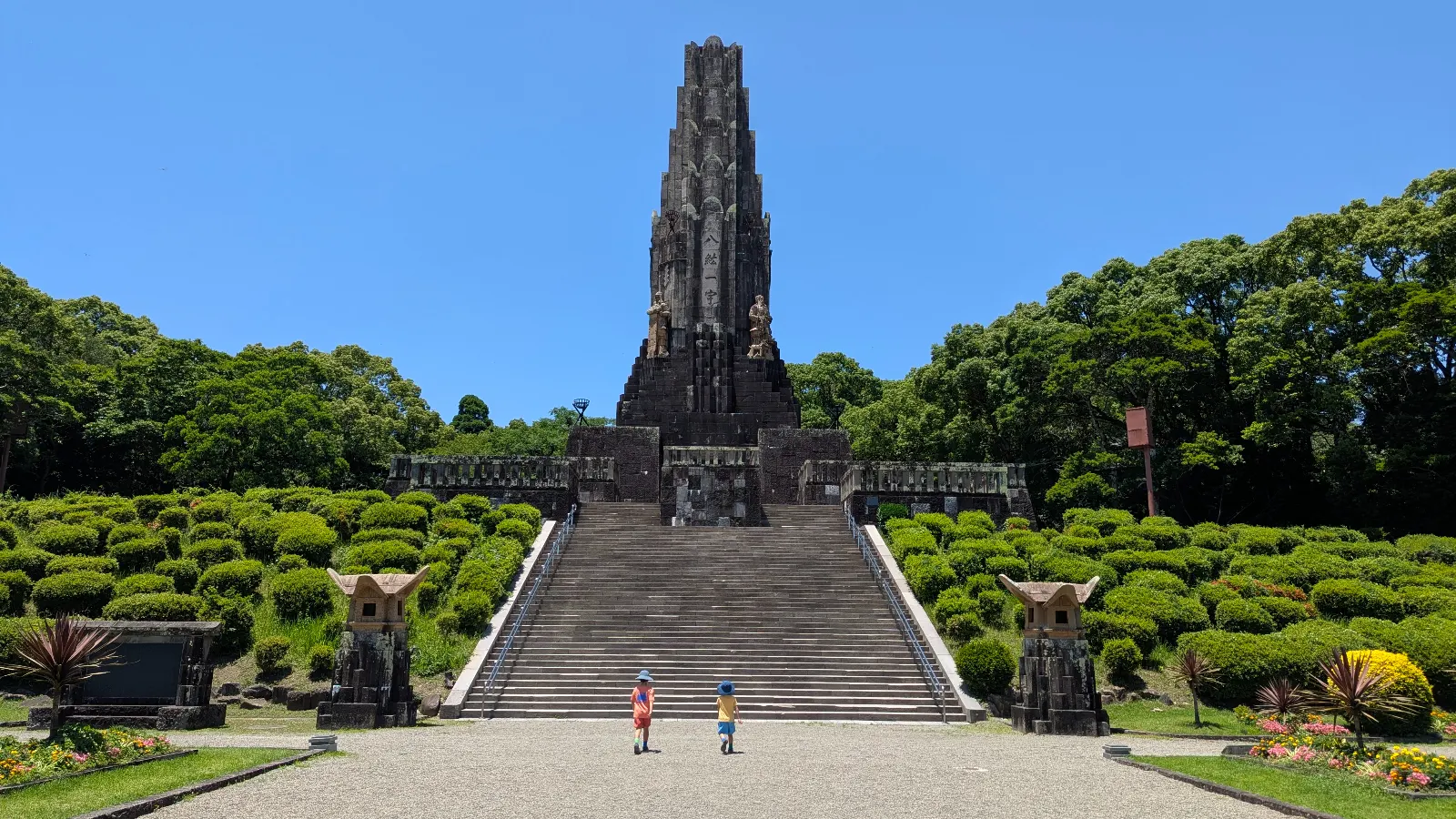
For the Anchor
Stops that relieve unfamiliarity and unconfirmed-structure depletion.
For a child who depletes through unfamiliarity and unconfirmed structure, the strongest stops are Udo Jingu, Sun Messe Nichinan, and Takachiho Gorge.
Udo Jingu is a vermilion shrine set inside a sea cave on the Nichinan coast, and what makes it an Anchor stop is the ritual at its heart: the Undama luck-ball throw, where boys use the left hand and girls the right to toss a clay ball toward a depression in Kameishi, the turtle rock below. That is a fixed, rule-bound task with a clear goal, exactly the kind of confirmed structure a predictability-seeking child can lock onto in an unfamiliar place. A younger Anchor focuses entirely on landing the throw; an older one takes in the cave shrine and the legend behind it as well as the task.
Who it costs.The Sprinter. Reaching the cave shrine means a set of stairs and a coastal cliff approach, sustained descent and climb that draws down a low-stamina child even though the shrine itself is a short visit.
How to make it work.Pair it with Sun Messe Nichinan on the same Nichinan-coast day, since the two sit close together and share the drive south from the city.
If this isn’t your child: one of Miyazaki’s defining sights for any family, with the cave setting and the luck-ball throw the parts every child engages with.Sun Messe Nichinan is an open-air hilltop park above the sea whose payoff is fixed and visible from the start: seven full-size Moai replicas, built with the permission of Easter Island authorities, standing in a row over the Pacific. For an Anchor the whole stop is predictable in the best way, a bounded, signposted circuit with grassy terraces, sculptures, and a clear destination, so a child always knows what is coming and where it ends. A younger Anchor heads straight for the statues and photographs each one; an older one walks the full grounds and the coastal viewpoints knowing the route holds no surprises.
Who it costs.The Sprinter, mildly. The park runs across a hillside with gentle slopes between terraces, which adds up over a full visit for a low-stamina child, though it never reaches the demand of the coast’s cliff shrines.
How to make it work.Go mid-morning or late afternoon for the best light on the Moai, and pair it with Udo Jingu to make the drive south worthwhile in one coastal day.
If this isn’t your child: a genuinely odd and photogenic stop that lands with almost any family, and the single image most associated with a Miyazaki trip.Takachiho Gorge is a deep volcanic canyon of sheer columnar cliffs and the Minainotaki waterfall, and the experience that defines it, a rented rowboat along the gorge floor, is the one element that makes it an Anchor stop. The boat rental is a booked, ticketed, time-slotted task with a fixed route between the cliffs and a clear start and finish, which gives a structure-seeking child a confirmed plan to hold inside dramatic and unfamiliar surroundings. A younger Anchor watches the cliffs from the boat with a parent at the oars; an older one helps row the fixed loop and counts the waterfalls.
Who it costs.The Sprinter most of all, then the Sensor and the Dynamo. The gorge is reached by steep stairs and uneven paths, and the boats draw long queues that mean standing in line for a low-stamina child, so the descent and the wait tax stamina and patience well before the boat ride itself begins.
How to make it work.Treat Takachiho as its own day given the long drive inland, arrive early for calm water and the shortest boat queue, and read the dedicated guide before you go.
If this isn’t your child: still one of Kyushu’s most striking landscapes and worth the trip for the view alone, though families with a low-stamina or crowd-sensitive child should weigh the stairs and the queue honestly.For the Sprinter
Stops that relieve sustained-walking and standing depletion.
For a child who depletes through sustained travel-style walking and standing, the strongest stops are the Phoenix Zoo, the Science Center, and Miyazaki Jingu.
The Phoenix Zoo is a tropical-themed zoo with elephants, flamingos, and monkeys, plus a small amusement park inside the grounds. For a low-stamina child the structure is forgiving: shaded paths, frequent rest zones, and stroller-friendly flat ground throughout, so walking is broken into short stretches between animals rather than one long march, and the mini amusement park gives a seated reward partway through. Sustained-walking depletion is managed by the layout itself. A younger Sprinter rides between the flamingos and the carousel; an older one covers more of the grounds knowing the rides and rest zones are there to bank energy against.
Who it costs.The Sensor, around midday. Heat and crowds build in the open enclosures and the amusement-park corner concentrates noise, which draws down a sensory-sensitive sibling faster than the walking tires the Sprinter.
How to make it work.Arrive at opening or in the late afternoon to skip the midday heat, and use the amusement-park rides as the planned rest stop rather than an extra at the end.
If this isn’t your child: a reliable half-day for any family with young children, and one of the few city stops that combines animals and rides in one flat, stroller-easy site.The Miyazaki Science Center is a hands-on science museum with experiments, a space-flight simulator, a full-size rocket replica, and one of the world’s larger planetariums. For a low-stamina child it is an almost entirely indoor, flat, stroller-accessible stop where the engagement is seated or standing in one place rather than walked, which is the opposite of the cliff-and-stair stops on the coast. The planetarium is the clearest example: a reclined seat and a fixed show let a Sprinter rest completely while still doing the visit. A younger Sprinter works the hands-on floor and the rocket; an older one books the simulator and times the visit around a planetarium show.
Who it costs.No profile heavily. Its only real constraint is the planetarium schedule, a booking-and-timing friction rather than a Reserve cost, since the best of the visit is keyed to set show times.
How to make it work.Check the planetarium times before you arrive and build the visit around the show you want, holding the stop for a rainy day or a quiet weekday afternoon.
If this isn’t your child: an excellent rainy-day option for any family with children roughly four to twelve, with the rocket and simulator the parts that hold attention longest.Miyazaki Jingu is the city’s principal shrine, set in wide, flat, tree-shaded grounds in the Bunka Koen cultural-park area. For a low-stamina child the appeal is the gentle footprint: level gravel paths, generous shade, and benches throughout, so a visit is a slow, restful walk rather than a demanding one, an easy stop to slot on a tiring day. The same cultural park holds the Miyazaki Prefectural Art Museum, a calm, free, open-interiored gallery whose periodic Studio Ghibli special exhibitions pull families specifically, and which folds neatly into the same flat, low-stamina block. A younger Sprinter feeds the koi and runs the shaded paths; an older one takes in the shrine and the rotating museum exhibition next door.
Who it costs.No profile heavily. The honest budget note is that the Art Museum’s permanent collection is small and the stop is strongest when a special exhibition is running, so its draw varies with the calendar rather than the child.
How to make it work.Check the Art Museum’s exhibition schedule before you go, and pair the shrine, the museum, and the nearby Nature and History museum into one calm, flat city-park block.
If this isn’t your child: a tranquil, free shrine for any family and an easy pairing with the cultural-park museums, best timed to a special exhibition next door.Open with the child who runs short first.
Start the day with the stop that serves the child whose Reserve depletes fastest, then chain the rest around it.
Settle these first. Takachiho Gorge is the one stop that controls its own day: the rowboats are booked, time-slotted, and draw long queues, so reserve a slot and arrive early, and treat the long inland drive as a full day rather than an add-on. Any beginner surf lesson at Kisakihama should be booked ahead so an older child’s session is confirmed on arrival. Udo Jingu and Sun Messe Nichinan sit close together south of the city and are best chained into a single Nichinan-coast day. Everything else is flexible fill around those gated stops.
When to go, and what costs nothing.
Mornings hold the most Reserve, so the open, single-route stops that toddlers and low-stamina children manage best (Aoshima Island, the Phoenix Zoo, Kisakihama Beach) belong early, before the midday heat and crowds build on the coast. Summer beach days are the exception worth shifting to late afternoon, when the sun eases off the open sand. The free stops carry real weight in Miyazaki: Aoshima Island and Shrine, Heiwadai Park, Kodomono Kuni Park, Kisakihama Beach, the Prefectural Museum of Nature and History, and Miyazaki Jingu all cost nothing to enter. Several of those, Heiwadai, the Nature museum, and Miyazaki Jingu, are also among the calmest, lowest-stamina stops here, so for a sensory-sensitive or low-stamina child the free route and the reserve-protecting route are often the same route. The paid stops, Sun Messe Nichinan, Florante Miyazaki, the Phoenix Zoo, the Science Center, and the Takachiho boats, are the ones to budget and book around.
Three bases that fit a family’s Reserve.
A resort recovery base, a beachfront stay near Aoshima, and a riverside city base, each chosen for how a depleted child recovers at the end of the day.
| Property | The LuNi Reason | Budget |
|---|---|---|
|
LUNI Pick
Phoenix Seagaia Ocean Tower
Resort base, ocean views
|
A full resort base with pools, ocean views, and kids’ activities that gives a Sprinter and a Sensor a genuine recovery anchor, the room to decompress fully at the end of a high-output coastal day rather than just a bed. | ¥¥¥ |
| Holiday Inn Resort Miyazaki Beachfront near Aoshima | A beachfront stay with onsen baths and family rooms near Aoshima, placing a Dynamo’s beach and island stops within easy reach and giving the whole family an onsen reset between active coastal days. | ¥¥ |
| Miyazaki Kanko Hotel Riverside city base, onsen | A riverside city base with larger rooms and its own onsen, the central stay for families working the Bunka Koen cluster and the zoo by day and day-tripping to the coast, with space for an Anchor to hold a routine across nights. | ¥¥ |
Budget: ¥¥¥
Budget: ¥¥
Budget: ¥¥