Haneda Airport to Tokyo with kids,and the clock that decides it.
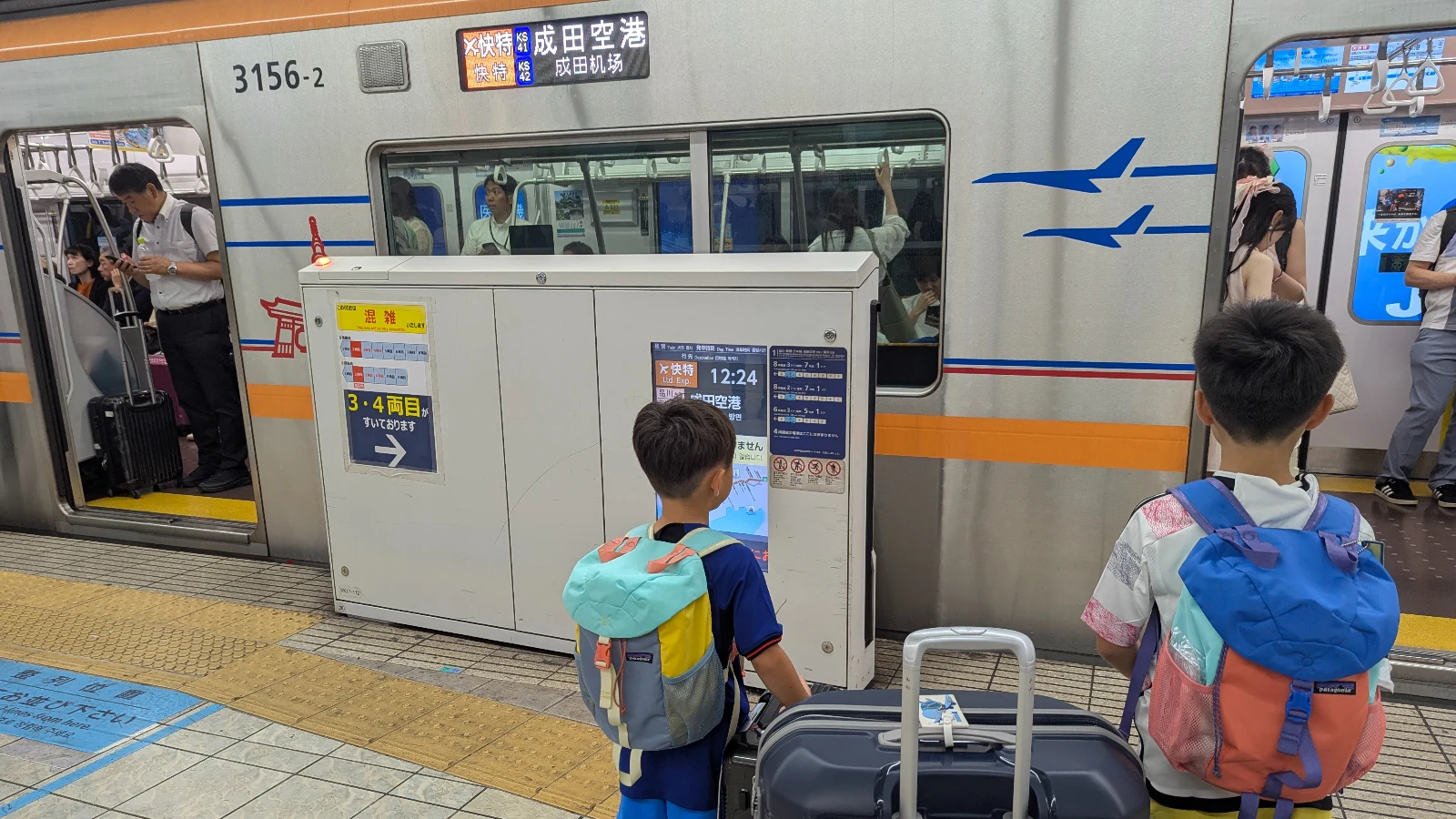
- Last Trains
- 00:08 Keikyu, 00:10 monorail
- Keikyu From Terminal 3
- ¥330 to Shinagawa in 11 minutes
- After Midnight
- The Access bus, ¥2,800, from 00:20
- Child Fare
- Monorail ¥260 for ages 6 to 11
- Which Line
- The one ending nearest your hotel
Some links on this page are affiliate links. LuNi may earn a commission at no extra cost to you.
Haneda to Tokyo with kids is decided by the clock, not the fare. Haneda is close enough that no route is a bad one: the Keikyu from Terminal 3 reaches Shinagawa in 11 minutes for ¥330, and the monorail reaches Hamamatsucho in about 20 minutes for ¥520, or ¥260 for a child aged 6 to 11. Take the line that ends nearest your hotel with no change in the middle. Then check the last train, the Keikyu at 00:08 and the monorail at 00:10, with nothing again until 05:26. After midnight, the Access bus costs ¥2,800.
It is decided by where your bed is.
A change of trains costs a family more than the fare difference ever saves: luggage down a staircase, a stroller through a gate, and a headcount on a platform with children who have been awake too long. Find your hotel below, board the thing named there, and ignore the rest of this page. Then check one number, which is the last train, because it is earlier than anyone expects.
Shinagawa, Asakusa or along the Asakusa Line.
Eleven Minutes, No Change: the Keikyu Airport Line.
¥330 adult and half that for a child aged six to eleven, and Shinagawa in eleven minutes from Terminal 3. It then runs through onto the Toei Asakusa Line without a change, so Shimbashi, Nihombashi, Asakusa and Oshiage all arrive on the train you boarded at the airport. For most families staying east of the palace this is the whole answer and it costs less than a coffee.
Half the Adult Fare, and No Toilet on Board: what to know before you board.
Keikyu publishes adult fares only and the child rule is half of whatever the adult pays, so there is no table to hunt for at the machine. There are no toilets on Keikyu trains, which on an eleven-minute ride is fine and on the through service to Asakusa is worth knowing. Use the toilets in the arrivals hall before you go down to the platform.
Hamamatsucho or on the Yamanote loop.
One Change, and You Choose Where: the Tokyo Monorail.
¥520 adult and ¥260 child, and about twenty minutes to Hamamatsucho. From there it is one change onto the Yamanote and Keihin-Tohoku lines, which reaches most of the loop. The ride itself is the best thing about it with children: it runs on an elevated track across the bay, so the window does twenty minutes of work that no train underground can.
Do Not Pay to Change Terminals: the free bus does it.
The monorail charges ¥230 adult and ¥120 child to move between Terminal 3 and Terminals 1 or 2. The free inter-terminal bus does exactly the same job for nothing. It is a small amount of money and a large amount of standing with bags, so take the bus.
Shinjuku, Ikebukuro or Shibuya.
No Ticket Gates at All: the Airport Limousine Bus.
¥1,400 adult and ¥700 child to Shinjuku and Nakano or to Ikebukuro, ¥1,300 and ¥650 to Shibuya, and ¥1,200 and ¥600 to Tokyo Station on specified segments. About forty minutes to the first Shinjuku stop, around eighty departures a day between 06:15 and 23:40, two checked bags per person below deck. The product is the absence of stairs: kerb to kerb, nobody lifts a case, nobody counts heads at a gate.
Not Low-Floor, Not Step-Free: the one thing it cannot do.
The limousine coaches are not low-floor and are not wheelchair accessible, which is the one explicit accessibility statement on this whole route and it is a negative. A folded stroller goes below deck with the bags. If someone in the party cannot manage coach steps, the train is the accessible option here rather than the bus, which is the reverse of what most families assume.
Yokohama or Kawasaki.
Twenty-Three Minutes, Southbound: the Keikyu again.
The same line that runs north into Tokyo runs south to Yokohama in twenty-three minutes from Terminal 3, with nothing to work out on the way and no change to make. Haneda is genuinely closer to Yokohama than it is to half of Tokyo, which is worth knowing at the point a family is choosing a base rather than at the point they are choosing a train.
00:08 is the number that decides the night.
Haneda takes flights long after its trains stop. This is the part of the page to read before you book an evening arrival, not after you land on one.
Then Nothing Until 05:26: the last trains.
The last Keikyu leaves at 00:08 and the last monorail at 00:10, and the first services of the morning do not run again until 05:26. There is no late train, no reduced service and no night bus network filling the gap. A flight scheduled to land at 23:30 has about half an hour of margin for immigration, baggage and a walk to the platform, which is not enough margin to plan on.
Four Departures, Four Stops: the late-night access bus.
¥2,800, leaving at 00:20, 01:00, 01:40 and 02:20 for Shinjuku Station West Exit, Busta Shinjuku, Higashi-Shinjuku and Ikebukuro East Exit, in under thirty minutes on empty roads. Note the boarding order: the 00:20 run leaves Terminal 2 at 00:05 and Terminal 1 at 00:10, ahead of Terminal 3, so the departure time on the timetable is not the time at your terminal.
Ask for the Flat Fare to Your Ward: the taxi, if your base is not one of the four.
Haneda runs zoned flat fares, quoted before tolls, with a premium between 22:00 and 05:00. The zone chart is published as an image with the ward names inside the graphic, so no fare can be matched to a ward from here. Ask for the flat fare to your ward before you get in, and treat it as the answer when the base is outside the four bus stops or the party will not fit one bus row.
What a child actually pays.
Both lines run the same three age bands and both halve the adult fare for a school-age child. What catches families out is what counts as school age, and how many small children ride free behind one adult.
| Journey | Adult | Child (6 to 11) | Notes |
|---|---|---|---|
| Terminal 3 to Monorail HamamatsuchoTokyo Monorail | ¥520 | ¥260 | About 20 minutes. |
| Terminal 3 to Terminal 1 or Terminal 2Tokyo Monorail | ¥230 | ¥120 | The free inter-terminal bus does the same job for nothing. |
| Terminal 3 to Shinagawa or SengakujiKeikyu Airport Line | ¥330 | Half the adult fare | 11 minutes to Shinagawa. |
Terminal 3 to Monorail Hamamatsucho
Tokyo MonorailAdult ¥520 · Child ¥260
Terminal 3 to Terminal 1 or Terminal 2
Tokyo MonorailAdult ¥230 · Child ¥120
Terminal 3 to Shinagawa or Sengakuji
Keikyu Airport LineAdult ¥330 · Child half fare
School entry is the line, not the birthday. A child of 6 who has not started school counts as an infant and rides free; a 12-year-old still in elementary school pays the child fare. Children aged 1 to 5 ride free, two per fare-paying passenger, so two adults with three small children pay a child fare for the third. A child riding alone pays the child fare whatever their age.
The money case takes one line. Two adults and two children aged 6 to 11 pay 1,560 yen from Terminal 3 to Hamamatsucho, against 4,200 yen for the same family on the bus to Shinjuku. The 2,640 yen gap buys no speed. It buys one vehicle from the terminal door to the hotel district, with no gate and no bags in anyone’s hands. On an arrival day that is often worth it; on a departure day it rarely is. Every child from 6 to 11 taps their own ticket or card, and the counter rules for a child IC card sit in the family guide to Japanese trains.
The floor you land on decides which gate you want.
Haneda is vertical. Terminals 1 and 2 put both railways directly under your feet. Terminal 3 puts three sets of gates on three levels, two of them going where you want and one of them not.
At Terminals 1 and 2 the geography is simple. Keikyu and the monorail both sit on B1F, immediately beneath the terminal, so there is one direction to go and the choice of line happens at the gate. Free buses circulate between all three terminals, which is also the cheapest way to move between them, since the monorail charges 230 yen for the same trip.
Terminal 3 needs a decision before you move. The Keikyu gates for central Tokyo and Yokohama are on the 2F arrival lobby, the floor you walk out onto, and the monorail gates are on 2F arrivals and the 3F departure lobby, about a minute from arrivals. The Keikyu gates on B2F go to Terminals 1 and 2 only. Settle the line before you leave the baggage hall, then go to that gate and no other.
Buy on an IC card. Tap in with Suica or PASMO and there is nothing to work out at a machine, and Keikyu runs a contactless tap-to-ride option at the gate as well. For anywhere past the Keikyu network the machines carry a Toei Line button and a JR transfer button rather than a station list. The monorail is covered by the Japan Rail Pass.
The takuhaibin counters shorten the walk. Terminal 3 takes bags from 04:00 to 01:00 at JAL ABC on the 2F arrival lobby, and from 05:00 to 23:00 at Yamato Transport on the same floor. Terminal 2 has Yamato on the 2F international arrival lobby from 05:45 to 23:00, and Terminal 1 has Yamato from 07:00 to 21:00 on 1F. Confirm the delivery date at the counter, and keep passports, medication and a change of clothes per child with you.
The questions parents actually ask.
What is the easiest way to get from Haneda Airport to Tokyo with kids?
The Keikyu Airport Line is the default. It runs every 4 to 10 minutes, reaches Shinagawa in 11 minutes from Terminal 3 for 330 yen, and continues onto the Toei Asakusa Line for Asakusa and Oshiage without changing trains. The Tokyo Monorail suits families based near Hamamatsucho. The Airport Limousine Bus suits families with more luggage than hands.
How much does the Haneda Airport transfer cost for a family of four?
Two adults and two children ages 6 to 11 pay 1,560 yen on the Tokyo Monorail from Terminal 3 to Hamamatsucho, at 520 yen per adult and 260 yen per child. The same family on the Airport Limousine Bus to Shinjuku pays 4,200 yen, about 2,640 yen more for one vehicle from the terminal door.
What time is the last train from Haneda Airport to Tokyo?
The last Keikyu train to Shinagawa leaves Terminal 3 at 00:08. The last Tokyo Monorail towards Hamamatsucho leaves Terminal 3 at 00:10. After that the only scheduled service into the city is the late-night access bus at 00:20, 01:00, 01:40 and 02:20, at 2,800 yen. The first train of the morning is 05:26.
Do children pay on the Tokyo Monorail and the Keikyu Airport Line?
Children ages 6 to 11 pay half the adult fare on both lines, which is 260 yen on the monorail from Terminal 3 to Hamamatsucho. Children aged 1 to 5 ride free, two per fare-paying passenger, and each child beyond two needs a child ticket. A 6-year-old who has not started school counts as an infant and rides free.
Is the Airport Limousine Bus better than the train with a stroller?
It is better for luggage and worse for boarding. The bus takes two checked pieces per person in the hold, each within 50 by 60 by 120 centimeters and 30 kilograms. The coaches are not low-floor and are not wheelchair accessible, so fold the stroller at the door and stow it below.
Which gate should we use at Haneda Terminal 3 with luggage?
At Terminal 3 the Keikyu gates for central Tokyo and Yokohama are on the 2F arrival lobby, the floor you walk out onto. The Tokyo Monorail gates are on the 2F arrival lobby and the 3F departure lobby. The Keikyu gates on B2F serve Terminals 1 and 2 only. At Terminals 1 and 2 both platforms are on B1F.
Can we send our suitcases from Haneda Airport to the hotel?
Yes. Terminal 3 has a JAL ABC counter taking bags from 04:00 to 01:00 on the 2F arrival lobby, and a Yamato Transport counter from 05:00 to 23:00 on the same floor. Terminal 2 has Yamato on the 2F international arrival lobby from 05:45 to 23:00. Confirm the delivery date at the counter.