Japan with Kids:the myth, and what actually happens.
- Is Japan Safe for Children?
- Yes: among the world’s safest countries
- Safe Travel, Day to Day
- Local children ride the trains on their own
- Best Age to Take Kids
- 5 to 12; toddlers and teens do well too
- If Something Gets Lost
- Lost property is routinely returned
- Is It Child-Friendly?
- Yes: konbini food at any hour, no car needed
Some links on this page are affiliate links. LuNi may earn a commission at no extra cost to you.
Yes. Japan ranks among the world’s safest countries, and a family feels it on the first day: lost property is routinely returned, and local elementary-school children ride the trains without an adult. The rest of the reputation, that Japan is complicated, expensive and too foreign for young children, rarely survives the trip. The trains are punctual and signed, no rental car is needed in the major cities, and 7-Eleven, Lawson and FamilyMart sell familiar food around the clock. Takuhaibin, the luggage delivery service, costs about 2,200 to 3,200 yen a suitcase from Tokyo to Kyoto. The best age window runs from 5 to 12.
The myth parents arrive with.
The myth runs like this. Japan is a beautiful country, but a difficult one to travel with young children. The transport is a maze of unreadable signs. The prices are punishing. The culture is so different, so formal, so quiet, that kids will be either overwhelmed or bored, and a family will spend the trip apologizing for them. It is a destination to save for when the children are older, or for a trip without them at all.
Every part of that belief is either wrong or backwards, and this piece dismantles it one facet at a time. The claim underneath is specific: measured against the practical demands of moving through a foreign country with kids, Japan is the most structurally forgiving destination on earth. The safety, the cleanliness, the transport, and the everyday welcome are not pleasant surprises layered on top of a hard trip. They are the trip’s foundation.
The lens for reading it correctly is The LUNI Framework, which treats family travel as a budget across three currencies rather than two. Money and time are the two every parent already tracks. The third is Reserve: each child’s specific, finite capacity to absorb what a travel day asks of them. Most trips that break do not break on money or on the itinerary. They break because Reserve ran out before anyone recognized it was a budget at all. Hold that third currency in mind, because the reason the myth is wrong is that Japan spends it more slowly than almost anywhere else a family can go.
“Too complicated to get around.”
This is the load-bearing fear, and it collapses faster than any other on contact with the actual system.
Start with getting around, because it is the fear the myth is built on and the one the country answers most completely. It helps that the background condition is unusual too: Japan is among the ten safest countries in the world, and the practical effect on a family trip is larger than parents anticipate. Violent crime is exceptionally rare, lost property is routinely returned, and local elementary-school children navigate the train network without adult supervision. The low-level vigilance that drains parents elsewhere, tracking bags, monitoring distance, scanning crowds, largely disappears. That recovered attention is what lets a parent be present for the trip rather than managing it defensively.
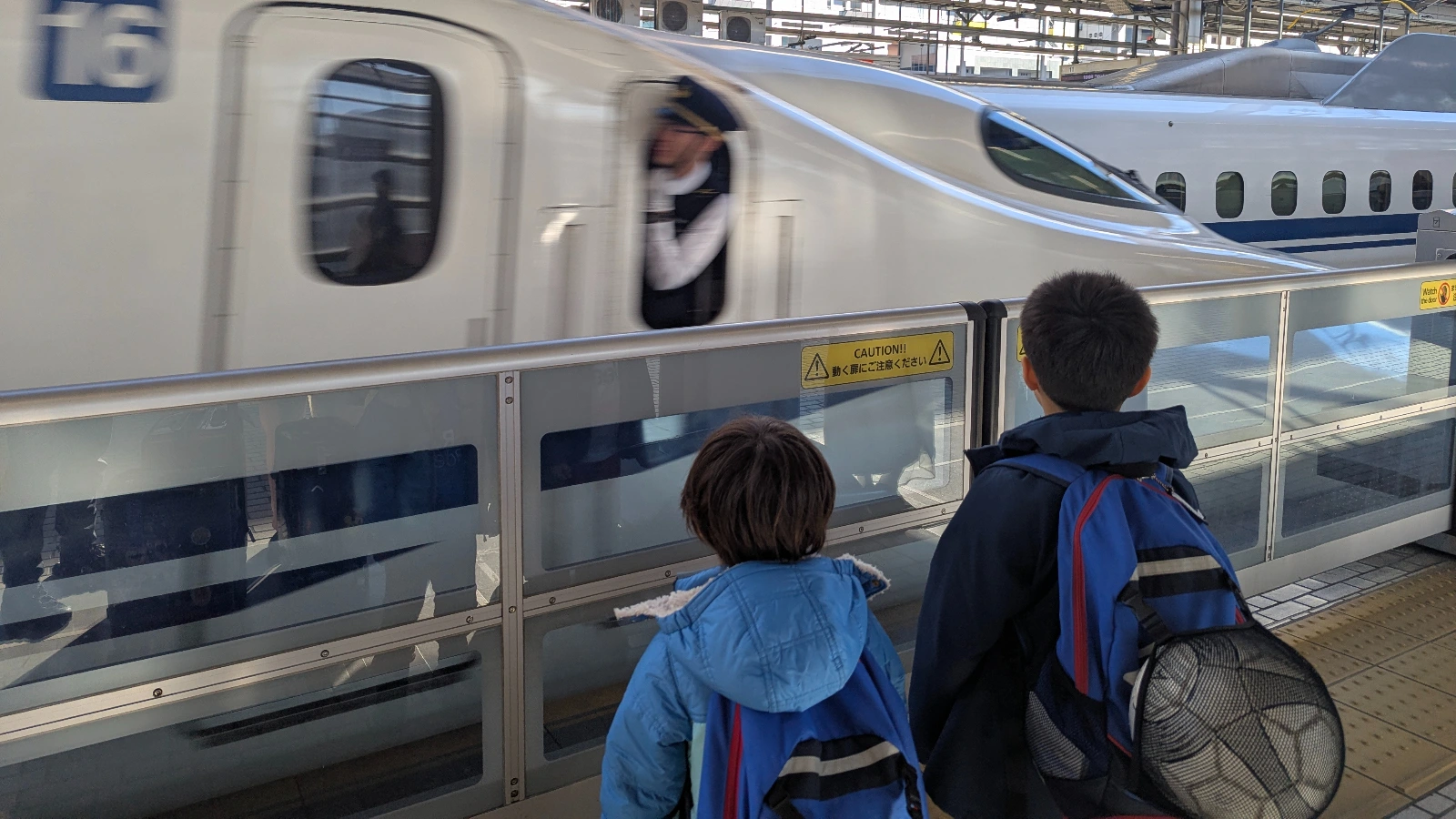
The transport reputation rarely survives the first ride. The Shinkansen is fast, punctual to the minute, and one of the most reliably enjoyable things a family can do in the country: spacious seats, snack carts, and a novelty for children that holds across multiple journeys. City metro systems in Tokyo, Kyoto, and Osaka carry a reputation for complexity that the actual experience does not support. Most major stations have elevators, bilingual signage, and staff equipped to help families. No rental car is required for the cities where families spend nearly all their time.
Then there is the advantage most first-timers never use. Takuhaibin, Japan’s luggage delivery service, sends suitcases directly between hotels for roughly 2,200 to 3,200 yen per suitcase, by size. No carrying luggage up station stairs, through crowds, or onto a packed train with a tired child in the other hand. For families managing strollers and car seats, it changes the physical shape of a travel day entirely. The one detail to plan around: the drop-off cutoff is usually the evening before departure, not the morning of, and delivery lands the following evening rather than same-day.
“Too expensive for a family.”
The cost fear is real in exactly two places and mistaken almost everywhere else. The correction is knowing which is which.
Japan’s cost structure favors families who plan around the calendar rather than against it. Daily transport, casual and convenience-store meals, and entry to temples, shrines, and many museums are genuinely budget-accessible. The two costs that actually climb are airfare and accommodation near peak events, and both are predictable months ahead.
The food safety net doubles as a budget one. The convenience store network of 7-Eleven, Lawson, and FamilyMart runs around the clock with egg sandwiches, onigiri, fried chicken, steamed buns, and fruit at prices that make a picky eater cheap to feed. Conveyor-belt sushi lets children choose exactly what they want at their own pace, and most sit-down restaurants offer okosama sets, dedicated children’s meals with mild curry, rice, and hamburger steak. A family rarely pays a premium to keep everyone fed.
Two of the windows to plan around are named and dated. Obon, in mid-August, is a nationwide memorial period when domestic travel peaks, hotels sell out months ahead, and Shinkansen seats need early reservation. Southbound traffic peaks early in the window, and the Nozomi runs all-reserved across it with no non-reserved seating at all. Golden Week, late April to early May, does the same in spring. Treating either as an invisible date on the calendar is the single planning error most responsible for a trip feeling expensive. Book across those windows deliberately, or structure arrival and departure to avoid the core days, and Japan comes in well under the price its reputation quotes.
“Too foreign for kids to engage with.”
This is the facet parents feel most and misread most, because the very difference they fear is the thing that pulls children in.
Japan’s culture is participatory by design, not by accident. At Shinto shrines like Meiji Jingu, children clap, bow, and write wishes on ema plaques. At Senso-ji in Asakusa, the incense ritual is immediately comprehensible and physically engaging. At Fushimi Inari in Kyoto the torii corridor is the rare cultural site that is also a movement outlet, an uphill walk with no queue and no requirement to stand still, which makes it the right place for a child who depletes through restricted movement and the wrong place to put last on a day that has already asked them to be still. The country does not require a child to understand its culture in order to engage with it. Engagement comes first, and understanding builds around it. That sequence, experience before explanation, is why cultural visits here work for children who would find similar sites elsewhere passive and alienating.
The stimulation-versus-depth tension resolves itself. The common family conflict, one child wanting stimulation and a parent wanting cultural depth, does not need active management in Japan because the country carries both at once. A single day in Tokyo can hold the hands-on digital art of teamLab Planets and the grounds of a centuries-old castle. Teenagers who disengage from conventional tourism stay engaged because contemporary Japan, the anime districts, the arcades, the streetwear, carries genuine weight beside the historical sites. No family member has to give up their version of the trip.
The attraction infrastructure was, in effect, built around children. Kids Plaza Osaka is the clearest case: it is a museum a child is allowed to climb through rather than walk past, which is why it survives being the only thing on the day. Foreignness, the thing the myth treats as a barrier, is the engine.
The small rituals of Japan, removing shoes at a ryokan entrance, bowing at a shrine, choosing a fortune slip, give a child a genuine role to play rather than an observer’s seat. When a child has a job to do inside an experience, they stop watching and start participating. That shift from spectator to participant is what turns a cultural visit into something they actually carry home.
“Too much for a child to handle.”
The last version of the myth is the honest one, and it is the reason the framework exists. Japan is not effortless. It is forgiving in a way you can plan around.
Strip away the fears about logistics, cost, and culture, and a real one remains: a full day abroad spends a child’s Reserve, and Japan’s density means a lot happens in a day. This is where the third currency earns its keep. Read that way, Japan’s structure works in a family’s favor rather than against it, because the country lets you spend the other two currencies, money and time, to protect the third.
The Anchor child depletes through unfamiliarity and unconfirmed structure, and a foreign country is unfamiliarity in concentrated form. Japan answers this better than almost anywhere: almost every restaurant carries an okosama set, the same shape of meal in the same kind of box wherever you are in the country, and most order through a ticket machine with pictures on it, so the two moments that usually go wrong for this child, what is coming and how to ask for it, are both settled before anyone sits down. A younger Anchor needs the box itself to look familiar; an older one needs to know the order of the day and will accept a new meal once it does. The planning consequence is that an Anchor’s Reserve holds far longer here than the myth would predict.
The Sprinter depletes through sustained travel-style walking and standing, and a typical Japan day runs long on both. The country’s own density is the fix. Major stops in Tokyo, Kyoto, and Osaka cluster tightly, so a morning in Asakusa can cover Senso-ji, Nakamise street, and Sumida Park inside a radius most Sprinter children manage comfortably. The planning consequence is to spend the walking where it is dense and refuse to spend it twice: one cluster a day, and the train ride between clusters treated as the rest rather than as the transition to more. A younger Sprinter needs the stroller kept in the plan even on days it is refused; an older one needs the second cluster taken off the day entirely.
This is also why Japan scales with the child rather than aging out of relevance. A four-year-old in a waterfront park, a nine-year-old on the castle and science-museum circuit, and a teenager navigating a district alone are three different trips in one country, each calibrated to a different Reserve. The destination does not change. The child does, and Japan has a version ready for each stage.
The questions families ask most.
Is Japan safe for kids?
Yes. Japan ranks among the top ten safest countries in the world by every major measure. Violent crime is exceptionally rare, lost property is routinely returned, and local elementary-school children commute by train without adult supervision, which is an accurate indicator of the baseline safety a visiting family can expect. The practical effect is that the low-level vigilance that drains parents in most destinations largely disappears.
What age is best to take kids to Japan?
Japan works at every stage, but the experience differs by age. Children aged 5 to 12 sit in the most universally rewarding window: old enough to engage with cultural sites, physically capable of the walking, and still receptive to the novelty. Toddlers are well served by Japan’s facility infrastructure, and teenagers by its contemporary culture. There is no single right age, only a different version of the trip at each one.
Will picky eaters find food they will actually eat in Japan?
Yes, and more reliably than parents expect. Karaage, udon, gyoza, onigiri, and plain white rice are accepted by most children immediately, and conveyor-belt sushi removes the pressure of ordering. The convenience store network of 7-Eleven, Lawson, and FamilyMart functions as a 24-hour safety net with egg sandwiches, fried chicken, and fruit, and most sit-down restaurants offer okosama sets built for children.
Do families need a car to travel Japan with kids?
No. Most families traveling the major cities of Tokyo, Kyoto, Osaka, Hiroshima, and Fukuoka have no need for a rental car. Trains and metro cover virtually every family-relevant destination, most major stations have elevators and English signage, and the Shinkansen is a genuine highlight rather than a chore. Car rental is worthwhile only for rural Hokkaido, parts of Okinawa, or areas outside the rail network.
Is Japan expensive for a family trip?
Japan’s cost structure favors families who plan around the calendar. Daily transport, convenience-store and casual meals, and entry to temples, shrines, and many museums are genuinely budget-accessible. The largest costs are airfare and accommodation near peak events, particularly Obon in mid-August and Golden Week in late April and early May, when hotel prices climb and availability tightens. Families who avoid those windows or book far ahead find Japan more affordable than its reputation suggests.
Is Japan too complicated for a first international trip with children?
No. The reputation for complexity rarely survives contact with the actual experience. Signage in major hubs is bilingual, station staff assist families, luggage can be sent ahead by Takuhaibin so nobody carries suitcases up stairs, and the density of the major cities keeps high-value stops close together. By almost every practical measure Japan is the most structurally forgiving country on earth for a first trip abroad with kids.