Indoor Activities in Osaka With Kids:
which room holds your child.
An Osaka indoor day is usually chosen by what is famous. Fame tells a parent how many other families will be in the room, and nothing else.

No path to follow, and one zone where a stream is the only thing between child and animal.
Nothing to pay, and on a weekday nobody unbooked gets through the door.
Sixty meters of enclosed tube from the third floor down to the basement.
Closed from early September 2026. Most Osaka lists still recommend it.
Some links on this page are affiliate links. LuNi may earn a commission at no extra cost to you.
You have the days. Now the nights.
Where to stay in Osaka →Nine rooms, and the child each one holds.
Nine indoor stops across Osaka and its edges, sorted by who they are for rather than by fame.
Family travel runs on three currencies, not two. Money and time are the pair every parent already counts; the third is the child’s reserve, their finite capacity to absorb what travel asks of them. These nine are not ordered best to worst. They are grouped by which child each one is for, across the four profiles. Osaka makes that grouping unusually useful, because its indoor rooms are extreme rather than average: a sixty meter slide inside a tower, a library with a rule about who gets priority, a room where a child climbs down a rescue ladder. The Dynamo runs short when they cannot move, the Sensor on unfiltered input, the Anchor when nothing is confirmed, the Sprinter on standing.
Osaka Science Museum, Nakanoshima.
Not because it is the best room here for any single child, but because it asks the least of a family before they commit. No reservation, five minutes from Watanabebashi, a lift to all four exhibition floors, and a ticket good all day, so a family can walk out and come back.
Find the profile that fits your child, then read down to it.
| The Room | What It Settles | Best For |
|---|---|---|
| TsutenkakuShinsekai | A 60 m slide as the way down, gated at 120 cm and age seven. | Dynamo |
| Abeno Disaster Prevention CenterAbeno Forsa 3F | A ladder and a rescue bag the child descends themselves. | Dynamo |
| NIFRELExpocity | No fixed route, and one zone separated by a stream, not a wall. | Dynamo |
| Osaka Aquarium KaiyukanTempozan | House rules that bar shouting and amplified sound outright. | Sensor |
| Nakanoshima Children’s Book ForestNakanoshima | Sessions that empty and refill, so the room never accumulates. | Sensor |
| Osaka Museum of HistoryTanimachi 4-chome | A lift to 57 m, then four floors of exhibition, all downhill. | Anchor |
| Ezaki Glico MemorialNishiyodogawa | A booked, fixed hour with two groups in the building at a time. | Anchor |
| Osaka Science MuseumNakanoshima | A published order to follow, and a dome with a door that shuts. | Sprinter |
| Sakishima Cosmo TowerNanko | Different routes up and down, so nothing is walked twice. | Sprinter |
Tsutenkaku
Dynamo
Abeno Disaster Prevention Center
Dynamo
NIFREL
Dynamo
Osaka Aquarium Kaiyukan
Sensor
Nakanoshima Children’s Book Forest
Sensor
Osaka Museum of History
Anchor
Ezaki Glico Memorial Museum
Anchor
Osaka Science Museum
Sprinter
Sakishima Cosmo Tower Observatory
Sprinter
For the Dynamo
Rooms that hand a child a job to do with their hands and feet.
For a child who empties out when they cannot move.
The way down is a slide. The Tower Slider runs sixty meters from the third floor, twenty-two meters up, to the basement four and a half meters below ground, turning one and a half times around the lift shaft on a slope of about thirty degrees and taking roughly ten seconds. A movement-led child spends most of an observation tower being asked to stand still and look at something far away. Here the building hands them a physical event with a beginning and an end. A seven-year-old rides it twice; a fifteen-year-old works out the turn and rides it properly the second time.
Who it costs.The Sensor, and not only in the tube. The fourth floor is built around flashing lights and a mirror ball as a deliberate night-club effect, and the slider itself is a sealed transparent tube with no way out once it starts.
How to make it work.Read the gate before you promise it to anyone. A rider must be at least 120 centimeters, aged seven to sixty-five, and under 120 kilos; a helmet is compulsory and every bag, phone and hat goes into a locker first. Riders with claustrophobia, motion sickness, bone or heart conditions, or mobility or visual impairment are excluded, as are pregnant riders. It is not the only way down, so a child who cannot ride takes the lift and meets the others at the bottom.
If this isn’t your child: seven levels of Shinsekai nostalgia with a rooftop deck that takes the weather full in the face, and a slide most of the family will watch rather than ride.A disaster prevention center where the child climbs down an evacuation ladder and then descends again in a rescue bag, with extinguisher training and a smoke scenario in between. Nowhere else indoors in Osaka asks a child to do something physical with a real consequence attached, and that is why a movement-led child stays past twenty minutes: the body does the learning rather than sitting through it. A seven-year-old does the extinguisher and the smoke route; a fourteen-year-old takes the ladder seriously and remembers it.
Who it costs.The Sensor. A smoke scenario means a darkened enclosed corridor, and the whole visit is a staff-led sequence with no stepping out of the middle of a course.
How to make it work.Book it. The center runs capacity-limited guided courses and warns that an unreserved family may wait a long time or not get on a course at all, with lead times for applicants from outside Osaka running to three months. Children under six need an adult with them, and anyone under 120 centimeters cannot take part in the earthquake simulation.
If this isn’t your child: one floor of a commercial building near Tennoji where a child does the thing instead of reading about it, and it has to be arranged weeks out.In one zone the only thing between the child and the animals is a small stream. There is no barrier and no glass in the movement zone; the boundary is water, and the visitor stays on their side of it. That changes what a child does with their body: they are not queuing at a window, they are moving through a room where the animals move too. And there is no mandatory route, whatever most guides say. Eight themed zones sit over two floors and the child chooses the order. A four-year-old follows whichever animal is nearest; a twelve-year-old takes the twenty-minute projection room in the middle as the sit-down.
Who it costs.The Sprinter. It is out at the monorail beyond a walk across Expocity, and the animals cannot be touched, so the only thing a tired child can do is keep walking.
How to make it work.Take the hand stamp at the exit. Same-day re-entry is unlimited, which is what makes the long way out worth doing: the family breaks for food in the mall and walks back in. Preschool children need a guardian, and one zone is built around venomous species.
If this isn’t your child: the most interesting animal building in the Osaka area, and a monorail ride from the city to reach it.For the Sensor
Rooms with a published rule about what is allowed to happen inside them.
For a child who empties out on noise, crowding and unfiltered input.
Kaiyukan is the only building on this map that bans raised voices and amplified sound as a house rule, alongside flash photography, which is prohibited outright at the special tank and at the seal pool. That is not a claim about how loud the room is, it is a statement about what the building permits, and for a child who depletes on unfiltered input a rule is worth more than an impression. The route runs from an entrance tunnel to the top level and then down a single spiral, with benches along it. A five-year-old is carried past the rays; a thirteen-year-old times the feeding programs.
Who it costs.The Sensor too, on the way out, and this is the change most guides have not caught up with: re-entry has ended. A family that steps outside to settle a child cannot come back in on the same ticket, so the spiral has to be completed in one go.
How to make it work.Take a timed e-ticket rather than a same-day one, because a walk-up may be held until its entry time. And correct the version you have read elsewhere: most of the route is ramp, but part is stairs and escalators, so it is not the entirely step-free circuit it is described as. The aquarium suggests carrying a small child instead of pushing them, because the stroller sightline sits below the tanks.
If this isn’t your child: a one-way descent past thirty thousand animals, and no door back in once you have left it.The room empties completely between sessions, which is the structural fact that makes it work. Entry runs on timed slots with a full turnover, so a family does not walk into a crowd that has been building since opening; they walk into a room that was cleared twenty minutes earlier. The building is three stories of concrete, about 800 square meters, walls lined floor to ceiling with books. The house rules go further: children’s reading takes priority when it is busy, filming is prohibited, and self-study and screens are discouraged. A four-year-old is read to on the lower floor; a fourteen-year-old finds a corner and is left alone in it.
Who it costs.The Dynamo. The stated activity is reading and there is nothing else in the building to do, so a movement-led child empties it faster than the slot lasts.
How to make it work.Book, even though it is free and even on a weekday. A hundred places per session go online and fifty are held for walk-ins, and that half is withdrawn when an event runs. One reservation covers five people, under-twos not counted. There are no lockers, so everything you bring stays with you.
If this isn’t your child: the calmest free hour on Nakanoshima, and a booking is still required to get into it.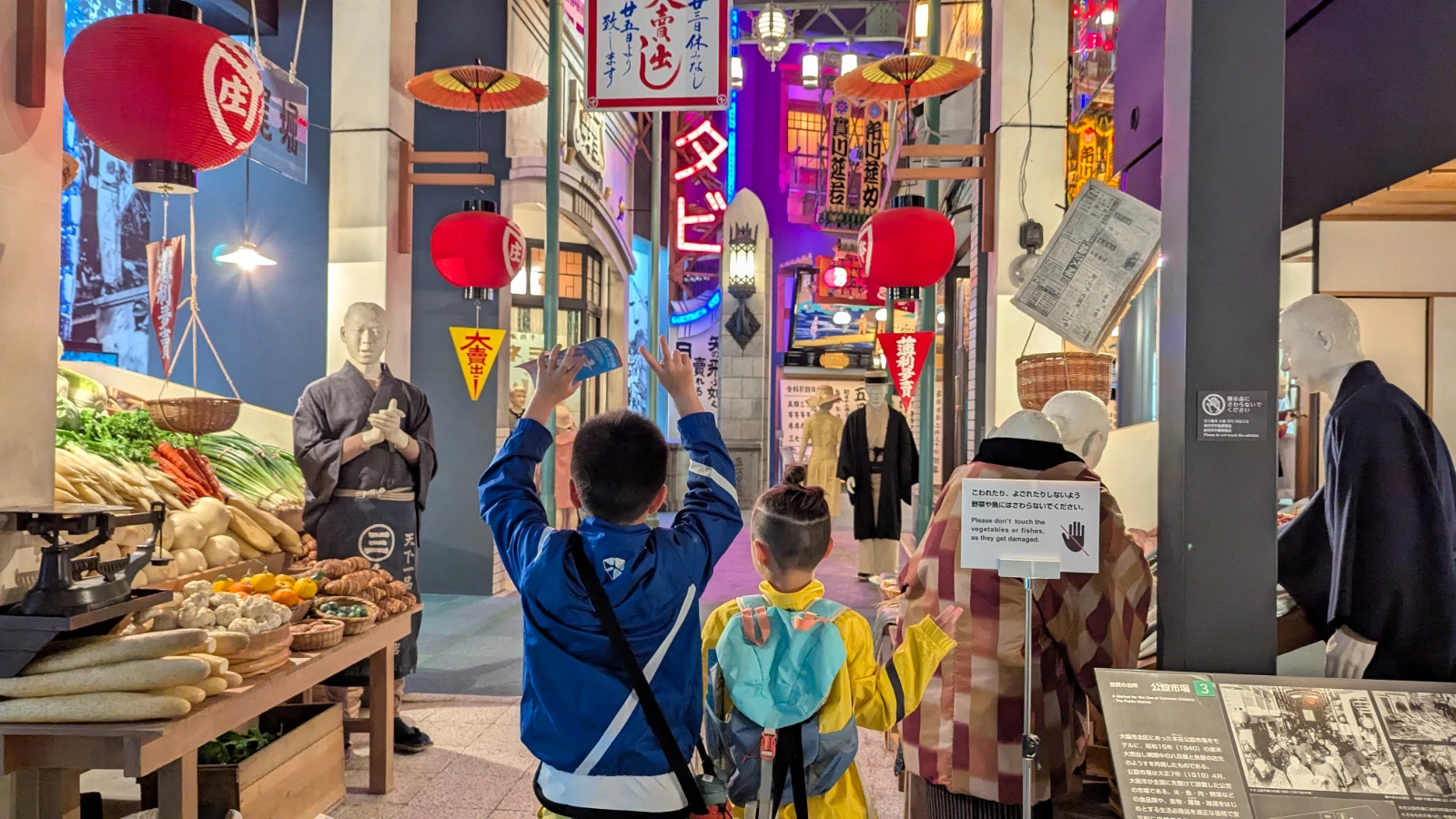
For the Anchor
Rooms that settle the hour before the family leaves the hotel.
For a child who empties out when nothing is confirmed and everything is new.
The permanent exhibition runs one way, from the tenth floor to the ground, and that is the whole shape of the visit: a child who needs to know what happens next can be told it before they walk in. The lift carries the family to fifty-seven meters and every floor after is downhill, ending on a recreated twentieth-century street. The top floor opens on a full-scale reconstruction of the great hall of the Naniwa Palace, vermillion columns and a tiled floor, with windows that look down onto the ground the real palace stood on, so the first thing confirmed is the best thing in it. A six-year-old works the recreated dig on the eighth floor; a thirteen-year-old reads the city forward from the palace to the trams.
Who it costs.The Dynamo. Touching the exhibits and the cases is prohibited, umbrellas may not be carried inside because they damage the displays, and notes are pencil only.
How to make it work.Nothing is booked and nothing is timed, so it takes a wet morning at no notice. The station exits sit at the foot of the building, which makes it one of the few Osaka stops with no approach to negotiate. The rest area is on the second floor, not on the exhibition floors, so plan the break for the way out.
If this isn’t your child: four exhibition floors that are entered at the top and never climbed, and a window onto the excavation they are about.The same building runs two opposite contracts on different days, and knowing which one you are walking into is the whole job. On a weekday it is reservation only, booked by the day before, with a fixed sixty-minute visit and a cap of two groups in the building per slot. On the first and third Saturday of the month it flips: no reservation, free viewing, up to seven groups. For a child who needs the shape settled in advance the weekday version is unusually complete, because the hour, the ending and the size of the crowd are known before you leave. A six-year-old goes for four thousand toys; a thirteen-year-old for the 1931 vending machine that played a film.
Who it costs.The Sprinter, twice. The station walk is sixteen to eighteen minutes through an industrial district with no cover, and the two floors are joined by stairs, with only a single-person stair lift as an alternative.
How to make it work.Entry costs nothing, so the only thing rationed is the slot, and on a weekday there is no walk-up at all. Book the day before at the latest. There is no factory tour attached to this one, whatever you have read, so come for the collection and the Dotonbori sign history.
If this isn’t your child: a free hour among four thousand toys, behind the strictest weekday door in the city.For the Sprinter
Buildings where the machinery does the climbing.
For a child who empties out on sustained walking and standing.
Four exhibition floors and not one of them has to be climbed. A lift serves all of them and the published route runs top to bottom, so a child who runs out of legs starts on the fourth floor and descends. The planetarium is the reason to come early rather than late: a seated dome running about forty-five minutes, the rare stop that hands stamina back instead of spending it, and the door shuts, because nobody is admitted once a show has started. A five-year-old watches from a guardian’s lap; a fourteen-year-old sits the full dome and then works the physics floor.
Who it costs.The Sensor. Forty-five minutes in a dark dome with no mid-show exit, and quiet is enforced in it: a child who cannot watch quietly is asked to leave.
How to make it work.Nothing is reserved for a family, so it absorbs a late start. Two details change a day: the ticket covers the exhibition halls all day, so you can leave and come back, and a child in the third grade of elementary school or below cannot visit unaccompanied. Free lockers are on site.
If this isn’t your child: four floors and a dome five minutes from Watanabebashi, and the one room worth timing your arrival around.The way up and the way down are different routes. A glass lift climbs from the ground to the fifty-second floor, escalators carry the family the last three floors to the viewing level at 252 meters, and the descent uses escalators to the fifty-first and lifts from there. Nothing is walked twice and no queue is joined twice, which is the saving for a child who runs short on standing: the return leg of a tower visit is where a family usually loses them. The viewing floor is a single 360-degree level, with nothing above or below it to be persuaded up to. A five-year-old rides the glass lift as the event; a fourteen-year-old takes the harbor and the bridges.
Who it costs.The Anchor. A route that changes machinery halfway and comes down a different way is harder to describe in advance than a lift and a deck, so the shape cannot be confirmed to a child as simply as it can elsewhere.
How to make it work.Walk-up is normal, so this is an evening stop rather than a booked one, and it holds a clear night better than a grey afternoon. One thing to confirm first: the escalators between the lift floor and the viewing floor are the only published link between them, and they go out for works, so check the ascent before you make the trip to the bay.
If this isn’t your child: the highest view in Osaka reached without a single step upward, and a long way out to the port to get it.Build the day around the one that is booked.
Three of the nine cannot be walked into, so the booked one is the fixed point. Open with whichever child runs short first: the Dynamo on restricted movement, the Sensor on input, the Anchor on unconfirmed structure, the Sprinter on standing.
Three things worth getting right.
The Osaka Museum of Housing and Living is shut. It closed for an extended period in early September 2026 and is not due back until the new year, shop included. It appears on almost every Osaka rainy-day list, so a family will find it recommended and then find the door locked.
Free does not mean open. Nakanoshima Children’s Book Forest and the Ezaki Glico Memorial Museum both cost nothing and both refuse a family that has not made an arrangement, in one case on every day of the week. Treat the two of them as the most booked stops on this page, not the most casual.
One structural note: the escalators between the lift floor and the viewing floor at Sakishima Cosmo Tower are the only link between them, with no stair route published, and they have been out for works.
What puts a room on this list.
Osaka indoor lists sort on visitor numbers and on whether a place has a famous photograph. Neither predicts how a child behaves inside the building.
The axis here is what a building does to a child while they are inside it. Four questions decide it. Is there anything to operate, or only to look at? Does the room set the rate, or does the child? Can the order be stated before anyone walks in? And how much of the visit is spent standing? Sorted that way a free reading room beats several ticketed attractions, and a disaster prevention center on the third floor of an office block earns a place a famous tower does not.
The questions parents actually ask.
What are the best indoor activities in Osaka with kids?
It depends far less on the weather than on the child. Tsutenkaku, Abeno Disaster Prevention Center and NIFREL hold a child who empties out when they cannot move; Kaiyukan and Nakanoshima Children’s Book Forest a child short on noise and input; the Osaka Science Museum and the Ezaki Glico Memorial Museum a child who needs the hour settled in advance; the Osaka Museum of History and Sakishima Cosmo Tower a child who runs out of legs. If only one is possible, make it the Science Museum: central, unreserved, a lift to every floor, and a ticket good all day.
What can you do in Osaka with kids when it rains?
The Osaka Museum of History, because the station exits sit beneath it and the whole permanent exhibition is reached by lift and then walked downhill. Four floors descend from a full-scale reconstruction of the Naniwa Palace great hall, 57 meters up, to a recreated twentieth-century street at the bottom. Nothing is booked, so a wet morning turns into it without notice. The Osaka Science Museum does the same on Nakanoshima and adds a seated planetarium.
Which indoor activities in Osaka need advance booking?
Three, and one of them is free. Nakanoshima Children’s Book Forest runs timed slots every day: a hundred places per session go online in advance, fifty are held for walk-ins, and that half disappears when an event is on. The Ezaki Glico Memorial Museum takes no weekday walk-ins and must be booked by the day before. Abeno Disaster Prevention Center runs capacity-limited staff-led courses and warns that an unbooked family may not get on one. Everything else here can be walked into.
Is Osaka Aquarium Kaiyukan good for young children?
Yes, with two corrections to the version repeated everywhere. The route is not entirely step-free: most of it is ramp, but part is stairs and escalators, which matters with a buggy. And re-entry has ended, so a family that walks out to settle a small child cannot come back in on the same ticket. Set against that, the house rules bar shouting and amplified sound anywhere inside, and the aquarium suggests carrying a small child rather than pushing them, because the low stroller sightline hides the tanks.
What free indoor activities are there in Osaka with kids?
Two, and both still need planning. Nakanoshima Children’s Book Forest costs nothing and is a three-story room whose walls are lined with books, but every visit runs on a booked timed slot. The Ezaki Glico Memorial Museum costs nothing either and is stricter: on a weekday nobody unbooked is admitted, though the first and third Saturday of each month flip it to walk-in. Free in Osaka means no ticket, not no arrangement.
Which Osaka indoor activity works for a teenager?
The Tower Slider at Tsutenkaku, which is the rare Osaka attraction gated at the older end rather than the younger. It runs 60 meters from the third floor to the basement in a transparent enclosed tube, turning one and a half times around the lift shaft in about ten seconds, and a rider must be at least 120 centimeters tall and over the age of six. A helmet is compulsory and loose items go into a locker. It is not the only way down, so a younger sibling takes the lift and meets them at the bottom.
Is the Osaka Museum of Housing and Living open?
No. It shut for an extended closure in early September 2026 and is not due back until the new year, shop included. Plenty of guides still list it as an open rainy-day option, so check before you build a Tenjimbashisuji morning around it. The nearest substitute for a full-scale walk-through reconstruction of an older Osaka is the Osaka Museum of History, whose ninth and seventh floors recreate the medieval city and the twentieth-century street.