Indoor Playgrounds in Osaka With Kids:
the gate on every door.
Every indoor play floor in Osaka has a gate on it: a height, a weight, an age ceiling, a signature, a phone number. The gate decides who gets in, not the equipment.
Both conditions, not either. The one room here that genuinely holds a teenager.
Age three to second grade go in alone. A mobile number is registered at the door.
Three rooms hold 180 each. Tickets come from a machine inside, on the day only.
Fourth grade and below need a guardian in a swimsuit, three children to one adult.
Some links on this page are affiliate links. LuNi may earn a commission at no extra cost to you.
You have the days. Now the nights.
Where to stay in Osaka →Nine play rooms, and the gate on each.
Four of these are central. Five are a deliberate trip out, and that is stated rather than buried.
Family travel runs on three currencies, not two. Money and time are the pair every parent already counts; the third is the child’s reserve, their finite capacity to absorb what travel asks of them. These nine are not ordered best to worst. They are grouped by which child each one is for, across the four profiles. An Osaka play floor is not a generic room with equipment in it: each has a rule on its door about who may come in, how long they may stay and whether an adult has to be beside them, and that rule decides the afternoon. The Dynamo runs short when they cannot move, the Sensor on unfiltered input, the Anchor when nothing is confirmed, the Sprinter on standing.
Kids Plaza Osaka, Ogimachi.
This one wins on breadth rather than on any single child. It sits on a station exit, takes no reservation, sets no time limit, and loans twenty strollers free to the families whose smallest member will not last five floors on foot.
Work out which of the four your child is, then go straight to that group.
| The Room | What It Settles | Best For |
|---|---|---|
| Tondemi HirakataHirakata Mall 3F, 4F | A 10 m tower with a net trampoline, gated at 110 cm and 20 kg. | Dynamo |
| Tentoumushi BIG STAGEKawachinagano | A foam dive pit, a slackline, and no session clock at all. | Dynamo |
| ATC Asobi MareNanko, ITM 5F | An indoor pony ride, and ball pools split at age six. | Dynamo |
| Skids Garden DainichiMoriguchi | No medal games, no crane games, and nothing brought in. | Sensor |
| Gravity Research UmedaGrand Front 6F | One activity in the whole room, graded so the child picks. | Sensor |
| Dream 21Higashiosaka | Four named rooms, each with its own published headcount. | Anchor |
| Bornelund KID-O-KIDGrand Front 3F | Staff who show a child how the equipment is meant to be used. | Anchor |
| Kids Plaza OsakaOgimachi | Twenty loan strollers and stroller parking on two floors. | Sprinter |
| Chuo Indoor PoolShimanouchi | The one play format that carries the child instead of tiring them. | Sprinter |
Tondemi Hirakata
Dynamo
Tentoumushi Park BIG STAGE
Dynamo
ATC Asobi Mare, Nanko
Dynamo
Skids Garden Dainichi
Sensor
Gravity Research Umeda
Sensor
Dream 21, Higashiosaka
Anchor
Bornelund KID-O-KID, Grand Front
Anchor
Kids Plaza Osaka
Sprinter
Osaka Municipal Chuo Indoor Pool
Sprinter
For the Dynamo
Floors built so a child can spend everything they arrived with.
For a child who empties out when they cannot move.
The gate is on the body, not the birthday, and that is why this one holds a teenager. A child must be at least 110 centimeters tall and weigh between 20 and 120 kilos, and both conditions have to be met. Almost every other play floor in Osaka runs an age ceiling at the end of elementary school, so a thirteen-year-old is turned away for being thirteen. Here they are admitted for being big enough. What they get is a roughly 10 meter athletic tower with a net trampoline spanning two floors, a graded climbing wall, a trampoline area and an obstacle course ending in a ball pool.
Who it costs.The Sensor. Both floors are activity zones end to end, with no room in the building that is not part of the course, and the child is inside a 90-minute session they cannot pause.
How to make it work.Sessions run 90 minutes at 30-minute intervals, with web tickets sold up to half an hour before each, so pick the slot and build the day around it. Dress for it: skirts and loose flowing clothes are not allowed, accessories, watches and hats come off, and glasses come off for some activities. One adult aged 18 or over covers up to five children of elementary age or below.
If this isn’t your child: the most serious athletic floor in the prefecture, at the exit of Keihan Hirakatashi station, and forty minutes from central Osaka to reach it.This one has a foam dive pit that nothing else on the list has, and no session clock at all. A child bounces off a bed, lands in foam, and does it again for as long as the family stays. That matters more than the equipment list suggests: a timed hall turns discharge into a task with a deadline, and a deadline is what stops a child spending everything. Trampolines, bouldering, climbing walls and a slackline fill the rest. A six-year-old lives in the kids corner and the pit; a fourteen-year-old works the boulder wall between jumps.
Who it costs.The Anchor, at the door rather than inside. Small children may be refused entry when the hall is busy, so the plan can fail on arrival with nothing to be done about it.
How to make it work.Socks are compulsory, so bring them. Every user signs an agreement to the safety rules before going on, which is worth explaining to a child in advance rather than at a counter. Head-first entry into the dive pit is prohibited. No reservation is needed for an ordinary visit. It is ten minutes on foot from either Chiyoda or Kawachinagano.
If this isn’t your child: the one hall on this map with no clock running, and it is at the far southern end of the Nankai line.There is a pony ride indoors, and the ball pools are split by age. Those two facts do more work than the other eighteen attractions combined. The split is the important one: one pool is for ages 0 to 5 and a second for 6 and over, so a two-year-old is not sharing a pit with a ten-year-old and neither sibling has to be managed out of the other’s way. Around them sit trampolines, roller racers, cycle karts from age four, motorbikes from five, inflatable slides and a ninja maze.
Who it costs.The Anchor. Individual corners carry their own age and size limits, so a child cannot be told in advance which of the twenty things they will actually be allowed on.
How to make it work.It is directly connected to Trade Center-mae station, which makes it the only entry on this map with no walk at the end of the journey. Take the re-entry stamp on the way out, because there is no limit on coming back within the day. Adults are refused without a child and children are refused without an adult, and the age ceiling is twelve.
If this isn’t your child: twenty attractions on one floor at the end of the New Tram line, and nothing at all for a teenager.For the Sensor
Rooms defined by what has been left out of them.
For a child who empties out on noise, crowding and unfiltered input.
This branch has no medal games and no crane games installed, which separates it from the rest of its own chain, where those cabinets sit beside the play space. Take that with the second rule and the room becomes unusual: nothing may be brought in. No food, no drink, no toys, no belongings. What is in the room is the room’s own equipment and the children using it. For a child who depletes on unfiltered input, a space defined by subtraction is worth more than one defined by how much it contains.
Who it costs.The Anchor. This is a drop-off, and a drop-off removes the one fixed point a child who runs on the familiar actually uses, which is the adult standing at the edge of the room.
How to make it work.Register a mobile number at the door, because it is compulsory and it is how staff reach you if the child is unwell. Children from age three to the second grade may be left; a child aged 0 to 2 needs a guardian aged 16 or over in the room. Staff are qualified childcare or education professionals rather than attendants, which is why the format works at all.
If this isn’t your child: a supervised room inside a mall in Moriguchi, and it stops dead at the second grade, so it covers only the bottom of the range.There is one activity in the room and nothing else. Bouldering walls and lead climbing walls, with a beginners wall built for children and novices, and no rides, no cabinets, no stage, no zones. That single-format room is the whole argument for a child short on input, and the grading does the rest: the problems are set at difficulties the child chooses between, so the level is theirs to set rather than the room’s to impose. A seven-year-old works the beginners wall; a fifteen-year-old takes the lead walls.
Who it costs.The Sprinter. Climbing is sustained effort in the arms and the legs, and there is no low-effort alternative in the room to fall back on when it runs out.
How to make it work.Allow time for the first-visit registration, a one-off done on arrival before anyone climbs. Climbing shoes are rented with chalk included. An elementary-age child must be accompanied, at a maximum of three children to one adult. It is three minutes from JR Osaka, three floors above the Bornelund room in the same building.
If this isn’t your child: the calmest room on this map and the most central, and it asks a child to do one thing for the whole visit.
For the Anchor
Rooms that can be described to a child before the doors open.
For a child who empties out when nothing is confirmed and everything is new.
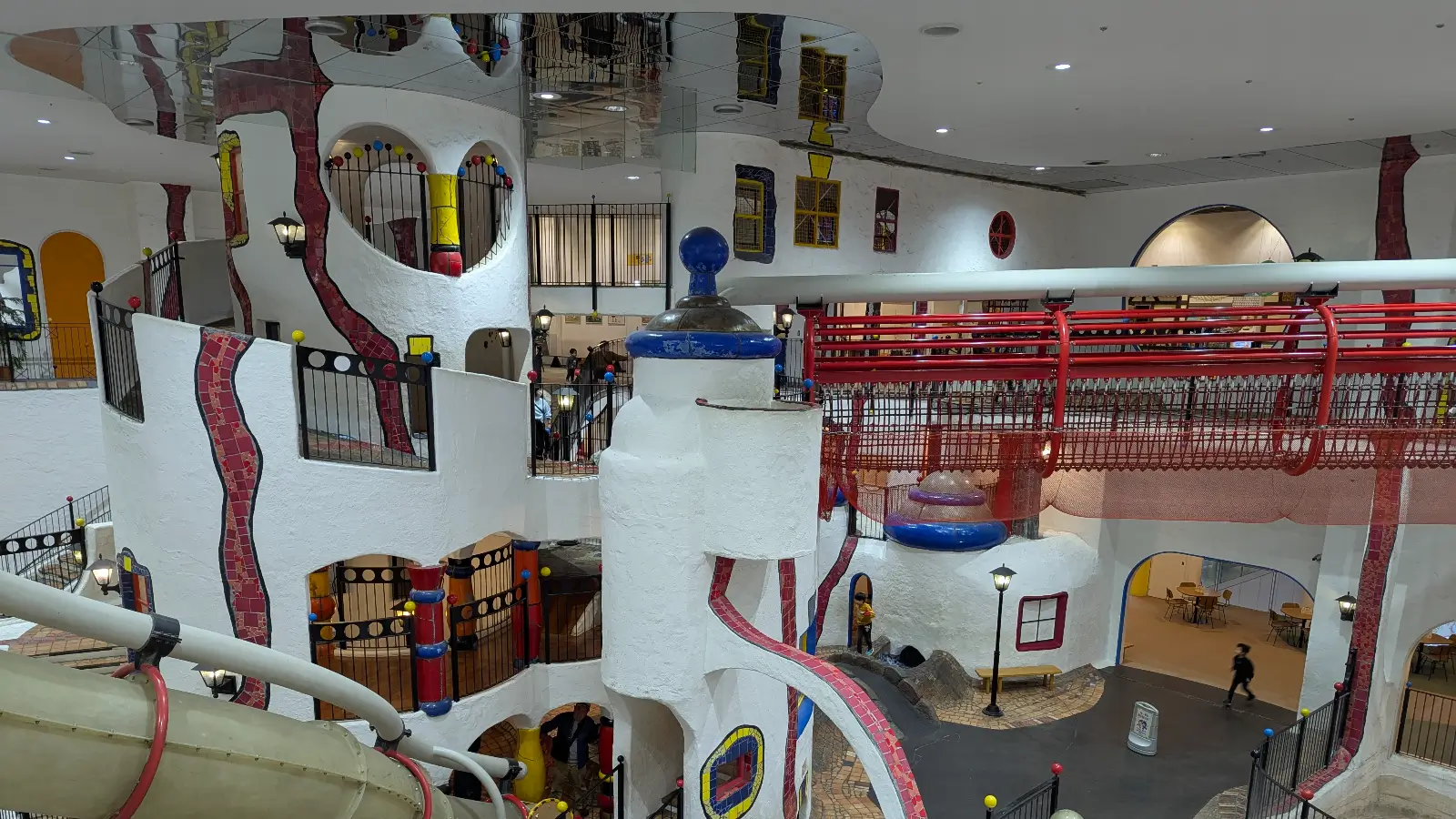
Four named rooms, three of them with a published headcount of 180. A science room, a planetarium, an indoor sports hall, and a 189-seat cultural hall with movable seating. That is the entire building and it can be told to a child on the train, which is what a child who depletes on unconfirmed structure needs: not a promise that it will be nice, but a list of four rooms that turns out to be true. The sports hall carries climbing nets, a trampoline jump platform, a rocket slide and a unicycle corner. The science room runs a globe screen, a ball coaster and a railway diorama that runs every fifteen minutes. A four-year-old lives in the sports hall; a twelve-year-old takes the planetarium.
Who it costs.The Sprinter. It is about 900 meters northeast of Higashi-Hanazono station and the building has no car park at all, so the walk in and the walk out are both on the legs.
How to make it work.Nothing can be reserved. Tickets are issued only on the day from a machine inside the building, so the room caps are the only thing between the family and a full house. Go early. The planetarium is the counterweight to the sports hall: a darkened, narrated room with reclining seats, and the one place to put a child who has had enough of the other three.
If this isn’t your child: a municipal building with four completely different rooms in it, and a nine hundred meter walk from the station at each end of the day.The staff here are Play Leaders, and their job is to show a child how a piece of equipment is meant to be used and what to do with it at their age. They are explicit that this is not supervision: the guardian stays beside the child and remains responsible for them. For a child who depletes on unfamiliarity that distinction is the point, because what drains them in a play hall is not the noise, it is standing in front of a structure with no idea what is expected of them. Here somebody tells them. The floor holds a ball pool, a trampoline zone, climbing equipment, pretend-play areas and a baby garden.
Who it costs.The Dynamo. Entry is metered from a short base unit and extended in small increments, and during a timed session the only permitted reason to leave the room is the toilet, so a movement-led child is on a clock from the moment they step in.
How to make it work.Entry runs through an advance-purchase account, and once the procedure is complete you are expected inside within thirty minutes, so do not register from the other side of Umeda. Socks are required. A group mixing teenagers of thirteen and over with young children is not admitted, and the baby garden is reserved for children up to eighteen months.
If this isn’t your child: the best-run play floor in central Osaka, five minutes from JR Osaka, and it is sold by the half hour.For the Sprinter
Rooms that take the standing out of a play afternoon.
For a child who empties out on sustained walking and standing.
The building lends you the legs. Twenty strollers are loaned free from the information desk, rated to about fifteen kilos, with stroller parking on two of the floors, which is the single most useful thing any five-floor play building in this city does. Everywhere else a small child who runs out halfway is carried or the visit ends. Here the family is handed the means to continue. The floors are themed rather than repeated: a ball circus at the entrance, a making floor, a play floor built around a children’s street, and a try-it floor of science at the top. A two-year-old is pushed between floors; a ten-year-old works the science floor alone.
Who it costs.The Sensor. The ground-floor ball circus is the first thing a family meets and it is lively by design, so the visit opens at its loudest point rather than building toward one.
How to make it work.The shape is worth knowing: you enter on the first floor and leave from the third, and that same door lets you back in on the same day. Bring a packed lunch, because you may eat it in the building, and use the fourth-floor rest space, which has wooden tables and benches rather than a corridor. A guardian must enter with the child. Nothing is booked and there is no time limit.
If this isn’t your child: the widest-range play building in Osaka, on a station exit at Ogimachi, and no clock on any part of it.Water is the one play format that carries a child instead of tiring them. Every other room on this map converts a child’s remaining stamina into activity and hands back a child with less of it. A heated six-lane 25 meter pool, a shallow infant pool and a relaxation pool do the opposite, because the body is supported and a child who cannot stand for another hour can float for one. One lane runs on a movable floor, so the shallow depth is set rather than fixed.
Who it costs.The parent, which is the honest version. A child in the fourth grade or below cannot enter without a guardian aged 16 or over, that adult must be in the water in a swimsuit rather than watching from the side, and one adult may bring at most three such children.
How to make it work.A swim cap is compulsory for everyone and rental caps exist, so nobody is turned back for forgetting one. Solo swimming is barred for the fourth grade and below, so an older sibling cannot mind a younger one. It is eight minutes southeast of Nagahoribashi, the most central entry here.
If this isn’t your child: an hour in central Osaka that gives a tired child back more than it takes, as long as an adult is willing to get changed.Start with the one that gates hardest.
Open with whichever child runs short first: the Dynamo on restricted movement, the Sensor on input, the Anchor on unconfirmed structure, the Sprinter on standing. Two of these are slotted and one issues tickets only on the day.
Three things worth getting right.
Pure Heart Kids Land at Frespo Shinkana refuses a teenager outright. It is the largest play floor in the prefecture, sixteen named zones on one mall floor in Sakai, and it admits children of elementary age and below with a parent. A visitor aged thirteen through nineteen is turned away whether or not a parent is with them, so an older sibling waits outside. Entry is also fully membership-based, registered with photo identification, which can be done on site but not skipped.
Half of this list is a trip out, and that is deliberate. Hirakata, Kawachinagano, Moriguchi and Higashiosaka are not places a visiting family passes through, and these rooms are uncrowded and unwritten about because they are suburban. Treat them as a destination for the day rather than as something to slot into a Namba afternoon.
Two rooms in Grand Front Osaka sit three floors apart and could not be less alike: Bornelund on the third and Gravity Research on the sixth. A family with two children who want opposite afternoons can split in one building, which nothing else in the city allows.
What earns a play floor a place here.
Osaka play lists sort on floor area and attraction counts. Neither tells a parent whether their child will be let in.
The axis here is what the building has and has not got, and who it lets through the door. Four questions decide it. What is physically in the room, and what has been left out of it? Who is admitted, by height, weight, age or membership? Is an adult required in the room, or barred from it? And does the visit run on a clock the family sets or the venue does? Sorted that way, a municipal sports hall with four rooms and a ticket machine outranks several larger commercial floors.
The questions parents actually ask.
What are the best indoor playgrounds in Osaka?
Nine rooms, and the gate on each door narrows it fast. Tondemi Hirakata, Tentoumushi Park and ATC Asobi Mare are for a child who empties out when they cannot move; Skids Garden and Gravity Research for a child short on input; Dream 21 and Bornelund for a child who needs to know what happens next; Kids Plaza and the Chuo Indoor Pool for a child who runs out of legs. Kids Plaza is the safest single choice, because it holds the widest spread and loans a stroller to carry the smallest.
Which Osaka indoor playground works for a teenager?
Tondemi Hirakata, and it is close to the only one. Most Osaka play floors run an age ceiling at the end of elementary school, and the largest of them will not admit a thirteen to nineteen year old at all, accompanied or otherwise. Tondemi gates on the body instead: at least 110 centimeters tall and between 20 and 120 kilos, both conditions met. That admits a thirteen to sixteen year old rather than excluding them. Gravity Research Umeda is the other room that holds that age.
Are there indoor playgrounds in central Osaka?
Four of these nine are central or near it, and five are a deliberate trip out. Kids Plaza sits on a station exit at Ogimachi, Bornelund and Gravity Research are three floors apart inside Grand Front Osaka, and the Chuo Indoor Pool is eight minutes from Nagahoribashi. Tondemi is in Hirakata, Tentoumushi in Kawachinagano, Skids Garden in Moriguchi, Dream 21 in Higashiosaka and ATC Asobi Mare at the bay. The suburban ones are the least crowded precisely because they are suburban.
Can you leave a child at an indoor playground in Osaka?
At one of them, within a narrow age band. Skids Garden takes children from age three to the second grade of elementary school without the guardian staying, with qualified childcare staff in the room and a mobile number registered at the door. Children aged 0 to 2 need a guardian aged 16 or over present. Everywhere else the opposite applies: at Bornelund and ATC Asobi Mare the adult must be in the room, and a child alone is refused.
Which Osaka indoor playground is best for a toddler?
ATC Asobi Mare, because of how it splits the room. Its two ball pools are separated into a zone for ages 0 to 5 and one for 6 and over, so a two-year-old is not sharing a pit with a ten-year-old, and the same floor holds jumbo blocks, a toy area and a dress-up street. Bornelund at Grand Front is the central alternative and reserves its Baby Garden for children up to 18 months.
Do Osaka indoor playgrounds need to be booked?
Mostly no, with two exceptions that shape a day. Tondemi Hirakata runs 90-minute sessions starting at 30-minute intervals and sells web tickets up to half an hour before each one, so it is slotted rather than free-flow. Bornelund at Grand Front runs entry through an advance-purchase account and expects you inside within 30 minutes of completing the procedure. Dream 21 is the odd one: no reservation exists at all, and tickets are issued only on the day from a machine inside the building.
Is there a free indoor play space in Osaka?
Yes. The City of Osaka runs a Children and Child-Rearing Plaza in every one of its 24 wards, free and needing no booking, each holding two things: a gathering space for infants and toddlers with their guardians, and a drop-in covering elementary through high-school age. The catch is the clock, not the cost. Elementary-age access is restricted to defined afternoon windows on weekdays, wider at weekends and in school holidays, so it is a neighborhood resource rather than an afternoon’s plan.