Tokyo Tower with Kids: Night Views, Lights, and 600 Steps.
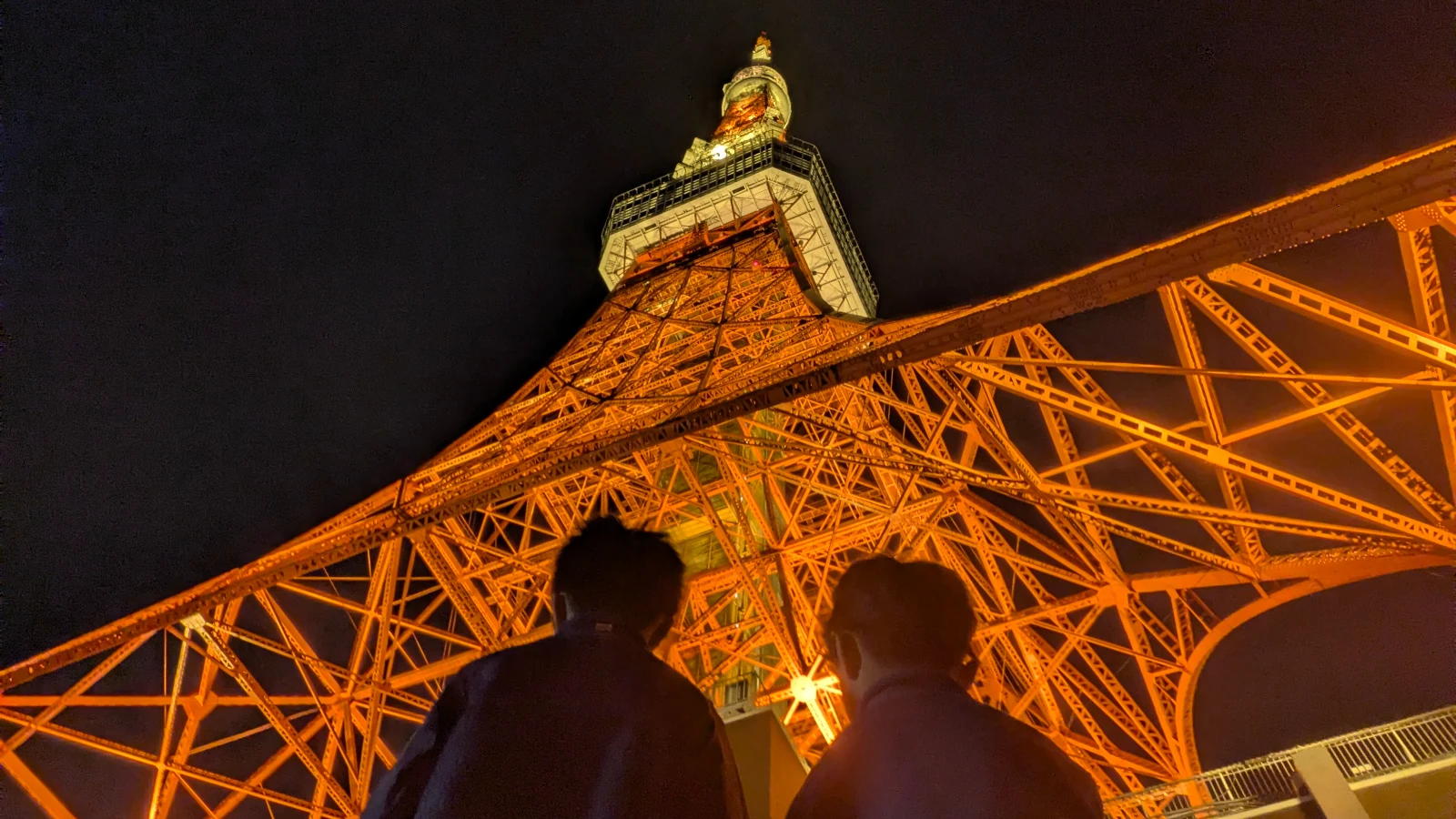
Tokyo Tower looks like a view to stand at, but for a child who needs to move, the weekend stairs are the visit, and after dark the lights take over.
Elementary and junior high ¥900. Booking ahead is offered, not required: online by card, or at the FootTown counter.
Top Deck tours can stop in bad weather, and the Main Deck’s last entry can come earlier when crowded. Open every day of the year.
Kindergarten-age climbers take about 15 minutes up the stairs.
Even kindergarten-age children manage the weekend climb.
Best left at the FootTown first-floor operation center, as there are stairs on the way; loaners for newborns to under 4.
Some links on this page are affiliate links. LuNi may earn a commission at no extra cost to you.
Is Tokyo Tower worth it with kids?
The short version, before the costs, the timings and the case for each child.
Yes, and the best version of it is at night. After sunset the tower sparkles white on every hour, and from the Main Deck the whole city is lit below, which is the view children remember. The other reason to go is the stairs. On weekends and holidays a family can climb to the Main Deck on open-air steps instead of riding up, and for a child who needs to move, that climb turns a deck built for looking into a real task. For a child who finds busy places hard, keep the visit short, because there is no way back in once you leave. Leave the stroller at FootTown, since there are stairs on the way, and plan the evening around the lights.
Planning Your Visit to Tokyo Tower with Kids.
Three decisions shape a Tokyo Tower visit, and the first is the day. The climb is a weekend and holiday event that weather can cancel, so a family with a climber chooses a dry weekend and keeps a weekday as the elevator fallback. The second is the hour. Come after dark, when the lit city and the tower’s own sparkle give a child something to wait for, and let that timing set the rest of the evening. The third is the stroller, which stays at FootTown because there are stairs on the way, so bring a carrier for the smallest child. Entry is once only, so the family goes up ready: fed, rested and with the evening planned around the next sparkle rather than the clock.
Every LuNi attraction guide starts with a visit, with our own children
LuNi rates and writes about attractions only after visiting them with children. Luca and Nico were at Tokyo Tower, and what they did there is recorded further down this page, including how each child actually met it.
Children arrive with different tolerances: for noise, for lines, for standing still, for being on their feet all day. A guide written for the average of them helps almost nobody. So every place on this site is read four ways, and each verdict says which children it already suits and what makes it work for the rest. Whoever you are bringing, the answer here is built for your family rather than for a general reader.
Restricted-movement depletion eases on the open-air stairs on weekends and holidays, so time the visit for a dry weekend and let the child climb.
Sensory-input depletion peaks on a lit, busy deck with no re-entry once inside, so keep the visit short and plan somewhere quiet straight after.
Unfamiliarity eases with fixed prices, tickets bought ahead and a sparkle on every hour after sunset, so tell the child exactly when the lights will change.
Walking and standing stay modest with elevators and a barrier-free route up; leave strollers at FootTown, since there are stairs on the way.
- Cost
- Main Deck ¥1,500 adult / ¥600 age 4 and upElementary and junior high ¥900. Booking ahead is offered, not required: online by card, or at the FootTown counter.
- Booking
- Online by card, or at FootTownSold online, by card, and at the FootTown first-floor counter; there is no telephone booking.
Hotels we would book for this visit.
Bedtime decides the room here: a tower visit is an evening, and a child who waited up for the sparkle needs the night to end soon after it. Three Tokyo family hotels, the pick first, one of them at Shiodome.
| Property | The LuNi Reason |
|---|---|
| LUNI Pick The Prince Park Tower Tokyo | The Prince Park Tower Tokyo is for the family that makes the tower its whole evening. A child who has climbed the weekend stairs or waited up for the sparkle has little left by the last hour, so settle the room first, go up after dinner, and keep the end of the night to the ride back and bed. |
| Hotel Villa Fontaine Grand Shiodome | Hotel Villa Fontaine Grand Shiodome is for a family whose Tokyo week runs on trains rather than around one sight. The tower is one evening among several, so the room earns its place on the other days too: a child who steadies on the familiar comes back to the same door each night, whatever the day held. |
| Tokyo Prince Hotel | Tokyo Prince Hotel is for the child who fades soonest once the sparkle is over. The argument is the same evening: a bed that ends the night early for a child who spent the day looking, so the tower stays a treat at the close of the day rather than one more demand on it. |
Hotel Villa Fontaine Grand Shiodome
Nearby attractions, matched to your child.
Three pairings for what the tower leaves unmet: an immersive art museum near the same station, a huge open park for a child who needs quiet space, and a gallery of lit tanks for a watcher.
| Pairing | Why This Solves the After-Visit | For Your |
|---|---|---|
| LUNI Pick teamLab Borderless Azabudai Hills; Kamiyacho Station, 2 min | Two minutes from Kamiyacho Station, one of the tower’s own stations, teamLab Borderless is a museum with no map to explore on foot. A Dynamo’s restricted movement finds room there to wander, though a Sensor’s sensory input runs high inside the dark rooms. | Dynamo |
| Yoyogi Park Harajuku; free and always open | After a lit, busy deck, Yoyogi Park gives a Sensor the opposite the next morning: open lawns in daylight, where loud or amplified music is banned. Sensory input thins out with room on every side, after an evening packed close at the glass. | Sensor |
| Art Aquarium Museum GINZA Ginza; timed tickets, 9F entrance | For an Anchor, Art Aquarium Museum GINZA is a visit whose shape can be told before the day: up to the ninth floor, down one escalator with the staff, on a timed ticket. Unfamiliarity eases with every step named in advance; a Dynamo’s restricted movement meets its look-only rule, so keep that child’s visit short. | Anchor |
teamLab Borderless
Azabudai Hills; Kamiyacho Station, 2 min For YourDynamo
Yoyogi Park
Harajuku; free and always open For YourSensor
Art Aquarium Museum GINZA
Ginza; timed tickets, 9F entrance For YourAnchor
How two children actually met this attraction.
Two children went up the same tower at night and took completely different things from it. One cared most about the tower itself, planning a photograph at the base and delighted to see the structure lit; the other cared about the city below, circling the windows and narrating everything that flashed. Both of them were glad, in the end, that they had come after dark, which is the clearest lesson of the visit. The lit tower and the lit city are the experience. Plan the whole evening around them, and around the hour: a photograph at the base for the child who loves the structure, and a loop of the deck windows for the child who needs to move, before the energy of the evening runs out.
Luca fixed on the tower’s scale before he was anywhere near the top. At the base he worked out the exact angle and distance that would make the tower appear to balance directly on top of him, directing whoever held the camera until the forced-perspective photo lined up. He was visibly pleased the family had come at night, telling everyone he had wanted to see the structure with all its lights on.
This is the Anchor pattern. A child whose Reserve depletes through unfamiliarity and unconfirmed structure settles by making a plan of his own and seeing it through, and a photograph worked out in advance gave him exactly that. For a similar child, tell him before the evening what he will see and when, including the hourly sparkle, and give him one thing to plan himself, a photograph at the base or a landmark to find from the deck.
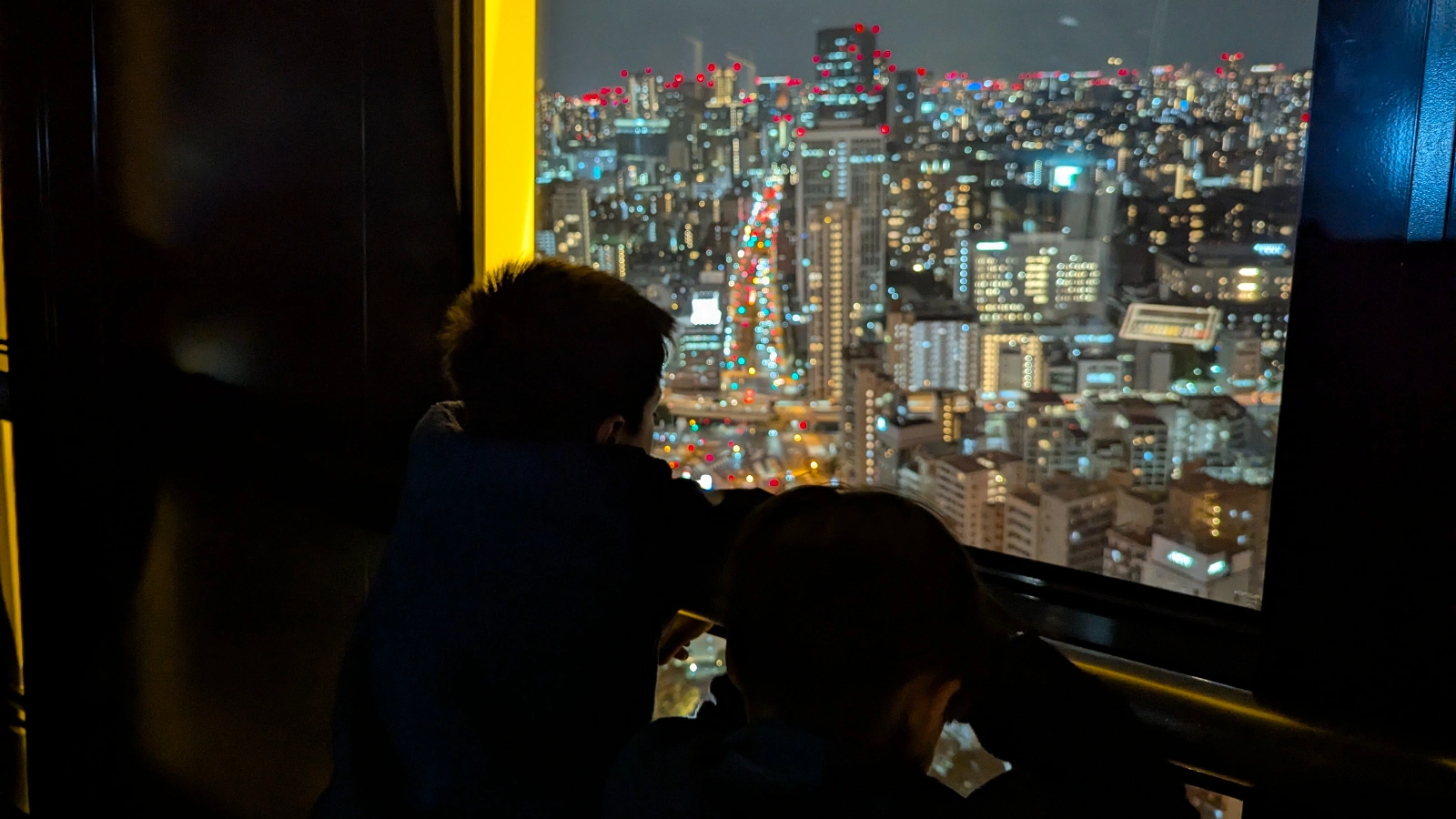
Nico did not stay still for a second. He moved along the deck windows in a near-constant loop, pressing up to the glass at one angle, darting to the next, then circling back, narrating the whole time in a running stream about the city flashing and changing far below. His engagement held strongest early in the visit and started to thin as the evening ran on.
This is the Dynamo pattern. A child whose Reserve depletes through restricted movement will turn any deck into a circuit, because moving is how he takes a place in. For a similar child, choose a weekend and let him climb the open-air stairs, which gives the visit a real physical task, then let him loop the deck freely. Keep the evening short enough that it ends while he is still enjoying it, rather than after the energy has gone.
Seeing a city at night from above turns an ordinary evening into an event a child will remember for years. The lights below, the tower lit around them, the sense of being up late somewhere special: these are the moments that make travel feel different from home. Children do not need a packed day to feel they have seen a place. Sometimes one well-chosen evening, looked forward to all afternoon and shared with the people they love, does more for a child’s sense of wonder than a week of attractions.
The LUNI Rating for Tokyo Tower.
The verdicts split on what a lit, busy deck asks of each child. The Sensor pays most because there is no re-entry once inside and the deck can grow crowded. The Dynamo needs a plan because a deck is a place for looking, eased by the open-air stairs on weekends. The Anchor and the Sprinter are well served: the visit is easy to plan, and elevators and a barrier-free route carry the family up. Choose the day and the hour, and the tower rewards it. Tokyo Skytree asks the same of a Sensor: sensory input rises on that deck as well, so keep it short too.
Climb it on a dry weekend. The Dynamo depletes through restricted movement, and an observation deck is a place for standing and looking. What rescues the visit for a moving child is the open-air stairs: about 600 steps from the FootTown roof to 150 meters, open for climbing on weekends and holidays from 9:00 to 16:00, at the normal deck fee. The climb takes about 12 to 13 minutes, and even kindergarten-age children make it in about 15.
Let the climb decide the day. Choose a weekend or holiday with dry weather, since the stairs close in rain, storms and heatstroke alerts, and once started there is no switch to the elevator. Let the child climb, then give them a loop of the deck windows. On a weekday or a wet day, the elevator will do, but keep the deck visit short and give the child a job at the windows, a landmark to find.
What this means for your Dynamo: a deck is a place for looking, and the weekend stairs are the release for restricted movement. A younger Dynamo needs the climb on a dry weekend; an older one can count the steps and set the pace.Keep it short, and plan quiet straight after. The Sensor depletes through sensory input, and a lit observation deck at night concentrates it: the city flashing below, other visitors along the windows, and on the hour the tower’s own sparkle. The Main Deck’s last entry can be brought forward when it is crowded. And entry is once only, so a child who needs a break cannot step out and come back in.
So the answer is time rather than a trick. Keep the visit short, settle bathroom breaks and snacks before going up, and decide in advance when the family will come down. Choose the hour that suits the child rather than the one that suits the photographs, and plan somewhere calm straight after rather than a second busy stop.
What this means for your Sensor: input runs high on a lit deck with no re-entry once inside. A younger Sensor needs a short visit and a quiet place after; an older one can choose the hour and signal when to go down.Tell the child exactly when the lights will change. The Anchor depletes through unfamiliarity and unconfirmed structure, and Tokyo Tower is easy to make predictable. Prices are fixed and published. Tickets are sold online and at the FootTown counter. And the lights keep a schedule a child can learn: a two-minute sparkle on every hour after sunset, the Diamond Veil on Mondays and Thursdays from 20:00 to 22:00.
Share the schedule with this child. Tell them what time the family will arrive, when the next sparkle will come, and when you will head down. If you are climbing, tell them how many steps and roughly how long. A child who knows the lights are due at eight o’clock will spend the minutes before it watching, happily, for the change, and will call it out when it comes.
What this means for your Anchor: unfamiliarity eases once the lights are known to run on the hour. A younger Anchor needs the next sparkle named in advance; an older one can keep time and call it for the family.Leave the stroller at FootTown, and ride up. The Sprinter depletes through sustained travel-style walking and standing, and the tower asks for less of both than its height suggests. The Main Deck is reached by elevator, and there is a barrier-free route to it, arriving on the deck’s second floor, with staff to help down to the first. Strollers can be used in FootTown and on the Main Deck, and rental strollers are lent for the youngest, newborns to under 4.
Only the stroller needs planning. Leave it at the FootTown first-floor operation center, because there are stairs on the way, and bring a carrier for a small child. Skip the open-air stairs for a tired child, and keep the deck visit to a single loop. For this child, the tower is a short, easy evening if the elevator does the work, and one of the kinder evenings Tokyo offers a tired child.
What this means for your Sprinter: the elevator and a barrier-free route up keep walking and standing modest. A younger Sprinter needs a carrier, with the stroller left at FootTown; an older one can manage a loop of the deck.The questions parents actually ask.
Entry to the decks is once only, which settles how a family goes up. A family goes up fed, rested and with bathroom breaks settled, because a child who needs a break cannot step out and come back. The stairs keep their own rule: the climb is for weekends and holidays in dry weather, and the way down is open every day. Strollers stay at FootTown, since there are stairs on the way. Give it a whole evening of a Tokyo trip, not the hour left over. And the tower’s lights run on the hour after sunset, which sets the time to arrive.
Is Tokyo Tower worth visiting with kids?
Yes, especially after dark, when the lit city and the tower’s own hourly sparkle are the reason to go. For a child who needs to move, the open-air stairs on weekends and holidays turn the climb into the highlight. For a child who finds busy places hard, plan a short visit, since there is no re-entry once you are in.
How much does Tokyo Tower cost for a family?
The Main Deck costs 1,500 yen for adults, 1,200 yen for high school students, 900 yen for elementary and junior high students, and 600 yen for children of 4 and over. The Top Deck Tour costs 3,300 yen for adults on the web or 3,500 yen at the counter, with lower prices for each younger band.
Can children climb the stairs at Tokyo Tower?
Yes. The open-air stairs climb about 600 steps from the FootTown roof to 150 meters, about 12 to 13 minutes, and even kindergarten-age children reach the top in about 15 minutes. You can go up on weekends and holidays from 9:00 to 16:00, and down every day from 9:00 to 20:00, at the normal deck fee.
What happens to the Tokyo Tower stairs in bad weather?
They close. The open-air stairs are canceled in rain, storms and heatstroke alerts, and once you start, you cannot switch to the elevator partway, so decide before the first step. On a wet or very hot day, plan to ride the elevator instead, and save the climb for a clear weekend morning when the stairs are open and the child is fresh.
Can you bring a stroller to Tokyo Tower?
Yes, in FootTown and on the Main Deck, but it is better left at the FootTown first-floor operation center, because there are stairs on the way. Rental strollers are lent at Information for newborns to children under 4, up to 20 kg, in limited numbers. There is no nursing room on the decks.
When do the Tokyo Tower lights sparkle?
On every hour from sunset to midnight, the tower runs a two-minute white sparkle. The Infinity Diamond Veil lights up on Mondays and Thursdays from 20:00 to 22:00. The everyday Landmark Light turns silver in summer, from July 7, and orange in winter, from early October, which is the look most families remember.
Can you leave Tokyo Tower and come back in?
No. Entry to the Main Deck and the Top Deck is once only, so settle snacks and bathroom breaks before going up. Tickets are sold online, by card only, and at the FootTown first-floor counter, and there is no telephone booking. Tripods are not allowed on the Top Deck, and the decks are entirely non-smoking.
How do you get to Tokyo Tower?
The nearest stations are Akabanebashi, about five minutes on foot, and Onarimon, about six; Kamiyacho is about seven minutes, and Shibakoen and Daimon about ten. There is a barrier-free route to the Main Deck elevator, which arrives on the Main Deck’s second floor, with staff to help down to the first.
Where Tokyo Tower fits your Japan trip.
Official site and opening information: Tokyo Tower