A 3-Day Kyoto ItineraryThat Adapts to Your Child.
- With Teenagers
- Teens run the Arashiyama and Fushimi Inari days
- Where to Start
- Day 1 in Higashiyama, the gentlest cluster
- With Toddlers
- One temple swapped for park and riverside
- The Three Days
- Higashiyama, Arashiyama, Fushimi Inari
- A Fourth Day
- The Nintendo Museum
The things to do with kids in each part of the city, and why a temple morning costs more than its map suggests.
Some links on this page are affiliate links. LuNi may earn a commission at no extra cost to you.
Kyoto with teenagers works on the same three-day route as Kyoto with younger children; only the handling changes. Start on Day 1 in Higashiyama, the gentlest cluster for a jet-lagged arrival, then give Days 2 and 3 to Arashiyama and Fushimi Inari, which a teen can lead while reading the trains. A toddler gets the same route with one temple stop swapped for park and riverside time. Kyoto looks like the calm city, but the calm is not evenly spread: stone steps and long approaches cost more than a map shows. A fourth day unlocks the Nintendo Museum.
Why the day breaks when it breaks.
Family travel runs on three currencies, not two. Money and time are the ones parents already watch. The third is the child’s Reserve, their finite capacity to absorb what a travel day asks of them. Kyoto spends that Reserve unevenly, through the stone-step climbs, the look-don’t-touch stillness of a temple, the long approach a map makes look short, and the early-afternoon collapse is simply the account hitting zero. The LUNI Framework counts that third currency so the day stops going bankrupt at 2 p.m.
This guide works in two moves. First, one strong three-day Kyoto route: the backbone we would hand any family walking in cold, built as three tight clusters so the Reserve goes into the city rather than the trains. Then the profile layer, where the framework names how your particular child runs down and what one change protects them, because the child who empties in stillness needs a different Kyoto day than the one who empties on the climb. The route holds for everyone. The adjustment is yours alone to make.
Three days, one cluster a day.
Kyoto’s best family stops fall into three pockets: Higashiyama in the east, Arashiyama in the west, and the southern shrines with the Kyoto Station stops. One pocket a day is the whole trick.
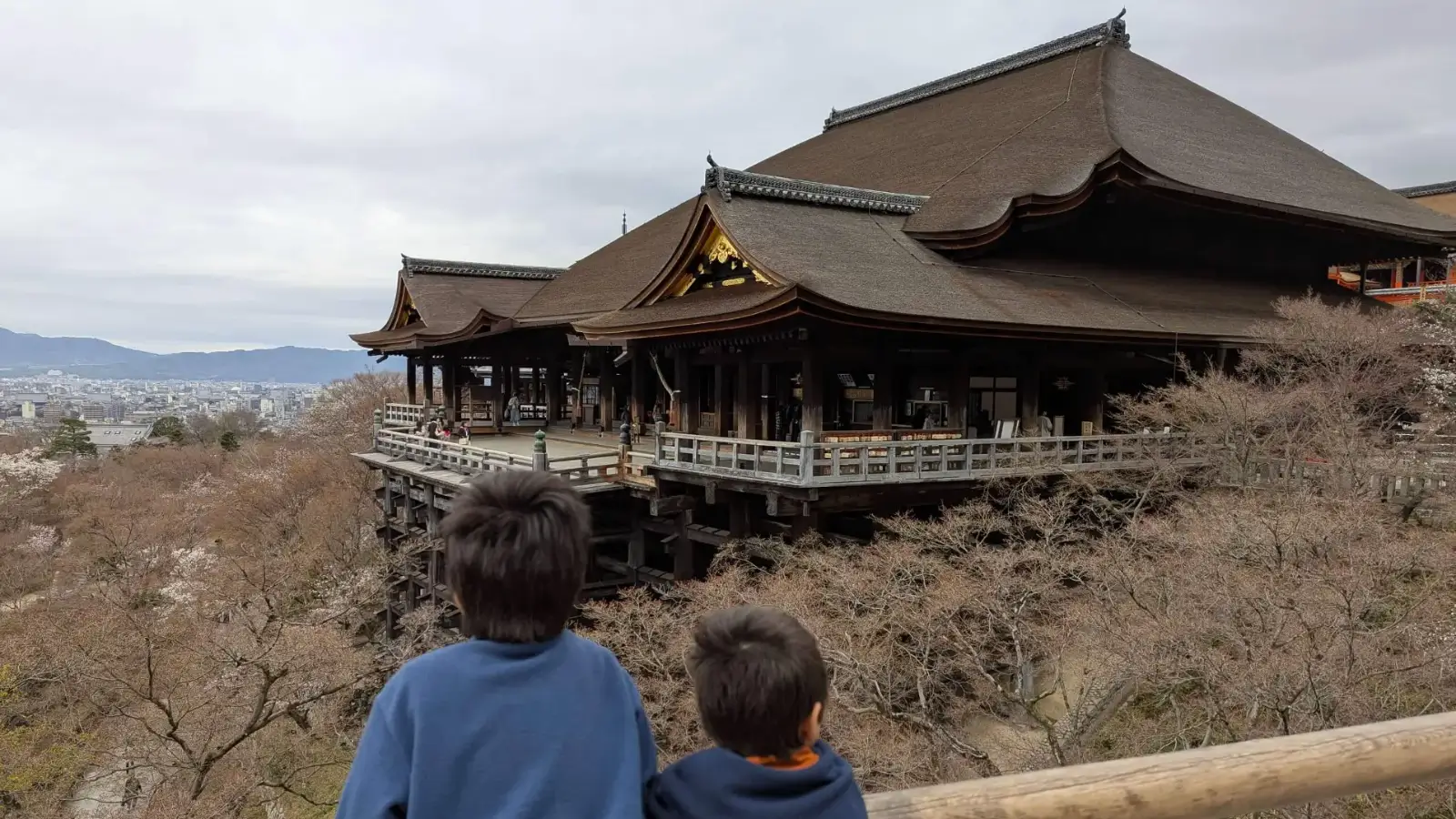
Kyoto spreads its highlights to opposite edges of the city, and this route removes the classic mistake of pairing an eastern temple with a western one and losing an hour of a child’s Reserve to the trains. Each day stays inside one pocket. Day 1 walks Higashiyama in the east, a single chain from Kiyomizu-dera down the approach streets to Yasaka Shrine, Maruyama Park, and Gion, a soft opener for a jet-lagged family. Day 2 crosses to Arashiyama in the west for the bamboo grove at dawn, the Tenryu-ji grounds, and Monkey Park Iwatayama, with the Hozugawa River boat floating back down into the cluster from its start a short train ride away in Kameoka. Day 3 drops south to Fushimi Inari at opening, then up to the Kyoto Station stops, the Railway Museum and teamLab Biovortex or the Nidec Kyoto Tower deck, closing near the station for departure.
Run it as written and a first-time family has a genuinely good three days. The Nintendo Museum is left off on purpose: it runs on a timed reservation booked a few months ahead and is a half to full day on its own in southern Kyoto, so it earns a fourth day rather than a slot carved out of these three. Kinkaku-ji and Nijo Castle stand ready as swap-ins. The profile layer below is what tightens this backbone into the right trip for your group.

The one change your child needs.
Same three days, four different trips. One profile below is the one quietly running your family’s clock. Read yours, make its single change, and the route that looked fine on paper starts working in practice.
The change: lead every day with the walked, open thing and keep the sealed, seated stops out of the mornings. The Dynamo’s Reserve depletes through restricted movement, so the danger stops are the ones that pen a child in place: the look-don’t-touch corridor of the Arashiyama bamboo grove, which offers no side routes and nothing to convert movement into engagement, and the two hours of enforced stillness on the Hozugawa River boat, which is the single worst structure for a movement-driven child. The route already hands this profile its best day. Day 3 opens at Fushimi Inari, where the vermilion torii corridor turns a shrine visit into sanctioned climbing and the restlessness discharges as forward momentum up the mountain, exactly the relief a Dynamo needs from Kyoto’s otherwise still temple circuit. Let them climb to the Yotsutsuji lookout before anything asks them to stand quietly.
On Day 2, protect the west. Walk the bamboo grove fast and early, then send the Dynamo up the 20-minute climb to Monkey Park Iwatayama, where the ascent is the point rather than an obstacle and the child arrives at the summit regulated enough to watch the macaques. Skip the seated river boat for this profile, or pair it with a discharge stop, never run it cold. On Day 1’s Higashiyama chain, the approach streets are walked rather than toured, so hand the child the lead between Kiyomizu-dera and Gion and let the movement pressure spend itself on foot. A younger Dynamo burns it on the temple approaches and the monkey climb; an older one takes the full Fushimi Inari loop to the summit and paces the group on the trains.
The change: treat teamLab and the midday crowds as the real threat, and protect the calm mornings that offset them. The Sensor’s Reserve depletes through sensory input, and Kyoto hides its heaviest load in plain sight. teamLab Biovortex, the Day 3 station-side option, concentrates mirrored rooms, shifting light, and continuous projection with no low-stimulation corner to retreat to, so for this child swap it out for the Nidec Kyoto Tower deck or the Railway Museum’s ground-floor play area instead. The Golden Pavilion, if you trade it in as a swap-in, is another one to reconsider: Kinkaku-ji’s tight, one-way crowd flow runs high on this profile. The good news is that the route’s calmest stops are genuine recovery, not filler. The Arashiyama bamboo grove is one of the few places in Kyoto where input drops rather than climbs, on one firm condition.
That condition is timing. Arrive at the bamboo grove before 7 a.m. and it is a real reset, 15-meter stalks and a soft low rumble and nothing to decode; by mid-morning the crowd turns it into the opposite. Build Day 2 around that early calm and let it carry the day. On Day 1, Kiyomizu-dera itself is calm and rates well for a Sensor, but keep the packed Gion lanes short and optional, one pass rather than a long stay in the crush. Most of all, do not stack the intense stops back to back: drop the calmest half-day you can spare, a slow morning or an afternoon back at the hotel, between a high-input stop and the next one, so the Sensor comes in with Reserve still in hand rather than already drained.
The change: lock one base for all three nights, and talk the child through each day before it starts. The Anchor’s Reserve depletes through unfamiliarity and unconfirmed structure, which makes the most protective decision on this whole trip one you take before leaving home: a single hotel, held for all three nights. The temptation in Kyoto is to move, a night near Arashiyama for the west day, a night near the station for the last, but a fresh room costs an Anchor far more than the train time a move saves. Pick one base near Kyoto Station or Gion and every cluster is a single clean ride away. That one booking decision does more for an Anchor than anything you can do once the trip is underway.
Then work the rhythm that keeps them steady. Before you leave the room each morning, narrate the day as a sequence: Kiyomizu-dera first, then the approach streets, lunch in Maruyama Park, Gion after, back here by four. Before bed, do the same for tomorrow, because an Anchor settles faster into sleep when the next day is already a known quantity. Sequence matters inside a day too. The route’s most Anchor-friendly stops reward it by design: the Kyoto Railway Museum runs on a floor layout a structure-reliant child can track from the entrance, and Nijo Castle, the Day 3 swap-in, gives a single-direction route from the Ninomaru corridor through the nightingale floors to the garden loop. Lead each day with the confirmed stop and leave the open-ended lanes of Gion for when the child is steadiest. If you add the Nintendo Museum as a fourth day, its timed, pre-booked route is the most Anchor-perfect stop in the city.
The change: put a genuine sit-down meal in the middle of every day, and treat the two big climbs as optional rather than mandatory. The Sprinter’s Reserve depletes through sustained travel-style walking and standing on hard ground, and Kyoto is unusually hard on this child because so much of it is stone steps and temple approaches rather than flat sidewalks. The route’s two highest-rated stops are also its two biggest risks here: Kiyomizu-dera on Day 1, reached up a long stepped approach, and Fushimi Inari on Day 3, an uneven stone climb with sustained elevation gain where a low-stamina child can empty the whole day’s Reserve on the ascent alone. For this profile, set a firm turn-back point on both: the terrace at Kiyomizu without the full hillside beyond it, the Yotsutsuji lookout about 40 minutes up Fushimi Inari and no further.
Then build the recovery in. Kyoto gives a Sprinter genuine gifts if you use them: the Hozugawa River boat on Day 2 is fully seated for its whole run, nothing to walk or climb, and Nishiki Market near the station is flat, covered, and paced as move-sample-move rather than a standing queue. Measure a small child before booking it, since the boat takes no one shorter than about 80 cm, even on a lap.
Take a real 45-minute seated meal in the middle of every day rather than grazing on the move, because for this child that seated block is not indulgence, it is the recovery that pays for the afternoon. Keep the heaviest climbing off the final day so the trip does not lose its last hours to spent legs, and if the child fades, cut the optional climb rather than pushing through it. A younger Sprinter watches the boatmen work the poles and grazes the market stalls; an older one takes the lower Fushimi Inari loop at their own pace and stops when the legs say so.
Few families travel with one child, and siblings almost never share a profile. When two collide on the same Kyoto day, the rule is simple: the child with the tighter limit sets the shape, and the other’s needs fit into the space that leaves. Pair a Sensor with a Dynamo and the day runs to the Sensor’s ceiling, with the Dynamo’s movement slotted into the gaps, never the other way around, because a blown sensory threshold ends the day for everyone while unspent energy only needs somewhere to go. In practice that looks like the Dynamo climbing ahead up the Fushimi Inari corridor while the Sensor eases through the quiet lower gates, or the Sprinter taking a seated lunch in Arashiyama while the Anchor hears tomorrow walked through. Find the child who caps the day soonest, build to them, and one itinerary carries the whole family instead of two plans pulling against each other.
The questions parents actually ask.
Is 3 days in Kyoto enough with kids?
Yes, for the city itself. Three days covers Kyoto’s three natural clusters from one hotel, one a day: Higashiyama in the east, Arashiyama in the west, and the southern shrines with the Kyoto Station stops. A fourth day is what unlocks the Nintendo Museum, which is booked far in advance, or a day trip to Nara or Uji, without compressing the core.
What is the best Kyoto itinerary by age?
The three clusters stay the same from ages 3 to 16; only the handling changes. A toddler gets more park and riverside downtime and one temple stop swapped out, while a teen leads the Arashiyama and Fushimi Inari days and reads the trains. Age sets how far a child can go before the Reserve runs low, not which stops they see.
Can toddlers and teens follow the same plan?
Yes, on the same three-cluster route. Where siblings differ, the child with the tighter limit sets the day’s shape and the other’s needs fold into the gaps, so one plan holds for a mixed-age family rather than splitting the group in two.
How much walking should families expect in Kyoto?
Plan for roughly 4 to 7 miles on active days, much of it on temple approaches and uneven stone steps rather than flat sidewalks. The Fushimi Inari climb on Day 3 and the Kiyomizu-dera approach on Day 1 carry the most sustained standing and stairs, so a child whose Reserve drains through walking needs a genuine seated meal built into the middle of each day.
Which Kyoto areas should a 3-day itinerary cover?
Cover them one cluster a day: Higashiyama in the east for Kiyomizu-dera and Gion, Arashiyama in the west for the bamboo grove and the monkey park, then the southern shrines and the Kyoto Station stops. Keeping to one area a day is not only shorter transit; it lets a tired child return to rest without crossing the city, and because the clusters load a child very differently, the order you run them in should follow how your child depletes.
What is the best time of year to visit Kyoto with kids?
Spring and autumn are easiest on a child’s Reserve, because mild days make the open temple approaches and the Arashiyama walks cost far less to get through. Summer heat is a depletion multiplier that shortens how long any child lasts on the Fushimi Inari climb and the outdoor stretches, so in July and August move those stops to early morning and lean on indoor anchors like the Kyoto Railway Museum and teamLab Biovortex.
Do we need a fourth day for the Nintendo Museum in Kyoto?
Yes, if it matters to your family. The Nintendo Museum runs on a timed reservation booked a few months in advance, which aligns with most families’ planning, and it is a half to full day on its own in southern Kyoto. Rather than carve it out of the three core clusters, treat it as the day-four unlock and book the slot when your dates are set.
What is the most common mistake families make in Kyoto?
Crossing the city more than once in a day, usually by pairing an eastern temple with a western one and losing an hour of a child’s Reserve to the trains. Keeping to one cluster a day, with one anchor stop and real rest around it, is what keeps three days enjoyable.