Fushimi Inari with Kids: a mountain hike, not a scenic walk.

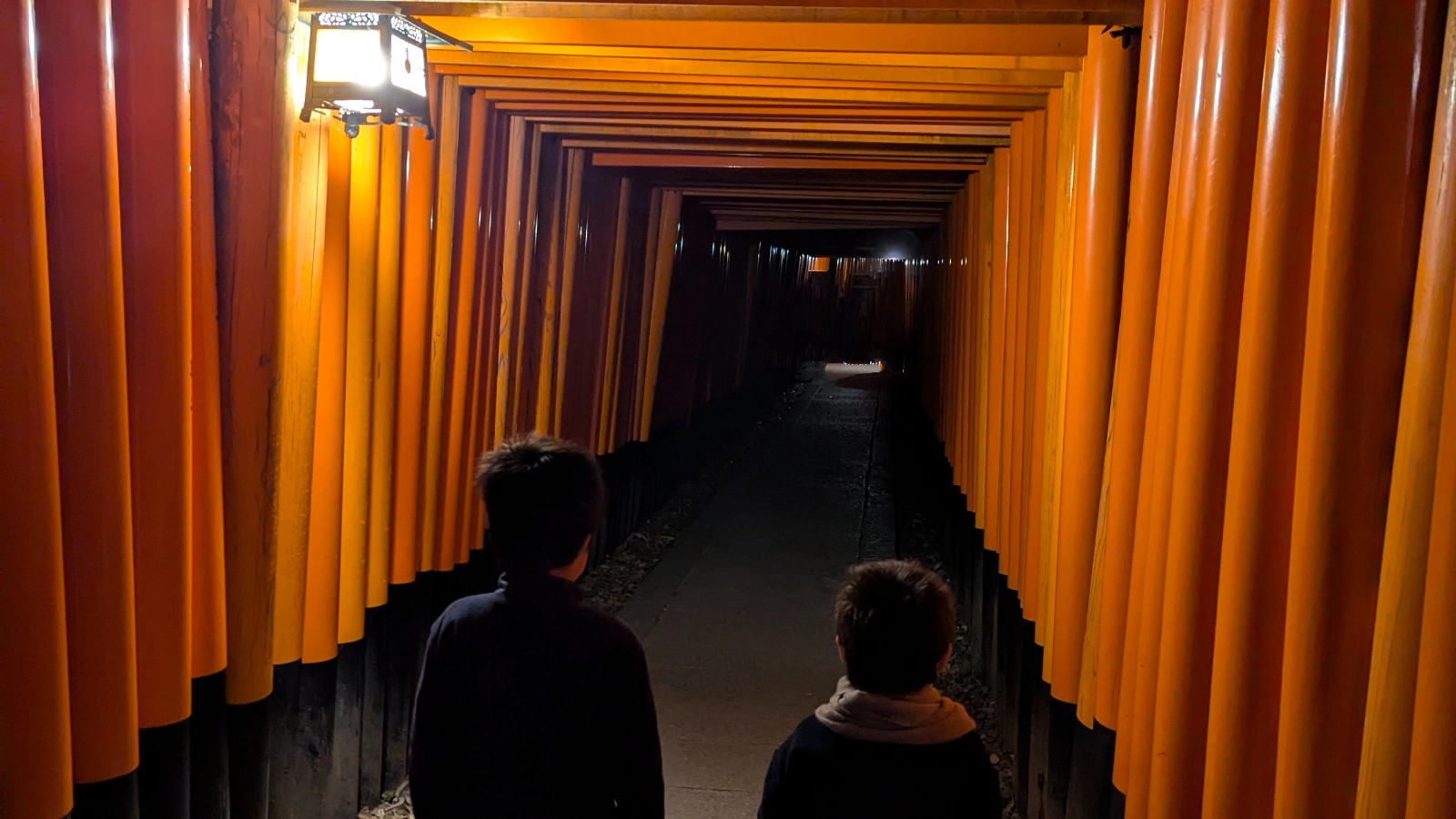
The torii at the foot of the mountain give every child the picture they came for; the real decision is how much of the mountain above them the family climbs.
No admission, so nothing to book; prayers, amulets and seals are paid for separately.
Worship is possible day and night; prayer reception runs 8:30 to 16:30.
The circuit is about 4 km; choose the turnaround before starting.
Any age can walk the first gates; how high to go depends on the child’s legs.
Strollers may be left only where the shrine designates; the mountain paths climb.
Some links on this page are affiliate links. LuNi may earn a commission at no extra cost to you.
Is Fushimi Inari worth it with kids?
The short version, before the costs, the timings and the case for each child.
Yes, and it is one of the best free outings in Kyoto for a child. There is no ticket to buy: the shrine’s paths climb Inariyama, a mountain of 233 meters, under about ten thousand torii, and a family goes as high as its legs allow. Getting there is the easy part, a short train ride from Kyoto Station. What decides the day is the turnaround. Choose it before you start, because the gates keep going and a tired child is always one more gate from wanting to stop. The shrine’s rules matter too: eating and drinking are allowed only at the free rest area, and nobody may sit down in the way, so brief the children at the first gate.
Planning Your Visit to Fushimi Inari with Kids.
The shrine asks for almost no logistics, which leaves a family free to spend its planning on the two things that matter. The first is the height. The paths go all the way up the mountain, and the right turnaround for a small or tired child is well below the top, chosen before the climb and said out loud. The second is food and rest. Eating is allowed only at the free rest area, so plan the snack for there rather than the path. The shrine’s map also shows a rest house with terrace seats beside Yashimagaike for a longer pause. Strollers can be left only at designated places, so decide where one waits. With the mountain done by midday, the afternoon belongs to another of Kyoto’s family stops, chosen by how the legs held up.
Every LuNi attraction guide starts with a visit, with our own children
LuNi rates and writes about attractions only after visiting them with children. Luca and Nico were at Fushimi Inari, and what they did there is recorded further down this page, including how each child actually met it.
Children arrive with different tolerances: for noise, for lines, for standing still, for being on their feet all day. A guide written for the average of them helps almost nobody. So every place on this site is read four ways, and each verdict says which children it already suits and what makes it work for the rest. Whoever you are bringing, the answer here is built for your family rather than for a general reader.
Restricted-movement depletion has little room to build on a free mountain climb under thousands of gates, so let the child set the pace and the turnaround.
Sensory-input depletion stays low when a child can turn back at any gate, so go early and step aside wherever people crowd the narrow paths.
Unfamiliarity and unconfirmed structure ease on a path of repeating gates with named stops, so choose the turnaround from the map and hold to it.
Sustained walking and standing mount on a 233-meter mountain whose gates keep going, so set the turnaround low and rest only at the rest places.
Hotels we would book for this visit.
Three Kyoto family hotels at Kyoto Station, five minutes by JR from Inari Station: one beside the station for the quickest start, and two with family rooms, one with bunk beds and one with a large bath.
| Property | The LuNi Reason |
|---|---|
| LUNI Pick The Thousand Kyoto Kyoto Station Central exit, about 2 minutes east | The room for a family that climbs early and stops when the child’s legs do. The best Fushimi Inari visit is an early one with a turnaround chosen in advance, and from this door both the start and the retreat are quick, so a tired child is off the mountain and indoors soon after. |
| MIMARU Kyoto Station Kyoto Station, 2 minutes’ walk | Two minutes from the station, with rooms that sleep a family on single beds plus a bunk. It suits the plan this shrine rewards: go early, climb as far as the child wants, and come back to the room for a real rest before the afternoon, instead of pushing tired legs into a second outing. |
| Hotel Vischio Kyoto by GRANVIA Kyoto Station Hachijo exit, 2 minutes south | On the south side of the station, with family rooms and a large public bath with a sauna, which is the right place for legs that climbed a mountain in the morning. The station is two minutes away, so the train to Inari is a short, easy start to the day. |
Hotel Vischio Kyoto by GRANVIA
Nearby attractions, matched to your child.
Three pairings for what the mountain leaves unmet: a child who needs to ride after the climb, a child who wants to keep moving indoors, and a child who wants a visit with a known length and rules.
| Pairing | Why This Solves the After-Visit | For Your |
|---|---|---|
| LUNI Pick Kyoto Railway Museum Kyoto Station side: Umekoji-Kyotonishi Station | After a mountain, the Kyoto Railway Museum is one JR stop from Kyoto Station, mostly indoors, and lends strollers free while they last. Sustained walking and standing ease when the rest of the day can be spent on wheels among trains rather than on foot among gates. | Sprinter |
| teamLab Biovortex Kyoto Kyoto Station, Hachijo East exit, 7 minutes | At teamLab Biovortex Kyoto a moving child keeps moving under a roof, on the climbing and bouncing works of its Athletics Forest. Restricted-movement depletion stays low where the art is meant to be climbed, though a Sensor’s sensory input runs high in its flashing, loud rooms. | Dynamo |
| Nijo Castle Central Kyoto, walk-up entry | At Nijo Castle the palace visit and its rules can be told in advance: one to two hours for the Ninomaru Palace and its garden, shoes off inside, no re-entry. Unfamiliarity and unconfirmed structure ease when the next stop’s shape is known before the family arrives. | Anchor |
Kyoto Railway Museum
Kyoto Station side: Umekoji-Kyotonishi Station For YourSprinter
teamLab Biovortex Kyoto
Kyoto Station, Hachijo East exit, 7 minutes For YourDynamo
Nijo Castle
Central Kyoto, walk-up entry For YourAnchor
How two children actually met this attraction.
Two children walked the same gates and found completely different things to do with them. One read them: he stopped at the writing, compared it closely, and reached his own conclusion about which gates were older. The other ran them: he turned what lined the path into a game with rules only he understood, and the game carried him further up the mountain than any adult could have. Neither was much interested in the view or the history, and neither asked to stop. For a parent, the lesson is that the gates work on children as objects, things to read, count or rate as they pass, and that a child with a self-made task goes further, and more cheerfully, than one who is simply told to keep walking.
Luca noticed something few visitors stop for: the characters written on the gates changed in density and style as the path climbed, with the lower gates carrying more elaborate writing than the higher ones. He walked past the views without comment and planted himself in front of two neighboring gates, comparing them for several minutes before deciding, on the evidence of the writing alone, that the lower gates were the older ones.
This is the Sensor pattern, running through one point of focused attention. A child whose Reserve depletes through sensory input manages a busy place best by fixing on one narrow thing and letting the rest fall away, which the writing on the gates let Luca do. Families with a similar child should protect the early part of the day for this kind of close looking, and step to the side of the path to do it, so the child is not standing in the way of the people behind.
Nico spent the first ten minutes of the path at a near-run, and the running had a purpose he had invented on the spot. He stopped at every fox statue to examine it and deliver a verdict, scary or friendly, based on a system he refused to explain to anyone. The gates streamed past almost unnoticed; the statues were the mission, and the mission kept him climbing without once asking how much farther.
This is the Dynamo pattern, powered by a self-made goal. A child whose Reserve depletes through restricted movement stays steady as long as the movement has a reason attached, and Nico supplied his own rather than waiting for one. Families with a similar child can lean on this: a game of rating or counting along the path turns the climb into play. Keep the pace to a walk on the narrow stretches, where others are passing, so the game stays inside the shrine’s rules.
Fushimi Inari offers a child one of travel’s best lessons in endurance: a path that keeps going, and the freedom to decide where to stop. The gates turn the climb into something to count, read or race, and a child who has set their own task climbs further than any instruction could send them. Just as valuable is the turning back. A child who chose the turnaround and reached it has learned that stopping on purpose is not the same as giving up, and that holds on every kind of mountain.
The LUNI Rating for Fushimi Inari.
One fact sits under all four verdicts: the shrine is a mountain lined with gates, free to walk, with no ticket. For a child who needs to move, that is freedom. For a child who needs structure, the repeating gates are a path that explains itself, and a child sensitive to input can turn back at any gate, so three of the four do well. For a child who tires, the same mountain is the problem, because every stretch climbed must be walked back down, and that is why the fourth child pays so much. A turnaround chosen at home is what turns that verdict into a plan.
Let the child lead, and agree on the turnaround. The Dynamo depletes through restricted movement, and Fushimi Inari takes away almost every restriction a famous sight usually carries. There is no ticket and no set length of visit: the paths climb Inariyama, 233 meters high, under about ten thousand torii, and a child can walk as far as the family agrees. The grounds are huge, about 870,000 square meters, and the climbing is the attraction rather than the way to it. For this child, that is as good as Kyoto gets.
A goal the child owns does most of the work. The gates themselves make a ready-made game, counted in tens or read as they pass, and a turnaround chosen on the map, where the Yotsutsuji viewpoint is the named stop, gives the climb an end the child can aim for. The rules still bind a child in motion: no loud noise, no sitting down in the way, no blocking the narrow paths. Make it a brisk walk with a target rather than a race, and let the child set the pace upward.
What this means for your Dynamo: restricted movement has room to go on a free mountain climb. A younger Dynamo needs a close target and a turnaround agreed on first; an older one can aim for the viewpoint and set the pace.Go early, and step aside to look. The Sensor depletes through sensory input, and Fushimi Inari is easier on this child than its fame suggests, because it asks for nothing in particular. There is no ticket, no timed slot and no minimum distance, and a child who has had enough can simply turn around. The gates repeat, which gives the eye one pattern to follow rather than a scatter of things to take in, and the family chooses how deep into it to go.
The pressure point is people rather than noise. Photographers and performers have been obstructing the narrow paths, and staff now caution anyone who blocks them. Go early in the day, keep to the lower stretches if the paths feel close, and when the child wants to stop and look, step aside rather than stand in the flow. The rest house beside Yashimagaike is the place for a longer pause, since sitting down in the way is against the rules.
What this means for your Sensor: being free to turn back at any gate keeps sensory input low. A younger Sensor needs a short stretch early in the day; an older one can climb further and pause at the rest places.Pick the turnaround from the map. The Anchor depletes through unfamiliarity and unconfirmed structure, and the torii paths are one of the most legible routes a family will walk in Kyoto: the same gate, repeated about ten thousand times up the mountain, confirms the way at every step. Getting there is simple too. JR Inari Station is right by the entrance, five minutes from Kyoto Station, and there is no ticket or booking that can go wrong on the day.
The unknown is how far. A mountain path has no natural end short of the summit, so give it one. The shrine’s map names the Yotsutsuji viewpoint and Yashimagaike, with its rest house; choose one as the turnaround before leaving, tell the child, and hold to it, so turning back is a plan being kept rather than a disappointment. Say the rules on the way in as well, since eating is allowed only at the rest area and a child who likes rules will want to know them.
What this means for your Anchor: the repeating gates keep unfamiliarity low. A younger Anchor needs the turnaround named and held; an older one can read the map and call the stop when the family reaches it.Set the turnaround low, and rest where resting is allowed. The Sprinter depletes through sustained travel-style walking and standing, and Fushimi Inari is a mountain: Inariyama rises 233 meters, and the gates climb it. The gates keep going, so a tired child has to be given a place to stop, and every stretch walked up is a stretch to walk back down. That is the whole of the difficulty. There is a rest house with terrace seats beside Yashimagaike, but it does not shorten the way back.
The distance is decided before the first step, never on the mountain. Keep a younger child to the lower gates and treat anything higher as a bonus, and use the rest places as the only stops, since sitting down in the way and eating on the move are both against the rules. Strollers may be left only at designated places, so plan where one waits and bring a carrier. Come by train to Inari Station, right by the entrance, to save the walking for the gates.
What this means for your Sprinter: walking and standing mount with every gate climbed. A younger Sprinter needs a low turnaround and a carrier; an older one can reach a named stop if the way down is counted in.The questions parents actually ask.
Fushimi Inari is free, and the climb is as hard as a family makes it, which is why the turnaround decides the day. The shrine’s rules are stricter than most visitors expect and are enforced: eating only at the free rest area, no sitting down in the way, and strollers only at the designated places. A child who would rather play than climb all morning is better matched to the Nintendo Museum on another day. At the shrine itself, name the gate where the family turns back before the first step is taken, and hold to it on the way up.
Is Fushimi Inari worth visiting with kids?
Yes. Entry is free, JR Inari Station is right by the entrance, and the paths climb Inariyama under about ten thousand torii, so a family can go as far as its children want and turn back at any point. Choose the turnaround before starting, because the mountain rises 233 meters and every step up is one to walk back down.
How much does Fushimi Inari cost?
Nothing. There is no admission fee and no ticket for walking the shrine’s paths. Prayers, amulets and seals are paid for separately. Because there is no ticket, there is nothing to book in advance, and a family can arrive at whatever time suits the children, which in practice means as early as they can manage.
How do you get to Fushimi Inari from Kyoto Station?
Take the JR Nara Line to Inari Station, five minutes from Kyoto Station; the shrine is right by the station. From Keihan Fushimi-Inari Station, walk about 5 minutes east, and from the Inari Taisha-mae stop of City Bus South 5, about 7 minutes east. For a family, the JR route is the simplest.
How high is the climb at Fushimi Inari?
Inariyama is 233 meters high, the southernmost of the thirty-six Higashiyama peaks, and about ten thousand torii line its paths. The shrine’s grounds cover about 870,000 square meters. Families choose their own distance: the Yotsutsuji viewpoint is one named stop on the way up, and turning back sooner is always possible.
Can you bring a stroller to Fushimi Inari?
A stroller may be left only at the shrine’s designated places, not anywhere else in the grounds. Decide before arriving where it will wait and how a small child will travel beyond it, and bring a carrier for the climb. Leaving a stroller anywhere other than the designated places breaks the shrine’s rules.
Where can children eat at Fushimi Inari?
Only at the free rest area. The shrine does not allow eating or drinking anywhere else in the grounds, including while walking or standing, and staff ask anyone breaking the rules to leave. For a pause, the shrine’s map also shows a rest house with terrace seats beside Yashimagaike. Take all trash away with you.
What rules should families know at Fushimi Inari?
No eating or drinking except at the free rest area, no loud noise or sitting down in the way, no climbing the lanterns, and no approaching or feeding wild birds and animals. Strollers are left only at designated places, pets and drones are not allowed, and photographs must not block the narrow paths. Staff ask anyone breaking the rules to leave.
Is Fushimi Inari good for a child who tires easily?
Yes, with a low turnaround. The mountain rises 233 meters and the gates keep going, so a child who tires easily should walk the lower paths and turn back while still fresh, remembering that the way down is walked too. Use the rest house by Yashimagaike for stops, and bring a carrier for a small child.
Where Fushimi Inari fits your Japan trip.
Official site and opening information: Fushimi Inari Taisha