teamLab Biovortex Kyoto with Kids: Where movement meets sensory load.
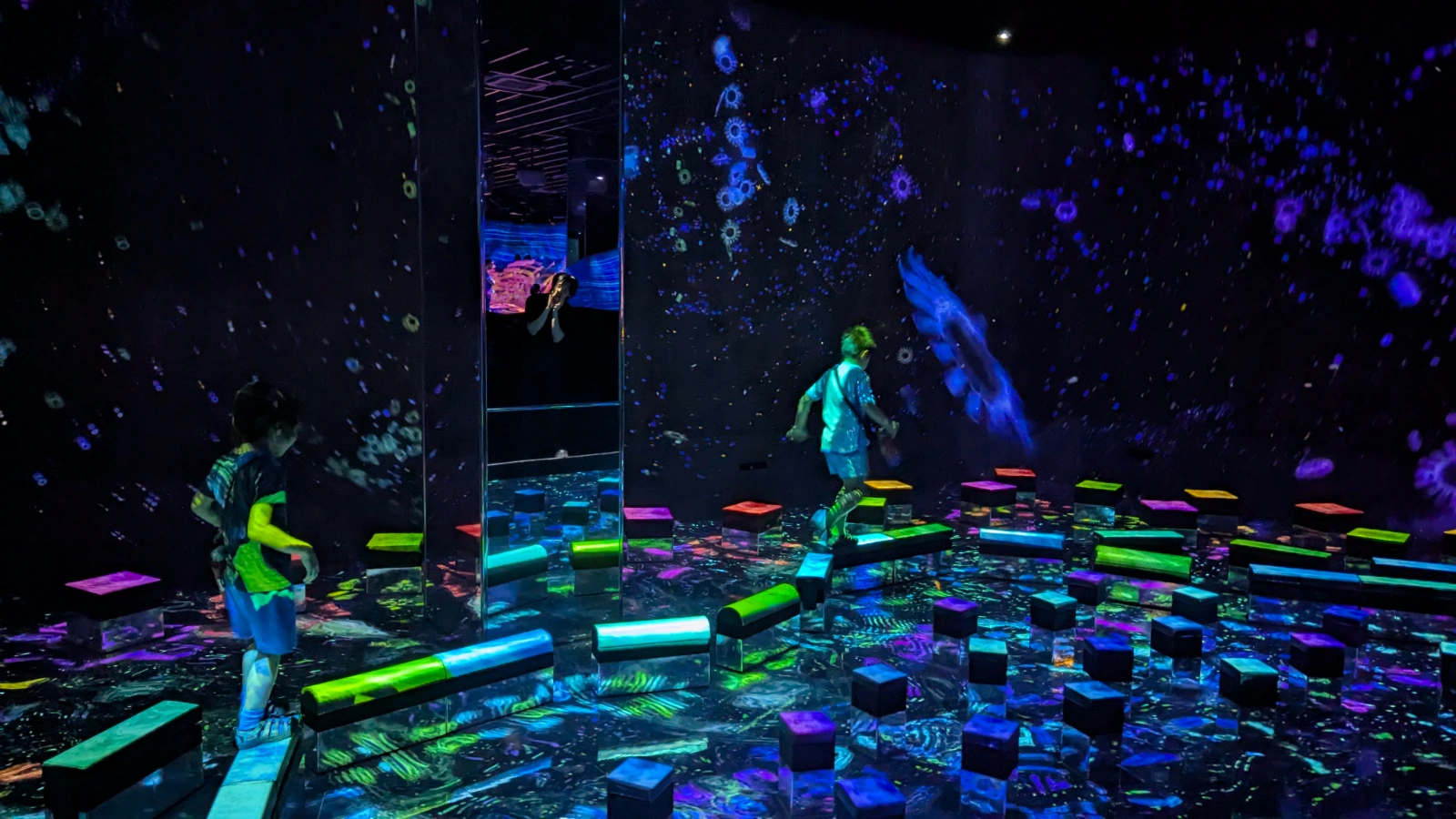
The same dark rooms that let a moving child climb, bounce and chase the art are the ones that flash, sound and smell for a child who takes everything in.
Ages 13 to 17 ¥2,800; 3 and under free; ¥200 more at the venue. Timed tickets can sell out.
No weekly closing day; hours can change with advance notice.
No time limit once inside, and no re-entry.
One guardian of 18 or over, a high schooler included, per three children of elementary age; some works set limits.
Strollers are not allowed in the rooms, and some works are reached only by stairs.
Some links on this page are affiliate links. LuNi may earn a commission at no extra cost to you.
Is teamLab Biovortex Kyoto worth it with kids?
The short version, before the costs, the timings and the case for each child.
Yes, for a child who wants to move, and with a plan for a child who takes everything in. The Athletics Forest is built to be climbed, jumped and balanced across, which a moving child will love. The same rooms are dark, with many changes of level, flashing light, loud sound and scent, and staff may refuse a work to anyone carrying a child, so a small child needs to walk it. That combination costs most the child sensitive to input, who needs a shorter visit and a leaving time agreed on at the door, and the smallest child, who has to manage it all on foot. For the child who moves, it may be the day of the trip they talk about longest.
Planning Your Visit to teamLab Biovortex Kyoto with Kids.
Four decisions shape this visit, and all of them come before the door. Book the tickets first: they are timed, the adult price changes with the date and slot, buying at the venue costs more, and nothing can be canceled, though official-site tickets can change date up to three times. Count the adults next, since every three children of elementary age or younger, free ones included, need a guardian of 18 or over. Then dress for it: sneakers, because heel-less sandals are refused on some works. And eat beforehand, since no food of any kind is allowed inside and strollers wait in the baggage area. Leave any bag 50 centimeters or longer at the hotel. The museum sits by Kyoto Station, so the day around it can reach the city’s other stops for children by train.
Every LuNi attraction guide starts with a visit, with our own children
LuNi rates and writes about attractions only after visiting them with children. Luca and Nico were at teamLab Biovortex Kyoto, and what they did there is recorded further down this page, including how each child actually met it.
Children arrive with different tolerances: for noise, for lines, for standing still, for being on their feet all day. A guide written for the average of them helps almost nobody. So every place on this site is read four ways, and each verdict says which children it already suits and what makes it work for the rest. Whoever you are bringing, the answer here is built for your family rather than for a general reader.
Restricted-movement depletion finds its outlet in an Athletics Forest built to be climbed, jumped and balanced across, so go there first, in sneakers.
Sensory-input depletion peaks in dark rooms of flashing light, loud sound and scent, with no re-entry, so plan the route and the exit before going in.
Unfamiliarity and unconfirmed structure run high in dark rooms whose works may refuse a child, so rehearse the rules and the refusals before entering.
Sustained walking and standing add up over one and a half to three hours, with no stroller inside, so plan a shorter visit.
- Cost
- ¥3,800 adults, varying by date / ¥1,800 ages 4 to 12Ages 13 to 17 ¥2,800; 3 and under free; ¥200 more at the venue. Timed tickets can sell out.
- Booking
- Timed tickets, onlineNo cancellations; official-site tickets change date up to three times.
Hotels we would book for this visit.
Three Kyoto family hotels at Kyoto Station, the museum’s own station: one on the Hachijo side, where the museum is, one on the Central side, and one with bunk-bed rooms for a family.
| Property | The LuNi Reason |
|---|---|
| LUNI Pick Hotel Vischio Kyoto by GRANVIA Kyoto Station Hachijo exit, 2 minutes south | On the Hachijo side of Kyoto Station, the same side as the museum, which is about seven minutes’ walk from the Hachijo East exit. Its family rooms and large public bath with a sauna suit the evening after hours on foot in the dark rooms, when a child’s legs have had enough. |
| The Thousand Kyoto Kyoto Station Central exit, about 2 minutes east | Across the station from the museum on the Central exit side, for a family that wants one base for all of Kyoto. The walk to the museum crosses the station, so allow extra time for it, especially on the way back with a tired child after a long visit in the dark rooms. |
| MIMARU Kyoto Station Kyoto Station, 2 minutes’ walk | Like the museum, it sits south of the station, so a child leaving the dark rooms tired has no station to cross before bed. Its bunk-bed rooms suit the evening after an afternoon of light, sound and climbing, when a bunk of their own feels to a child like a den after the noise. |
Hotel Vischio Kyoto by GRANVIA
Nearby attractions, matched to your child.
Three pairings for what a long indoor visit leaves unmet: a child who needs daylight and quiet, a child who needs to sit and ride, and a child who wants a day fixed in advance, down to the minute.
| Pairing | Why This Solves the After-Visit | For Your |
|---|---|---|
| LUNI Pick Fushimi Inari JR Inari Station, five minutes from Kyoto Station | The paths of Fushimi Inari are the answer to dark rooms: outdoors, free, and a child can turn back at any gate. Sensory-input depletion eases in daylight among repeating gates, though a Sprinter’s walking and standing run long once the mountain paths start to climb. | Sensor |
| Kyoto Railway Museum One JR stop: Umekoji-Kyotonishi Station | At the Kyoto Railway Museum, a single JR stop out from Kyoto Station, free strollers are lent while they last, which teamLab does not allow inside. Sustained walking and standing drop when a tired child can be pushed through the next museum instead of walking every step of it. | Sprinter |
| Nintendo Museum South of the city: Ogura, Uji | At the Nintendo Museum the day is fixed weeks ahead by lottery: the date, the entry time and a named ticket for each visitor, with the cost of every game known. Unfamiliarity and unconfirmed structure hardly start when so little of the day is left to discover. | Anchor |
Fushimi Inari
JR Inari Station, five minutes from Kyoto Station For YourSensor
Kyoto Railway Museum
One JR stop: Umekoji-Kyotonishi Station For YourSprinter
Nintendo Museum
South of the city: Ogura, Uji For YourAnchor
How two children actually met this attraction.
Two children went through the same rooms, and both treated the art as a set of rules to work out. One of them decoded it, testing what each touch and each path did until he was sure; the other played against it with his whole body, chasing, climbing and aiming. Neither stood back to look, which is the right way to meet this museum, since it is built to be touched and moved through, not admired from a distance. For a parent, the pair shows what to prepare each child for. A child who decodes needs time in each room, and a child who moves needs the rooms where moving is the point, reached early in the visit, before the energy is spent on the way there.
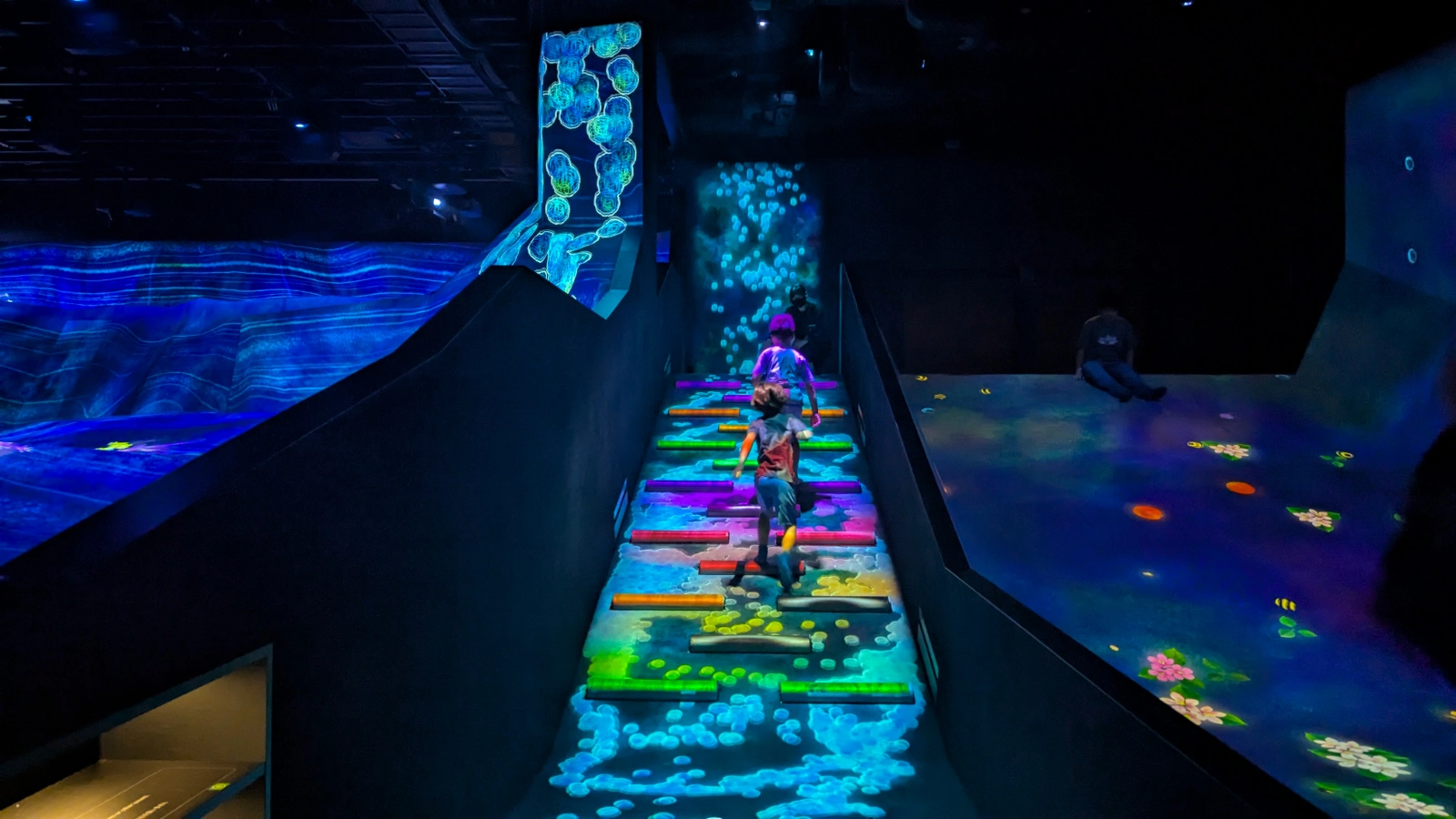
Luca treated each room as a system to decode. On the slide he worked out that avoiding the circles on the way down turned his run into fireworks rather than flowers, then went again to confirm the rule held. He chose the hardest paths through the balance swings on purpose, reading each route first, and in the kanji room he touched the character for rain and the wall rained, then the character for tree and watched it grow.
This is the Anchor pattern in its analytical form. A child whose Reserve depletes through unfamiliarity and unconfirmed structure settles a new space by working out the rule behind it, and Luca tested each room until its logic was confirmed and it became predictable. Families with a similar child should give them time to decode a room rather than rushing them through, because the confirmed rule is what turns an unfamiliar, dark place into one the child can relax in.
Nico moved the whole time. He went down the slide aiming for the circles so his run would burst into flowers, then wanted to go again. On the balance swings he picked a route that mixed difficult and easy and kept coming back to walk it. In the room where a small silver balloon spun and drifted, he chased it and let it bump into him, treating the installation as something to play against with his body.
This is the Dynamo pattern in its clearest form. A child whose Reserve depletes through restricted movement refills it through physical play, which is what Nico’s climbing, balancing and chasing were doing. Families with a similar child should head for the Athletics Forest first, while energy is highest, and treat the active works as the point rather than a warm-up. A Dynamo allowed to move through the exhibits stays steady; one asked to stand and look starts to spend what he has.
A museum where the art answers the body teaches a child that they can shape what they see. Climbing, bouncing and balancing through the works turns a gallery into a place of action, and for a moving child that is a rare invitation to enjoy art on their own terms. For a more sensitive child, the same rooms offer a lesson in knowing their limits and choosing when to step away. Either way the child learns that art is not only something to look at, but something to enter, test and answer.
The LUNI Rating for teamLab Biovortex Kyoto.
One fact sits under all four verdicts: teamLab Biovortex is a large, dark museum built to be moved through, working on body and senses at once. For a child who needs to move, that is the whole appeal, and the reason to go. For a child who takes everything in, the flashing light, sound and scent in the dark, with no re-entry, are why that child pays the most. The other two costs follow from the dark, the level changes and the length of the visit, which the ban on strollers makes harder. Sneakers and a short visit for the Sensor carry all four.
Go straight to the Athletics Forest. The Dynamo depletes through restricted movement, and teamLab Biovortex is built for this child. Its Athletics Forest is a set of works meant to be used with the whole body: aerial climbing through a flock of colored birds, a multi jumping universe, spheres that bounce in a caterpillar house, stepping stones to balance across. There is no time limit once inside, and the museum is teamLab’s largest in Japan, so a moving child has room and reason to keep going.
Order and footwear decide this child’s visit. Head for the Athletics Forest early, while the child’s energy is highest, and let the quieter rooms come after. Wear sneakers, because heel-less sandals and high heels are refused on some Athletics Forest works, and the free loan shoes are limited. Some works have height and age limits, so tell the child in advance that a work may say no, which keeps a refusal from ending the fun for a child who was counting on it.
What this means for your Dynamo: the Athletics Forest gives restricted movement its outlet. A younger Dynamo needs it early and the height limits explained; an older one can plan a route through the whole museum.Plan the route, and the way out. The Sensor depletes through sensory input, and this museum is made of it. The rooms are dark, with light that flashes, loud sound and scent, and some floors are mirrored. Staff may refuse certain works to anyone who feels unwell with flashing light. Once a family leaves, it cannot come back in, so a child who needs a break outside has ended the visit. That combination, a high load with no way to step out and return, is the whole difficulty.
This child needs choices made in advance, and a plan. Decide before entering which rooms matter most and in what order, and keep the visit nearer an hour and a half than three hours. Hold the child’s hand in the darkest rooms, and name what is coming wherever you can see it first. Agree on a signal for when it is enough, and treat leaving as a success rather than a failure. A child who needs more than this is better served by a quieter day elsewhere.
What this means for your Sensor: the dark rooms, with no re-entry, push sensory input high. A younger Sensor needs a short, planned route and a parent’s hand; an older one can choose the rooms and call the end.Rehearse the rules, including the refusals. The Anchor depletes through unfamiliarity and unconfirmed structure, and the museum is full of both: dark rooms, many changes of level, uneven footing, and works whose rules a child only discovers by trying them. Some works have height and age limits, some need stairs, and staff may refuse a work to certain visitors. A child who likes to know what is coming meets a building designed to surprise, and that is the cost.
Confirm whatever can be confirmed. The entry time is fixed by the ticket, there is no time limit inside and no re-entry once outside, and no food at all is allowed in. Say those rules on the way, and add the one that matters most: some works may say no, and that is the work’s rule, not a punishment. Then give the child the job of working out each room’s rule, which turns the surprise into a puzzle.
What this means for your Anchor: unfamiliarity runs high in dark rooms that keep changing. A younger Anchor needs the rules said and a hand held; an older one can take on each room as a rule to work out.Pace the visit, and plan on walking all of it. The Sprinter depletes through sustained travel-style walking and standing, here across one and a half to three hours on dark floors with many level changes and some works that need stairs. Strollers are not allowed inside and wait in the baggage area, and staff may refuse some works to anyone carrying a child, so a small child walks. Around the outside of the building, waiting, eating and sitting down are not allowed either.
Length is what to manage. Plan a shorter visit than the average, with the child’s favorite works first, and leave while the legs still have something in them, since there is no coming back in. Come from Kyoto Station’s Hachijo East exit, about seven minutes on foot, rather than a longer approach, and wear sneakers for the uneven footing. Eat before entering, because no food is allowed inside, and plan the rest of the day around a long sit-down.
What this means for your Sprinter: a long visit with no stroller is where walking and standing run out. A younger Sprinter needs a short route through the favorite works; an older one can manage more with sneakers and a planned exit.The questions parents actually ask.
Tickets here are timed, sold online, can sell out and cannot be canceled, and the rest of the planning is about which child is going. The age rules are specific, with one adult for every three children of elementary age or younger, free ones included, and a high schooler can count. And suitability depends almost entirely on the child: a gift to a child who moves, and hard work for a child who takes everything in. A child who needs daylight and set rules after the dark has Nijo Castle, walk-up and outdoors, for another day. In the museum itself, the dark rooms set the pace.
Is teamLab Biovortex Kyoto worth visiting with kids?
Yes, for a child who likes to move. It is teamLab’s largest museum in Japan, seven minutes’ walk from Kyoto Station, with an Athletics Forest built to be climbed and jumped. The rooms are dark, with flashing light, loud sound and scent, so a child sensitive to input needs a short, planned route. Plan one and a half to three hours.
How much are teamLab Biovortex Kyoto tickets?
The adult price, for 18 and over, is 3,800 yen and varies by date and time slot. Ages 13 to 17 pay 2,800 yen and ages 4 to 12 pay 1,800 yen, and those children’s prices do not vary; children 3 and under enter free. Buying at the venue costs 200 yen more, and students aged 13 to 17 show ID.
Do children need an adult at teamLab Biovortex?
Yes. Children of elementary age and younger must be with a guardian aged 18 or over, and a high school student may act as that guardian. There must be one guardian for every three children, and free children count toward the three, so a single parent with four young children needs a second guardian to enter.
Can you bring a stroller or carry a child at teamLab Biovortex?
Strollers are not allowed inside; they go to the baggage area. Staff may refuse some works to anyone carrying a child, and to anyone who cannot walk unaided, because the rooms are dark, with many changes of level and uneven footing. Plan for a small child to walk the whole visit, in sneakers, with a parent’s hand in the darkest rooms.
What should you wear to teamLab Biovortex?
Sneakers. Heel-less sandals and high heels are refused on some Athletics Forest works, and the free loan shoes are limited. Some floors are mirrored, and wraps are lent for them. Bags 50 cm or longer are not allowed, and support gear 30 cm or longer, drones and flash photography are banned, though photos and social media posts are welcome.
Can you eat, or leave and come back, at teamLab Biovortex?
No to both. Food of every kind, candy and packed lunches included, is not allowed inside, and only lidded drinks or bottles are. There is no time limit once inside, but there is no re-entry after leaving. Waiting, eating and sitting down around the outside of the building are not allowed either, so eat before arriving.
How do you get to teamLab Biovortex Kyoto?
It is about 7 minutes’ walk from the Hachijo East exit of Kyoto Station, or about 11 minutes from Keihan Shichijo Station. Families staying on the Central exit side of Kyoto Station, the Karasuma side, should allow extra time for crossing through the station first, which adds up with a tired child on the way back.
When should you book teamLab Biovortex tickets?
As early as the plan allows. Tickets may sell out, including at the venue, though same-day tickets are sold online while some remain. About 30 percent of international visitors buy at least 30 days ahead. There are no cancellations, but tickets bought on the official site can change date up to three times, until two hours before entry.
Where teamLab Biovortex Kyoto fits your Japan trip.
Official site and opening information: teamLab Biovortex Kyoto