Kyushu National Museum with Kids: the free floor carries the visit.
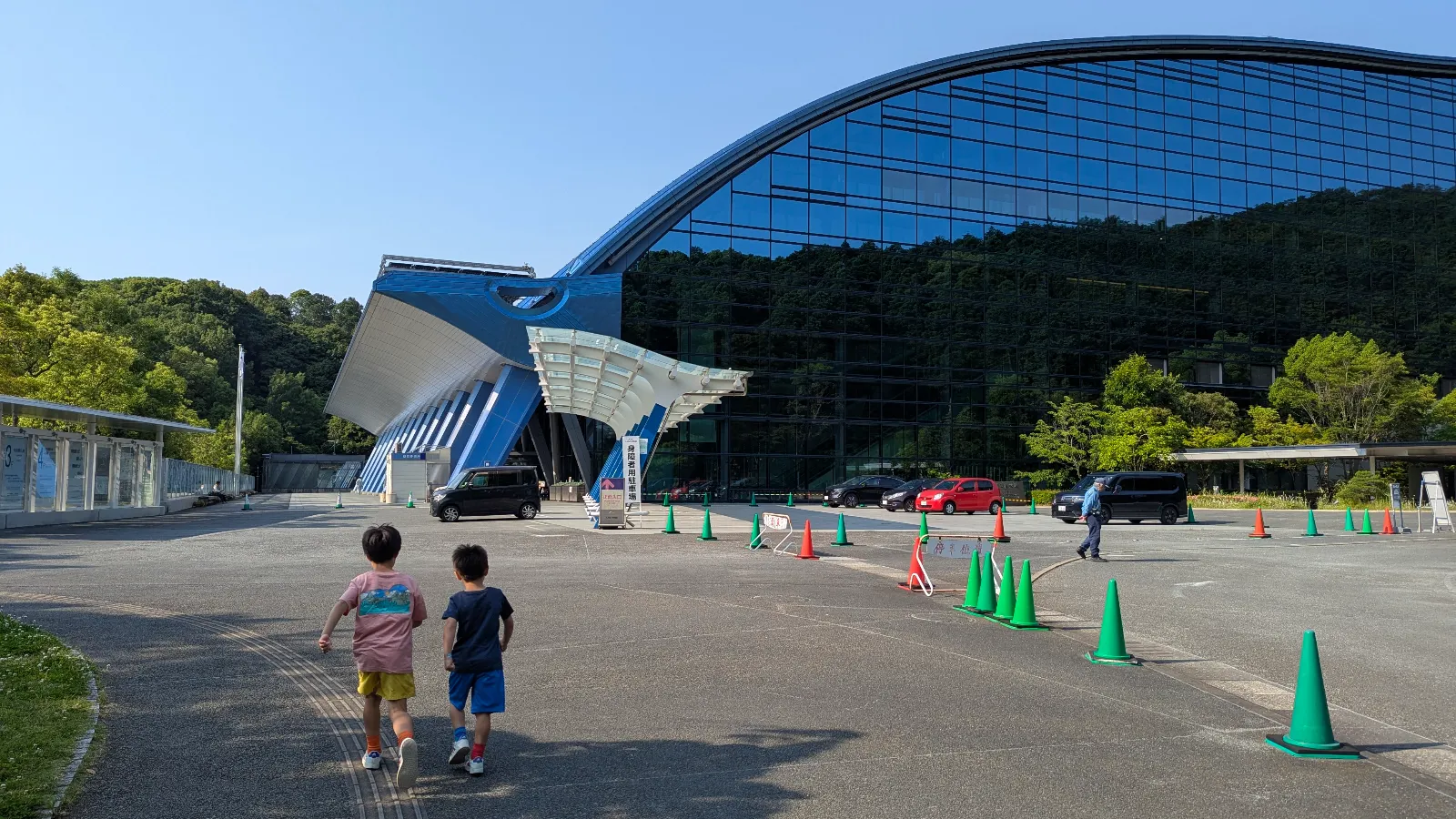
The museum’s hands-on children’s floor costs nothing to enter, and on a busy day it can be crowded and loud enough to limit entry, which decides when a family takes it.
University students ¥350; special exhibitions cost extra, and children pay for those. No booking needed.
Closed Mondays (the Tuesday after a Monday holiday) and at year-end; later on Saturdays during special exhibitions.
Galleries and Ajippa; add about ten minutes’ walk each way from Dazaifu Station.
Ajippa’s craft kits suit younger children; the upper galleries ask for no running and no touching.
May be refused in a crowded gallery, so bring a carrier; an inclined elevator serves the access tunnel.
Some links on this page are affiliate links. LuNi may earn a commission at no extra cost to you.
Is the Kyushu National Museum worth it with kids?
The short version, before the costs, the timings and the case for each child.
Yes, and for a reason most families never hear about before they go. The Kyushu National Museum does more for a child than its galleries suggest: the permanent collection is free for anyone under 18, the hands-on floor for children is free to everyone, and the same free floor has a calm-down room stocked with earmuffs. What it asks in return is behavior. Inside there is no running, no touching of the works and no eating, not even gum. So the visit works when the moving and the snacking happen outside, on the walk in and in the grounds, and the building is used for what it does best: a morning of looking, with a quiet room close by for the child who needs one.
Planning Your Visit to the Kyushu National Museum with Kids.
Three decisions make this morning. The first is the walk, because there is no other way in from the station: the route from Dazaifu runs along the shrine approach, through the precinct and into a tunnel of escalators and a moving walkway, so the shrine is part of the day whether you planned it or not, and a child should hear that before the train arrives. The second is timing for Ajippa, which can be crowded enough that entry is limited, so it belongs early. The third is equipment: bring a carrier, because a stroller may be turned back from a crowded gallery, and bring snacks for outside, since nothing is eaten indoors. Dazaifu sits outside the city of Fukuoka, so settle all three before the train leaves.
Every LuNi attraction guide starts with a visit, with our own children
LuNi rates and writes about attractions only after visiting them with children. Luca and Nico were at the Kyushu National Museum, and what they did there is recorded further down this page, including how each child actually met it.
Children arrive with different tolerances: for noise, for lines, for standing still, for being on their feet all day. A guide written for the average of them helps almost nobody. So every place on this site is read four ways, and each verdict says which children it already suits and what makes it work for the rest. Whoever you are bringing, the answer here is built for your family rather than for a general reader.
Restricted-movement depletion builds on gallery floors that forbid running, touching and eating, so spend the moving on the walk in and in the grounds.
Sensory-input depletion is well handled by a published sensory map, quiet rooms on each floor and a calm-down room with earmuffs.
Unfamiliarity and unconfirmed structure ease when the route in can be described landmark by landmark, and the hours and closing rule are fixed.
Sustained walking and standing fill the approach and the galleries, but chairs, quiet rooms and a moving walkway let a parent break it up.
- Cost
- Permanent galleries ¥700 adults / free under 18University students ¥350; special exhibitions cost extra, and children pay for those. No booking needed.
- Booking
- Walk up or e-ticketAjippa’s workshops need booking, its kits do not; e-tickets for the collection galleries are sold online.

Hotels we would book for this visit.
Dazaifu is a day out from a city base, so these are Fukuoka family hotels chosen for the base, not the museum. Dazaifu is about 35 minutes by Nishitetsu train from Tenjin, or 40 by the Tabito bus from Hakata, then ten minutes on foot.
| Property | The LuNi Reason |
|---|---|
| LUNI Pick Hotel Nikko Fukuoka | Hotel Nikko Fukuoka is for a family that wants every day of a Fukuoka week, the Dazaifu morning included, to start from the Hakata side of the city and end back in the same room. JR Hakata Station is three minutes’ walk, so each departure begins with the shortest first leg. |
| Grand Hyatt Fukuoka | Both ways to Dazaifu start within a walk of this room: JR Hakata Station, for the Tabito bus, is about fourteen minutes on foot, and Nishitetsu Fukuoka in Tenjin, where the train starts, about fifteen, so a family can choose the train or the bus on the morning itself, by how the children woke up. |
| Hilton Fukuoka Sea Hawk | Hilton Fukuoka Sea Hawk stands on the waterfront beside the building that holds teamLab Forest, so it suits a family pairing the quiet museum morning with a louder, moving afternoon in the same week, and a child who spent the morning keeping still has the bay a few steps from the door. |
Nearby attractions, matched to your child.
Three pairings for what the museum leaves unmet: a shrine the route already passes, open ground for a child who has held still all morning, and an aquarium that takes strollers and lends its own.
| Pairing | Why This Solves the After-Visit | For Your |
|---|---|---|
| LUNI Pick Dazaifu Tenmangu On the station route; joint ticket available | The station walk runs through the Tenmangu precinct, so this pairing adds no new journey. An Anchor who walked it on the way in comes back to ground already known, where unfamiliarity and unconfirmed structure stay low, and the shrine’s Treasure Hall and Kanko History Museum wait for a child with energy left. | Anchor |
| Ohori Park Central Fukuoka: Ohorikoen Station, 7 minutes’ walk | After a morning of no running, Ohori Park gives a Dynamo lanes built for it around the pond and an east playground with the bigger equipment. Restricted-movement depletion from the galleries needs exactly this: a place where running is the point, not a rule to keep. | Dynamo |
| Marine World Uminonakamichi Uminonakamichi Station | Strollers are allowed inside Marine World Uminonakamichi, and it lends them free against a 500-yen deposit while they last. Sustained walking and standing ease on a day when the youngest can ride through it, after a museum where a stroller may be turned back. | Sprinter |
Dazaifu Tenmangu
On the station route; joint ticket available For YourAnchor
Ohori Park
Central Fukuoka: Ohorikoen Station, 7 minutes’ walk For YourDynamo
Marine World Uminonakamichi
Uminonakamichi Station For YourSprinter
How two children actually met this attraction.
Two children went through the same museum and needed opposite things from it. One of them found the galleries more than enough and had to be pulled away from them; the other spent his time in the galleries waiting for something to do, and found it downstairs. Neither reaction is a verdict on the museum. It is a verdict on the order in which a family takes the building, and it is the reason the free first floor matters more than the collection for a mixed pair of children. A family with one of each should plan for both, and plan for the fact that the child who wants to stay and the child who wants to move will want it at the same moment.
Luca moved through the permanent galleries the way he moves through any room with panels to read, slowly and completely, stopping at the rotating exhibition to work out how each object had been made before reading the card that explained it. The samurai armor held him longest; he circled it, asking how the plates were joined and whether a child could have worn a smaller version. He had to be told twice that Ajippa was waiting.
This is the Anchor pattern. A child whose Reserve depletes through unfamiliarity and unconfirmed structure settles where a room can be read in order, and a gallery with an object and a card beside it gives that child something to finish. Families with a similar child should give the galleries first call on the morning and let the child set the pace, then warn them well before the move downstairs, because a second call is easier than a sudden one.
Nico lasted about ten minutes in the quiet galleries before he was narrating, touching the glass, and looking for something to do with his hands. The Ajippa zone was where he came alive: he went straight for the instruments, tried on costumes, picked things up and put them down and picked up the next thing, talking the whole time. The moment the museum gave him something to handle, the restlessness that had built in the galleries dropped away.
This is the Dynamo pattern. A child whose Reserve depletes through restricted movement spends it fast on a floor that asks for no running and no touching, and recovers it in a room built for handling things. Families with a similar child should keep the gallery time short and specific, then give the child the hands-on floor, and plan it early, because on a busy day that floor can be crowded enough that entry is limited.
A national museum with a hands-on floor for children makes a quiet argument: that a child’s way of learning, by touching, trying and asking, belongs in a serious place. Handling objects and playing with ideas downstairs makes the galleries upstairs feel less forbidding, because the child already knows the building welcomes them. Children made to feel at home in museums early tend to return to them for life. A visit that gives the hands and the eyes each their turn teaches that history is something to explore, not only admire.
The LUNI Rating for the Kyushu National Museum.
One fact runs under all four verdicts: this is a building of rules that also supplies the tools for living with them. No running, no touching, no eating; but chairs in the galleries, a quiet room on the first floor and a sensory map before the visit. That is why the child sensitive to input and the one who needs structure are both served without conditions, and why the child who needs to move and the child who tires need a plan that resolves it. Give the mover the grounds first and the galleries second, and the rules meet a child who has already run.
Move before the museum, and after it. The Dynamo depletes through restricted movement, and the galleries restrict it in every direction at once. There is no running inside, no lying on the benches and no touching the works, with a single exception, a ship-cargo model in the Silk Road room. There is no eating or chewing either, not even gum while walking. For a child who needs to move, that is a morning of holding back, however good the objects are.
Planning puts that right, because the movement can be placed around the building instead of inside it. The walk from the station is ten minutes of torii, bridges and a tunnel, and the grounds outside have a bamboo path and a lotus pond where eating is allowed. Inside, the one outlet is Ajippa, where the craft kits need no booking. Take it early, before it fills, keep the galleries to a short list of objects, and let the child spend the rest outside.
What this means for your Dynamo: restricted movement builds on floors with no running, touching or eating. A younger Dynamo needs Ajippa early and the grounds straight after; an older one can hold a short gallery list.Read the sensory map before the day. The Sensor depletes through sensory input, and the museum has already done much of the planning for this child. There is a sensory map of the building, marking light, sound, crowds and smell. On the first floor, beside Ajippa, a calm-down room of three small rooms has adjustable lights, earmuffs and calming goods, and there are rooms for resting when a visitor needs quiet on each floor, the third only during special exhibitions.
The one place to watch is Ajippa itself, which can be crowded and loud with instruments. So treat it as the high-input room it is: go early, give it a fixed length, and point out the calm-down room next door before going in, so the way out is known in advance. Galleries have chairs inside as well as outside, which gives a child a place to stop without leaving the room. Photography rules keep flash out of the galleries.
What this means for your Sensor: the loud input sits in one busy room, and the museum supplies the exits. A younger Sensor needs the quiet room shown first; an older one can use the sensory map alone.Describe the walk in, landmark by landmark. The Anchor depletes through unfamiliarity and unconfirmed structure, and this visit can be told in full before the family leaves the hotel. From Nishitetsu Dazaifu Station the route runs about 300 meters along the Tenmangu approach, through three torii, over the Taiko bridges, past the Treasure Hall and into a tunnel with escalators and a moving walkway. The hours are set at 9:30 to 17:00, and the closing rule is simple: Mondays, Tuesday after a Monday holiday, and the year-end.
Two things are worth saying out loud in advance. At the gallery entrance, children’s free entry depends on proof of their birth date, so carry it and tell an older child it will be checked. And Ajippa changes: exhibits rotate about monthly, and trying on costumes is sometimes unavailable, so describe it as a craft room with extras rather than promising a particular activity. Special exhibitions are ticketed separately, so decide at breakfast whether the family is going in.
What this means for your Anchor: a route and a building that can be described in full leave unfamiliarity little room. A younger Anchor needs the landmarks named; an older one can follow the route and carry the birth-date proof.Budget the walk in, and use the chairs. The Sprinter depletes through sustained travel-style walking and standing, and a Dazaifu day is on foot from the station onward. The route runs about ten minutes through the shrine approach and precinct before the museum begins, and inside, a gallery visit is done on foot. The museum asks families with small children to bring a carrier, because a stroller may be turned back from a crowded gallery, and there are eight loan strollers for the rest of the building.
The load stays manageable because the approach walk is optional and the building helps. A family arriving by taxi, or on the hourly bus from JR Futsukaichi, reaches the museum door without the approach walk. The tunnel carries visitors by escalator and moving walkway, and an inclined elevator takes strollers. There are chairs inside and outside the galleries, and rooms for resting on each floor, the third during special exhibitions. So plan the seated stops rather than waiting to need them: one inside the galleries, one on the free floor, and a longer rest outside before the walk back, which covers the same ground again. Keep the shrine to what the route passes.
What this means for your Sprinter: the walk in and the gallery standing carry most of the load. A younger Sprinter needs a carrier and planned seats; an older one can walk it if the stops are agreed on in advance.The questions parents actually ask.
Most of the museum is free for children, and most of its rules come with an exception. The permanent galleries are free for children, but special exhibitions are not. The hands-on floor is free, but it can be busy enough to limit entry. Strollers are allowed, but not always into a crowded gallery. And there is no eating inside at all, not even gum, which shapes the whole morning around the grounds. Dazaifu is a day out from the city, and the museum and the shrine fill it between them, which leaves Fukuoka’s other family stops for the rest of the week.
Is the Kyushu National Museum worth visiting with kids?
Yes. The permanent galleries are free for anyone under 18, the hands-on Ajippa floor is free for everyone, and a calm-down room beside it keeps earmuffs for children who need them. The limits are behavioral: no running, no touching and no eating inside the building, so plan the moving and the snacks for the grounds outside.
How much does the Kyushu National Museum cost for a family?
The permanent galleries on the fourth floor cost 700 yen for an adult and 350 for a university student, and are free for high school students, anyone under 18 and anyone 70 or over. Bring proof of each child’s birth date for the gallery entrance. Special exhibitions are priced separately, and children pay for those.
What are the Kyushu National Museum’s opening hours?
The museum opens 9:30 to 17:00, with entry until 16:30. It closes on Mondays, or on Tuesday when Monday is a national holiday, and at the year-end. On Saturdays during special exhibitions it stays open to 19:00, with entry until 18:30, and closing times can change.
What is Ajippa, and is it always open?
Ajippa is the museum’s hands-on floor for children, on the free first floor. Craft kits are always available and need no booking; workshops are booked ahead, and the exhibits change about once a month. It can be crowded and loud with instruments, and entry may be limited when it is busy, so arrive early for it.
Can you bring a stroller to the Kyushu National Museum?
Yes, and the museum lends eight of its own, but a stroller may be turned away from a crowded gallery, and the museum asks families to bring a baby carrier. The tunnel from the Dazaifu side has an inclined elevator for strollers and wheelchairs alongside its stairs, escalators and moving walkway.
How do you get to the Kyushu National Museum from Dazaifu Station?
Walk. From Nishitetsu Dazaifu Station the route runs about 300 meters along the Tenmangu approach, through three torii and over the Taiko bridges, past the Treasure Hall, and into a tunnel with escalators and a moving walkway. It takes about ten minutes, so the shrine is part of the museum visit, not a separate trip.
Can you eat at the Kyushu National Museum?
Not inside the building: no food, gum or candy, and no chewing while walking. Families eat outside, on the benches and chairs, along the bamboo path, by the lotus pond or at the rest house. M Cafe runs 10:00 to 17:00 and the restaurant and footbath teahouse 11:00 to 17:00, all three closed on Mondays with the museum.
Can children take photos at the Kyushu National Museum?
Yes, in the fourth-floor galleries, where some works are excepted, in the first-floor entrance hall and in Ajippa. Flash, tripods, selfie sticks, video and group photos are not allowed in the galleries, and the pictures are for personal enjoyment only. Tell an older child with a phone the rule before the gallery entrance.
Where the Kyushu National Museum fits your Japan trip.
Official site and opening information: Kyushu National Museum