Ohori Park with Kids: An Open Loop, Not a Short Walk.
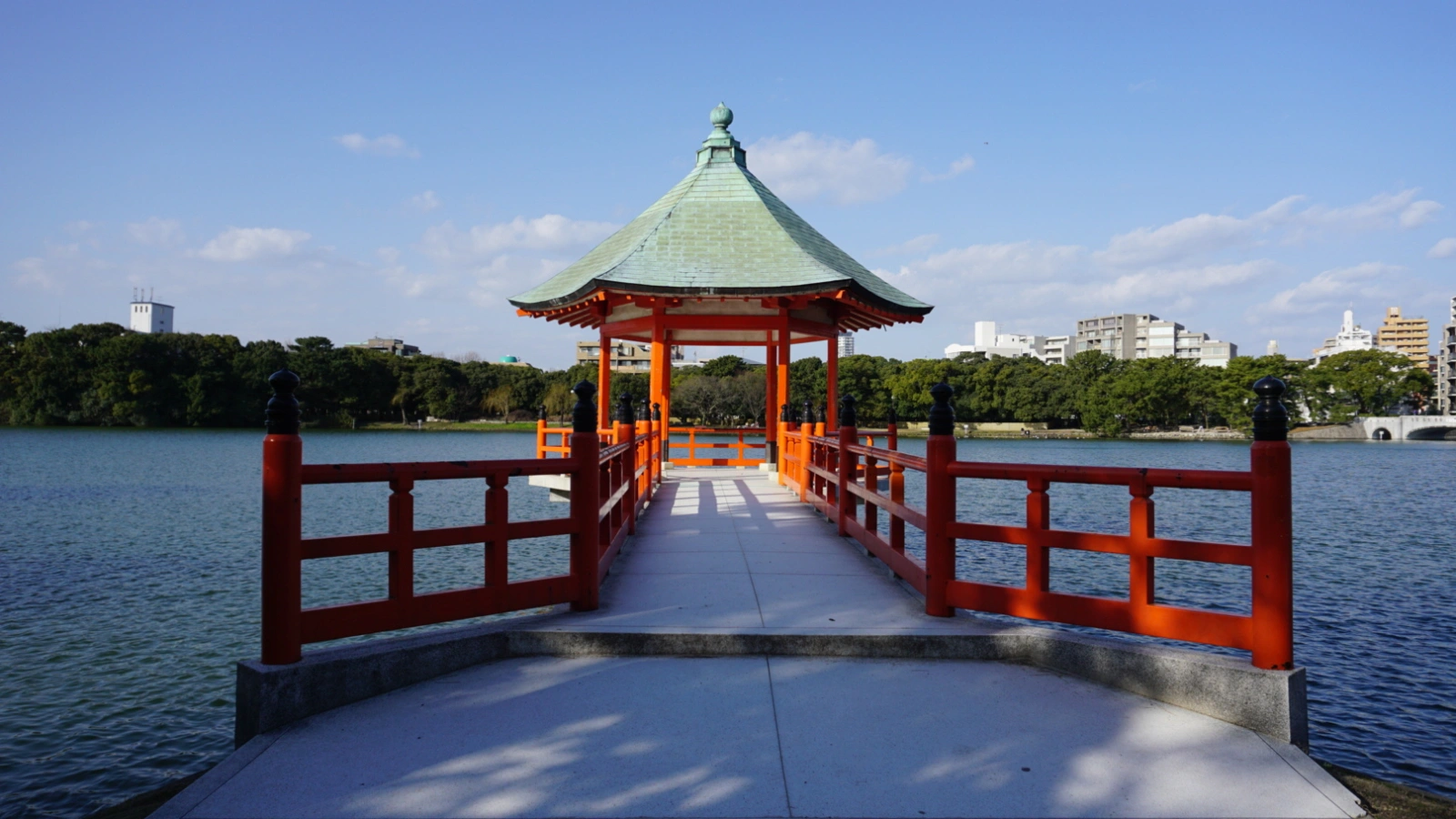
The loop around the pond runs about two kilometers, with a lane for every kind of mover and a playground on each side, and it is longer than it looks.
Under-6s and visitors 65 and over enter the garden free; boats are priced per 30 minutes. Nothing to book.
Boats open 10:00 on weekends and 11:00 on weekdays; the Japanese Garden opens at 9:00 and closes Mondays.
One loop is about 2 km, with walkers, runners and cyclists each in their own lane.
The west playground is built for small children; the east one has the bigger equipment.
One stroller and two wheelchairs are lent free at the parking lot.
Some links on this page are affiliate links. LuNi may earn a commission at no extra cost to you.
Is Ohori Park worth it with kids?
The short version, before the costs, the timings and the case for each child.
Yes, for any child who needs room to move, and the park is free, big and laid out in a way that works for children: the loop around the pond keeps walkers, runners and cyclists in separate lanes, the east playground has the bigger equipment and the west one is built for small children, with shade. Boats go out all year. What the park asks is legs. The loop is about two kilometers, and the pond is wide enough that the far side is a real walk from wherever the family started. So choose the side and the playground before arriving, and treat the full loop as optional rather than as the point of the visit.
Planning Your Visit to Ohori Park with Kids.
Three decisions shape a morning here. The first is which side to arrive on. The two subway stations, Ohorikoen and Tojinmachi, are each about seven minutes’ walk away, and the playgrounds sit on opposite sides of the pond, east and west, so the choice of station is really a choice of playground. The second is the boats, which open later than the park, so a family arriving early has time on land first, and a child who has run the path will sit in a boat far more happily. The third is whether to pay for the Japanese Garden, which is modest in price, free for under-6s and keeps its own closing day, and which suits a child who likes a garden with rules. Settle all three at breakfast, and the park is the easy morning of a Fukuoka week.
Every LuNi attraction guide starts with a visit, with our own children
LuNi rates and writes about attractions only after visiting them with children. Luca and Nico were at Ohori Park, and what they did there is recorded further down this page, including how each child actually met it.
Children arrive with different tolerances: for noise, for lines, for standing still, for being on their feet all day. A guide written for the average of them helps almost nobody. So every place on this site is read four ways, and each verdict says which children it already suits and what makes it work for the rest. Whoever you are bringing, the answer here is built for your family rather than for a general reader.
Restricted-movement depletion has almost nowhere to build, with a running lane, a large playground on the east side and boats, so let the child move first.
Sensory-input depletion stays low in a park this large, with lanes that keep bicycles and runners apart from walkers, and a shaded west playground.
Unfamiliarity and unconfirmed structure ease when the loop, its lanes and the two playgrounds can be named in advance, side by side.
Sustained walking and standing add up on a loop of about two kilometers with a single loan stroller, so choose one side and stay there.
Hotels we would book for this visit.
Ohori Park is a morning inside the city, so these are central Fukuoka family hotels chosen for the whole stay: Hotel Nikko three minutes’ walk from JR Hakata Station, the Grand Hyatt about 14 minutes, and one on the bay.
| Property | The LuNi Reason |
|---|---|
| LUNI Pick Grand Hyatt Fukuoka | It sits between Fukuoka’s two centers, about fourteen minutes on foot from JR Hakata and fifteen from Nishitetsu Fukuoka in Tenjin, so a free park morning can end with lunch on either side and a nap back at the room, which is the rhythm a short city outing with young children wants. |
| Hotel Nikko Fukuoka | For the days that leave the city, this is the room: the station is three minutes away, by an underground route when it rains, so a park morning and a day out by train start from the same short walk, and a child learns one way to the station for the whole week. |
| Hilton Fukuoka Sea Hawk | Beside Mizuho PayPay Dome and next door to teamLab Forest, it puts an indoor day on the doorstep, so a free morning on the park’s loop and playgrounds can be followed by an afternoon inside, with only the ride back to the room between them. |
Nearby attractions, matched to your child.
Three pairings for what the park leaves open: a museum with a quiet room for a child who wants calm, a building of climbing and bouncing for a child who wants more, and an aquarium that lends strollers.
| Pairing | Why This Solves the After-Visit | For Your |
|---|---|---|
| LUNI Pick Kyushu National Museum Dazaifu: about 10 minutes’ walk from Nishitetsu Dazaifu Station | On its free first floor the Kyushu National Museum keeps three small calm-down rooms stocked with earmuffs, and its sensory map shows the rest. Sensory-input depletion is easiest to manage on a second day where the quiet room is already part of the plan, marked before leaving the hotel. | Sensor |
| teamLab Forest Fukuoka Jigyohama: BOSS E-ZO FUKUOKA, 5F | For a child who finished the loop still running, teamLab Forest Fukuoka turns restricted-movement depletion into climbing and bouncing indoors; a Sensor pays heavily in sensory input there, under flashing light and loud sound with no break area inside the venue. | Dynamo |
| Marine World Uminonakamichi Uminonakamichi Station | At Marine World Uminonakamichi strollers are allowed inside, and the aquarium has its own to lend, free against a deposit. Sustained walking and standing are what the park loop spends, and an aquarium the youngest can ride through is the kind of day that gives them back. | Sprinter |
Kyushu National Museum
Dazaifu: about 10 minutes’ walk from Nishitetsu Dazaifu Station For YourSensor
teamLab Forest Fukuoka
Jigyohama: BOSS E-ZO FUKUOKA, 5F For YourDynamo
Marine World Uminonakamichi
Uminonakamichi Station For YourSprinter
How two children actually met this attraction.
Two children came to the same park and needed it for opposite reasons. One of them could not settle into open ground until something in it gave him a system to work out, and he found it only when the family went looking for something designed. The other took the open ground as an invitation and used every part of it he could reach. Ohori served both, but not in the same places. For a family with a mixed pair, the useful plan is to decide in advance which part of the park belongs to which child, and in which order, rather than walking the loop together and hoping it holds them both. A park this size can give each child the right corner, but only if someone has decided which corner that is before the family walks in.
Luca needed something to attach to before the open park meant anything to him. The Japanese Garden gave him that: he read the signage on the arrangement rather than simply walking through it. The larger hook was next door, at the Fukuoka Castle ruins in Maizuru Park, where he stayed far longer than the pond had held him, working over the surviving stone walls. He wanted to know why almost nothing remains.
This is the Anchor pattern. A child whose Reserve depletes through unfamiliarity and unconfirmed structure reads a wide open park as a space with nothing to hold, and settles once something offers a system to decode, such as a designed garden with signs to read. Families with a similar child should arrive with one designed feature chosen in advance, so the open ground becomes the space around a task rather than the whole of the visit.
Nico took the park at face value and used it hard. He ran stretches of the loop rather than walking them, and the stone bridges and the islands in the pond turned the walk into a game about reaching the next one. The swan boats were an immediate ask, and he wanted to steer. When the walking loop began to run long for him, the playground was the natural release point rather than the pond path.
This is the Dynamo pattern. A child whose Reserve depletes through restricted movement reads a park as space first and scenery second, so a loop becomes a running track and a string of islands becomes a race. Families with a similar child should give the park a movement goal, the next island, the boat, the east playground, and put the visit early in the day, before the same loop starts to cost the child more than it gives back.
A big city park with a pond, lanes for every pace and a playground on each side shows children how a city makes room for everyone at once. Runners, walkers, cyclists and families share the loop, and a child learns, without being told, to keep to a lane and to notice others. Carrying the family’s trash home adds a quiet lesson in looking after a shared place. Parks like this teach civic life at a child’s scale, which is one of the most useful things travel can teach.
The LUNI Rating for Ohori Park.
One fact runs under all four verdicts: Ohori is a large park that has been divided sensibly. Lanes separate the fast from the slow, playgrounds are split by age, and the pond gives the whole place a shape a child can understand from the first view. That is why three profiles are served without conditions. The difficulty is for the child who tires, because the same size that makes the park generous makes the loop long, and the park lends only one stroller. A child who tires can sit out the far side in a boat while the others walk it.
Give the child a lane, and let them use it. The Dynamo depletes through restricted movement, and Ohori gives movement a great deal of room. The loop around the pond is about two kilometers and is laid out in lanes: a brick walking path beside the water, a rubber-chip jogging lane, and an asphalt bicycle lane on the outside. The east playground, Kujira Park, has the park’s bigger, more active equipment and wide open sightlines, which suits a child who needs to climb as much as run.
The freedom comes with one piece of etiquette. Runners are asked to keep to the rubber-chip lane and to watch for children, so set the rule at the start: walk on the brick path by the water, run on the rubber-chip lane with a parent alongside, and never cut across the bicycle lane on the outside. Then give the child a destination, the next island, the east playground, the boathouse, and let the park absorb the energy. The boats open later in the morning, which makes them a good second act once the running is done.
What this means for your Dynamo: restricted movement discharges on a long loop and a big playground. A younger Dynamo needs a destination on the walking path; an older one can run a stretch of the loop and meet the family further on.Choose the quiet side and stay on it. The Sensor depletes through sensory input, and a park of about 398,000 square meters, most of it pond, gives this child a great deal of space between themselves and anyone else. The lanes help too: bicycles keep to the outer asphalt lane and runners to the rubber-chip lane, so the brick path beside the water is left to walkers. There is a wild bird forest, and the west playground, Donguri Park, is made for small children and has plenty of shade.
The practical move is to choose the side of the pond before arriving and not try to do the whole park. For a child who dislikes crowds, the smaller, shaded west playground is usually the gentler of the two. The Japanese Garden is a paid, separate space inside the park, useful when the child needs somewhere more contained than the open loop; it opens at 9:00 and closes on Mondays. Keep the boathouse for when the child is settled rather than using it as a reward.
What this means for your Sensor: a very large park spreads the input thin. A younger Sensor needs the shaded west playground and a short walk; an older one can choose a quiet stretch of the loop.Name the lanes, the sides and the order. The Anchor depletes through unfamiliarity and unconfirmed structure, and Ohori can be described completely from the park map. There is one loop around the pond, about two kilometers, in three lanes. There are two playgrounds on opposite sides, east and west, each with its own character. The Japanese Garden has fixed hours and a clear closing rule, and the boathouse keeps set hours by season. A parent can explain all of it at breakfast.
The work is to decide the order out loud before arriving: which station, which side, which playground, and whether the boats or the garden come into it. A child who likes to know will hold the plan better than the park, which is too big to be read at a glance from the entrance. Name the islands and the floating pavilion as landmarks along the way, so the walk between the two ends of the plan has points of its own.
What this means for your Anchor: a park that can be named lane by lane and side by side leaves unfamiliarity little room. A younger Anchor needs the order told; an older one can read the map and lead the way.Pick one side, and do not chase the loop. The Sprinter depletes through sustained travel-style walking and standing, and the size that makes Ohori generous is what makes it tiring. The loop is about two kilometers, and walking to the far side of the pond and back is most of that. The two subway stations are each about seven minutes’ walk from the park, which adds to the day before the park begins. The park lends a single stroller, along with two wheelchairs, at the parking lot.
A smaller plan makes it manageable. Reserve the one loan stroller by phone with the park office, or bring your own for a child who still uses one. Choose the station on the side of the playground you want and stay on that side. Use the boats as the seated half hour: a parent does the rowing or the pedaling, and the child rides. The shaded west playground is the better rest stop on a warm day. Leave the full loop for the child who asks for it.
What this means for your Sprinter: the loop and the walk from the station carry the walking and standing. A younger Sprinter needs a stroller and one side of the pond; an older one can walk further if the boat breaks the morning.The questions parents actually ask.
Ohori Park is free, the boats run all year, and there are two playgrounds rather than one. What catches families out is smaller: there are no bins, so carry a bag for the trash, the park lends only one stroller, so bring your own, and the Japanese Garden keeps its own hours, charges its own fee and closes on Mondays, so check the day before promising it to a child who likes gardens. As a free morning inside the city, it is the easy one to move when the weather changes, and on a wet morning Fukuoka’s indoor options take its place.
Is Ohori Park worth visiting with kids?
Yes. The park itself is free, the loop around the pond is about 2 kilometers with separate lanes for walkers, runners and cyclists, and there are two playgrounds, one for bigger children and one for small ones. The paid extras are the Japanese Garden and the boats, and a family can happily skip both.
Can you rent swan boats at Ohori Park?
Yes, all year. The boathouse rents hand-rowed boats, pedal swan boats and electric pedal swan boats, priced per 30 minutes. From April to August it opens 11:00 on weekdays and 10:00 on weekends, until 18:00; from September to March reception closes about an hour before sunset. Weather can change the hours.
Where are the playgrounds at Ohori Park?
There are two, on opposite sides of the pond. The east playground, Kujira Park, has the bigger, more active equipment and wide open sightlines. The west playground, Donguri Park, is built for small children and has plenty of shade. Choose by the youngest child, and tell the older one which side the family is heading for.
How much is the Japanese Garden at Ohori Park?
250 yen for adults and 120 yen for children under 15; under-6s and visitors 65 and over enter free. It opens 9:00 to 18:00 from May to September and 9:00 to 17:00 from October to April, with entry closing 15 minutes earlier. It closes on Mondays, or the next day after a holiday, and December 29 to January 3.
How do you get to Ohori Park?
Take the Kuko Line subway to Ohorikoen or Tojinmachi, each about 7 minutes’ walk, or a bus to the Kuromon or Ohori Koen stops, about 5 minutes. There is a paid parking lot on the north side, open 5:00 to 23:00 from May to September and 7:00 to 23:00 from October to April.
Can you bring a stroller to Ohori Park?
Yes. The park lends one stroller free, along with two wheelchairs, at the parking lot, and it can be reserved by phone with the park office; otherwise bring your own. The loop’s inside lane is a brick walking path along the water, away from the runners, who keep to the rubber-chip lane and are asked to watch for children.
What should families know about the rules at Ohori Park?
There are no bins, so every family takes its trash home. Fires, barbecues and fireworks are banned, dogs stay on a leash, and cars and motorcycles are not allowed in the park. Fishing is allowed only in the permitted zone, and groups must notify the park in advance.
What is there to see at Ohori Park besides the pond?
More than a first visit suggests. Around the loop of about 2 kilometers sit a wild bird forest, two children’s playgrounds, a Noh theater, the Japanese Garden, the boathouse, and islands in the pond linked by four bridges, with a floating pavilion. It is a prefectural park, open since 1929.
Where Ohori Park fits your Japan trip.
Official site and opening information: Ohori Park