Marine World Uminonakamichi with Kids: The Aquarium With Air.
A family naturally plans this aquarium around the dolphin show, but the day that works is also planned around a stroller, the lawn and the weather.
¥700 age 3 to preschool; high school pays the adult price. No booking needed; digital tickets cost the same.
Longer in Golden Week and summer, shorter December to February; entry closes an hour before closing.
Built around the posted show schedule; the dolphin and sea lion show runs about 30 minutes.
Priced from age 3; the outdoor close-viewing area and the strollers favor the younger end.
Loans against a ¥500 deposit, returned with the stroller; tricycles and wagons are refused.
Some links on this page are affiliate links. LuNi may earn a commission at no extra cost to you.
Is Marine World Uminonakamichi worth it with kids?
The short version, before the costs, the timings and the case for each child.
Yes, and it suits almost every child, because it was built with room in it. It has an outdoor area built for seeing animals from different angles and up close, a lawn for the moment a child needs open ground and a break from the glass, and a show pool that looks out over Hakata Bay. The shows and feeding times give the day fixed points for a child who wants them, and the lawn gives open ground to one who does not. The smallest child rides, since strollers go inside, so the day costs little even for legs that tire first. Plan the day around the dolphin show, and let the rest of the schedule fall in around it.
Planning Your Visit to Marine World Uminonakamichi with Kids.
Three decisions shape this day. First, the journey: the aquarium is out at Uminonakamichi, reached by two trains from Hakata, by bus or by the Uminaka Line boat, and the boat turns the trip itself into part of the outing, which a child who likes the water will remember longer than some tanks. Second, the anchor of the schedule. The dolphin show is the natural fixed point of the visit, with the big-tank show and the feeding times around it, and show times move with the season and the weekday, so read the posted schedule at the entrance. Third, the weather, which decides more of this day than any tank does, from the boat out to the time on the lawn. In a Fukuoka week, give it the dry day, since the boat and the lawn both want one.
Every LuNi attraction guide starts with a visit, with our own children
LuNi rates and writes about attractions only after visiting them with children. Luca and Nico were at Marine World Uminonakamichi, and what they did there is recorded further down this page, including how each child actually met it.
Children arrive with different tolerances: for noise, for lines, for standing still, for being on their feet all day. A guide written for the average of them helps almost nobody. So every place on this site is read four ways, and each verdict says which children it already suits and what makes it work for the rest. Whoever you are bringing, the answer here is built for your family rather than for a general reader.
Restricted-movement depletion stays low with three floors to move through and an outdoor area built for close viewing, so let the child lead.
Sensory-input depletion is eased by a sensory map and a show pool open to the bay, so read the map and sit back from the splash.
Unfamiliarity and unconfirmed structure ease with a first-visit guide and a posted daily schedule, so let the child choose the day’s fixed point.
Sustained walking and standing ease because strollers are allowed inside and lent free, so the youngest rides and the older child rests.
- Cost
- ¥2,500 adults / ¥1,200 elementary and junior high¥700 age 3 to preschool; high school pays the adult price. No booking needed; digital tickets cost the same.
- Booking
- Walk up or digitalSame price either way; the digital ticket charges a full cancellation fee from 16:30 on the day.
Hotels we would book for this visit.
The aquarium is a day out from the city, so these are Fukuoka family hotels: one 3 minutes’ walk from JR Hakata Station, where the rail route starts, one on the bay and one between Hakata and Tenjin.
| Property | The LuNi Reason |
|---|---|
| LUNI Pick Hotel Nikko Fukuoka | The aquarium’s route starts with a train from Hakata, and this room is three minutes from the station at street level, with an underground way in for wet days, so a stroller and a sleepy child reach the first platform dry and early, with two lines and about half an hour of riding still ahead. |
| Hilton Fukuoka Sea Hawk | Hilton Fukuoka Sea Hawk, on the bay, is for a family that wants the rest of its Fukuoka week on the waterfront, with teamLab Forest in the building next door, and treats the aquarium as the one day it heads out across the bay to Uminonakamichi, early and unhurried. |
| Grand Hyatt Fukuoka | With JR Hakata Station about a fourteen-minute walk away, it puts one walk at each end of the aquarium’s train day. For a child who naps on the ride home, that walk is the one stretch the stroller has to cover after the last show, and it is a plain walk rather than a change of trains. |
Nearby attractions, matched to your child.
Three pairings for another day in the same week: a park laid out in clear lanes, a building made for climbing and running, and a museum with a quiet room waiting for a child who has had enough noise.
| Pairing | Why This Solves the After-Visit | For Your |
|---|---|---|
| LUNI Pick Ohori Park Central Fukuoka: Ohorikoen Station, 7 minutes’ walk | The loop around the pond at Ohori Park is about 2 kilometers, laid out in marked lanes for walking, running and cycling, with a playground on the east side and another on the west. Unfamiliarity and unconfirmed structure find little to work on in a park this legible. | Anchor |
| teamLab Forest Fukuoka Jigyohama: BOSS E-ZO FUKUOKA, 5F | The Athletics Forest at teamLab Forest Fukuoka is a room of bouncing spheres and balance stones, which suits restricted-movement depletion on a second day; a Sensor pays for it in sensory input, since the lights flash, the sound is loud, and nowhere inside offers a break. | Dynamo |
| Kyushu National Museum Dazaifu: about 10 minutes’ walk from Nishitetsu Dazaifu Station | Earmuffs and a calm-down room wait beside the hands-on floor at the Kyushu National Museum, and a sensory map comes before the visit. Sensory-input depletion after a loud aquarium day recovers best on a day where the quiet room is already marked on the plan. | Sensor |
Ohori Park
Central Fukuoka: Ohorikoen Station, 7 minutes’ walk For YourAnchor
teamLab Forest Fukuoka
Jigyohama: BOSS E-ZO FUKUOKA, 5F For YourDynamo
Kyushu National Museum
Dazaifu: about 10 minutes’ walk from Nishitetsu Dazaifu Station For YourSensor
How two children actually met this attraction.
Two children spent the same day at the same aquarium and organized it in completely different ways. One built the visit around a single fixed point on the schedule and moved through everything else as a countdown to it. The other ignored the schedule entirely and followed whatever he could get close to. The aquarium suited both, which is its real strength. The first child’s method needed a posted time to hang the day on, and the schedule offers several to choose from: the dolphin show, the big-tank show and the feeding times. The child who ignores schedules needs nothing planned at all, because what he followed, the animals he could get close to and the tank he could circle, is there whenever the aquarium is open.
Luca planned the visit around the dolphin show before the family had reached the entrance. He found the posted showtimes, picked the one he wanted, and treated everything before it as a countdown, moving through the tank halls at a steady clip with the stadium as the fixed destination. He took the show seated and still, then declared the terrace cafe the correct place for lunch because it had the ocean view and a place to sit.
This is the Anchor pattern. A child whose Reserve depletes through unfamiliarity and unconfirmed structure does the confirming himself when he can: one posted time became the frame for the whole day. Families with a similar child should hand over the day’s schedule on arrival and let the child choose the fixed point, whether the dolphin show, the big-tank show or a feeding time on the posted schedule, since any one of them serves the same purpose.
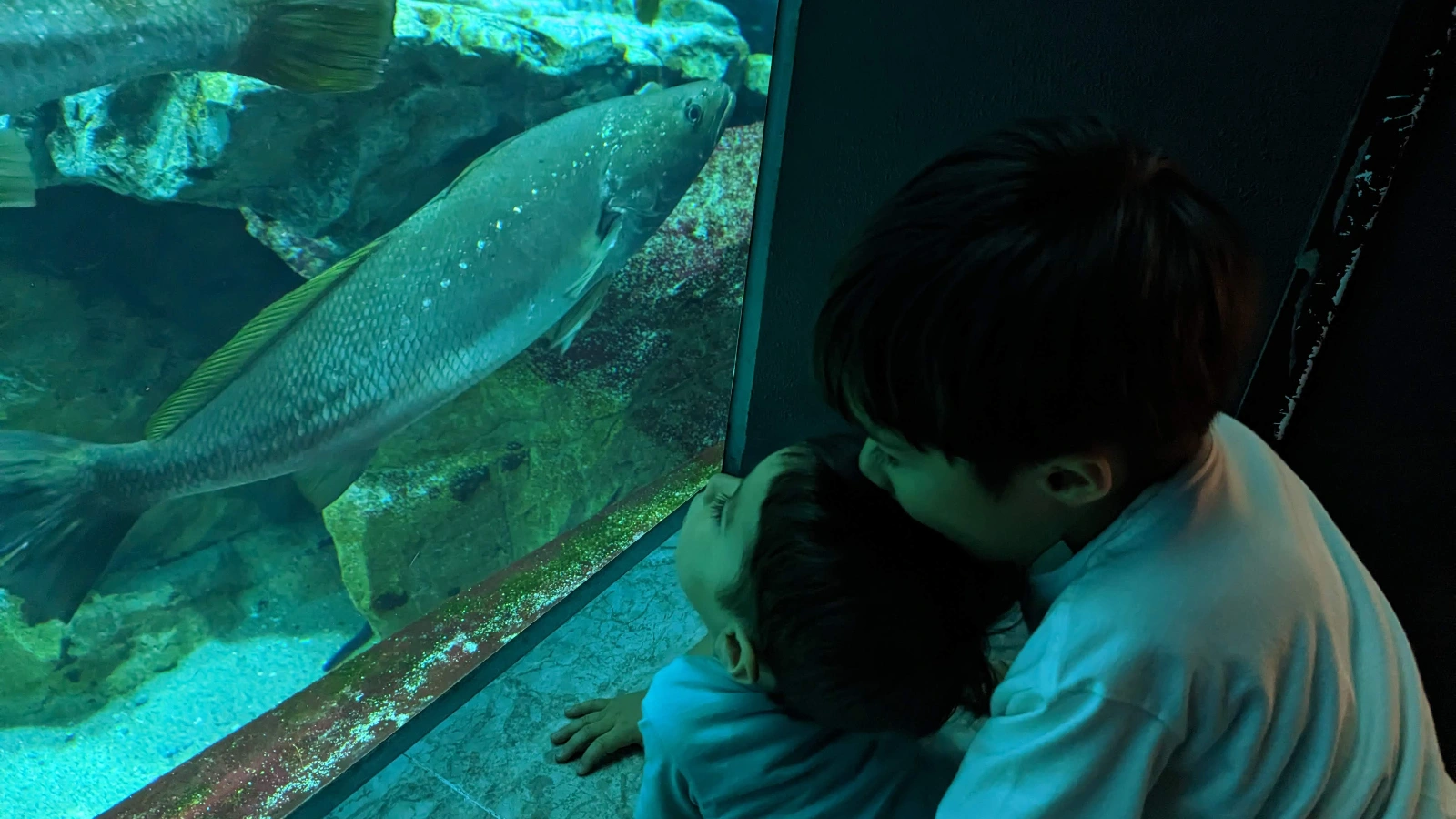
Nico went straight for the touch pool and stayed. He crouched at the water’s edge, reached for starfish and shellfish, and narrated each one, then circled back twice when the rest of the family had moved on. At the main ocean tank he pressed both hands to the two-story glass and tracked a single shark around the tank, turning his whole body to follow it, and only the promise of the dolphins pulled him onward.
This is the Dynamo pattern. A child whose Reserve depletes through restricted movement turns looking into moving whenever the room allows it, and this aquarium allows a great deal: three floors to cover and an outdoor area built for close viewing. Families with a similar child should let the child set the route and circle back as often as he likes, because a Dynamo following an animal around a tank is spending energy well rather than losing it.
An aquarium with dolphins, open lawns and tanks at every level gives a child a sense of how much life the sea holds, and how differently each creature lives. A dolphin show and a slow tank of fish, side by side, teach contrast: speed and stillness, spectacle and patience. Children often remember the quiet moment at the glass as vividly as the splash. A family that leaves room for both is showing a child that wonder comes in loud and quiet forms, and that each deserves their full attention.
The LUNI Rating for Marine World Uminonakamichi.
One fact runs under all four verdicts: this aquarium was built with room in it, indoors and out, and it lends the equipment a small child needs. That is why every profile is well served. What changes by season is the schedule: show times move with the season and the weekday, and the dolphin show, the big-tank show and the feeding times give the day its fixed points and, at the show pool, a seat with a view. Pick the one show that matters most to the child, and let the lawn and the outdoor area fill the time between.
Let the child set the route. The Dynamo depletes through restricted movement, and this aquarium gives a moving child more room than most. The tanks run across three floors, with the open-ocean tank rising through two of them, and the first floor opens onto Kaiju Island, an outdoor area laid out for watching animals from different angles and getting close to them. There is a lawn square for eating outdoors in fair weather, and the dolphins can also be seen at the Kaiju Island dolphin pool.
The case rests on that variety: a child can move between levels, indoors and out, without the visit stalling. The one rule to set before the show pool is that no hand goes in the water, because the animals may bite, and front rows get splashed, so a child who wants to be close should expect to get wet. Otherwise, let the child lead and circle back as often as he likes. Save the lawn for the end of the day, for a picnic in the open air, weather allowing.
What this means for your Dynamo: three floors and an outdoor area give a moving child room to spend it. A younger Dynamo needs the outdoor area early; an older one can set the whole route himself.Read the sensory map, then sit back from the splash. The Sensor depletes through sensory input, and the aquarium has planned for this child. There is a sensory map for visitors sensitive to light, sound and smell, and a guide for first-time visitors, both on the aquarium’s website to read before the day. The show pool looks out over Hakata Bay, which gives the loudest part of the visit an open view rather than walls. The dolphin and sea lion show runs about 30 minutes, long enough to settle into a chosen seat.
The practical lever is choosing where to sit and when to move. At the show pool, the front rows get splashed, so a child who dislikes surprises should sit further back, and seats are unreserved on most dates. Between tanks, Kaiju Island is outdoors, a change of air after the indoor halls. Show times vary by season and day, so check the day’s schedule on arrival and avoid planning two shows back to back. Let the child take the jellyfish and the deep sea at their own pace.
What this means for your Sensor: sensory input is highest at the show pool and easiest to manage from the back rows. A younger Sensor needs the map read beforehand; an older one can choose the seats himself.Give the child the schedule, not a promise. The Anchor depletes through unfamiliarity and unconfirmed structure, and Marine World publishes what this child needs before the day: a guide for first-time visitors and a daily schedule of shows and feeding times. The floor plan is fixed, from the coastal seas on the third floor to the open-ocean tank below. What changes is the timing: show times differ by season and weekday, so the day’s schedule, read at the entrance, is the one document this child needs.
So the day rests on the schedule rather than on any single show. The dolphin show is the easy fixed point, and the big-tank show and the feeding times do the same job: a time to be at a place, told in advance. Let the child pick the fixed point, then describe the rest of the route around it, from the coastal seas down to the open ocean.
What this means for your Anchor: a posted schedule and a fixed floor plan leave unfamiliarity little to work on. A younger Anchor needs one fixed time named; an older one can plan the day around the schedule.Bring the stroller, or borrow one. The Sprinter depletes through sustained travel-style walking and standing, and an aquarium day is mostly both. The journey from Hakata is two trains, about half an hour of riding, and inside, a visit moves between tanks on foot. What makes the difference is equipment. Strollers are allowed inside, and the aquarium lends strollers and wheelchairs free against a 500-yen deposit, while they last; tricycles and outdoor wagons are refused, and so is a stroller when staff judge it could bump into other guests.
For a younger Sprinter that settles it: ride the stroller from tank to tank and save the legs for the outdoor area. For an older child, the show seating is the natural sit, a half hour off their feet with something to watch, and the lawn is a second rest stop in fair weather. Entry closes an hour before closing time, so plan the last show as the day’s final seated stop.
What this means for your Sprinter: strollers and loans take most of the walking and standing off a young child. A younger Sprinter rides tank to tank; an older one needs a seated stop planned, and the show seating is the one to plan.The questions parents actually ask.
The dolphin show is the fixed point of a Marine World day, and the rest of the schedule, the big-tank show and the feeding times, moves with the season and the weekday. Prices go by age, the digital ticket has no time slot and costs the same as the gate, and strollers are allowed inside, with free loans for a family that left its own at the hotel. Packed lunches have their places, indoors for a wet day and outdoors for a dry one. The aquarium is one of Fukuoka’s indoor days that still has a lawn for a dry spell.
Is Marine World Uminonakamichi worth visiting with kids?
Yes. It allows strollers inside and lends them free, it has an outdoor area built for seeing animals close up, and it has a sensory map and a first-visit guide online. The dolphin and sea lion show runs about 30 minutes, in a pool that looks out over Hakata Bay.
How much does Marine World Uminonakamichi cost for kids?
Adults pay 2,500 yen, as do high school, university and vocational students. Elementary and junior high students pay 1,200 yen, and children from 3 up to school age pay 700. Visitors 65 and over pay 2,200, and for a child under 3, ask at the gate before assuming entry is free.
How long is the dolphin show at Marine World?
About 30 minutes, at a show pool that looks out over Hakata Bay. The front rows get splashed and most dates have unreserved seating, so a child who dislikes surprises can sit further back. Show times change with the season and the weekday; the big-tank show and the feeding times run through the day as well.
What are Marine World’s opening hours?
Standard hours are 9:30 to 17:30. In Golden Week and summer it stays open to 21:00, and from December to February it runs 10:00 to 17:00. Entry closes an hour before closing time. It shuts for four days from the third Monday of January, and typhoons or lightning can change the hours without notice.
Can you bring a stroller to Marine World?
Yes. Strollers are allowed inside, and the aquarium lends strollers and wheelchairs free against a 500-yen deposit, while they last. Tricycles and outdoor wagons are refused. At the show pool, bags cannot be used to save seats, the front rows get splashed, and no one puts a hand in the water, because the animals may bite.
Can you bring your own food to Marine World?
Yes, and it can be eaten in two places: the show pool seating, when no show is running, and the lawn square in fair weather. Both depend on the day, the seating on the show times and the lawn on the weather, so check the forecast the night before and plan to buy lunch if rain is coming.
How do you get to Marine World from Hakata?
By train, take the Kagoshima Line from Hakata to Kashii, about 11 minutes, then the Kashii Line to Uminonakamichi, about 20 minutes. A Nishitetsu bus also runs, and the Uminaka Line boat sails from Momochi or Hakata Pier. The gate is about 5 minutes’ walk from Uminonakamichi Station. Plan the return before the last show.
Do you need to book Marine World tickets in advance?
No. The digital ticket costs the same as the gate and carries no time slot, and it charges a full cancellation fee from 16:30 on the day of use. Reserved show seats were sold only on set summer dates, where each child from 3 needed a paid seat; on other dates every seat is unreserved.
Where Marine World Uminonakamichi fits your Japan trip.
Official site and opening information: Marine World Uminonakamichi