What to pack for Japan with kids,and why it is less than you think.
- Where Sizes Run Out
- Before a tall twelve-year-old does
- Bought There
- Diapers, clothes, snacks, sunscreen
- Pack From Home
- The bigger child’s clothes, and socks
- The Bag Ships Itself
- Takuhaibin, up to 200 cm and 30 kg
- The Whole List
- Medicine, plug, clothes, socks, a carrier
Some links on this page are affiliate links. LuNi may earn a commission at no extra cost to you.
Pack less for Japan with kids than you would anywhere else. Japan sells almost anything a child needs within a short walk of the hotel, from diapers and clothes to snacks and sunscreen, and takuhaibin carries the heavy case ahead to the next hotel while the family rides the train without it. The weight a family hauls up a staircase is the weight that costs a child their afternoon. So the honest list is short: the five things Japan will not sell you, ship for you or wash for you. The medicine, the plug, the bigger child’s clothes, socks and a carrier.
Pack less here than you would anywhere else.
Family travel runs on three currencies rather than two. Money and time, and then the child’s Reserve, which is their finite capacity to absorb what a trip asks of them. A packing list is an attempt to spend the first two to protect the third.
The country does most of the packing for you.
Two of these are why a family can travel Japan with a half-empty case. The third is the one thing that cannot be taken on trust.
Closer Than Your Own Cupboard: what is already on the shelf.
A convenience store sits within a short walk of almost any hotel a family would book, and a drugstore is rarely much further. Matsumoto Kiyoshi and the chains like it carry sunscreen, wipes, diapers, thermometers, bandages and everything medicinal short of a prescription. Nishimatsuya and Akachan Honpo are children’s superstores: clothing by the centimeter, bottles, formula, rain gear. Daiso covers the small plastic thing nobody thinks of until they need it, and Don Quijote covers the odd one at eleven at night. None of that needs two weeks of itself in a suitcase.
Your Luggage Takes a Different Train: the forwarding habit.
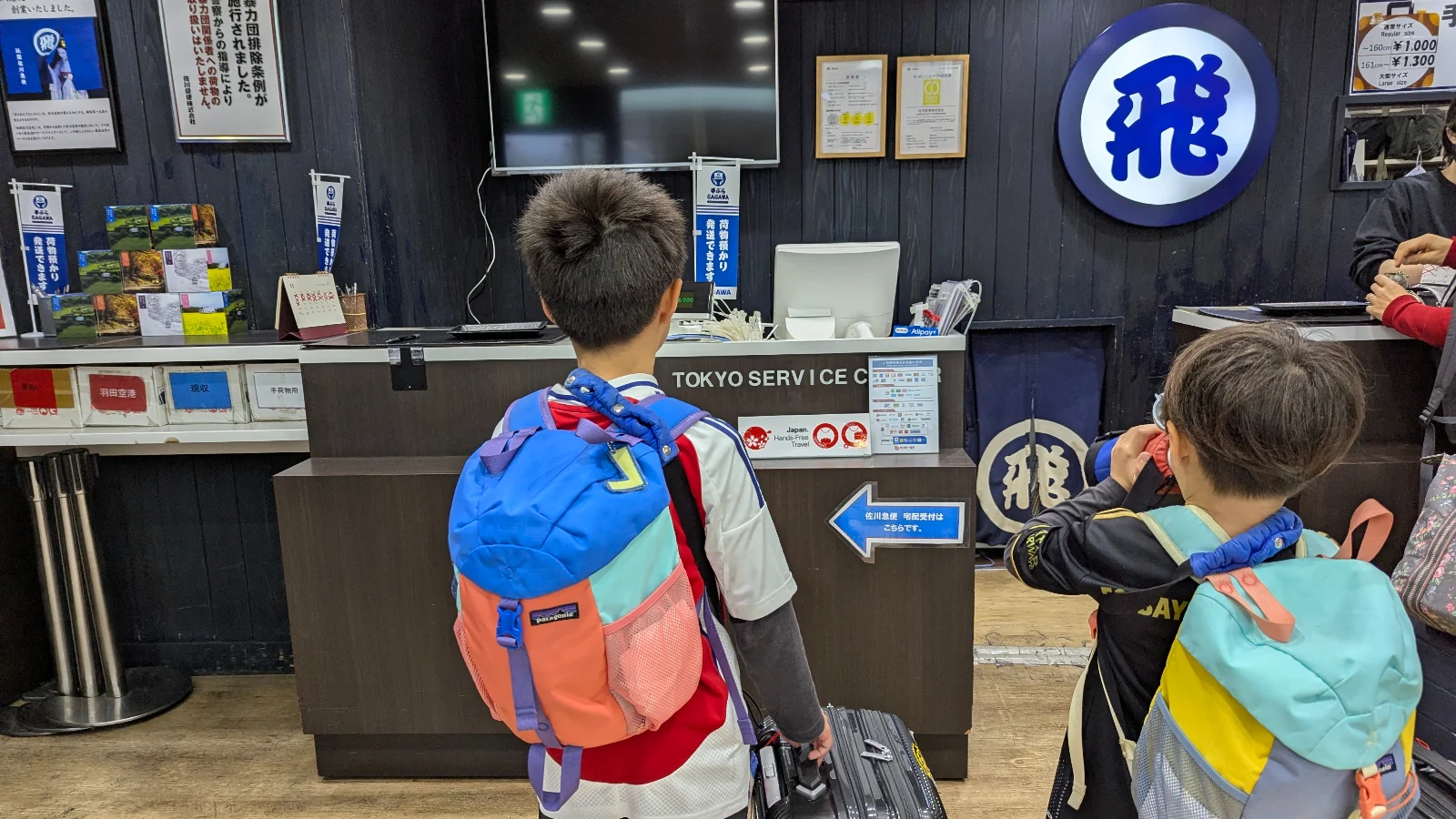
The service is takuhaibin, and it is the single biggest reason packing rules change at the Japanese border. A parcel is accepted up to 200 centimeters across its three dimensions and 30 kilograms, which is a full-size family suitcase, and hotels send and receive them as routine rather than as a favor. With Yamato, a Size 160 case from Kanto to Kansai is 3,160 yen one way and a Size 200 is 5,410. Allow two days as standard and three from some areas, or use the same-day service on the limited routes that offer it: Haneda Airport to the twenty-three wards is 5,780 yen for a Size 160 case, and Kyoto Station to a hotel in the city is 3,470. The bag you drag through a rush-hour interchange never has to be the bag you brought from home.
The One Promise Nobody Made: a hotel coin laundry.
The familiar version of this reasoning ends with a coin laundry in the basement of every Japanese hotel, and that part is not true. Some have one, many do not, and the difference tracks neither the room rate nor the chain. It is the one assumption a family cannot take on trust, so confirm it at your own hotel by name rather than planning a five-day wardrobe around a washing machine that turns out not to be there.
Five things that have to come from home.
Everything else is a convenience. These five are the whole of what Japan will not sell you, ship for you or wash on your behalf, and the first one is settled weeks before you fly.
Check the Ingredient, Not the Brand: your child’s prescription medicine.
Some prescription medicines cannot enter Japan at all. No permit exists for them, a prescription from your own country is expressly no defense, and the one that catches families is amphetamine, which is the active ingredient in Adderall. Other medicines for the same condition come in freely, and others again come in with an advance permit, and nothing on the outside of the box tells the three apart. So check the active ingredient against Japan’s controlled substances list rather than the brand name, and check it weeks out, because a permit is not a same-week document. Ordinary prescriptions travel on a one-month personal allowance.
An Adapter Is Not a Converter: one hundred volts and two flat pins.
North America runs 110 to 120 volts and most of Europe, Australia and Asia run 220 to 240. Japan runs 100, and the socket takes two flat pins. An adapter changes the shape of the plug and nothing at all about the voltage, so the thing to check is the appliance, not the charger: a hair dryer or a bottle sterilizer is where this shows, and a phone charger will almost certainly be fine. Japan also runs two frequencies rather than one, fifty hertz in the east and sixty in the west, divided roughly at the Fuji river in Shizuoka, which matters only to a motor.
Above the Children’s Rail: clothes and shoes for a bigger child.
Japanese children’s clothing and rental equipment is sized by the child’s height in centimeters, and the ranges stop earlier than a visiting parent expects. Rusutsu rents a wear set of jacket and pants at 6,200 yen a day for a child against 7,800 for an adult, with children’s sizes running 90 to 140 centimeters and the child discount ending at twelve, so a thirteen-year-old is renting adult wear at the adult price. The same shape repeats across clothing, footwear and helmets. A three-year-old can be dressed from scratch on arrival almost anywhere in this country. A fifteen-year-old needs the jacket, the boots and the spare shoes to come out of the case.
Two Pairs Each: socks, because of the floors.
Shoes come off inside temple halls and original castle keeps, and the stairs inside a keep are climbed in socks on bare timber at up to sixty-one degrees. Thin socks are the wrong footwear for the steepest thing your child will climb all trip, and the pair they have on will already be damp from a morning of walking.
The Trash Can That Is Not There: somewhere to put a day’s wrappers.
Public trash cans are rare in Japan, and a family eating its way through a day outside produces more than it expects. The wrappers, the drink bottles and the ice cream cup travel with you until a convenience store or a station platform offers somewhere to put them. A folded bag in the day pack is the difference between that and a handful, and the ones that do exist are usually split between burnables, PET bottles and cans rather than taking everything.
As Well as the Stroller, Not Instead: a carrier, while it still fits.
Bring the stroller. It never has to be folded on Japanese public transport, which was settled nationally rather than left to each operator, with three narrow exceptions that are mostly about buses. Then accept that it will not help on two kilometers of forest path with no wheeled access, on castle stairs, or on ten minutes of loose shrine gravel. Those are the days a carrier earns the space it took from a three-year-old’s clothes. Past about four the carrier stops being an option, and the equivalent for a nine-year-old is not a piece of equipment at all: it is a shorter afternoon on the same terrain, planned before you leave the hotel.
A short list changes, and the rest of the year does not.
Everything above holds in every month of the year. Four things move with the calendar, and only two of them are worth space in the case.
| The Season | What Actually Changes | The Call |
|---|---|---|
| SummerJune into September | Humidity near three quarters, and a national heat alert that names children. | Bring hats |
| The RainJune to July, then September to October | September and October are wetter in Tokyo than the rainy season is. | Bring a dry bag |
| Winter on HonshuTokyo, Kyoto, Osaka | Cold, but above freezing by day, and indoors is heated everywhere. | Bring nothing extra |
| Winter in HokkaidoSapporo, Niseko, Rusutsu | Below freezing all day, on compacted ice, for weeks at a time. | Bring base layers |
| Spring and AutumnThe two most wanted | The crowds and the room rate move. The case does not. | Change nothing |
SummerJune into September
Bring hats
The RainJune to July, then September to October
Bring a dry bag
Winter on HonshuTokyo, Kyoto, Osaka
Bring nothing extra
Winter in HokkaidoSapporo, Niseko, Rusutsu
Bring base layers
Spring and AutumnThe two most wanted
Change nothing
Humid, Not Just Hot: June into September.
Tokyo’s August normal is a daily high of 31.3 degrees Celsius with relative humidity at 74 percent, and July sits at 29.9 and 76. The figure that should shape the day is not either of those: it is the heatstroke alert, issued jointly by the Ministry of the Environment and the meteorological agency whenever the forecast wet bulb globe temperature reaches 33, across fifty-eight regions, from late April to late October, with children named among the people who need particular care. Two things are worth the case space, a wide hat for each child and more spare shirts than feels reasonable. The cooling towels, neck rings, handheld fans and salt candy are all on the shelf in any drugstore or convenience store from early summer.
Wetter in Autumn Than in the Rainy Season: the rain.
Most packing advice has this backwards. Tokyo’s normal rainfall is 167.8 millimeters in June and 156.2 in July, against 224.9 in September and 234.8 in October. September is also the peak of the typhoon season alongside August, at 3.3 approaches each in an average year out of 11.7, with about three making landfall. Almost none of that changes the case. A clear vinyl umbrella is a convenience-store purchase on the morning it rains, and a child’s rain boots are a children’s-store purchase. What is worth bringing is a dry bag for the electronics and a second pair of shoes each, because wet sneakers do not dry overnight in a Japanese hotel room in September.
Below Freezing All Day: Hokkaido is not a colder Tokyo.
Tokyo in January normally reaches 9.8 degrees by day and falls to 1.2 at night, which is a coat and a hat. Sapporo in January normally reaches minus 0.4 by day and minus 6.4 at night, which is a different category of clothing, because the city does not get above freezing at all. Thermal base layers are the one thing worth flying in: they are flat, they weigh nothing and they do the work two sweaters would. Leave the ice grips at home, because Sapporo sells the strap-on kind at most convenience stores in the city, bought on the first morning and fitted on sight. Leave the snow wear at home too if a resort is on the itinerary, because the resorts rent jacket and pants by the day and a week of it would fill a whole case by itself.
Nothing Moves: spring and autumn.
The two seasons families most want are the two that ask least of the case. Layers, and the same shoes as every other month of the year. What moves in spring and autumn is the crowd and the price of a bed rather than the weather, which is a planning decision and not a packing one, and both the blossom and the leaves arrive inside a window rather than on a date.
Length, bases and the age of the child.
Two families in the same month, with children the same age, will still pack differently for three reasons that have nothing to do with the weather.
Ten Days Is the Hinge: how long the trip is.
Under about ten days, pack what the family needs and plan no wash at all. Over it, pack a week and use a laundry, because the case does not get any bigger and the volume problem solves itself as the trip goes on. Only one length changes the rules rather than the quantities, and that is a trip running past a month, where the one-month personal allowance on prescription medicine stops covering the child and an import confirmation has to be applied for before departure.
Two Bases or Five: whether you move.
A family that lands in Tokyo and stays there can bring whatever fits the plane. A family moving five times is doing the moving itself, and four wheeled cases through a rush-hour interchange is the version of this trip nobody enjoys. Two numbers push the same answer. Add a bag’s three dimensions together: above 160 centimeters it needs a reserved oversized space on the Tokaido, Sanyo and Kyushu Shinkansen, the line families ride between Tokyo, Kyoto, Osaka and Hakata, and above 250 it cannot be carried at all. Then the cabin, because a domestic flight inside Japan is a smaller aircraft than the one that brought you, and ANA allows two items at ten kilograms combined. One large case forwarded and one small one carried clears both, and a family moving fast needs the small one to cover two nights rather than one.
Three to Sixteen: what the age of the child changes.
A three-year-old is the easy case and the one every packing list is secretly written for: everything that child wears, eats or wipes is on sale a short walk away, so the case carries the carrier, a familiar cup and very little else that could not be replaced by lunchtime. An eight-year-old sits in the middle, where their own small backpack is worth more than anything inside it, because a child carrying their own water and their own layer stops asking an adult for both. A fourteen-year-old inverts the list. That child is past the end of Japan’s children’s size rail, so shoes, a jacket and a spare of everything have to come from home, and they need their own adapter rather than a share of a parent’s.
The questions families ask most.
What medication can you not bring into Japan?
Four substance classes are prohibited outright, no permit exists, and a prescription from your own country is expressly not a defense: heroin, opium powder, methaqualone, and amphetamine and methamphetamine. Amphetamine is the case that catches families, because it is the active ingredient in Adderall, and the answer there is a flat no, even for treatment. Check the ingredient, not the brand.
What changes about packing for Japan by season?
Less than most lists suggest. Summer adds hats, spare shirts and a heat plan, because Tokyo’s August normal is a daily high of 31.3 degrees Celsius at 74 percent humidity. Rain adds a dry bag, and September and October are wetter in Tokyo than the rainy season. A Hokkaido winter adds thermal base layers. Spring and autumn add nothing at all.
Do you need to reserve a space for a suitcase on the Shinkansen?
On three lines, yes, above a size. Baggage whose three dimensions add up to more than 160 cm needs a reserved oversized space on the Tokaido, Sanyo and Kyushu Shinkansen, the route most families ride between Tokyo, Kyoto, Osaka and Hakata. Above 250 cm it cannot be carried at all. The northern lines are under a different regime.
Do you have to fold a stroller on a Japanese train?
No, and that was settled nationally rather than left to each operator. A stroller does not have to be folded, with three narrow exceptions, two of them about buses: where the stroller is over the size that fits, where a bus’s structure makes an unfolded stroller unsafe, and on buses running difficult routes. Look for the national stroller mark.
Should you pack light for Japan with kids?
Pack light in volume and heavy in the five things that cannot be replaced. Japan ships your bags between hotels, sells whatever a child needs within a short walk, and restocks the rest. What it will not do is release a medicine refused at the border, sell you the right plug for a hair dryer, or find snow wear for a tall thirteen-year-old.
What plug and voltage does Japan use?
One hundred volts, lower than anywhere you are likely to be arriving from: North America runs 110 to 120, and most of Europe, Australia and Asia run 220 to 240. The plug takes two flat pins. Japan also runs two frequencies, 50 hertz in the east and 60 in the west. Anything that heats or has a motor is where this matters.