Yoyogi Park with Kids: Open Space, Not a Playground.
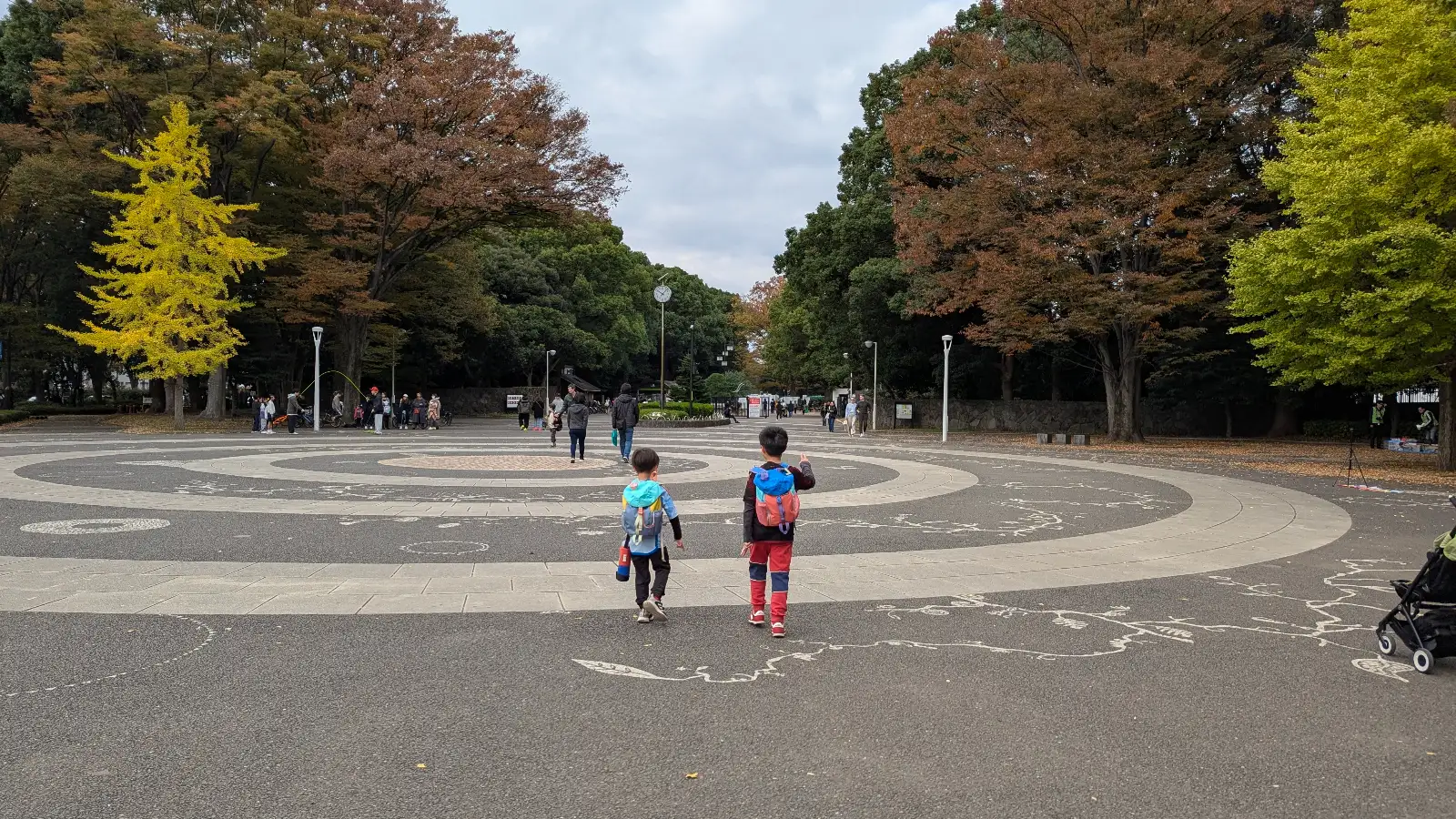
Yoyogi Park gives a Tokyo child something the city rarely does, huge open ground that is free and always open, and it asks only that no ball comes along.
Some facilities charge: rental bikes by the hour, and paid parking.
The service center and facilities close over the year-end holidays.
The park never closes, so the visit lasts as long as the children do.
An infant cycling course takes training-wheel bikes; older children can ride the long course.
Few steps and many benches. Three minutes on foot from JR Harajuku and from two subway stations. Accessible restrooms, diaper-changing tables, wheelchair loans and a nursing room.
Some links on this page are affiliate links. LuNi may earn a commission at no extra cost to you.
Is Yoyogi Park worth it with kids?
The short version, before the costs, the timings and the case for each child.
Yes, and after a few days of trains and museums it can be the best morning of the week for your children. Yoyogi Park is huge, free and never closed, and it gives a child the one thing the city rarely offers: room. A child who has been held still in stations and museums all week will use it without being told how. The condition is what you bring. It is not a playground, and the rules say so: ball games, skateboards, loud music and tents are banned, so the park is for walking, running about on the grass and picnicking on a mat. A family that packs for a sports afternoon will spend it explaining the rules; a family that packs a mat and a snack will have the morning it came for. Come early and let the children use the space.
Planning Your Visit to Yoyogi Park with Kids.
Three decisions shape a morning in Yoyogi Park, and the first is what to bring. Ball games, skateboards, roller skates and tents are all banned, so leave them at home and bring a mat and food ready to eat, since cooking and barbecues are not allowed. The second is the bikes: the cycling center rents them by the hour and has a weekly closing day, so check the day if a ride is the plan. The third is the time. The park never closes and its cafe opens early, so an early start is easy, and a morning on the grass before the city wakes up is one of the quiet pleasures of a Tokyo trip. Leave while the child still wants more, and the rest of the day inherits a good mood.
Every LuNi attraction guide starts with a visit, with our own children
LuNi rates and writes about attractions only after visiting them with children. Luca and Nico were at Yoyogi Park, and what they did there is recorded further down this page, including how each child actually met it.
Children arrive with different tolerances: for noise, for lines, for standing still, for being on their feet all day. A guide written for the average of them helps almost nobody. So every place on this site is read four ways, and each verdict says which children it already suits and what makes it work for the rest. Whoever you are bringing, the answer here is built for your family rather than for a general reader.
Restricted-movement depletion finally has room on open ground that never closes, though ball games are banned, so let the child roam the lawns.
Sensory-input depletion falls away in a huge park where loud or amplified music is banned, so give a Sensor the quiet lawns early in the day.
Unfamiliarity eases with a park that is always open and a clear list of rules, so read the rules together and choose the gate before arriving.
Walking and standing add up across a very large park, so choose one area to enjoy, plan a sit at the cafe, and keep it short.
Hotels we would book for this visit.
Open ground is best spent early, so each room here puts the park within an easy start, before the day’s other plans begin. Three Shibuya family hotels, the pick first: for a child who has run all morning, the ride back should be short.
| Property | The LuNi Reason |
|---|---|
| LUNI Pick Hotel Indigo Tokyo Shibuya | Hotel Indigo Tokyo Shibuya is for a family giving the park the morning and Shibuya the afternoon. Open ground is best spent early, while a child has the most to run off, and a base in the same ward makes the lawns an easy start, so the afternoon in the city begins with the running already done. |
| Shibuya Excel Hotel Tokyu | Shibuya Excel Hotel Tokyu is for a family that stays at the park until the child is done: the park in the morning, the evening back in Shibuya, and a child who has spent the day on open ground never has to cross the city to reach bed, however late the park day runs. |
| Trunk Hotel Cat Street | Trunk Hotel Cat Street sits between Shibuya Station and Harajuku, for a family whose days here start on the lawns. The park is three minutes on foot from JR Harajuku, and a room on the Harajuku side of the ward makes an early morning on the grass the easy first thing of the day. |
Nearby attractions, matched to your child.
Three pairings for what an open park leaves over: a shrine whose rites run in a fixed order, a short indoor morning for a child whose legs have had enough, and a famous statue with a story to tell.
| Pairing | Why This Solves the After-Visit | For Your |
|---|---|---|
| LUNI Pick Meiji Jingu Shrine Harajuku; free, wooded approaches | At Meiji Jingu Shrine, worship follows an order a child can learn at home: hands and mouth at the temizuya, then two bows, two claps and a bow. For an Anchor, unfamiliarity eases when the steps are known and practiced before the gate. Rehearse the claps at breakfast. | Anchor |
| Tokyo Toy Museum Yotsuya; closed on Thursdays | For a Sprinter whose walking and standing added up across the park, the Tokyo Toy Museum is a short indoor morning, 90 to 120 minutes, with an elevator. Tickets are best bought online ahead, since counter sales can stop, and it closes on Thursdays. | Sprinter |
| Hachiko Statue Shibuya Station, Hachiko Exit; free | For a Sprinter, the Hachiko Statue is a stop that costs almost nothing in legs: a bronze dog at the Shibuya Station exit named after it, and a story worth telling on the way. A Sensor’s sensory input meets a crowded public plaza there, so keep that child’s stop to one photograph. | Sprinter |
Meiji Jingu Shrine
Harajuku; free, wooded approaches For YourAnchor
Tokyo Toy Museum
Yotsuya; closed on Thursdays For YourSprinter
Hachiko Statue
Shibuya Station, Hachiko Exit; free For YourSprinter
How two children actually met this attraction.
Two children went to the same park and neither of them cared much for the lawns, which is the most honest lesson Yoyogi has to teach. One found the open space unremarkable and fixed instead on a single concrete detail he could study; the other ignored the view and turned the whole park into a search, moving the entire time. Both had a good day, and neither needed the space to be pretty. That is how children use a big park. Give the one who studies something small to find within it, and give the one who moves a task to carry across it. The open ground does the rest, as long as nobody tries to make it a playground or fill it with equipment the rules turn away.
The lawns and trees did little for Luca, who had expected more flowers and more variety than the park delivered. What held him was a single concrete detail: the graffiti on one of the park’s bridges. He fixed on the red bridge in particular, studying the painted dragon and the colored diamond beside it, and pronounced it the best thing there. The open space registered as unremarkable.
This is the Anchor pattern. A child whose Reserve depletes through unfamiliarity and unconfirmed structure does not settle into open space for its own sake; he looks for one thing he can read, and holds on to it. For a similar child, give the park a purpose before you arrive, a place to find or a detail to look for, so the open ground becomes a map with a destination rather than a field with no edges, and let him lead the way to it.
Nico turned the park into a search. He spent his time hunting for pine cones to carry back to his teacher and school friends, moving constantly across the ground in the process, though he came away disappointed at how few he found. He also noticed something most visitors miss: people who could not see were being guided so that they, too, could run freely in the park.
This is the Dynamo pattern. A child whose Reserve depletes through restricted movement uses a park best when he has a mission that keeps him moving across it. For a similar child, give him a task before you arrive, counting bridges or finding the cycling center, one that needs no collecting, since the park asks visitors not to take plants or animals. The movement is the point; the task simply keeps it going across the whole morning.
A huge park with no play equipment trusts children to invent their own play, and they almost always do. An open lawn becomes a racecourse, a search ground or a place to lie back and watch the sky, depending entirely on the child. That kind of self-directed play builds imagination and confidence in ways a playground cannot, because nothing tells the child what the space is for. On a trip full of scheduled sights, a morning with nothing planned but grass is often the one where a child feels most free, and most themselves.
The LUNI Rating for Yoyogi Park.
Three profiles are served without conditions, because a free, always-open park gives most children what they need. The Dynamo gets room to move, the Sensor gets space away from noise, with loud music banned, and the Anchor gets a park with no gate hours and a clear list of rules. Only the Sprinter needs a plan, because this is a very large park and a tired child can find the walk back as long as the walk out. Plan one area, not all of it, and that cost takes care of itself. Shinjuku Gyoen National Garden makes the same trade with gates and rules, for a child who wants edges.
Let the child roam; no ball needed. The Dynamo depletes through restricted movement, and after a few days of city travel, a park this size is exactly what a moving child needs. Yoyogi Park is free, always open and huge, and running about on the grass is not on its list of banned activities. For a child who has been held still in trains and museums, an hour of open ground resets the whole trip.
The limits are specific. Ball games and sports practice are banned, as are skateboards and roller skates, so the energy has to go into moving rather than playing a game. For wheels, the cycling center rents bikes by the hour, with an infant course for training-wheel bikes, though it closes on Mondays. Give an older child a mission across the park, and a younger one the grass nearest the gate, with a parent close by and a mat to come back to.
What this means for your Dynamo: open ground that never closes gives restricted movement real room. A younger Dynamo needs the grass nearest the gate and the infant cycling course; an older one needs a mission across the park.Give the Sensor the lawns early in the day. The Sensor depletes through sensory input, and a park of this size is one of the best places in Tokyo for this child to recover. Loud or amplified music is banned, as are drones and fireworks, and the park is large enough that a family can find a quiet stretch of grass away from the paths. For a child who has had too much city, room on the grass is how the input comes down.
So plan it as a reset. Come early, soon after the park cafe opens, and find a spot on the lawns before the day gets going. Let the child sit, look and wander at their own pace. Keep the busier neighborhood around Harajuku for later, or for another day. A Sensor who starts the morning in Yoyogi Park will manage the afternoon far better.
What this means for your Sensor: input falls away in a huge park where loud music is banned. A younger Sensor needs a quiet spot on the grass early; an older one can wander and choose where to settle.Read the rules together, and choose the gate. The Anchor depletes through unfamiliarity and unconfirmed structure, and Yoyogi Park is simple to explain. It is always open, with no gate hours and no ticket, and its rules are set out as a clear list. Three stations are about three minutes away: JR Harajuku, Yoyogi-koen on the Chiyoda Line and Meiji-jingumae. The cycling center keeps its own hours, 9:00 to 16:30, and closes on Mondays.
Lay the plan out for this child. Read the rules together, so the child knows that balls and skateboards are not allowed, and why. Choose the station and the gate, and pick one destination in the park, the cycling center or a particular lawn, so the open space has a shape. An Anchor who knows where the family is going will enjoy getting there, and will notice far more along the way.
What this means for your Anchor: unfamiliarity eases with a park that is always open and a clear list of rules. A younger Anchor needs the rules read at home; an older one can choose the station and the route in.Choose one area, and sit at the cafe. The Sprinter depletes through sustained travel-style walking and standing, and Yoyogi Park is very large. A tired child can find the walk back to the station as long as the walk out, and on open ground there is nothing to break the distance into pieces unless the family does it, with one area, one rest and the walk back planned together.
The fix is choosing less. Pick one area to enjoy rather than crossing the whole park, and plan a sit at Doutor Park Cafe Yoyogi or on a picnic mat. For a child who would rather ride than walk, the cycling center rents bikes by the hour. A Sprinter who has rested twice will walk back to Harajuku without complaint, and will want to come again.
What this means for your Sprinter: a very large park is where walking and standing add up. A younger Sprinter needs one area and a picnic mat; an older one can ride the cycling course instead of walking it.The questions parents actually ask.
Yoyogi Park is open ground with a list of bans, so the packing matters more than the timing. Ball games, skateboards and loud music are banned. Bikes are rented by the hour and not on Mondays. The cafe opens at 7:00, and cooking is not allowed. And the park never closes, so an early start is always possible, before the paths fill with the rest of the city. It costs nothing to enter, which makes it one of Tokyo’s free mornings worth planning around. Once inside, a mat and a snack do more for a family than any sports gear would.
Is Yoyogi Park worth visiting with kids?
Yes, as open space rather than a playground. It is the fifth largest metropolitan park in Tokyo’s 23 wards, free and always open, three minutes from JR Harajuku, and it gives a child room to move that the city rarely offers. The rules matter, though: ball games, skateboards and loud amplified music are all banned, so bring energy, not equipment.
Can children play ball games at Yoyogi Park?
No. Ball games and sports practice, including baseball, soccer, tennis and golf, are prohibited in the park. So are skateboards and roller skates, drones and radio-control toys, tents and sunshades, and climbing trees. A separate sports field can be booked, but for an ordinary family visit the park is for walking, running about on the grass and picnicking on a mat.
Can you rent bikes at Yoyogi Park?
Yes, at the cycling center, called Pedalico, which runs a course of about 2,000 meters, a practice course and an infant course for training-wheel bikes. Bikes cost 300 yen an hour, or 100 yen with training wheels, and helmets 100 yen. Rentals run 9:00 to 16:00, and the center closes on Mondays.
When is Yoyogi Park open?
The park itself is always open, with no gate hours. Its service center and some facilities close over the New Year period, and the cycling center keeps its own hours and closes on Mondays. For a family, that means an early morning or an evening walk is always possible, even when the rentals are shut, as they are all day on Mondays.
Is there food at Yoyogi Park?
Yes. Doutor Park Cafe Yoyogi opens from 7:00 to 20:00, which makes an early breakfast in the park easy, and the Olympic memorial lodging opened as a cafe in April 2026. Cooking, barbecues and fires are not allowed, so a family picnic means food brought ready to eat, and a mat, since tents and sunshades are banned too.
How do you get to Yoyogi Park?
JR Harajuku, Yoyogi-koen Station on the Chiyoda Line and Meiji-jingumae Station are each about three minutes on foot, and Yoyogi-Hachiman on the Odakyu Line about six. There is paid parking for 65 cars, open around the clock, for a family arriving by car. Harajuku is the easiest arrival for most families, three minutes from the park on foot, as are both metro stations.
What are the rules at Yoyogi Park?
Beyond the bans on ball games and skateboards, the park prohibits loud or amplified music, drones, fireworks, tents and sunshades, unpermitted performances, climbing trees and hanging hammocks, collecting or feeding plants and animals, and walking on the cycling course. Unpermitted commercial photography is prohibited too. Personal photographs of the family are fine.
Where should families stay near Yoyogi Park?
Hotel Indigo Tokyo Shibuya and Shibuya Excel Hotel Tokyu in Dogenzaka, and Trunk Hotel Cat Street in Jingumae, all sit in Shibuya Ward, so the park in the morning and the city in the afternoon fit one day. Cat Street, on the Harajuku side, suits a family that wants the lawns first thing.
Where Yoyogi Park fits your Japan trip.
Official site and opening information: Yoyogi Park