Meiji Jingu Shrine with Kids: a free forest walk, never a run.
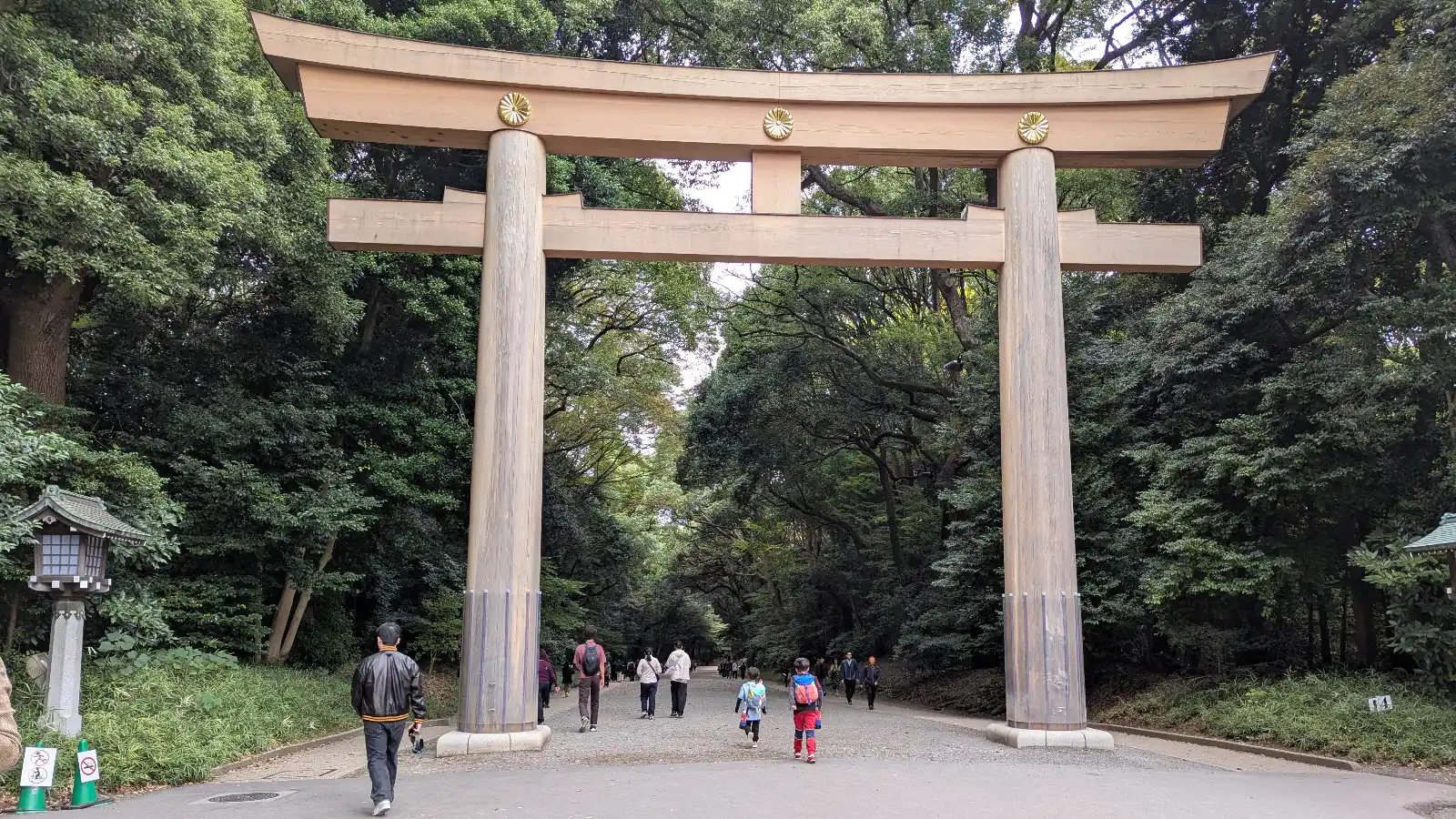
Meiji Jingu is a free walk through a forest to a great torii and a main hall, open from sunrise, but it is a place for walking, and running is not allowed.
No fee for the grounds and nothing to book; the Inner Garden charges 500 yen.
October 5:40 to 16:40, November 6:10 to 16:10; the times change every month.
Every part of the approach is walked, because cars are kept off it.
No running or sports in the grounds without permission; set that rule before the gate.
Past the first torii the paths are easy going, with a downhill slope; the west approach is gravel, so leave it out. Wheelchair ramps, an elevator, wheelchair loans and a nursing room.
Some links on this page are affiliate links. LuNi may earn a commission at no extra cost to you.
Is Meiji Jingu Shrine worth it with kids?
The short version, before the costs, the timings and the case for each child.
Yes, and it is the calmest big sight in Tokyo to put in front of children, provided the family arrives knowing its one rule. The grounds are free, the gates open at sunrise, and the approach leads through the forest to the great wooden torii, twelve meters high, and on to the main hall. There is plenty for a child to find and do: the torii itself, the water basin with its order of rinsing, the bows and claps at the hall. What the shrine asks in return is a walking pace. Running and sports are not allowed in the grounds, and the forest itself is off limits, so a child who needs to burn energy should do it somewhere else first.
Planning Your Visit to Meiji Jingu Shrine with Kids.
Three decisions make the visit work, and the first is the rule: this is a walking place, so tell a moving child before the gate, and plan somewhere to play afterward, because the shrine is not that place. The second is the hour. The gates open at sunrise and close at sunset, so the times shift through the year; check the month before planning, and an early visit is always possible for a family whose children wake at dawn. The third is food: eating is allowed only in the designated places, Mori no Terrace by the Harajuku gate and Forest Terrace on the south approach, so plan the snack stop in advance rather than carrying food along the walk for a hungry child. A child who hears all three at breakfast walks the approach knowing what it holds.
Every LuNi attraction guide starts with a visit, with our own children
LuNi rates and writes about attractions only after visiting them with children. Luca and Nico were at Meiji Jingu Shrine, and what they did there is recorded further down this page, including how each child actually met it.
Children arrive with different tolerances: for noise, for lines, for standing still, for being on their feet all day. A guide written for the average of them helps almost nobody. So every place on this site is read four ways, and each verdict says which children it already suits and what makes it work for the rest. Whoever you are bringing, the answer here is built for your family rather than for a general reader.
Restricted-movement depletion is met by a long free walk with the torii to find, but running is not allowed, so set that rule at the gate.
Sensory-input depletion stays low on a forest approach closed to cars, with no ticket line at the gate, so come early and keep to the walk.
Unfamiliarity eases when the approach, the great torii and the worship order are known in advance, so teach the bows and the water basin at home.
Walking and standing add up on approaches closed to cars, with eating only at two designated places, so plan one of them as the sit-down stop.
Hotels we would book for this visit.
Three bases for a family putting the shrine at the start of the day, when the gates have just opened: one on the Harajuku side, and two for a family basing itself in Shinjuku for several days.
| Property | The LuNi Reason |
|---|---|
| LUNI Pick Trunk Hotel Cat Street | Trunk Hotel Cat Street sits seven minutes from Harajuku, for a family that wants the shrine first thing and the Harajuku streets after. The early gate suits a child who feels every noise, and from this side of the ward a sunrise start needs no train before breakfast, only a walk the child can wake up on. |
| Keio Plaza Hotel Tokyo | Keio Plaza Hotel Tokyo is for a family covering Shinjuku and the shrine across several days. The shrine is a morning that asks for walking and nothing else, so pair it with a Shinjuku afternoon that gives a moving child room, and let the room be the fixed point both halves of the day come back to, whatever the weather. |
| MIMARU Tokyo Shinjuku West | MIMARU Tokyo Shinjuku West puts a kitchen and a dining table in every room, which suits the sunrise gate: breakfast at the table before anyone is hungry on the approach, and no meal to find on the way. Eating is allowed only at two places in the grounds, so a fed child starts the walk ready. |
Nearby attractions, matched to your child.
Three pairings for what a walking-only shrine leaves unmet: a child who needs rules that allow play, a child whose legs want the shortest stop next, and one who wants open lawns right beside the forest. Pick before the torii.
| Pairing | Why This Solves the After-Visit | For Your |
|---|---|---|
| LUNI Pick Shinjuku Gyoen National Garden Closed Mondays; Children’s Square | At Shinjuku Gyoen National Garden the Children’s Square lets children of elementary age and under use soft balls and skipping ropes. Restricted movement, held back all morning at the shrine, gets its outlet there, in a square built for exactly the play the shrine forbids. | Dynamo |
| Hachiko Statue Shibuya Station, Hachiko exit; free | The Hachiko statue stands at the Hachiko exit of Shibuya Station, a free stop that asks almost no walking after the shrine’s long approach. Walking and standing stay low there, though a Sensor’s sensory input meets a busy station plaza. Keep that stop short. | Sprinter |
| Yoyogi Park Beside the shrine; always open, free | Next door to the shrine’s forest, Yoyogi Park opens out into wide lawns with no gate hours, and loud or amplified music is banned there. For a Sensor, sensory input stays low on open grass in daylight, so the quiet of the approach can carry on into a slow late morning. | Sensor |
Shinjuku Gyoen National Garden
Closed Mondays; Children’s Square For YourDynamo
Hachiko Statue
Shibuya Station, Hachiko exit; free For YourSprinter
Yoyogi Park
Beside the shrine; always open, free For YourSensor
How two children actually met this attraction.
Two children walked the same approach and found completely different shrines. One made it about scale and facts, and let a single number organize everything he saw; the other ignored the buildings and watched the people, because the people were the part that kept changing. That is the honest picture of Meiji Jingu with children. The forest and the buildings stay the same, but on any given day there is something happening in the grounds, and a child will find it before an adult does. A parent does not need to fill the walk with explanations or a plan. Give the fact-lover the torii and its measurements before the gate, and the watcher a steady walking pace, permission to look at whoever passes, and let the approach itself set the rhythm.
Luca went straight for the size of the place. He stood under the grand torii gate measuring it against himself, and once he had learned just how big the torii really was, that fact became the anchor for the rest of the visit. When a wedding procession crossed the courtyard he tracked it closely, deciding it had made the family photo more significant because it does not happen on an ordinary day.
This is the Anchor pattern. A child whose Reserve depletes through unfamiliarity and unconfirmed structure holds a new place steady by fixing one confirmed fact at its center, and Luca built the whole visit around the torii. For families with a similar child, hand them that fact before they arrive: twelve meters high and 17.1 meters wide, built of wood, and standing where the two approaches meet. It turns an unfamiliar forest into a place with a known middle.
Nico was less interested in the structures than in the people moving among them. He noticed the small children dressed for shichi-go-san, the formal kimonos worn for the shrine-visiting rite of passage, and tracked them around the grounds, narrating who was going where. The costumes held him on the open path far longer than the buildings did, and he kept circling back to point out each new one he spotted.
This is the Dynamo pattern. A child whose Reserve depletes through restricted movement will find the moving part of any scene, and at a shrine where running is not allowed, Nico found it in the people. For families with a similar child, give that attention a job: count the gates, spot the next family at the water basin, find the torii before anyone else does. Keep the pace a steady walk, and plan somewhere afterward where he can move freely.
Meiji Jingu offers children something travel rarely does: a chance to take part rather than watch. Washing the hands in the right order, bowing, clapping and bowing again are small acts, but performing them with care tells a child that a place deserves respect and that they are capable of giving it. Children often love ritual more than adults expect, because it is clear, physical and shared. A forest walk that ends in a rite they have learned teaches how to be a guest in someone else’s sacred space, anywhere in the world.
The LUNI Rating for Meiji Jingu Shrine.
Three of the four children are served well by one of the free things to do in Tokyo that opens at sunrise: a walk through a forest to a torii and a main hall, with rules a child can learn. The Dynamo’s case carries a condition: movement here means walking, since running and sports are not allowed. The Sprinter needs a plan because the approaches are closed to cars and everything is walked, with eating allowed only at two designated places. None of it is hard to plan, and all of it is better planned at home. Watch the mover: a forest invites more than a walk.
Make the walk the activity. The Dynamo depletes through restricted movement, and Meiji Jingu offers a long, free walk through a forest at a pace the child can set, which is a real outlet for a moving child. It also has one firm limit: running and sports are not allowed in the grounds without permission, and visitors are asked to keep out of the forest itself. It works because walking counts, not because running is possible.
So give the walk jobs. Find the great torii, which stands where the south and north approaches meet. Do the water basin in its order: both hands, then the mouth from cupped hands, then both hands again. Lead the bows and claps at the main hall. A Dynamo with things to do keeps walking happily; a Dynamo with nothing to do soon starts testing the one rule the shrine insists on, which here is exactly the wrong outcome. Plan open ground for the afternoon, and tell the child it is coming; that promise makes the walking morning easy.
What this means for your Dynamo: restricted movement is met by walking, never running, here. A younger Dynamo needs the torii and the water basin as jobs; an older one can lead the family through the worship order at the hall.Come early and stay on the walk. The Sensor depletes through sensory input, and Meiji Jingu keeps much of that input out. There are no cars on the approaches and no ticket line at the gate, so the walk to the main hall is a forest path rather than a street. For a child who feels every noise and movement around them, that is an unusually gentle way to see one of Tokyo’s great sights.
Make it gentler still with the hour. The gates open at sunrise, so an early visit is always there for the taking, before the rest of the city’s day begins. Keep to the approach and the main hall rather than adding extra stops, and plan the next part of the day as something quiet too, so the calm of the morning is not spent in the afternoon. For this child, few sights in the city are as kind.
What this means for your Sensor: input stays low on a forest walk kept free of cars. A younger Sensor needs the visit timed to the gates opening; an older one can choose the quieter approach and set the length of the stop.Teach the order before the gate. The Anchor depletes through unfamiliarity and unconfirmed structure, and a shrine has more structure than most places a family visits. The great torii stands where the south and north approaches meet. The water basin has an order: both hands, then the mouth from cupped hands, then both hands again. At the main hall, an offering, then two bows, two claps and one bow. The gate hours are set by the sun and published month by month.
Give the child all of it before the trip. An Anchor who knows the sequence arrives holding it, and one who has practiced the bows at breakfast will lead them at the hall rather than watch anxiously for cues. Tell them, too, about the torii’s size, twelve meters high, so the first sight of it confirms something they already know rather than surprising them. The child then arrives as the expert on the one thing everyone comes to see.
What this means for your Anchor: unfamiliarity eases once the torii, the basin and the bows are known in order. A younger Anchor needs the bows practiced at home; an older one can learn the whole order and teach it to the family.Plan the sit-down before the walk begins. The Sprinter depletes through sustained travel-style walking and standing, and at Meiji Jingu everything is walked. Cars are not allowed on the approaches, so there is no shortcut to the main hall, and eating is allowed only in the designated places, Mori no Terrace by the Harajuku gate and Forest Terrace on the south approach. A child who tires on foot feels the whole length of the approach in both directions.
The cost here is real, but the fix is simple. Choose one of the two eating places as the planned rest before setting out, and tell the child where it is. Bring a carrier or stroller for a small child, keep the visit to the approach and the main hall, and leave the Inner Garden for another day unless the first half went well. The shrine will still be there on another, less tired morning.
What this means for your Sprinter: the approaches are closed to cars, so walking and standing add up. A younger Sprinter needs a carrier and a planned stop at a terrace; an older one can manage the walk if one terrace is promised halfway.The questions parents actually ask.
The shrine’s rules shape a visit more than its hours do, and they matter more here than at most sights. Running and sports are not allowed in the grounds without permission, insects may not be caught, and eating is allowed only in the two designated places. The gates follow the sun, so the hours change every month, and the Treasure Museum is closed, with no reopening date given. Read them out on the train in, and the gate becomes the moment a child already knows what to do. At the shrine itself, a child who knows the rules before the gate has the easiest morning of anyone there.
Is Meiji Jingu Shrine worth visiting with kids?
Yes, for most children, as long as the family comes for a walk and not a run. The grounds cost nothing, the gates open at sunrise, and the approach through the forest to the great torii and the main hall gives a child plenty to find. The one child to plan around is a tired walker, since cars are kept off the approaches.
What time does Meiji Jingu open?
The gates open at sunrise and close at sunset, so the hours change every month: 5:20 to 17:20 in September, 5:40 to 16:40 in October, 6:10 to 16:10 in November, 6:40 to 16:00 in December and 6:40 to 16:20 in January. Check the month before planning an early start or a late visit.
Can children run at Meiji Jingu?
No. The shrine does not allow running or sports in the grounds without permission, and visitors are asked to keep out of the forest itself. Tell a child before the gate that this is a walking place, and give them something to do with that walk instead, such as finding the great torii or learning the bows at the main hall.
Can you eat at Meiji Jingu?
Only in the designated places. Eating and smoking are not allowed elsewhere in the grounds, and there are two places set aside for food: Mori no Terrace by the Harajuku gate and Forest Terrace on the south approach. Plan a snack stop at one of them rather than carrying food along the walk for a hungry child.
Is the Meiji Jingu Treasure Museum open?
No. The Treasure Museum is currently closed, and no reopening date has been given. The Meiji Jingu Museum is a separate building, so do not confuse the two when planning. For a family, the grounds, the great torii and the main hall are the visit in any case, and none of them charges a fee.
How big is the torii at Meiji Jingu?
The great torii stands 12 meters high and 17.1 meters wide, a wooden torii built in the myojin style. It stands where the south and north approaches meet. The gate standing today dates from 1975, which is a good fact to hand a child who asks how old it is.
How do you pray at Meiji Jingu?
At a water basin, rinse both hands, cup water in your hands to rinse the mouth, then rinse both hands again. At the main hall, make an offering, then bow twice, clap twice and bow once. It is a Shinto shrine, unlike Senso-ji, which is a Buddhist temple, and a child who learns the order beforehand usually enjoys doing it.
Can children catch insects at Meiji Jingu?
No. The shrine asks visitors not to catch or bring in animals of any kind, insects included, and not to take plants or soil. It also advises covering skin against insect bites, so long sleeves or repellent are sensible on a summer visit. Leave the insect net at the hotel; the forest here is for walking through.
Where Meiji Jingu Shrine fits your Japan trip.
Official site and opening information: Meiji Jingu