Takkoku-no-iwaya with Kids: The fifth hall under the cliff.
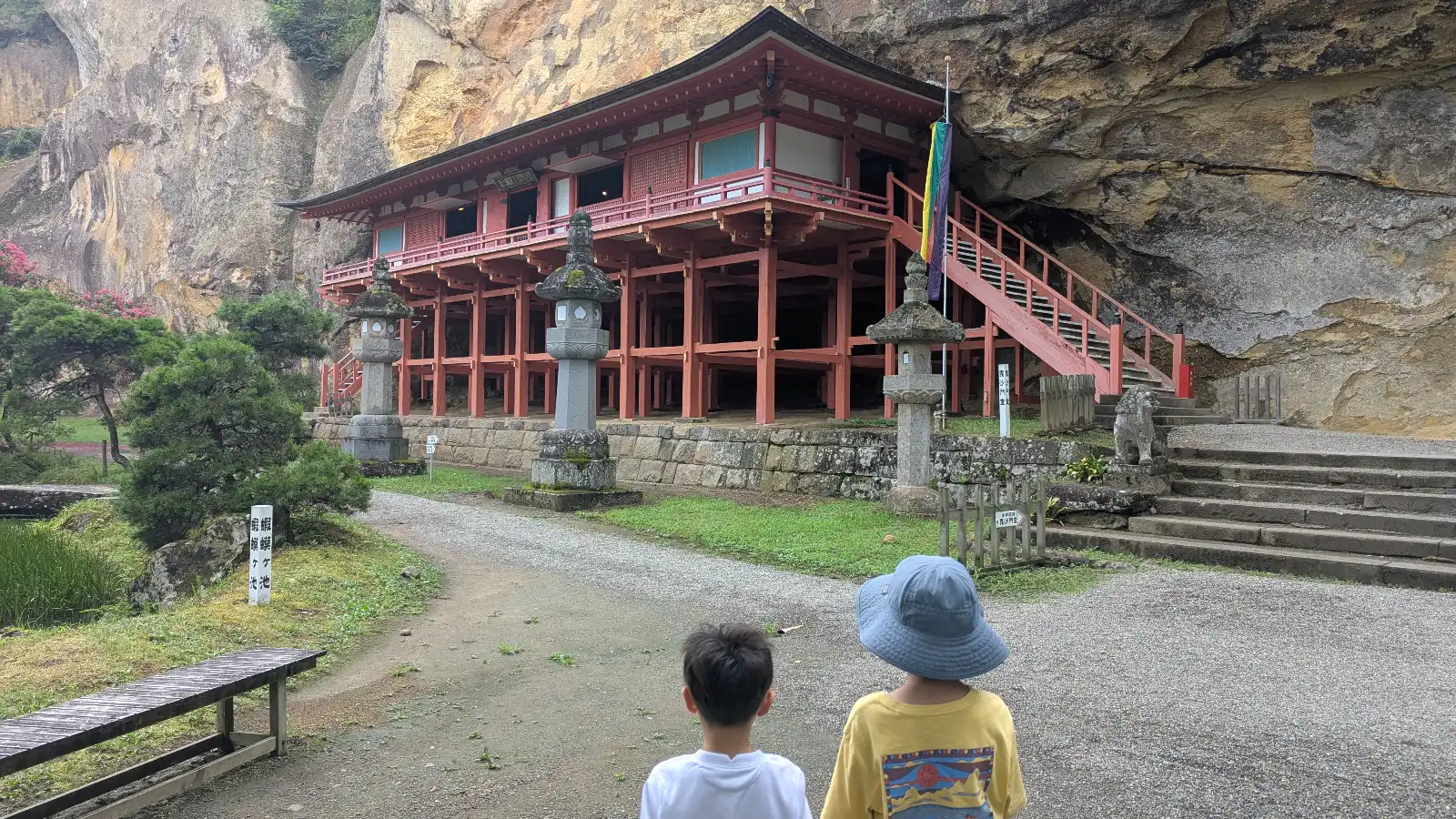
Half an hour under a rock face is cheap for a child who came to look at things, and expensive for the one who arrived needing somewhere to put their body.
Elementary children pay only on organized school trips; groups of 30 or more take 10 percent off. Entry cannot be booked ahead.
8:00 to 16:30 from November 6 to the end of February. Open all year.
The longer end suits a child who stops under the cliff carving.
Younger children take the gates and the bridge; older ones take the carving and the dates.
Some links on this page are affiliate links. LuNi may earn a commission at no extra cost to you.
Is Takkoku-no-iwaya worth it with kids?
The short version, before the costs, the timings and the case for each child.
Yes, and its size is the argument. This is thirty minutes to an hour, not a morning: three gates, a hall wedged under a rock face, and a Buddha cut into the cliff beside it, with an elementary child costing nothing at the gate. A stop that short is almost impossible to get wrong on the day, which is exactly why families misplace it in the week instead, treating a national historic site as the filler between two larger ones. The better use is the opposite. Put it first, in the hour after it opens, when the valley is empty and the larger site down the road has not started taking people yet, and it stops being an add-on and becomes the calmest stop of the day.
Planning Your Visit to Takkoku-no-iwaya with Kids.
Three things shape the visit and none of them is the ticket. The first is the hour, because the gate opens early and almost everybody in this valley is somewhere else until the bigger temple down the road gets going. The second is that nothing is eaten or drunk inside the precinct, so the snack a family is carrying belongs outside the precinct, before or after, and is worth saying out loud before anyone is hungry. The third is that everything here arrives on four wheels, so the last ten minutes are a taxi or a drive and the carrier rather than the stroller comes out at the gate. No bus runs to the temple, so the taxi from Hiraizumi Station, about ten minutes, is the whole of the public route.
Every LuNi attraction guide starts with a visit, with our own children
LuNi rates and writes about attractions only after visiting them with children. Luca and Nico were at Takkoku-no-iwaya, and what they did there is recorded further down this page, including how each child actually met it.
Children arrive with different tolerances: for noise, for lines, for standing still, for being on their feet all day. A guide written for the average of them helps almost nobody. So every place on this site is read four ways, and each verdict says which children it already suits and what makes it work for the rest. Whoever you are bringing, the answer here is built for your family rather than for a general reader.
Restricted-movement depletion builds fast on a thirty-minute circuit with a route to follow, so the running and the snack both happen before the first gate.
Sensory-input depletion stays low in a forested valley where the visit is outdoors and looking, so the opening hour is the setting that protects it.
Unfamiliarity and unconfirmed structure are answered by a marked route, three gates in order and a dated history, so hand over the facts rather than comfort.
Sustained walking and standing never accumulate across a circuit of thirty minutes to an hour, so the footing is the thing to manage, not the distance.
- Cost
- ¥500 adult / ¥200 junior high and high school / elementary freeElementary children pay only on organized school trips; groups of 30 or more take 10 percent off. Entry cannot be booked ahead.
- Booking
- Walk-up

Hotels we would book for this visit.
Nothing sleeps in this valley, so all three of these are a drive, and the one we would take comes with a transfer of its own. Assume the rail leg ends at Ichinoseki.
| Property | The LuNi Reason |
|---|---|
| LUNI Pick KAMENOI HOTEL Ichinoseki Genbi, with a free pick-up from Ichinoseki Station | The free transfer from Ichinoseki Station, about twenty minutes, means a family without a car does not start the day by booking something. On a day whose whole cost is the last ten minutes by road, a family that has solved the first twenty arrives settled. |
| Bellino Hotel Ichinoseki About 5 minutes by taxi from Ichinoseki Station | The city option, five minutes from the Shinkansen platforms by taxi, not on foot. It is the easiest night to put either side of a long rail day, and for a child who has been sitting since breakfast the hop out to the valley happens first rather than fourth. |
| Naruko Kanko Hotel Naruko Onsen, 2 minutes on foot from Naruko-Onsen Station | This one belongs to a night in an onsen town rather than the morning of a half-hour stop, and a long transfer in front of a short visit is the wrong shape for a child back in the car within the hour. Place it after Hiraizumi. |
Nearby attractions, matched to your child.
A short stop is not a day, so what sits beside this valley decides more than the valley does, and so does how the week is shaped around a valley reached only by road.
| Pairing | Why This Solves the After-Visit | For Your |
|---|---|---|
| LUNI Pick Chusonji Temple The World Heritage precinct up the road | This valley holds a moving child inside one short, marked route. Chusonji hands that back as a hillside: a self-paced approach of 700 to 850 meters and buildings spread across the top. Park at the bottom rather than the hilltop lot, or the outlet shrinks to 240 meters and the pairing stops working. | Dynamo |
| Geibikei Gorge Boat Ride Ichinoseki | The circuit here is short but uneven, and the next stop is where the legs come out of the day altogether. A flat-bottomed boat is seated time that still counts as a destination, which is the rarest thing to find for a child who is spending stamina. | Sprinter |
| Hiraizumi Cultural Heritage Center Hanadate, between Motsuji and Chusonji | A child leaves this valley holding a rebuilt hall, a broken carving and a name from 801, and no frame to put them in. An indoor room that sets the Hiraizumi story out in one fixed order finishes what a thirty-minute circuit starts. | Anchor |
Chusonji Temple
The World Heritage precinct up the road For YourDynamo
Geibikei Gorge Boat Ride
Ichinoseki For YourSprinter
Hiraizumi Cultural Heritage Center
Hanadate, between Motsuji and Chusonji For YourAnchor
How two children actually met this attraction.
Two children walked the same short circuit and both of them went straight past the religion to the engineering. Neither asked who Bishamonten was. Both wanted to know about the join: how a wooden hall comes to be standing underneath a rock face, and what that arrangement means for the hall. One of them treated it as a problem in engineering and the other as a problem in construction, which are different questions with the same subject, and between them they spent the whole half hour on it. That is a fair reading of the place, and it is worth knowing in advance, because it is the question a parent will be handed here, and it is a better question left open than closed with a comfort.
Luca fixed first on the omikuji, delighted that a fortune here cost only ten yen when they usually run a hundred, and he drew one, read good luck, and turned the price over as a puzzle. Then his attention went to the join. He studied where the old wood met the rock and asked, more than once, how much longer the temple could stay pressed under the cliff without breaking. He was not worried so much as analyzing.
This is the Anchor pattern. A child whose Reserve depletes through unfamiliarity and unconfirmed structure settles by testing a place until it holds, and Luca did it on the cliff-and-beam join rather than on the route. Families with a similar child should let that question stand rather than close it with a reassurance nobody can give, and hand over what does check out: the route, the three gates in order, and the year this hall was built.
Nico summed the place up fast, a cool temple in the cliff, and then could not let go of one question: how did people make it. He was less interested in looking than in the doing behind it, picturing how anyone carved a hall and a giant face into solid rock. His attention kept moving with the question: in a space that asked him to hold still, the mystery kept his mind busy while his body had nowhere to go.
This is the Dynamo pattern. A child whose Reserve depletes through restricted movement holds on longer when a moving mind is given work, and Nico found his own by turning a still site into a construction problem. Families with a similar child should arrive with the carving’s measurements ready, its height and the length of its face, which a younger Dynamo can pace out on the ground while an older one works out what came off it and when.
A temple set against a rock face, with a great Buddha carved into the cliff above it, offers a child a lesson in how nature and faith shape each other. Learning that an earthquake brought down most of the carving, and that erosion is still slowly changing it, shows a child that even stone is not permanent. That idea is both humbling and fascinating. A child who stands beneath a cliff that is still changing begins to understand that the world they live in is always, quietly, being reshaped.
The LUNI Rating for Takkoku-no-iwaya.
One fact drives all four verdicts, and it is the size of the place. The circuit is short: three torii in sequence, a hall built hard against the rock in the manner of Kiyomizudera, and the cliff carving west of it. There is a route the precinct recommends worshippers follow, and a short list of what is not done inside, which includes eating and drinking. So this is a small, ordered, outdoor half hour that asks a child to look and move quietly through it. That is generous to three profiles and expensive for one, and the expensive one is not the one most families would guess.
Everything that makes this place easy makes it small. The Dynamo depletes through restricted movement, and the length is not the problem here; the shape of the visit is. The circuit runs in a recommended order through three gates to a hall pressed under a rock face, and a child who wants to get ahead of the family, double back, or take a second run at something is being asked not to. There is no open ground built into the route and nothing on site to be worked with the hands, so the whole visit resolves into looking.
The carving is the answer, and a better one than it sounds. Bring its measurements, because a child handed them has something to do with their body: pace the shoulders out on the ground, then work out where the chest was before the earthquake took everything below it. Everything else has to happen outside the gates. Nothing is eaten or drunk inside the precinct, so the snack stop and the running are the same stop, and both come before the first torii rather than after the last.
What this means for your Dynamo: restricted movement is the whole cost and it arrives early. A younger Dynamo needs the discharge finished before the gate and the carving to measure against; an older one holds the circuit when the construction question is handed over as work rather than as scenery.The hour you choose does more than the site does. The Sensor depletes through sensory input, and what this visit asks of a child is to walk through a forested valley outdoors, look at a hall and look at a cliff. The load is set almost entirely by how many other people are doing the same thing in the same narrow space. So be at the gate when it opens. Most of the traffic in this valley is bound for the larger temple down the road, which opens half an hour later, and that first half hour here is as close to a private visit as a national historic site gets.
Inside the hall there is less happening than a child may expect, and that cuts in this profile’s favor. The principal figures are hidden images kept in a closed cabinet that will not be opened for years, so the interior is a small wooden room rather than a lit display. A child who finds looking easier than being surprised gets that room on most days, though not on the 1st or the 3rd of the month, when a fire rite runs in the morning and a festival in the afternoon.
What this means for your Sensor: sensory input is cheap here and the crowd and the calendar are what make it costly. A younger Sensor should come in the first hour, when the valley is still empty; an older one can take the same low load and spend it standing under the carving for as long as they like.A marked route, and a history that is a list of dates. The Anchor depletes through unfamiliarity and unconfirmed structure, and this site answers the first half before a family arrives. There is a route the precinct recommends and three torii to pass through in order, so the shape of the visit is given rather than guessed. The circuit takes thirty minutes to an hour, and the list of what is not done inside is short. A child who needs to know what happens next can be told it in the car.
Expect the question of whether it will hold, and let it stay a question. A child standing under a hall wedged beneath a rock face will ask it, sometimes more than once, and a promise about the rock is the one answer this profile should not be given. What a parent can hand over instead is the surprise an Anchor enjoys: the hall looks ancient and is not. The temple is twelve centuries old, but this building is the fifth to stand here, and a younger one than anybody expects.
What this means for your Anchor: unconfirmed structure is the cost and confirmable facts are the currency. A younger Anchor settles once the three gates and the route are named in order; an older one settles on the dates, which check out where a reassurance would not.Nothing here accumulates. The Sprinter depletes through sustained travel-style walking and standing, and this is the rare stop where neither gets the chance to add up. The circuit is thirty minutes to an hour end to end, the whole of it is on one level of the valley floor, and the last ten minutes of the journey are by road, so a child arrives with their legs intact rather than having spent them getting here. There is no approach to climb, which is what usually charges this profile before anything is seen.
What is worth managing is the ground rather than the distance. The surfaces here are uneven stone and loose gravel with steps between the levels, so a stroller is possible but slow going, and a carrier is the easier tool for the youngest. Plan for the visit to be walked in one piece rather than paced, because standing through a short circuit is cheaper than stopping and starting through it. Then take the seated stop next, while the day still has the credit.
What this means for your Sprinter: the duration is the reason it works, and the footing is the only thing to plan. A younger Sprinter rides the gravel in a carrier; an older one walks the whole circuit in one go and should be given the seated stop straight afterwards.The questions parents actually ask.
Most of what a family asks here comes down to three things, and two of them are about expectations rather than logistics. The first is what is actually inside the hall, which is less than the name suggests and worth saying before the gate. The second is how old the building is, because a child standing under a rock face will ask and the honest answer is not the romantic one. The third is the money, which is the smallest number in this valley by a distance, because an elementary child pays nothing at all and an adult pays 500 yen.
Is Takkoku-no-iwaya Bishamondo worth visiting with kids?
Yes, and it is the cheapest half hour in Hiraizumi: 500 yen for an adult and nothing at all for an elementary child. What a family gets is a wooden hall built hard against a rock face and, west of it, a Buddha cut into the cliff itself. The gate opens at 8:00, which is early enough to have the valley to yourselves.
How long do you need at Takkoku-no-iwaya with kids?
Thirty minutes to an hour. The shorter end covers the circuit at a walking pace, and the longer end belongs to a child who stops under the cliff carving and starts asking how it was made. It is short enough to sit either side of a longer stop, which is usually how a family should place it.
What age is Takkoku-no-iwaya Bishamondo best for?
From about five, when a child can take in a hall that grows out of a rock face rather than standing in front of one. Younger children get the three torii and the bridge and are easier carried than walked over the gravel. Older ones take the carving, the fires and the dates, and this is where those land.
How much does Takkoku-no-iwaya cost with children?
An adult is 500 yen and junior high and high school are 200. Elementary children are free unless they arrive on an organized school trip, which is an unusually generous gate for a national historic site. Admission is also free from midnight on New Year’s Eve through New Year’s Day, and groups of thirty or more take ten percent off.
Can you see the Bishamonten statue inside the hall?
No, and it is worth telling a child before the gate. The principal figures are kept as hidden images inside a cabinet given by the Date family, and the next scheduled opening is in 2042. A child promised a god of war meets a closed cabinet instead, so the thing to promise is the hall and the cliff carving.
How old is the hall at Takkoku-no-iwaya Bishamondo?
The precinct dates from 801 and the temple from 802, but the hall standing against the cliff was rebuilt in 1961 and is the fifth on the spot. The one before it burned in 1946 when fire spread from a neighboring farm, and the principal figure and twenty statues were carried out.
How do you get to Takkoku-no-iwaya from Hiraizumi Station?
About ten minutes by taxi or car from JR Hiraizumi Station. Drivers come in about ten minutes from the Ichinoseki interchange or the Hiraizumi Smart interchange, and about fifteen from Hiraizumi-Maesawa. The one arrival decision to settle before leaving is how the family covers that last stretch, by taxi from the station or by car.
What is the Ganmen Daibutsu at Takkoku-no-iwaya?
A Buddha cut into the cliff west of the hall, about 16.5 meters tall on a rock face of about 33, with a face 3.6 meters long and shoulders 9.9 meters across. It is known as the northernmost cliff-carved Buddha in Japan. An earthquake in 1896 brought down everything below the chest, which is why a child sees a face and shoulders.
Where Takkoku-no-iwaya fits your Japan trip.
Official site and opening information: Takkoku-no-iwaya Bishamondo