Zao Fox Village with Kids: One adult per child, or no entry.
An hour south of Sendai is a place a family can drive to, pay for and still be turned away from at the gate, and almost nobody writes the reason down.
Elementary and younger free. Nothing to book for a family; groups come through travel agencies.
To 16:00 in winter, last entry 30 minutes before closing. Closed Wednesdays except in the May holidays and Obon; winter days vary with snow.
One loop of the enclosure, on foot the whole way.
One adult for every child: a lone adult with two or more children is turned away.
A baby carrier takes the stroller’s place inside.
Some links on this page are affiliate links. LuNi may earn a commission at no extra cost to you.
Is Zao Fox Village worth it with kids?
The short version, before the costs, the timings and the case for each child.
LuNi does not recommend this visit. If your family decides to go anyway, everything below is written to make that day work.Start with the rule that decides whether the day happens at all: one accompanying adult is required per child, and a single adult arriving with two or more children is refused entry. That is not a guideline, and the drive from Sendai is about fifty minutes. Past the gate, this is a forest enclosure holding over 100 foxes of eight kinds, walked on a paved path, and it is genuinely unlike a zoo. Its headline offer is holding a fox, and that is open only from high school age, so the children on most family trips will watch it rather than do it.
Planning Your Visit to Zao Fox Village with Kids.
Three things settle this day and the first one can end it. Count the adults: one per child, with entry refused to a lone adult bringing two or more. The second is the clock, and it is not the closing time that matters but the last entry, half an hour earlier, which the operator moves and announces a day ahead. The third is how a family gets there, and the usual advice is wrong: a scheduled route bus runs from October, daily except Wednesdays, and the one gap in it is the Wednesdays the village opens anyway, in Japan’s May holidays and at Obon. A family without a car can also have the village call a taxi for the return leg by asking the staff. Settle all three, and the day holds.
Every LuNi attraction guide starts with a visit, with our own children
LuNi rates and writes about attractions only after visiting them with children. Luca and Nico were at Zao Fox Village, and what they did there is recorded further down this page, including how each child actually met it.
Children arrive with different tolerances: for noise, for lines, for standing still, for being on their feet all day. A guide written for the average of them helps almost nobody. So every place on this site is read four ways, and each verdict says which children it already suits and what makes it work for the rest. Whoever you are bringing, the answer here is built for your family rather than for a general reader.
Restricted-movement depletion discharges on a walked loop through a free-range enclosure, though the paved path is the only ground anybody may use.
Sensory-input depletion meets animals that follow from behind and pull at clothing, which is unpredictable contact rather than noise, and cannot be sat out.
Unfamiliarity and unconfirmed structure meet a calendar the operator keeps revising in its own posts, down to a last-entry time announced only a day ahead.
Sustained standing is the whole cost, because sitting down is prohibited in the grounds and the only seating is inside the feeding house.
Hotels we would book for this visit.
Three family hotels judged on the only thing that matters for a day an hour outside the city: how early a family can be moving south, with the children fed.
| Property | The LuNi Reason |
|---|---|
| LUNI Pick Hotel Metropolitan Sendai East Connected to Sendai Station | This is a day that starts early and ends before a last entry that can move without notice, so the useful thing a hotel can do is put the family on the road or the platform immediately. Connected to the station, it does that, and it suits both the rail route south and a rental collected in the city. |
| The Westin Sendai Sendai Trust Tower, 6 to 9 minutes’ walk from the station | Same station, six to nine minutes on foot in front of it, and no difference at all once the car or the train is moving south. For a child who travels better after a sit-down breakfast, the short walk to the station is a first stretch of the legs before an hour in a seat. |
| Sendai Royal Park Hotel Izumi Ward, about 30 minutes by taxi from Sendai Station | The weakest of the three for this day and it is simple geometry: Shiroishi is south of Sendai and this property sits on the northern edge, so a family driving from here adds the width of the city to a fifty-minute run before it starts. |
Hotel Metropolitan Sendai East
Nearby attractions, matched to your child.
Three pairings back toward the city, chosen for what each repairs after an hour on your feet among loose animals, from a seat under a dome to a building full of things to touch.
| Pairing | Why This Solves the After-Visit | For Your |
|---|---|---|
| LUNI Pick HOKUSHU Sendai City Science Museum About an hour back toward Sendai, then north | The whole difficulty here is a site that keeps revising its own rules. The science museum is the opposite proposition: named floors, numbered zones, fixed admission and a posted science show, all of it knowable before anybody walks in. | Anchor |
| Sendai Astronomical Observatory An hour back toward Sendai, then west | An hour of standing with nowhere to sit is exactly this child’s worst arrangement. A projection at the observatory is a seat with a start and an end, and an early Zao start lands a family there in the afternoon when the slots are open. | Sprinter |
| Sendai Umino-Mori Aquarium An hour back toward Sendai, then east to the coast | Animals that follow and tug at a coat are contact a child cannot predict or stop. The aquarium puts glass back between the child and the animal, at a pace they set, with two floors of it and no obligation to do anything. | Sensor |
HOKUSHU Sendai City Science Museum
About an hour back toward Sendai, then north For YourAnchor
Sendai Astronomical Observatory
An hour back toward Sendai, then west For YourSprinter
Sendai Umino-Mori Aquarium
An hour back toward Sendai, then east to the coast For YourSensor
How two children actually met this attraction.
Two children arrived at the same verdict from opposite directions and neither of them needed an adult to lead them to it. One studied the animals and constructed an explanation for what he was looking at. The other took one pass, enjoyed the movement, and said the same thing in five words. Nothing about the day was frightening and nothing about it was spoiled. What is worth knowing before bringing a child here is simply that a child will form a view, that the view may not be the one the trip was booked for, and that a family should be ready to hear it rather than talk a child out of it. Both of ours reached the same place from opposite ends of the loop, and neither needed the visit explained to them afterward.
Luca fixed on the animals’ conditions rather than on the animals. He noticed that some of the foxes could only walk around a small area and decided they were kept in cages for their whole life so that people could hold them. He worked the reason out himself, without being prompted or told any of it, and then delivered his verdict entirely unasked, in three words and without any apparent difficulty: it was sad.
This is the Anchor pattern. A child whose Reserve depletes through unfamiliarity and unconfirmed structure will build an explanation for whatever is in front of them rather than leave it open, and will hold to that explanation once it is built. Families with a similar child should expect a reasoned position rather than a reaction, and should be prepared to discuss that position honestly rather than manage it, because an explanation that is argued with tends to be held harder afterward.
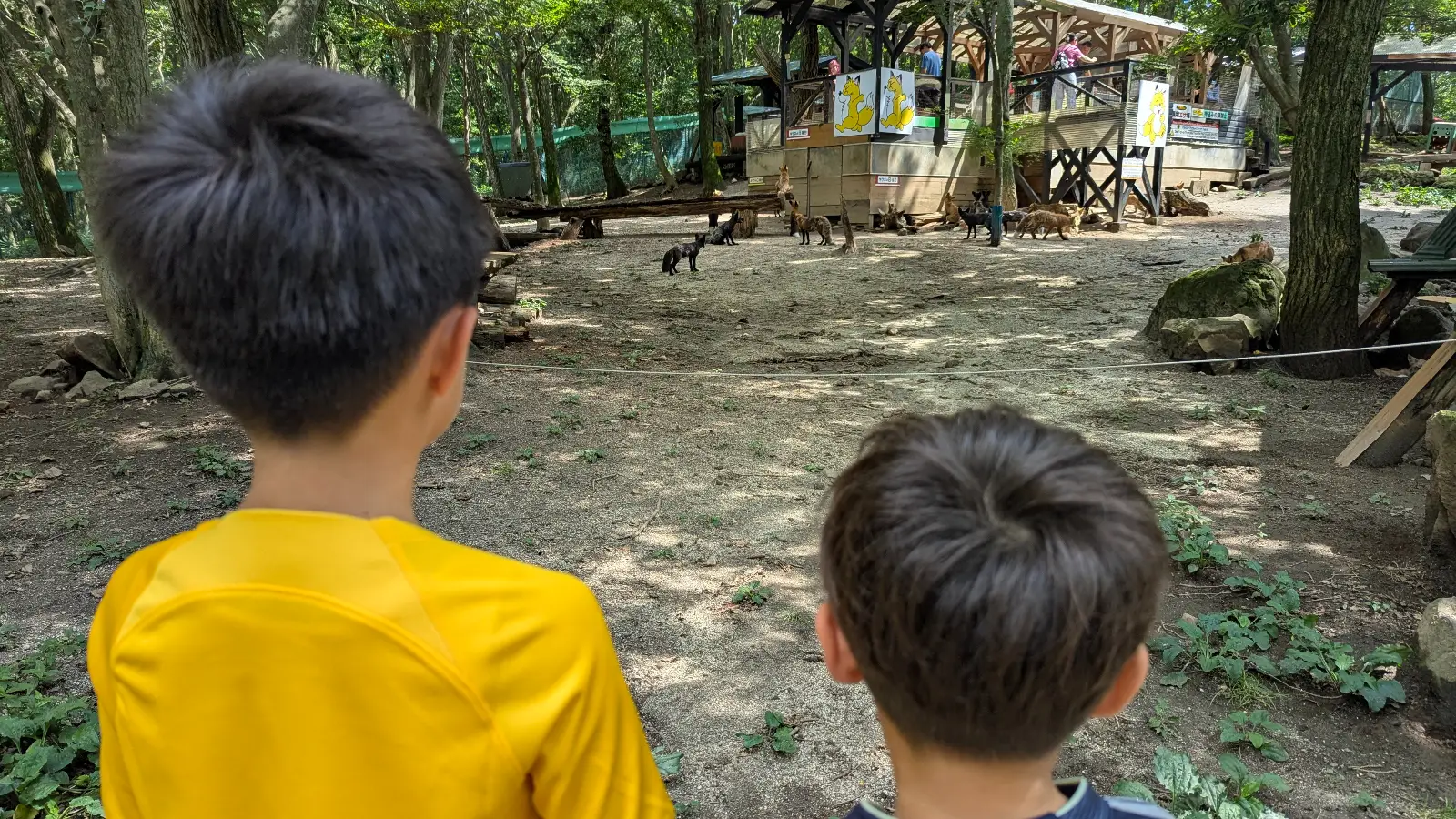
Nico watched the loose foxes moving across open ground and thought they were cool. Then, in the same breath and without any visible working out, he arrived where his brother had arrived after much longer: cool, but sad for the foxes. That was the entire review. He did not revisit it, did not add anything to it later in the day, and did not appear to find the two halves of it at all difficult to hold together.
This is the Dynamo pattern. A child whose Reserve depletes through restricted movement reads a place at walking speed and judges it in one pass, which is not shallowness but a different sampling rate. Families with a similar child should let the loop be walked rather than paused at, and should take the quick verdict seriously rather than wait for a considered one, because it has already arrived complete, and a second, more considered verdict rarely follows the first one.
A village where foxes roam freely lets a child meet a wild-looking animal on its own ground, and the rules that come with it teach as much as the animals do. Watching without touching, keeping to the path and respecting an animal’s space are lessons in patience and humility. For a younger child, learning that holding a fox waits until high school age is a small lesson in patience. A child who has walked quietly among foxes comes away with a deeper respect for animals that are not pets, however much they look like one.
The LUNI Rating for Zao Fox Village.
One fact drives all four verdicts and it is not the foxes. It is that this is a free-range site with published conditions attached to almost everything a family would normally take for granted: who may bring whom, what may be brought in, where anyone may walk, whether anyone may sit, and when the gate shuts. Several of those conditions are the opposite of what a family would assume from the photographs, and none of them is a suggestion. The verdicts below are judgments about a child meeting those conditions rather than about the animals, because the conditions are what a family actually has to plan around.
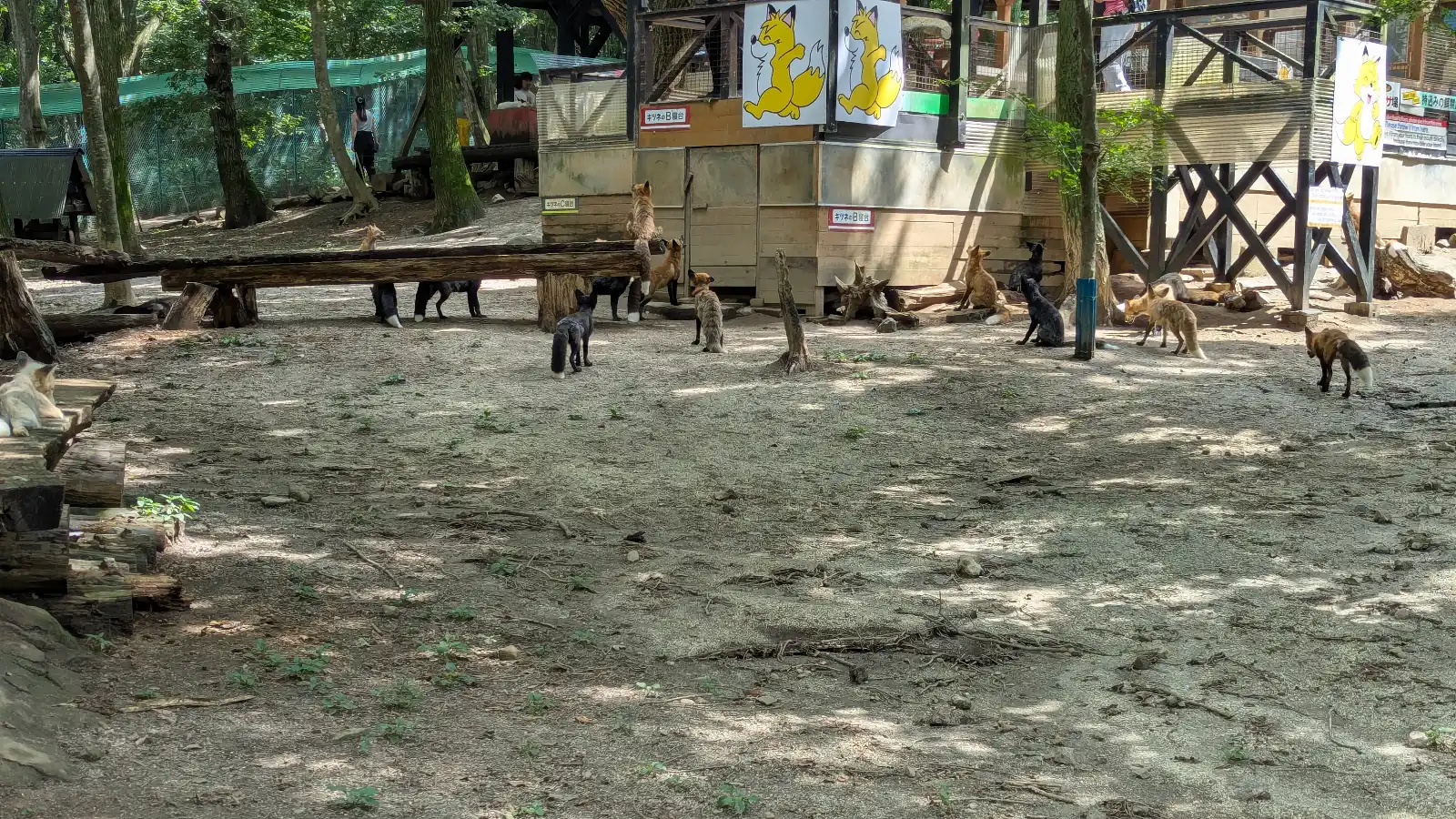
This is a walk, and the walk is the attraction. The Dynamo depletes through restricted movement, and almost nothing here asks a child to be still. Over 100 foxes move loose through an enclosure laid out within forest, and a family walks a loop through the middle of it. The one constraint on movement is directional rather than restrictive: visitors are asked not to walk anywhere except on the paved path, and off-path entry is prohibited, so the freedom is to keep going rather than to go anywhere.
There is a longer mission here than most families use. Eight kinds of fox live here: Ezo red, silver, platinum, brown platinum, cross, marble, and the Arctic and blue foxes, which are a different animal from the red fox, academically speaking. Spotting all eight is a genuine task rather than a three-item one, and the site also keeps rabbits, horses and goats. The condition that shapes all of it is the entry rule: one adult per child, so a moving child always has an adult within reach.
What this means for your Dynamo: restricted movement is barely charged, so long as the path rule is understood first. A younger Dynamo walks the loop with an adult at arm’s length; an older one can be given the eight-coat spotting task and run it.The input here is physical contact a child cannot predict. The Sensor depletes through sensory input, and what this place does to a child is physical: walk the grounds and some foxes follow you from behind, and some pull at your clothing. That is not noise or crowding, which a child can be moved away from. It is unannounced touching from an animal moving faster than they are, and it is presented by the operator as part of what makes the place worth visiting rather than as a hazard.
The rest of the published rules describe the same problem from other angles. Touching the foxes is prohibited because biting accidents are frequent; visitors are asked not to linger near the entrance, where the animals crowd, and photography is banned in that area for the same reason; foxes react to the sound of a plastic bag and to a hand going into a pocket, and may jump at a person mistaking it for food; dropped belongings are damaged or buried, and valuables can be left at the counter. A child who startles easily will meet several of these in the first five minutes.
What this means for your Sensor: sensory input arrives as contact rather than volume, and there is no quiet corner to retreat to. A younger Sensor should probably be somewhere else; an older one should be told exactly what the animals do before the gate.Almost nothing about this day is fixed far enough in advance to promise a child. The Anchor depletes through unfamiliarity and unconfirmed structure, and this operator revises its own calendar continuously and announces it in posts rather than on its opening-hours page. The standing rule is that it closes on Wednesdays, except Wednesdays in the May holidays and Obon. Around that rule sit the closures that arrive on short notice: in April the village shut for four days for construction and gave two days’ notice, and alongside that sit one-off holiday openings, weather closures, and winter operating days that vary from year to year with snowfall and temperature.
The last entry is the part that costs a family the day. It is half an hour before closing as a standing figure, and it moves: on one stocktaking day it was brought forward by fifteen minutes and announced the evening before. The operator asks visitors to check its own website rather than third-party listings for opening days and hours, which is a reasonable request and also an admission. For this child, the plan that survives is a named arrival time at opening rather than a named departure, because only the front of the day is stable.
What this means for your Anchor: unconfirmed structure is the whole difficulty and it is the operator’s own doing. A younger Anchor needs the day framed as a single morning errand; an older one can be shown the notices and given the checking job themselves.Sitting down in the grounds is prohibited, and the benches are not for people. The Sprinter depletes through sustained travel-style walking and standing. That single rule decides this verdict. The operator bans sitting because a person at fox eye level draws the animals in and is interfered with, and it states plainly that the stone walls and benches a visitor passes are for the foxes only. The single place a family may rest is inside the feeding house, which stands at the center of the free-range area. The rest is further in, not near the gate.
That puts this child’s only seat in the building food is thrown from. Throwing food anywhere else teaches the foxes to jump at people, so feeding happens in the one room a family may sit in, and sitting there puts a child at fox eye level, the exact position the sitting ban exists to prevent. A tired Sprinter and an overloaded Sensor therefore need the same room for opposite reasons. Strollers are not admitted at all, and a carrier is what the village asks for instead. Wheelchairs and walking frames cannot be used in the free-range area, because some foxes react to them; a wheelchair user must be accompanied and receives a discount.
What this means for your Sprinter: sustained standing is unavoidable and the rest point is in the middle rather than at the edge. A younger Sprinter should be in a carrier; an older one should walk to the feeding house first and rest before the loop, not after it.The questions parents actually ask.
The adult count decides a visit here before anything else: one adult per child, or the day ends at the gate rather than inside it. After that, almost everything worth knowing is a published rule that runs against what the photographs suggest: the ground is paved rather than rough, sitting is forbidden rather than scarce, a bus exists where most guides say none does, and the time the gate stops admitting people is not the time it closes. It is an animal encounter unlike Japan’s zoos and aquariums: the animals roam, and the rules protect the child from them. Count the adults twice before leaving the hotel.
Can one adult take two children to Zao Fox Village?
No. One accompanying adult is required per child, and entry is refused to a single adult bringing two or more children. The operator gives its own reason: this is a free-range site and children are frequently hurt in falls or bitten. Check the ratio before anybody gets in the car.
Is Zao Fox Village worth visiting with kids?
It depends on what a family wants from an hour with animals. Over 100 foxes of eight kinds move loose through a forest enclosure, which is genuinely unlike a zoo. Its central offer is holding a fox, which is open only from high school age, so a younger child watches that part rather than joins it.
What does Zao Fox Village cost and when is it open?
Junior high school age and above pay 1,500 yen; elementary age and younger are free. It closes on Wednesdays, except Wednesdays falling in the May holidays or Obon. Closing is 16:30 in summer and 16:00 in winter, and last entry is half an hour before that.
How do you get to Zao Fox Village without a car?
A scheduled route bus runs, despite what most guides say: the Shiroishi-Zao Sanroku Junkan service, daily except Wednesdays, from October. Otherwise it is about 20 minutes by car from Shiroishi-Zao Station, or roughly 50 minutes from Sendai by expressway. Camper vans are refused during Golden Week.
Can you take a stroller to Zao Fox Village?
No. Entry with a stroller is not permitted and the operator asks visitors to use a baby carrier instead. That is an entry condition rather than a comment on the ground, which is paved: visitors are asked not to walk anywhere except on the paved path.
Is it safe to let a child near the foxes?
Touching the loose foxes is prohibited, and biting accidents are frequent. Foxes follow visitors, pull at clothing, react to the sound of a plastic bag and to a hand entering a pocket, and will damage or bury anything dropped. Keep an arm’s reach and empty pockets.
Can you sit down at Zao Fox Village?
Not in the grounds. Sitting down is prohibited, because staying at fox eye level draws the animals in, and the stone walls and benches a visitor passes are reserved for the foxes. The only seating for people is inside the feeding house at the center of the enclosure.
What age is Zao Fox Village best for?
Eight and up, and the floor is set by who gets hurt here, which is children in falls and bites, rather than by ticket bands. Younger children enter free but need an adult each and constant reach. Older children can be told what the site is before arriving, which is the better visit.
Where Zao Fox Village fits your Japan trip.
Official site and opening information: Zao Fox Village