Kamakura Great Buddha with Kids: The Daibutsu You Can Step Inside.
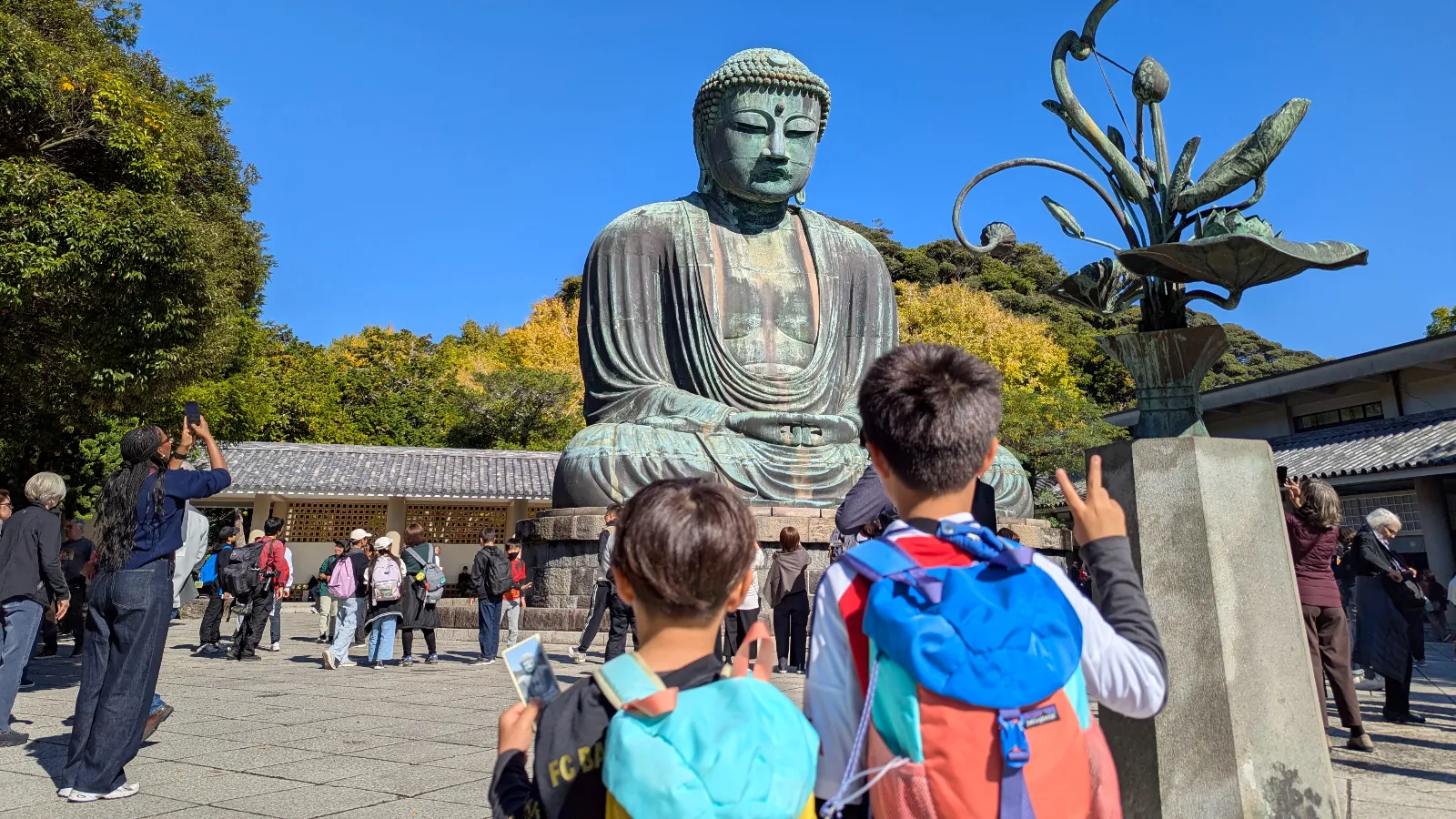
One giant statue a child can walk inside for 50 yen more, in grounds where no food is allowed and the interior shuts on heat-alert afternoons.
Preschoolers free; inside the statue, ¥50 more. No booking needed. No food inside / sealed water bottles only.
From October to March they close half an hour earlier / the interior closes at 16:30. The gates open daily.
One statue and its interior; the interior closes earlier than the grounds, so go in first.
Preschoolers enter free, and strollers can use the sloped routes here.
Ramps serve the grounds, but some places have steps, and an adult must handle the stroller.
Some links on this page are affiliate links. LuNi may earn a commission at no extra cost to you.
Is the Kamakura Great Buddha worth it with kids?
The short version, before the costs, the timings and the case for each child.
Yes, and it is one of the easiest big sights in Kamakura for a family. The Great Buddha stands in the grounds of Kotoku-in, and for a small extra fee a child can go inside the statue, which turns a thing to look at into a place to walk through. Admission is modest, children from elementary through high school pay half, and preschoolers enter free. Two rules change the plan. No food or drink may be brought in beyond sealed bottles of water, and visitors carrying snacks to eat on the walk are turned away at the gate. And on days Kanagawa issues a heatstroke alert, the interior closes for the afternoon, so go early in summer. The Great Buddha is also the natural first half of a morning with Hasedera, five minutes away on foot, for a child who wants the stairs and cave.
Planning Your Visit to the Kamakura Great Buddha with Kids.
Three decisions make this an easy visit, and the first depends on the season. In summer, go in the morning, because a heatstroke alert closes the interior for the afternoon, and when to visit Japan with children is worth reading with that in mind. The second is food, and it is the one that catches families out: eat before the gate, carry only a sealed water bottle, and leave no snack in a small hand, since a child holding one can be turned back. A snack finished at Kamakura Station settles it before the gate. The third is the approach, where the bus from Kamakura Station to Daibutsu-mae stops right at the temple and saves the walk from Hase for children who will want their legs later, at Hasedera. Settle those three and the visit takes care of itself, whatever the age of the child, and the morning stays unhurried.
Every LuNi attraction guide starts with a visit, with our own children
LuNi rates and writes about attractions only after visiting them with children. Luca and Nico were at the Great Buddha at Kotoku-in, and what they did there is recorded further down this page, including how each child actually met it.
Children arrive with different tolerances: for noise, for lines, for standing still, for being on their feet all day. A guide written for the average of them helps almost nobody. So every place on this site is read four ways, and each verdict says which children it already suits and what makes it work for the rest. Whoever you are bringing, the answer here is built for your family rather than for a general reader.
Restricted-movement depletion stays low when the visit moves from outside the statue to inside and back, so build the day around that walk-through.
Sensory-input depletion stays low around one statue in open grounds, so let the child take it in at their own distance before going inside.
Unfamiliarity and unconfirmed structure ease with one statue, fixed hours and a food rule stated plainly, so tell the child all three before arriving.
Sustained walking and standing stay short with the bus stopping right outside and sloped routes for strollers, so ride in and keep the visit compact.
Hotels we would book for this visit.
Three Kamakura-area hotels, for a family staying overnight so the Great Buddha can be an early visit on a summer morning, before the heat and the rule that comes with it.
| Property | The LuNi Reason |
|---|---|
| LUNI Pick Hotel Metropolitan Kamakura In Kamakura | In Kamakura, for a family that wants the Great Buddha early, before the summer heat rule can close the interior for the afternoon. The bus from Kamakura Station’s east exit stops right at the temple, so an early start from a Kamakura base is simple, and the morning is the family’s own. Go inside the statue first. |
| Kamakura Prince Hotel | Kamakura Prince Hotel is on the coast west of Hase, for a family that wants the statue early and the sea after it. Four can share its Kamakura Suite, two of them on sofa beds, and a kids’ room is among the facilities, useful on a summer day when the heat closes the interior in the afternoon. |
| LACER SUITES KAMAKURA | LACER SUITES KAMAKURA stands three minutes from JR Kamakura’s west exit, and the station is where the bus to the statue starts, from the east exit, so an early start needs only a walk through the station. A Deluxe Twin with two queen beds takes a family of four, and the rooms have no TV. |
Nearby attractions, matched to your child.
Three visits for what one statue leaves undone: a temple of stages five minutes away for a child who needs more to explore, a shrine approach in open air for calm, and an aquarium along the coast.
| Pairing | Why This Solves the After-Visit | For Your |
|---|---|---|
| LUNI Pick Hasedera Temple About 5 minutes on foot from the Great Buddha | Five minutes on foot from the statue, Hasedera Temple gives a Dynamo a whole hillside to climb through: a pond, a carved cave, stairs with a hall halfway up and a terrace over the sea. Restricted movement, held in front of one statue, has somewhere to go. | Dynamo |
| Tsurugaoka Hachimangu JR Kamakura East Exit, 10 minutes’ walk | At Tsurugaoka Hachimangu the Dankazura approach runs between banks of cherry trees, and the grounds hold Genpei Pond and a peony garden. Sensory-input depletion eases along an open approach and beside a pond, with the gates open from early morning to evening every day. | Sensor |
| Enoshima Aquarium Odakyu Katase-Enoshima, 3 min on foot | For an Anchor, Enoshima Aquarium is a stop whose shape is fixed before the day: open 9:00 to 17:00 through November with last entry at 16:00, three minutes on foot from Odakyu’s Katase-Enoshima Station. With no parking of its own, the route there is a train, settled in advance. | Anchor |
Hasedera Temple
About 5 minutes on foot from the Great Buddha For YourDynamo
Tsurugaoka Hachimangu
JR Kamakura East Exit, 10 minutes’ walk For YourSensor
Enoshima Aquarium
Odakyu Katase-Enoshima, 3 min on foot For YourAnchor
How two children actually met this attraction.
The statue did two different jobs for two different children, and both happened because a child can go inside it. One brought his own comparisons and a question of rank, and found the interior more interesting than the outside because it showed him how the thing was made. The other judged it with his body, huge from the grounds and small from within, and wanted to walk back out and check. That is the case for paying the extra 50 yen: the interior turns a statue a child looks at into a place a child moves through, which suits the careful child and the restless one alike. In summer, go in the morning, before the afternoon heat rule can close it, and make the inside the moment the visit builds toward rather than an afterthought.
Luca’s first reaction was comparison. He had seen larger statues and larger Buddhas elsewhere, so the scale did not surprise him, and he said so plainly. What held him was working out where this one ranked: not the biggest, he decided, but probably the oldest. Going inside interested him precisely because it broke his expectation. He had pictured the inside of a Buddha and found something else instead, a hollow structure that read as engineering rather than as a statue.
This is the Anchor pattern. A child whose Reserve depletes through unfamiliarity and unconfirmed structure settles by fitting a new thing into what he already knows, ranking it and checking it against what he expected. The Great Buddha rewards that work because it is one object with an inside that can be visited. Families with a similar child should hand over the comparison to make, how it measures against other statues and what the inside shows, rather than asking the child simply to admire it.
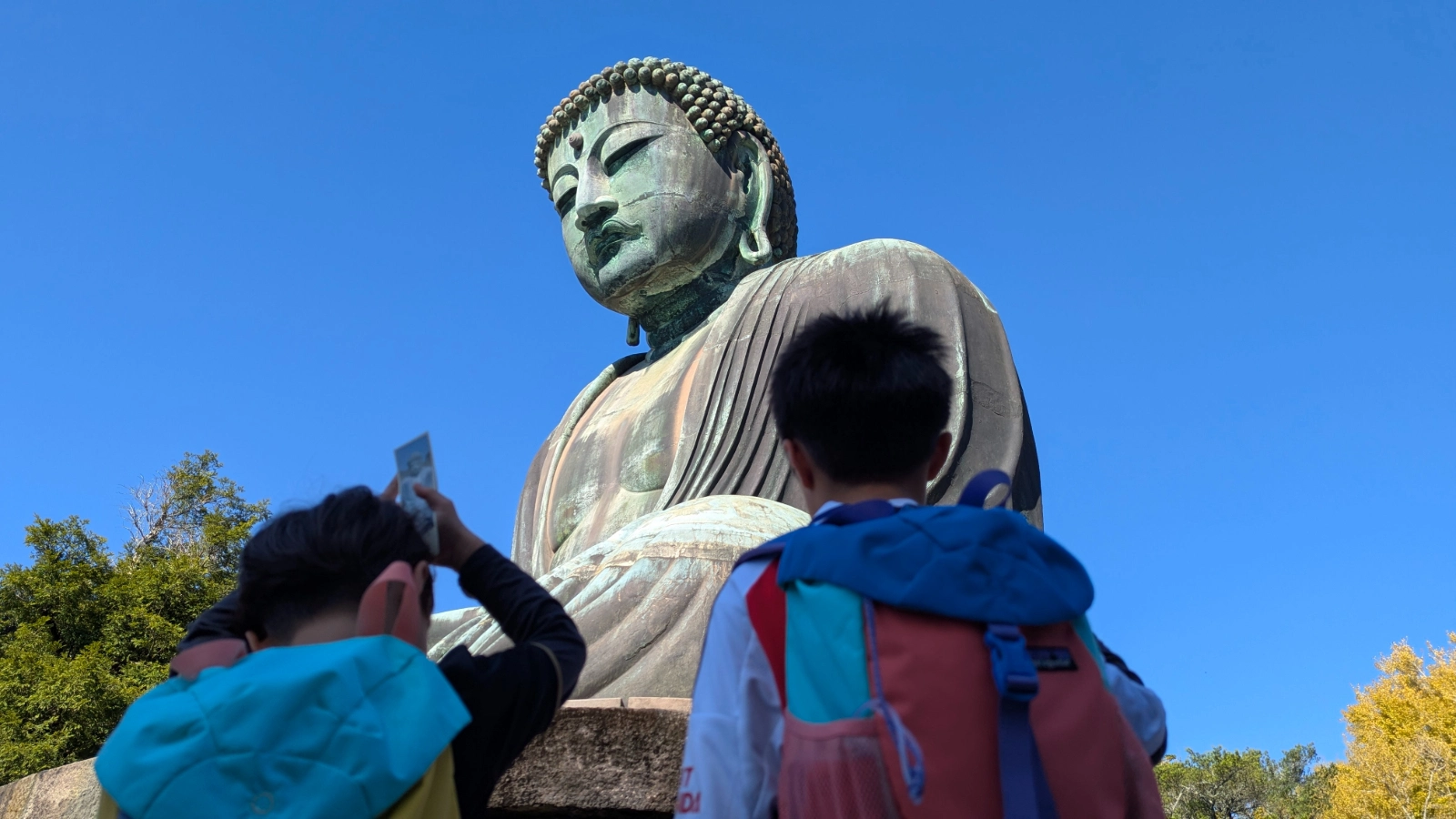
Nico read the statue with his body rather than his knowledge. From the courtyard he was certain it was enormous and said as much, tipping his head all the way back to take in the height. Then he went inside, and the verdict flipped. Standing within the hollow bronze, he announced that it now felt small, and the contradiction plainly delighted him more than either fact on its own. He wanted to go back out and check the outside again.
This is the Dynamo pattern. A child whose Reserve depletes through restricted movement understands a place by moving through it, and Nico’s reading of the statue came from walking from outside to inside and back. Families with a similar child should build the visit around that movement rather than the minutes spent looking, pay the extra 50 yen without hesitation, and let the child go back out to check, because for this child the contrast between the two views is the whole experience.
Standing before a statue this large, and then stepping inside it, gives a child a sense of scale no photograph can. A child who walks around the Great Buddha, goes inside and comes out to look again begins to wonder how people made something so vast, and why. That wonder is often where an interest in history starts. A place that invites a child to compare, from far away, up close and from within, teaches that the same thing can look entirely different depending on where you stand to see it.
The LUNI Rating for the Kamakura Great Buddha.
One fact sits under all four verdicts: the Great Buddha is a single statue a child can see from outside and then walk inside, in grounds with sloped routes and clear rules. The child who needs to move gets the walk through; the child sensitive to input gets one object in open grounds; the child who needs structure gets fixed hours and a plainly stated food rule; and the child whose legs tire first gets a bus to the door. All four children do well here. Among Japan’s temples and shrines for children, few ask so little of a family, and fewer let a child step inside.
Make the inside the event. The Dynamo depletes through restricted movement, and a single statue sounds like the wrong stop for this child, since looking is mostly standing. The Great Buddha changes that because the statue can be entered: for 50 yen more, a child walks inside it, and the visit becomes a route rather than a view. Outside, the grounds give room to move before going in, and a child who has seen the statue from outside first gets far more out of the inside, because the difference is the whole surprise.
Put the interior at the center of the visit. Walk the grounds first, then go inside, then come back out and look again, and let the child decide how many times the comparison needs making. The interior keeps shorter hours than the grounds, and on heat-alert days the afternoon viewing is suspended, so in summer a morning visit keeps the best part of the visit available. Leave snacks outside the gate, since eating is not allowed anywhere in the grounds.
What this means for your Dynamo: the Great Buddha turns restricted movement into a walk through. A younger Dynamo needs the inside and the outside back to back; an older one can compare them as long as he likes.Let the child choose the distance. The Sensor depletes through sensory input, and the Great Buddha is one of the gentler big sights in Kamakura for this child: a single statue, in the grounds of Kotoku-in, that can be taken in at whatever distance and pace the child chooses. The one enclosed moment is the interior, a small extra step for 50 yen that a Sensor can take or leave. Everything else happens in the open air of the grounds.
Distance first, then a choice about the inside. Let the child look from far away first and move closer only as they want to, then describe the interior before offering it, so going in is a decision rather than a surprise. In summer, go in the morning, when the interior is sure to be open, since heat-alert days suspend the afternoon viewing. Keep the visit short and let the statue do its work, without adding a second or third stop to the same short hour.
What this means for your Sensor: at the Great Buddha sensory input stays within the child’s own distance. A younger Sensor needs the interior described first; an older one can decide on the spot whether to go in.Tell the rules at breakfast. The Anchor depletes through unfamiliarity and unconfirmed structure, and the Great Buddha is easy to confirm: one statue, opening hours that change only twice a year, an interior with its own shorter hours, and plain prices, 300 yen for adults, 150 from elementary through high school, and free for preschoolers. The rules are few and firm, which is exactly what this child needs to know before arriving rather than discover at the gate.
Say the rules aloud. No food comes into the grounds except sealed water bottles, and a child holding a snack will be turned back, so eat before. On heat-alert days the interior closes in the afternoon, so a summer plan puts it first. And inside the statue, family photographs are fine, though the temple refuses any media filming. With those said, nothing at the gate will be new to the child, and the visit starts calm rather than with a correction.
What this means for your Anchor: at the Great Buddha a few firm rules leave unfamiliarity nothing to guess. A younger Anchor needs the food rule said twice; an older one can check the heat alert that morning.Take the bus to the door. The Sprinter depletes through sustained travel-style walking and standing, and the Great Buddha keeps both short. The bus from Kamakura Station’s east exit, from the Enoden bus stop 1 or the Keikyu bus stop 6, stops at Daibutsu-mae, right at the temple, and Enoden Hase Station is about seven minutes on foot. Inside the grounds, slopes let a stroller through, though some level changes need an adult’s hands, and wheelchairs are lent during the day.
A short approach and a short visit suit this child. Ride the bus in rather than walking from Hase Station, keep the stroller for a younger child, and plan the visit around the statue and its interior rather than the wider neighborhood. With Hasedera five minutes away, an older Sprinter can add it the same morning, but a younger one has had a full visit here and can stop without missing anything, which is the right way to end a Sprinter’s morning in Kamakura.
What this means for your Sprinter: at the Great Buddha walking and standing barely begin before the statue. A younger Sprinter needs the bus and a stroller; an older one can walk on to Hasedera afterward.The questions parents actually ask.
The Great Buddha is mostly a matter of getting in: the price by school level, the hours for the grounds and the interior, and the food rule that turns families back at the gate. Each is short, and together they point to one plan, which is to arrive fed, with a sealed water bottle, and in the morning if it is summer. For the ride out from Kamakura Station, Japan’s trains with small children covers the Enoden, one of the two easy routes, and the bus from the east exit is the other. Either way the statue is reached in minutes rather than the better part of an hour.
Is the Kamakura Great Buddha worth visiting with kids?
Yes. It is one statue a child can see from the grounds and then walk inside for 50 yen more, and it is quick to reach, with a bus stop right at the temple. Adults pay 300 yen, elementary through high school students 150, and preschoolers enter free. Bring no food; sealed water bottles only, and eat well before the gate.
How much does the Great Buddha cost?
Adults pay 300 yen at the gate. Junior high, high school and elementary school students pay 150 yen, and preschoolers enter free. Going inside the statue costs 50 yen more per person. A family of two adults and two elementary children pays 900 yen, or 1,100 yen with all four going inside. Decide before the gate who goes inside the statue.
What are the opening hours?
From April to September the grounds open 08:00 to 17:30, and from October to March 08:00 to 17:00, with entry until 15 minutes before closing. The interior of the statue opens with the grounds and closes at 16:30 all year. On heatstroke-alert days, the afternoon interior viewing is suspended. In summer, see the interior early.
Can you go inside the Great Buddha?
Yes, for 50 yen more than the admission. The interior keeps shorter hours than the grounds, and on days when Kanagawa Prefecture issues a heatstroke alert the afternoon viewing is suspended, and morning viewing can stop too. The temple refuses media filming inside the statue, but family photos are fine, so the camera need not go in the bag.
Can you bring food to the Great Buddha?
No. Eating and drinking in the grounds are not allowed, and food may not be brought in, except sealed bottles for hydration; paper and plastic cups are refused. Visitors carrying food to eat while walking are turned away at the entrance, and there are no bins inside, so finish snacks before arriving and keep small hands empty at the gate itself.
Is the Great Buddha stroller friendly?
Mostly. The grounds have slopes so a stroller can be used, but there are some level changes where an adult needs to carry or steady it. Wheelchairs are lent during the day, from 09:00 to 16:00, for any visitor who needs one. Pets are allowed only fully inside a cage or bag, and never walking on the grounds themselves.
How do you get to the Great Buddha?
From Kamakura Station’s east exit, the simplest route with children is a bus from the Enoden bus stop 1 or the Keikyu bus stop 6 to Daibutsu-mae, which stops right at the temple. Or ride the Enoden to Hase Station and walk about 7 minutes through the town. Hasedera is about 5 minutes away on foot. Take the bus there and walk between the two.
Is Hasedera close to the Great Buddha?
Yes, about five minutes on foot, so the two fit easily into one morning with small children. The Great Buddha is the quicker visit, one statue and its interior, and Hasedera the longer one, with a cave, stairs and a terrace, so put the Great Buddha first while children are fresh for the stairs that follow in the afternoon.
Where the Kamakura Great Buddha fits your Japan trip.
Official site and opening information: Kotoku-in (Kamakura Great Buddha)