Art Aquarium Museum Ginza with Kids: look closely, and touch nothing.
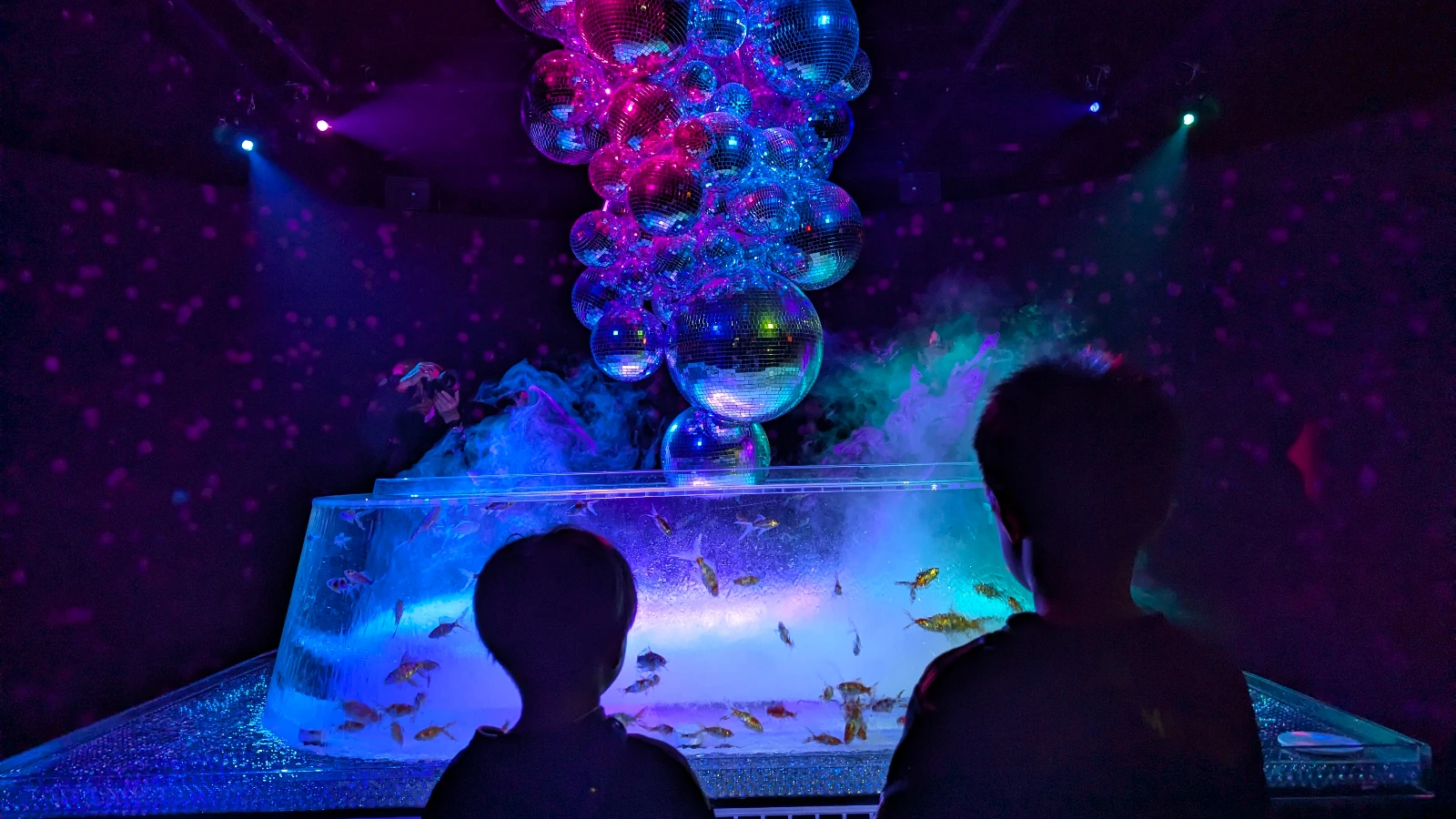
Art Aquarium turns goldfish into an art show of lit tanks, sound and scent, and it holds every child to one hard rule: look as long as you like, touch nothing.
Two children of elementary age or under enter free per paid ticket. Book on the web: once it sells out, there are no day tickets.
No weekly closing day; closed on Ginza Mitsukoshi’s closing days and at times for maintenance.
There is no re-entry, so the visit runs in one go.
Children of elementary age and under must come with a guardian.
Stroller parking on the ninth floor, before the entrance; bring a carrier.
Some links on this page are affiliate links. LuNi may earn a commission at no extra cost to you.
Is Art Aquarium Museum Ginza worth it with kids?
The short version, before the costs, the timings and the case for each child.
Yes, for the right child, and it is worth being honest about which one that is. This is not an aquarium in the usual sense. It is goldfish as art, in tanks lit and scored like a stage, and the museum guards them as works, so the rules are strict. No hands in the tanks, no touching the fish, no eating, and no coming back once you leave. A child who loves to watch, notice and name things will get a great deal from it. A child who needs to handle the world will spend the visit being told no. Book it for the watcher, keep it short for the mover, and remember that two younger children enter free with each paid ticket.
Planning Your Visit to Art Aquarium Museum Ginza with Kids.
Three decisions shape a visit here, and each one is easier made at home. The first is the ticket. Buy on the web rather than at the machine: it is cheaper, its date and time can be moved before the slot, and once web tickets sell out there is no day ticket to fall back on. Count the children, too, since two younger ones enter free with each paid ticket and a third pays. The second is the stroller, which stays on the ninth floor, so bring a carrier for a small child. The third is timing within the day: there is no re-entry and no eating inside, so plan the meal for afterward. A gallery this strict is best kept to a morning, with the afternoon given to one of Tokyo’s family stops where hands are welcome.
Every LuNi attraction guide starts with a visit, with our own children
LuNi rates and writes about attractions only after visiting them with children. Luca and Nico were at Art Aquarium Museum Ginza, and what they did there is recorded further down this page, including how each child actually met it.
Children arrive with different tolerances: for noise, for lines, for standing still, for being on their feet all day. A guide written for the average of them helps almost nobody. So every place on this site is read four ways, and each verdict says which children it already suits and what makes it work for the rest. Whoever you are bringing, the answer here is built for your family rather than for a general reader.
Restricted-movement depletion is the whole risk in a look-only gallery with no touching and no re-entry, so keep the visit short and plan open ground after.
Sensory-input depletion comes from light, sound and scent combined on the Goldfish Path, so walk it once, early, and let the child set the pace.
Unfamiliarity eases with a dated, timed ticket and a staff-guided escalator entry, so describe the ninth-floor start and the rules before the family arrives.
Walking and standing stay modest indoors, with a station exit at the building and an escalator in, though strollers stay outside, so bring a carrier.
- Cost
- ¥2,500 web / ¥2,700 at the machineTwo children of elementary age or under enter free per paid ticket. Book on the web: once it sells out, there are no day tickets.
- Booking
- Web ticket, dated and timedThe date and time can be moved before your slot; web tickets cannot be canceled.
Hotels we would book for this visit.
Of the family hotels in Tokyo, stay in Ginza itself, the museum’s own district, because the hotel decision here is about the hour after the gallery: a child who has held still all morning needs somewhere close to rest or move before the afternoon.
| Property | The LuNi Reason |
|---|---|
| LUNI Pick Hyatt Centric Ginza Tokyo | Hyatt Centric sits in the museum’s own district, so the family can take the first slot of the day without a cross-city trip beforehand. That matters for a child who has to keep their hands still for the whole visit: book the earliest slot, arrive rested, and spend the stillness the museum asks for while it is still fresh. |
| Millennium Mitsui Garden Hotel Tokyo | The Millennium Mitsui Garden is the base for a family that wants the afternoon in the district too. A child who spent the museum holding still needs the next hour to move, and staying in the same district turns the room into the break: back to rest after the gallery, then out again once the stillness has worn off. |
| Muji Hotel Ginza | Muji Hotel Ginza is for a family staying on to see more of the district. After a morning of strict rules, the day turns on the child getting their hands back, and a room in the same district makes a midday return easy to plan before the afternoon asks anything else of them. |
Millennium Mitsui Garden Hotel Tokyo
Nearby attractions, matched to your child.
Three pairings for what the museum leaves unmet: open ground for a child who has held still through a look-only gallery, a calmer, seated aquarium for more fish with less input, and an evening tower that runs to a clock.
| Pairing | Why This Solves the After-Visit | For Your |
|---|---|---|
| LUNI Pick Shinjuku Gyoen National Garden Shinjuku; free for junior high and under | After a gallery of hands behind the back, Shinjuku Gyoen National Garden gives restricted movement somewhere to go. A Dynamo who walked the dark gallery with hands held still gets wide lawns to cross at its own pace, and the stillness the museum asked for is repaid in open ground and sky. | Dynamo |
| Sumida Aquarium Tokyo Skytree Town; Solamachi 5F and 6F | For a child who loved the fish and not the light show, Sumida Aquarium offers the same wonder with less sensory input: seats at the big Ogasawara tank, and a hand stamp that allows a break outside and a way back in. | Sensor |
| Tokyo Tower Akabanebashi Station, about 5 min on foot | For an Anchor who liked the timed ticket, Tokyo Tower keeps an evening on a known clock: after sunset the tower sparkles at the top of every hour. Unfamiliarity has little to work on when the next moment is announced; a Sensor’s sensory input climbs there, so plan that child a short stay. | Anchor |
Shinjuku Gyoen National Garden
Shinjuku; free for junior high and under For YourDynamo
Sumida Aquarium
Tokyo Skytree Town; Solamachi 5F and 6F For YourSensor
Tokyo Tower
Akabanebashi Station, about 5 min on foot For YourAnchor
How two children actually met this attraction.
Two children walked through the same rooms and found two different ways to cope with them. One found a pattern in the light and stood still to master it; the other found a rule in the floor and kept moving to obey it. Neither of them was taught that, and both of them needed it. The difference matters more here than almost anywhere in Tokyo, because this is a museum that gives a child nothing to do with their hands. That is the useful thing to take from their visit. A watcher will settle once something holds their eye, so let them stay at that tank as long as it works. A mover will invent a game if you do not, so give them one before the first tank, one that keeps their hands to themselves.
Luca stationed himself beside the multi-sided NEO Oiran tank and stayed there for close to ten minutes, longer than he gave any other installation. What held him was not the fish but the light: he worked out that the color cycle repeated on a fixed sequence and began calling each change before it happened. He said afterward that the part he liked was where the fish had flashing lights and colors.
This is the Sensor pattern, and it is a hopeful one. A child whose Reserve depletes through sensory input does not always need to escape a busy room. Where the input repeats, the child can lock onto the repetition and use it to filter everything else, and the lit tanks gave Luca exactly that. For a similar child, find the one work that holds them and let them stay there, and leave the Goldfish Path, with its sound and scent, until they are settled.
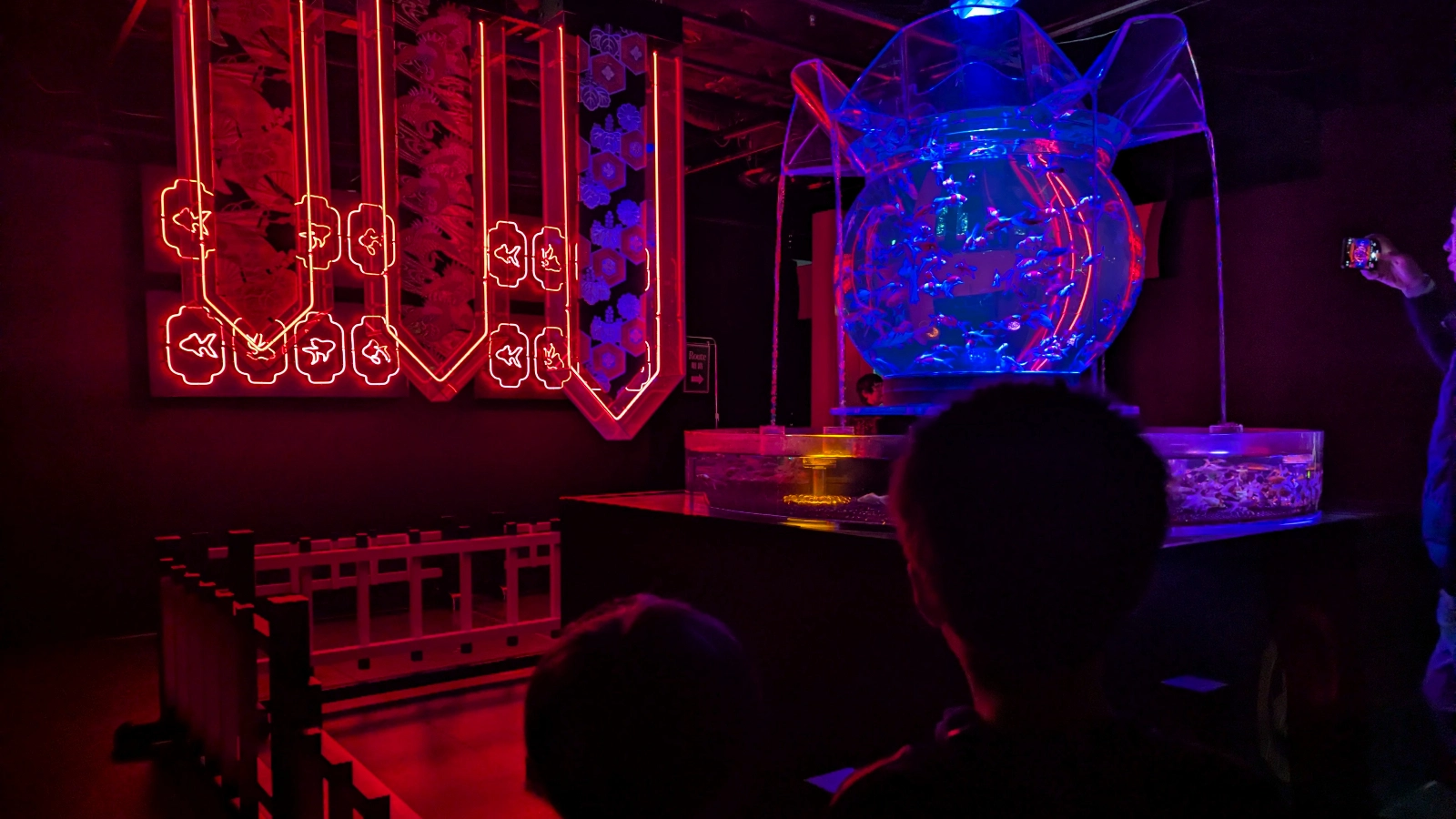
Nico moved through the museum faster and wider, registering the sheer quantity of fish rather than settling on any one tank. His summary was that there were so many fish and it was cool. Along the Goldfish Path he invented a rule for himself, walking the shadowed edges of the floor tiles without stepping into the bands of neon spilling from the torii-gate tank bases. The rule kept him moving the whole way.
This is the Dynamo pattern. A child whose Reserve depletes through restricted movement will manufacture a physical task when a place offers none, and in a gallery where hands must stay out of every tank, that task is what keeps him steady. Do not count on the floor supplying one. For a similar child, set the game before you arrive, counting tanks or finding one color in each room, and keep the visit short enough that the game outlasts it.
A museum that forbids touching asks a child to do something harder than it sounds: to let a thing be beautiful without holding it. Hands are how young children understand the world, so an hour of looking only is a real exercise in restraint, and many children manage it better than their parents fear. The watcher discovers that stillness has its own rewards; the mover discovers that a rule can be kept for a while and then set down. Both are learning that attention, not possession, is what makes a moment theirs.
The LUNI Rating for Art Aquarium Museum Ginza.
The verdicts split on one question: can the child keep their hands still? The museum is strict, with no touching the fish or the works and no hands in the tanks, which is why the Dynamo is the child it costs most. It is a place for the watcher in the family, and a hard visit for the mover. The Sensor needs a plan because the Goldfish Path adds sound and scent to the light. The Anchor and the Sprinter are served without conditions, on a timed ticket and a short, indoor visit. Keep it short for the mover, and let the watcher set the pace at the tanks.
Keep it short, and plan the lawn for straight after. The Dynamo depletes through restricted movement, and Art Aquarium asks for almost nothing else. It is a look-only gallery: no touching the fish or the works, no hands in the tanks, no eating, and no leaving and coming back once inside. Some tanks sit low and are viewed from above, with fish at the surface, which is exactly where a curious hand goes. For a child who learns by doing, every good moment arrives with a rule attached.
No plan turns this museum into something active; it can only be made shorter. Book a slot early in your day, set a quiet game before the first tank, and hold a small hand at the low tanks. Then go straight to open ground, somewhere a child can move the stillness off, before asking anything else of them.
What this means for your Dynamo: a look-only gallery with no touching is where restricted movement builds fastest. A younger Dynamo needs a short visit and a hand held at the low tanks; an older one needs a game set before the first room.Walk the Goldfish Path once, and early. The Sensor depletes through sensory input, and the museum does not rely on light alone. The Goldfish Path, the tanks shaped like torii columns, combines light, sound and scent, and the seasonal programs change the mood through the year, one summer evening program running with darker lighting and eerie music. Entry may also be held when the museum is crowded, which adds waiting to the load.
The load stays manageable because the heaviest input is concentrated in one named installation a parent can plan around, and visitors are asked not to use flash or any light, phone lights included, so bursts from other cameras should be rare. Walk the Goldfish Path early, while the child is fresh, and then let them choose one calmer tank to stand at. Check the current program before booking an evening slot.
What this means for your Sensor: input comes as light, sound and scent together on the Goldfish Path. A younger Sensor needs it walked early and briefly; an older one can choose a calmer tank to settle at and set the pace.Describe the ninth-floor start before you go. The Anchor depletes through unfamiliarity and unconfirmed structure, and Art Aquarium can be described almost completely before the family leaves the hotel. The web ticket fixes a date and a time, and both can be moved before the slot if the day changes. The museum is on the eighth floor of the Ginza Mitsukoshi New Building, but the entrance is on the ninth, where staff guide everyone down an escalator into the museum.
That upside-down start is the one detail to say out loud, because a child who expects to walk straight in will be caught by it. Tell them: up to the ninth floor, leave the stroller, then down the escalator with the staff. Tell them the rules, too, since a child who knows the rules in advance rarely needs reminding. With that said, this is one of the easier museums in Tokyo to make predictable.
What this means for your Anchor: unfamiliarity eases once the ninth-floor entry and the escalator down are named in advance. A younger Anchor needs the rules said at home; an older one can hold the ticket and the time.Carry the small ones, and let the train do the rest. The Sprinter depletes through sustained travel-style walking and standing, and Art Aquarium asks for less of both than a day in Ginza usually does. Ginza Station Exit A7 comes out right by the building, the visit is entirely indoors, and the way in is an escalator, not a staircase. For a family arriving by subway, the walk before the first tank is a short one.
The catch is the stroller. Strollers are not admitted, and they wait in the stroller park on the ninth floor, so a child who usually rides has to walk or be carried through the whole museum. Bring a carrier for anyone small, and treat the visit as one continuous stretch on foot, since there is no re-entry. Book the meal for straight after, sitting down.
What this means for your Sprinter: walking and standing stay modest with a station exit at the building and an escalator in. A younger Sprinter needs a carrier, since strollers stay outside; an older one manages the visit on foot.The questions parents actually ask.
The museum treats every tank as a work of art, which is why its rules are strict. Children cannot touch the fish or the works, strollers stay outside, and there is no re-entry or eating inside. On tickets, two younger children enter free with each paid ticket, and web tickets are the safe choice because the machines stop when the web sells out. Photographs are welcome, as long as no light of any kind is used. A child who needs something in their hands is better served at Legoland Discovery Center Tokyo, where building is the point. Here, the whole visit rests on still hands.
Is Art Aquarium Museum Ginza worth visiting with kids?
For a child who can look without touching, yes. It is a gallery of goldfish tanks presented as art, and the rules are strict: no hands in the tanks and no eating inside. A child who needs to handle things or move freely will find it hard, so book it for the one who likes to watch.
How much are Art Aquarium tickets for children?
Up to two children of elementary age or under enter free with each paid adult or student ticket, and the third child pays the full price. Children cannot enter without a guardian. Adult tickets are 2,500 yen on the web and 2,700 yen at the machine; the 2,200 yen student price covers junior high to university and is sold on the web only.
Can you bring a stroller to Art Aquarium Ginza?
No. Strollers are not admitted, and there is a stroller park on the ninth floor, where the entrance is. The museum has no lockers of its own, but there are coin lockers on the twelfth floor of the same building. For a small child, bring a carrier, since the visit is on foot from the escalator onward.
Can children touch the fish at Art Aquarium?
No. The museum firmly refuses putting hands into the tanks or touching the goldfish, and the works themselves are not to be touched either. Some tanks are low and viewed from above, with fish at the surface, which is exactly where a curious hand goes first. Say the rule before you arrive, and hold a small hand at the low tanks.
Where is the entrance to Art Aquarium Museum Ginza?
The museum is on the eighth floor of the Ginza Mitsukoshi New Building, but the entrance is on the ninth floor, and staff guide visitors down an escalator into the museum. There is no direct entry from the eighth floor. Ginza Station Exit A7 comes out right by the building, and Higashi-ginza is two minutes away by underground passage.
Can you buy Art Aquarium tickets on the day?
Sometimes. Day tickets are sold at machines on the ninth floor, by card or cash, but once web tickets sell out no day tickets are sold at all. A web ticket is safer, and its date and time can be changed before the slot, though it cannot be canceled. Even with a ticket, entry may be held when the museum is crowded.
Can you take photos inside Art Aquarium Ginza?
Yes, photos and video are allowed, but without flash, lights of any kind, phone lights included, monopods or tripods. A child with a camera can be given one job, and the rule about light is the one to explain first. If you post pictures, take care over other visitors in the frame, as the museum asks.
Can you leave and come back into Art Aquarium?
No. Once you leave, there is no re-entry, so the visit runs in one go. Eating is not allowed inside, and only sealed bottles and flasks may be carried. Settle snacks, drinks and bathroom visits before going up to the ninth floor, and plan the meal for after the museum rather than halfway through.
Where Art Aquarium Museum Ginza fits your Japan trip.
Official site and opening information: Art Aquarium Museum Ginza