Tokyo With Kids:which stop is for which child.
- With Toddlers
- Ueno Zoo, Shinjuku Gyoen, Senso-ji
- Room to Move
- The Odaiba play zone and teamLab Planets
- Book First
- Ghibli, Disney and teamLab
- Quieter Stops
- Shinjuku Gyoen and the Ghibli Museum
- Easy on the Legs
- Skytree and the Tokyo Toy Museum
The best activities and things to do across a huge city, sorted so a family spends its days in one area at a time.
Some links on this page are affiliate links. LuNi may earn a commission at no extra cost to you.
Things to do in Tokyo with kids start, with toddlers, at Ueno Zoo, Shinjuku Gyoen and Senso-ji: stroller-friendly, low cost and no booking. The Odaiba play zone, teamLab Planets and Ueno Zoo suit a child who has to move; Shinjuku Gyoen and the Ghibli Museum are the quieter stops; a booked Disney day, Senso-ji and Shibuya Sky give the child who needs a set order a fixed shape. Skytree, the Tokyo Toy Museum and the Science and Technology Museum go easy on tired legs. Book Ghibli, Disney and teamLab first: each has dated or timed entry. Twelve stops, by child.
Which stop is for which child.
Organized not by which stop is best, but by which child each one is best for, across the four profiles of The LUNI Framework.
These twelve stops are not ordered best to worst. They are grouped by which child each one is for. The reason is structural: Tokyo is one of the most stimulating cities on earth, and the stop that thrills one of your children is the stop that empties another. So instead of one list, you get four short ones, organized by how each child runs out of steam. The Dynamo runs short when they cannot move. The Sensor runs short on noise and crowds. The Anchor runs short when nothing is predictable. The Sprinter runs short on walking and standing. Find your child below, and start there.
For the Dynamo
Stops that relieve restricted-movement depletion.
For a child who depletes through restricted movement, the strongest stops are the Odaiba play zone, teamLab Planets, and Ueno Zoo.
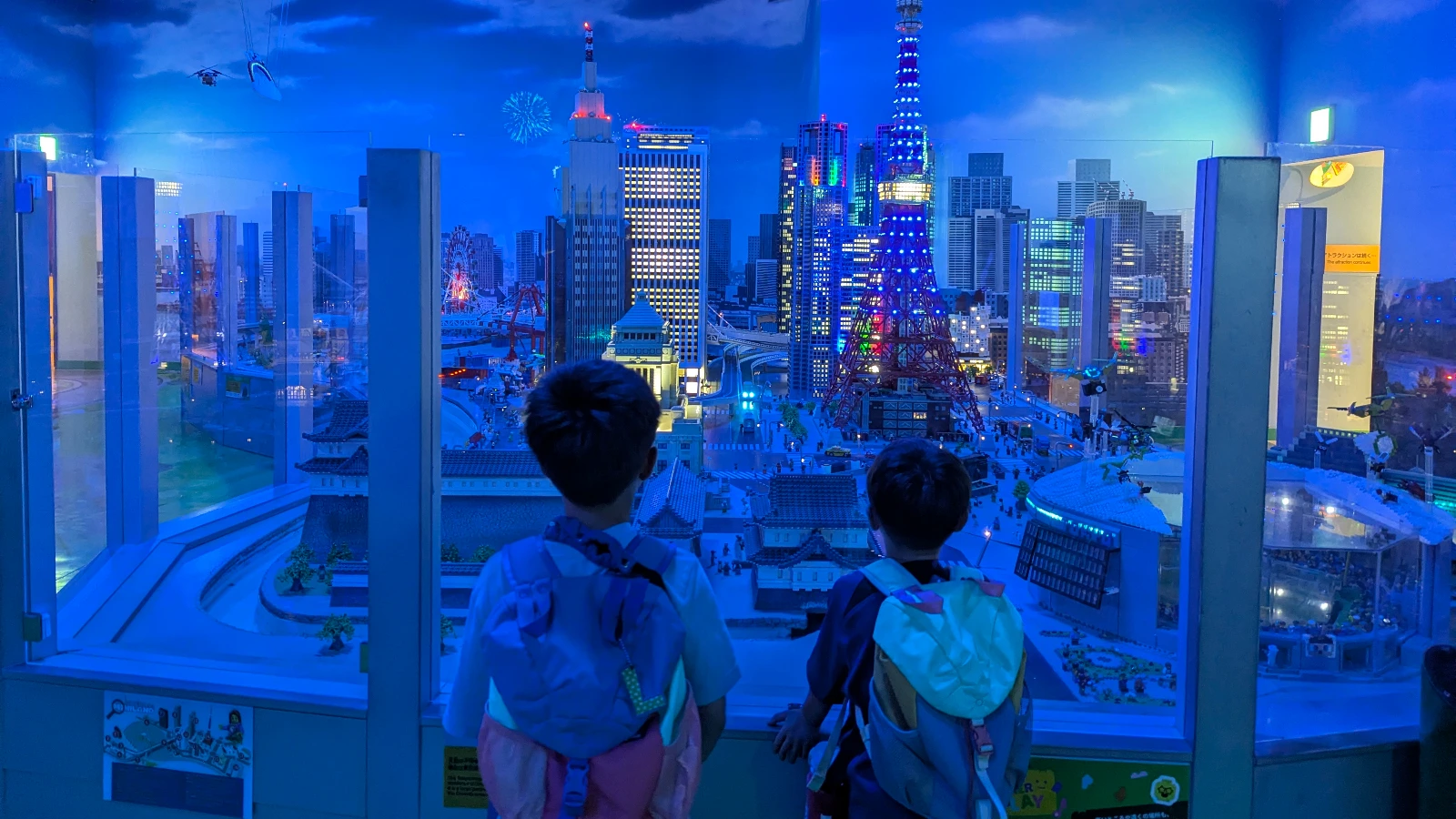
Odaiba is the one district in Tokyo where a movement-driven child can cross between high-stimulation venues without re-entering the transit system, and the waterfront promenade between them works as an active reset rather than dead time. LEGOLAND Discovery Center carries three hours of build-and-race activity, and Joypolis runs the highest sound and visual density of any fixed attraction in central Tokyo. A younger Dynamo burns energy across the LEGOLAND build zones; an older one takes the Joypolis rides at full tilt. For a quieter alternative in the same bay, Small Worlds is an indoor miniature museum a short walk away, and KidZania Tokyo, a role-play city where children work real jobs for in-park currency, is the strongest indoor discharge in the zone on a rainy day.
Who it costs.The Sprinter. The walking distance between DiverCity, Palette Town, and the waterfront is real ground, and a low-stamina child arrives at the afternoon venue already past their ceiling.
How to make it work.Pick one primary venue rather than the full district circuit: LEGOLAND for younger children, Joypolis for older, with the Gundam statue and waterfront as secondary stops taken in passing.
If this isn’t your child: still a lively half day by the bay, just not the reason to build the trip around it.The water rooms are the mechanism that makes teamLab Planets work for a Dynamo: wading through knee-deep water while projections shift in real time to how a child moves is active, consequence-generating engagement that a passive gallery cannot replicate. A child who would disengage within twenty minutes of a museum sustains full attention here because stillness produces a different result than movement. A younger Dynamo splashes through the shallow sequence; an older one chases the projection shifts room to room. The sister venue teamLab Borderless in Azabudai is the drier, maze-format alternative if the barefoot water rooms are a poor fit.
Who it costs.The Sensor, at high risk. Low ceilings, mirrored floors, and dark rooms can push a sensory-loaded child to a cascade before the most rewarding sections are reached.
How to make it work.Book the first morning slot before 10:00 a.m., when lower density gives a Dynamo the spatial range to move as the rooms are designed to be used.
If this isn’t your child: a genuinely beautiful hour, though a Sensor needs a walkthrough of each room before booking.The zoo’s split east and west sections, joined by a pedestrian bridge, distribute foot traffic and remove the static crowd bottlenecks that stall a movement-driven child at single-exhibit attractions. The open grounds of Ueno Park between the zoo and the museum give an unstructured discharge interval that makes the afternoon session viable. A younger Dynamo runs the park paths between animal houses; an older one takes the full east-west loop and the museum’s Japan Gallery after. Ueno Park itself, with its wide central avenue and pond, is free to roam and works as the reset between the two ticketed halves.
Who it costs.The Sprinter. The full loop between the zoo’s two sections adds walking distance most families do not account for at entry.
How to make it work.Cover one zoo section, take a seated break in the park, and treat the museum as the afternoon anchor rather than attempting the full circuit first. Go in the morning, when the zoo is calmest.
If this isn’t your child: the widest age-range stop in Tokyo, and the lowest-cost full day on this map.For the Sensor
Stops that let a sensory-loaded child recover.
For a child who depletes through sensory input, the strongest stops are Shinjuku Gyoen, the Ghibli Museum, and Miraikan.
Shinjuku Gyoen is the most reliably reachable large green space in central Tokyo, and its no-alcohol policy keeps it quieter and less congested than Ueno or Yoyogi on weekends, which matters directly for a child whose threshold is sensory. The garden’s three zones let a family move through different sensory environments inside one visit, and the greenhouse gives air-conditioned enclosure in humid months without indoor crowd density. A younger Sensor recovers on the open lawns; an older one walks the quieter Japanese garden at their own pace. For the same forest calm elsewhere in the city, Meiji Jingu’s shrine approach and the open lawns of Yoyogi Park both serve the profile, and Hama-rikyu Gardens offers a bayside version near the water.
Who it costs.The Sprinter. The grounds are large and stretches between the gates run long without seating, so a low-stamina child feels the distance.
How to make it work.Enter and exit at the two gates on opposite sides to plan one directional route, rather than backtracking to the entry gate once a child’s energy has peaked.
If this isn’t your child: the day that quietly holds the rest together, useful to any family as the morning before a busy afternoon.The museum’s low visitor density, enforced by fixed-capacity ticketing, produces a sensory environment that is essentially unavailable at any other major Tokyo family attraction. The Saturn Theater’s exclusive short film is a contained, low-stimulus, high-engagement interval that works as the most reliable reset in the visit. A younger Sensor settles into the hand-crafted rooms; an older one follows the animation exhibits closely. For a low-light indoor alternative on a Sensor day, Maxell Aqua Park Shinagawa runs a calmer aquarium format with dimmed tank galleries.
Who it costs.The Dynamo. The museum holds no physical output zone and no thrill components, so a movement-driven child reaches the edge of their attention window inside two hours.
How to make it work.Watch two or three Studio Ghibli films before arrival: without that context the museum reads as atmospheric but thin, so the preparation is a planning requirement, not optional enrichment.
If this isn’t your child: a beautiful, quiet two hours, best for families who already know the films.Miraikan’s newer interactive zones respond to movement and voice in real time, which produces high engagement at low crowd pressure when visited on a weekday morning, the combination a sensory-sensitive child needs. The Geo-Cosmos, a suspended LED sphere showing live satellite imagery, sets the museum’s principle of scale over text panels, and outside its scheduled display windows the atrium works as a quieter transit space a Sensor finds more manageable. A younger Sensor watches the sphere; an older one works the hands-on floors. For another low-stimulus, water-themed option nearby, Tokyo Sea Life Park in Kasai runs a compact, calm aquarium loop.
Who it costs.Very little. Miraikan rates well across every profile, which is why it doubles as the safest shared stop when siblings sit in different groups.
How to make it work.Arrive on a weekday morning and check the Geo-Cosmos display schedule at entry so the visit lands during a screening rather than a gap.
If this isn’t your child: the rare museum that works for all four profiles, and the strongest rainy-day pick on this map.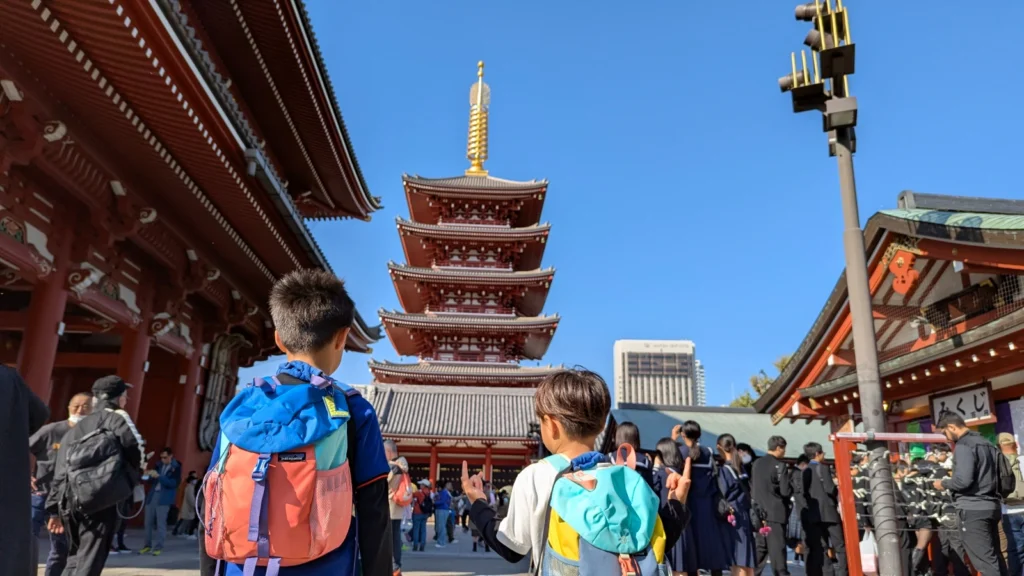
For the Anchor
Stops with confirmed, predictable structure.
For a child who depletes through unfamiliarity and unconfirmed structure, the strongest stops are a booked Disney day, Senso-ji, and Shibuya Sky.
A Disney day is one of the most structurally predictable things a family can build in Tokyo: the ticket, the map, the ride sequence, and the show times can all be confirmed in advance, which is exactly the certainty an Anchor relies on. The two parks are distinct machines and cannot be combined in a single day with children, so the choice between them is the consequential planning call. A younger Anchor is reassured by the named, familiar characters; an older one anticipates rides they already know are coming. For a fully indoor, timed, sequenced alternative when a whole park day is too much, the Warner Bros. Studio Tour Tokyo (The Making of Harry Potter) runs a fixed walk-through route with the same confirmed structure.
Who it costs.The Dynamo, at high risk. Queues of 90 minutes or more at peak rides are a threshold breach waiting for a trigger, not a friction point to manage.
How to make it work.For a Dynamo, Disney Premier Access on the three highest-demand rides is the structural fix, not an optional upgrade. Book the park one to two months ahead either way.
If this isn’t your child: the highest satisfaction ceiling in Tokyo, worth the planning for any family that has the day.The omikuji fortune-drawing ritual at Senso-ji is one of the few cultural interactions in Tokyo a child can start and finish independently inside a defined set of steps, which is the contained, completable task an Anchor needs in an unfamiliar setting. The pedestrianized Nakamise approach is wide enough that children move at their own pace, and it is free with zero ticket friction. A younger Anchor completes the coin-and-fortune sequence; an older one navigates the temple precinct through its fixed layout. A few minutes away, the Samurai Ninja Museum Asakusa runs fixed guided sessions with a clear start and finish, and the newly reopened Edo-Tokyo Museum in Ryogoku offers a walk-through Edo streetscape on a defined route.
Who it costs.The Sensor. After 10:00 a.m. the lateral pressure of congested foot traffic on the approach is the primary friction point, and no routing eliminates it at that hour.
How to make it work.Arrive before 8:00 a.m., when crowd density on the main approach is low enough to keep the visit manageable for every profile.
If this isn’t your child: the most logistically forgiving cultural stop in Tokyo, free and open at any hour.A timed ticket, a fixed elevator route, and a single defined platform make Shibuya Sky one of the most predictable outings in the city, the confirmed sequence an Anchor can rehearse in advance. Nothing about it improvises. A younger Anchor is reassured by the clear up-and-down format; an older one anticipates the view they already know is coming. For another bookable, structured indoor option, the Art Aquarium Museum in Ginza runs a fixed gallery route, and the Imperial Palace East Gardens offer free, formally laid-out grounds with a predictable circuit.
Who it costs.The Sensor, at high risk at the open-air edge during peak slots, where wind, height, and crowd compress at once.
How to make it work.Book a specific timed slot in advance so the Anchor has a confirmed sequence, and choose an off-peak slot to keep the Sensor cost down.
If this isn’t your child: the best high view in the city, worth booking for the sight alone.For the Sprinter
Short, low-stamina stops with little walking.
For a child who depletes through sustained walking and standing, the strongest stops are the Skytree tower, the Tokyo Toy Museum, and the Science and Technology Museum.
The Skytree complex stacks an observation deck, a full aquarium, and dining inside one elevator-connected tower, reached from Oshiage Station with step-free access and no outdoor walking from platform to lobby. For a low-stamina child it delivers the most attraction variety per unit of physical output in Tokyo: the deck is reached in 50 seconds by high-speed elevator, and the compact Sumida Aquarium completes in 60 to 90 minutes without backtracking. A younger Sprinter rides up and watches the tanks; an older one takes the higher gallery and the town food hall without re-entering transit. Tokyo Tower offers the same elevator-up, low-walk format on the other side of the city if the Skytree is out of the way.
Who it costs.The Dynamo. The complex has no unstructured output zone: both venues ask children to move slowly and stay within set pathways.
How to make it work.Pair it as an afternoon session after a morning discharge activity, rather than opening the day with it, and book the deck and aquarium as one combined visit.
If this isn’t your child: the most physically efficient outing in Tokyo, and an easy win on a tired day.Housed in a former schoolhouse in Yotsuya, the Tokyo Toy Museum is a compact, indoor, single-building stop where a low-stamina child moves between hands-on wooden-toy rooms without the walking distance that defeats the profile at campus-style attractions. Everything is at child height and within a few steps. A younger Sprinter settles into the toddler play room; an older one works the build-and-craft stations. For a contained, seated pairing nearby, the reservation-based Pokemon Cafe Tokyo asks nothing of a child’s legs and gives a fixed, timed sit-down break.
Who it costs.The Sensor, mildly. The play rooms fill with sound at peak, so an overloaded child feels the volume.
How to make it work.Go at opening on a weekday, before the rooms fill, so a Sprinter gets the low-walk play without the Sensor paying the peak-noise cost.
If this isn’t your child: a warm, low-key hour indoors, and a reliable rainy-day fallback.The Science and Technology Museum in Kitanomaru Park stacks its hands-on floors inside one building, so a low-stamina child rides between exhibit levels rather than crossing ground to reach them, and every floor is interactive rather than walk-and-read. A younger Sprinter turns the mechanical exhibits; an older one works the physics and engineering floors. Nearby, the small indoor Metro Museum is a low-walk, train-themed stop for a rail-minded child, and the larger Railway Museum in Saitama is the bigger option when the family will make the short trip out, though its scale asks more of the legs.
Who it costs.Very little. The museum rates well across every profile, so it works as a second shared stop when siblings sit in different groups.
How to make it work.Use the vertical layout deliberately: work top-down floor by floor so the elevator, not the child’s legs, carries the transitions.
If this isn’t your child: an all-profile indoor stop, and an easy pairing with the nearby palace gardens.Open with the child who runs short first.
The order of a Tokyo day is set by Reserve, not by the map. Each route opens with the stop that protects the named child, then chains to the nearest compatible one.
Settle these first. The Ghibli Museum, Tokyo Disneyland, DisneySea, teamLab Planets, and Shibuya Sky are all booking-gated, and a booking-gated stop controls the day’s shape more than the route does. Everything else on this map is walk-up fill-in arranged around whichever of those you have reserved.
What to fit in, and what costs nothing.
Four to five stops across three days is the realistic ceiling for families with children under 10: one full-day stop such as Disney, one half-day indoor stop such as teamLab Planets or Miraikan, and the rest filled with low-logistics options. The free stops carry real weight here: Senso-ji and Nakamise Street, the Odaiba waterfront and its Gundam statue, and the Imperial Palace East Gardens all cost nothing, and Shinjuku Gyoen charges only a small entry fee. As in most of Tokyo, the free route and the calm route are largely the same route.
Three bases that fit a family’s Reserve.
A shortlist chosen for location logic, not price tier. The full set is in the complete Tokyo hotel guide.
| Property | The LuNi Reason | Budget |
|---|---|---|
|
LUNI Pick
HOSHINOYA Tokyo
Ryokan calm, Otemachi
|
A luxury ryokan tower in quiet Otemachi where tatami rooms and a top-floor onsen give a sensory-loaded child a genuinely low-stimulation base to decompress at the end of a high-input Tokyo day, with the Imperial Palace gardens a short flat walk away. | ¥¥¥ |
| MIMARU Tokyo Ueno East Apartment rooms, near Ueno | Apartment-style family rooms with kitchenettes minutes from Ueno Park and its zoo, giving an Anchor the routine of a home base across a multi-night stay and a Sprinter the shortest daily walk to the trains. | ¥¥ |
| Trunk Hotel Yoyogi Park Beside the park | A boutique base set against Yoyogi Park’s green edge, where the open lawns give a Dynamo an immediate discharge zone on arrival and a Sensor a calmer, lower-density side of the city to return to each evening. | ¥¥¥ |
Budget: ¥¥¥
Budget: ¥¥
Budget: ¥¥¥
For every family-friendly option across Tokyo, see the full Tokyo family hotel guide.