
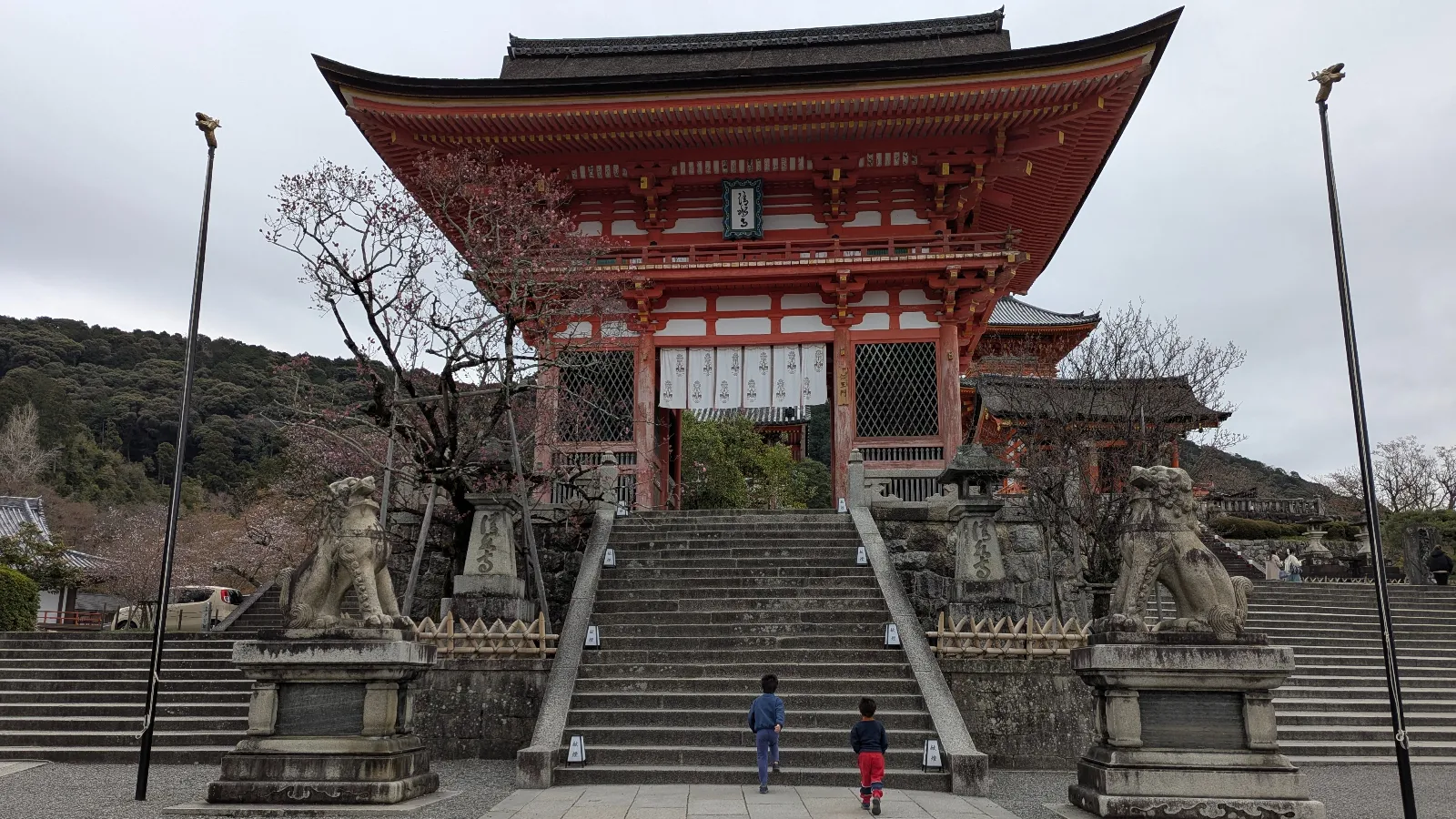
The steep stone streets of Sannenzaka make parents question whether the approach to Kiyomizu-dera is physically manageable for their child before the temple visit has even begun. The competing pull is one of the most photographed structures in Japan: an ancient wooden stage projecting over a forested hillside with a panoramic city view that no other Kyoto attraction replicates.
Whether this temple belongs on your itinerary depends entirely on your child’s travel profile, not on the temple’s reputation. For the full Kyoto planning picture, the Kyoto family-friendly travel hub covers every structure decision this city requires.
Is Kiyomizu-dera Worth Visiting with Kids? (Quick Answer)
Kiyomizu-dera is worth visiting for families whose child can handle a sustained uphill walk on uneven stone terrain and thrives in a structured outdoor cultural environment. The open grounds and early-morning calm suit Sensors and Anchors well, while the unavoidable staired approach on Sannenzaka makes it a demanding visit for Sprinter regardless of preparation or timing. This guide delivers profile-specific verdicts and identifies three Kyoto alternatives that solve for the gaps this temple cannot.
Pros of Visiting Kiyomizu-dera with Kids
- The expansive wooden viewing stage projects over an unobstructed forested hillside, delivering a panoramic city view that requires no cultural or historical context for a child to register as genuinely spectacular. This is the visual payoff that justifies the physical investment of the approach for families whose child has the stamina to reach it.
- The outer garden paths and perimeter routes sit well away from the densest pedestrian corridors near the main hall, giving families a navigable lower-pressure route through the grounds. For Sensors, this separation between the high-traffic core and the quieter perimeter is the structural quality that makes a visit workable rather than overwhelming.
- The approach streets of Sannenzaka and Ninenzaka function as a distinct, high-stimulation environment before the temple grounds begin, with food stalls, shop frontages, and visual variety that sustain engagement for children who would find a purely historical site too passive. Families traveling with Dynamos can treat the ascent itself as part of the experience rather than the cost of admission, preserving energy for the temple by keeping the child moving and interested on the way up.
- The main temple complex follows a legible, sequential path from the main gate through the main hall to the viewing stage, with a clear orientation that can be described to a child before arrival. This predictable progression gives Anchors a defined visit structure that reduces ambient anxiety in an otherwise busy environment.
- The open-air nature of the main grounds means families can control their own pacing and exit the densest areas without navigating enclosed corridors or ticketed interiors. There is no point in the visit where a family is trapped inside a space they cannot leave, which keeps the experience manageable for a wider range of children than a fully enclosed attraction of equivalent size would be.
Cons of Visiting Kiyomizu-dera with Kids (Important for Parents)
- The Sannenzaka approach is a sustained climb on steep, uneven stone steps with no flat bypass route to the main temple entrance. For Sprinters, this is not a manageable inconvenience, it is a stamina drain that consumes the physical reserves needed for the visit itself, making the approach the primary reason this attraction is a demanding environment for low-stamina children.
- Pedestrian flow through the narrow transition corridors near the main hall funnels visitors into dense, slow-moving queues with limited lateral movement. Parents of toddlers and young children who cannot reliably hold position in tight crowd conditions will need to carry them through these sections, adding physical load at the point in the visit when adult energy is already partly spent from the climb.
- The fragile historic wooden platforms restrict free movement in the area of the temple that delivers the principal visual reward. The Dynamo’s natural physical restlessness is directly incompatible with this environment, and there is no space at the summit where a high-energy child can move freely before or after the viewing deck.
- A paved path alongside the main ascent accommodates strollers technically, but the gradient and crowd density make using one genuinely impractical for most families. Parents who rely on a stroller for daily logistics should factor in that the climb will require significantly more physical effort than a flat urban street, and that carrying the child may become the more realistic option before the ascent is complete.
- Peak season crowd density on the wooden viewing platforms and exit corridors reaches a level that meaningfully changes the sensory environment for the entire visit, not just the most congested moments. For Sensors, the timing of arrival is the single most consequential planning decision at this attraction: families who cannot commit to an opening-hour visit during cherry blossom or autumn foliage season should treat the experience as a conditional choice rather than a reliable one.
Why “Worth It” Depends on Your Child
Two families can visit Kiyomizu-dera on the same morning and leave with opposite assessments, and both can be entirely right. The Family Fit™ framework makes that contrast predictable by identifying the specific physical and structural qualities of this attraction that determine each profile’s outcome before the visit begins.
The Dynamo – Caution. The historic wooden platforms and inner corridors require sustained movement restraint in a space where a high-energy child has no legitimate physical outlet. Plan activity on either side of the temple visit that gives Dynamos room to move freely, so the restricted environment at the summit does not become the defining memory of the day.
The Sensor – Go. The outer garden paths and open perimeter offer controllable exposure with clear sightlines and immediate exit access away from the densest pedestrian corridors. Arriving at the temple’s opening time secures the low-crowd, low-noise window that makes this rating reliable; later in the morning, the same paths operate at a substantially higher sensory load.
The Anchor – Go. The internationally recognizable format of a major Japanese hillside temple provides a clear, predictable visit sequence that a routine-reliant child can be briefed on in advance. The structured progression from the approach streets to the main hall to the viewing stage gives this profile a defined itinerary shape that reduces ambient anxiety.
The Sprinter – High Risk. The distance between any practical drop-off point and the temple entrance requires a sustained walk that a low-stamina child will struggle to complete with energy remaining for the visit itself. No routing option delivers Sprinters to the main gate without a meaningful physical cost. Families whose child relies on short, flat movement windows should treat this as a planned skip rather than a logistics problem to solve.
Families who have not yet identified their child’s travel profile will find the Family Fit™ Quiz the most efficient first step before finalizing this itinerary decision.
Who Will Enjoy Kiyomizu-dera with Kids (By Age Group)
Toddlers (under 3)
Toddlers lack the balance and spatial awareness to navigate steep, uneven stone steps independently, and the approach streets funnel pedestrians into narrow corridors where carrying a child becomes the only reliable option. The visit is not worth it at this developmental stage unless parents are fully committed to a wearable carrier for the entire duration, including the descent.
Preschoolers (3–5)
Children at this stage lack the attention span for an attraction whose primary reward is a panoramic view rather than tactile or interactive engagement. The visit is conditionally worth it only if the duration is capped under one hour and the family treats the approach streets, with their food stalls and sensory variety, as the main event rather than the temple itself.
School-Age Kids (6–10)
A school-age child has the physical stamina to complete the Sannenzaka climb and the developing capacity to register the scale of the wooden stage and the city view below it. This is the age range for which Kiyomizu-dera is most clearly worth it: the grounds are visually varied enough to hold attention through a full visit without requiring historical or cultural motivation from the child.
Older Kids and Teens (11+)
Teenagers respond to the visual drama of the wooden stage and the photogenic energy of the approach streets, and the surrounding district gives them enough independent movement to prevent the frustration that heavily regulated heritage sites typically produce in this age group. The visit is highly worth it for this band, provided the family arrives early enough to avoid the shoulder-to-shoulder density that reduces the experience to crowd management.
Japan demands 15,000 to 20,000 steps a day, and the difference between a memorable trip and a daily meltdown comes down to one thing: knowing your child’s exact physical and sensory threshold before you lock in non-refundable bookings.
Take the free, 60-second Family Fit Check to discover your child’s travel profile and get the exact pacing strategies that prevent a breakdown on day three.
Best Alternatives to Kiyomizu-dera for Families with Kids
- Fushimi Inari Taisha. The torii gate trail is self-paced, fully outdoor, and structurally open: families exit at whatever depth suits the child’s energy level, with no mandatory climb required to reach the attraction’s primary payoff. Fushimi Inari Guide
- Kinkaku-ji. The Golden Pavilion’s primary experience is delivered from a flat, paved perimeter path around a reflective pond, with no elevation gain between the entrance and the principal viewpoint. Kinkaku-ji Guide
- Nijo Castle. Strongest for families prioritizing low pedestrian density and historical grounds without the sensory compression of the eastern hills district. Wide gravel paths and an expansive moat perimeter provide a calm pacing environment that Kiyomizu-dera’s approach streets cannot offer at any hour. Nijo Castle Guide
For families who have confirmed this temple fits their child’s profile, the Kyoto family-friendly travel hub provides the sequencing and neighborhood structure needed to build the full day around it.
Final Recommendation: Is Kiyomizu-dera Worth It with Kids?
Kiyomizu-dera is worth visiting for families whose child can absorb a structured outdoor temple environment and sustain the physical effort of a staired hillside approach, and is a justified planned skip for any family where that physical demand is a genuine obstacle. Sensors and Anchors are well served here; Sprinters are not, and no early departure time changes that calculus. The visit succeeds for Dynamos only when the surrounding itinerary is built to give a high-energy child room to move freely on either side of the temple, compensating for the restricted environment at the summit. The single most effective preparation for families who decide to visit is arriving at the opening hour, which converts a potentially overwhelming pedestrian experience into one of the most rewarding cultural mornings Kyoto offers.
The Kiyomizu-dera Briefing: Essential Intel
Families deciding whether to visit Kiyomizu-dera with kids return to these questions most consistently, from whether the Sannenzaka approach is manageable for a child with low stamina to whether sensory-sensitive children can find a workable path through the grounds.
A: Kiyomizu-dera is a high-effort visit for families with infants. A paved path exists alongside the main ascent, but the gradient and crowd density make stroller use genuinely impractical for most families, and parents should expect to carry the child for portions of the approach. Unless your family is comfortable managing a sustained uphill walk with an infant in a carrier, this temple is better skipped until the child is old enough to handle the approach independently.
A: Sprinters will find the Sannenzaka approach physically exhausting before the temple visit has begun. No routing adjustment eliminates the hillside climb, which drains a low-stamina child’s reserves at the point where they are most needed. Kinkaku-ji, with its flat pond perimeter, is the correct substitute for families in this situation.
A: Peak season produces shoulder-to-shoulder density on the wooden viewing platforms and exit corridors that substantially changes the visit for families with young children. For Sensors, the early-morning timing window that makes this temple manageable is significantly compressed during peak season. Families who are not comfortable managing young children in high-density pedestrian environments should consider a non-peak visit or a very early arrival.
A: Yes, under a specific condition: arrival at the opening hour. Sensor’s suitability at this attraction is tied directly to the low-crowd, open-access environment the early-morning visit provides, with the outer garden paths offering clear sightlines and immediate exit options. The same grounds later in the morning represent a substantially higher sensory load, and that early-morning window does not extend past the first hour of opening.
A: Teenagers extract strong value from Kiyomizu-dera’s visual impact and the surrounding district’s independent food and shopping environment. The physical stamina demand of Sannenzaka is not an obstacle for this age group, and the photogenic quality of the wooden stage delivers the kind of visually striking content that makes teenagers genuinely engaged rather than politely tolerant.
A: The Anchor is the profile for whom this temple operates most cleanly. The predictable visit sequence, the internationally recognizable temple format, and the structured progression from approach streets to main hall to viewing deck give a routine-reliant child a defined shape that reduces ambient anxiety without requiring high physical tolerance. The Sensor comes a close second when the early-morning timing condition is honored.
A: Kiyomizu-dera is not a quiet cultural site in the way that a traditional shrine or meditation garden would be. The approach streets are lively, the viewpoint is open-air rather than interior, and the grounds absorb ambient noise in a way that smaller neighborhood temples do not. The correct caution for Dynamos is not silence or solemnity, it is the restricted movement on the fragile wooden platform specifically, which is one defined area within a substantially more open overall site.