Kyoto With Kids:which stop is for which child.
- Rainy-Day Kyoto
- Trains, Nintendo and teamLab
- Best Museum
- Kyoto Railway Museum, stroller-friendly
- The Famous Ones
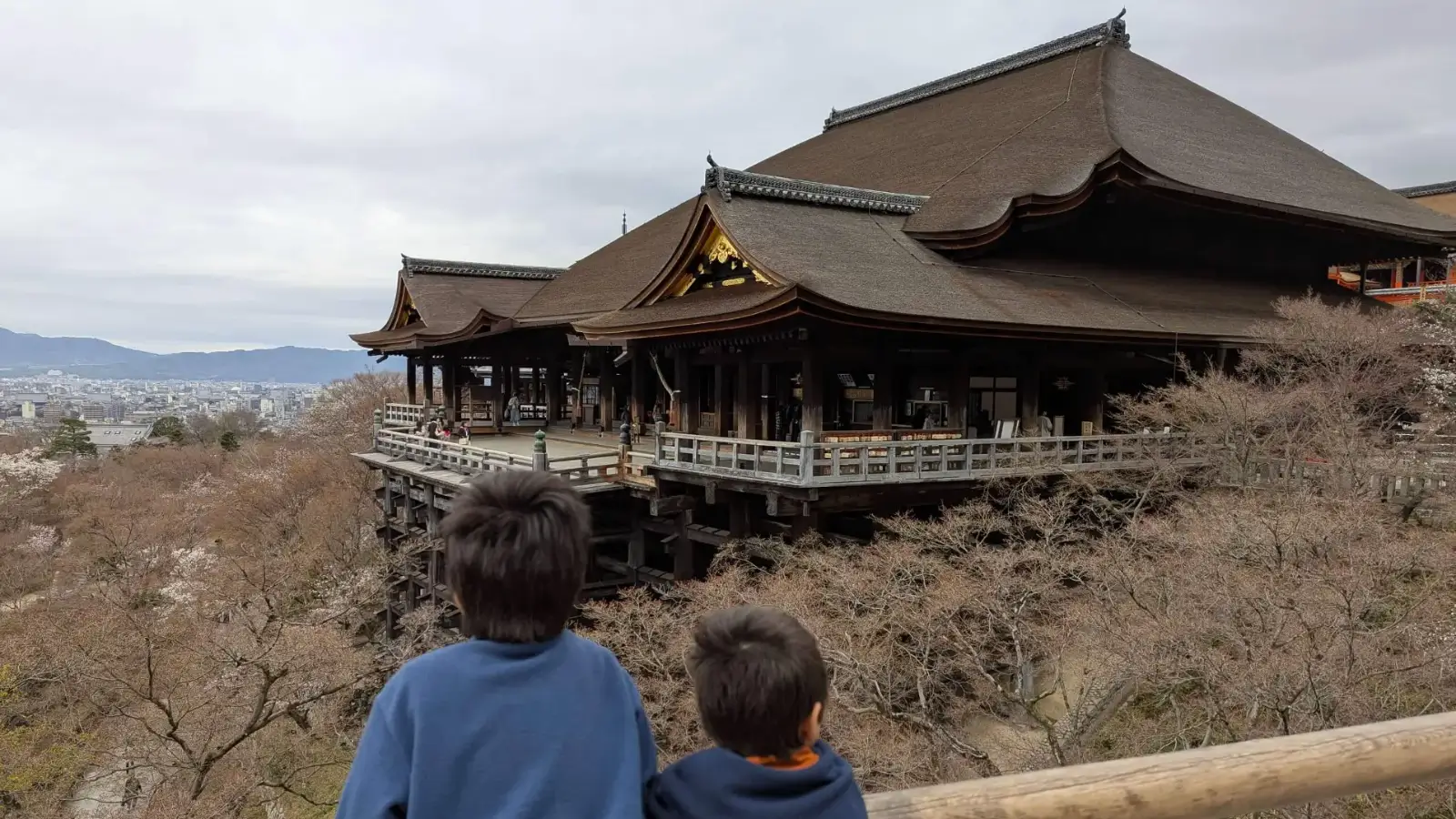
- Fushimi Inari and the Bamboo Forest
- How Many a Day
- Two to three, starting early
- Room to Move
- Monkey Park Iwatayama and teamLab Biovortex
Family activities and things to do across a city of temples and gardens, chosen for the child rather than for the guidebook.
Some links on this page are affiliate links. LuNi may earn a commission at no extra cost to you.
Kyoto with kids works best at two or three stops a day, since several are calmest early in the morning. The free ones, Fushimi Inari and the Arashiyama Bamboo Forest, are largely the calm route too. Fushimi Inari, Monkey Park Iwatayama and teamLab Biovortex give a restless child room; the Bamboo Forest, the Philosopher’s Path and the Kyoto Botanical Gardens are the quieter walks. When the weather turns, the Kyoto Railway Museum, the Nintendo Museum and teamLab are the strongest indoor stops, and the railway museum’s three floors are stroller-friendly. Every stop is mapped to the child it suits.
Which stop is for which child.
These stops are not ordered best to worst. They are grouped by which child each one is for, using The LUNI Framework, which tracks a third travel currency alongside money and time: each child’s Reserve, their finite capacity to absorb what a day of sightseeing asks of them. Kyoto matters here more than most cities, because the temple that calms one of your children is the climb that empties another. So instead of one list, you get four short ones, organized by how each child runs out of steam. The Dynamo runs short when they cannot move. The Sensor runs short on noise and crowds. The Anchor runs short when nothing is predictable. The Sprinter runs short on walking and standing. Find your child below, and start there.
For the Dynamo
Stops that relieve restricted-movement depletion.
For a child who depletes through restricted movement, the strongest stops are Fushimi Inari, Monkey Park Iwatayama, and teamLab Biovortex.
The vermilion torii corridor turns a shrine visit into sanctioned climbing: the repeating gates convert a high-energy child’s restlessness into forward momentum, which is the exact relief a movement-driven child needs from Kyoto’s otherwise still temple circuit. There is no point on the lower ascent where stillness is required, so the Reserve a Dynamo would burn standing in line is spent climbing instead. A younger Dynamo powers to the Yotsutsuji lookout and turns back; an older one takes the full loop to the 233-meter summit. Entry is free, which makes it the rare Dynamo stop that costs nothing.
Who it costs.The Sprinter, at high risk. The trail is uneven stone steps with sustained elevation gain, and a low-stamina child can empty their Reserve on the climb with the whole rest of the day still ahead.
How to make it work.Arrive before 8:00 a.m. to clear the tour-group compression on the lower corridor, and set the Yotsutsuji intersection, about 40 minutes up, as the firm turn-back point.
If this isn’t your child: still Kyoto’s most photographed walk, worth the lower loop at opening for the gates alone.A 20-minute uphill hike earns close-range time with roughly 120 free-roaming macaques at the summit, and for a Dynamo the climb is the point rather than an obstacle: restricted-movement depletion discharges on the ascent, so the child arrives at the top regulated enough to actually watch the animals. Feeding portions through the mesh of the observation hut inverts the usual zoo format, which reads as genuinely new to children who have done standard enclosures. It sits on the Arashiyama side of the city, so a Dynamo family can pair it with the riverfront and the covered lanes of the Kimono Forest around Arashiyama Station without adding a transit leg.
Who it costs.The Sprinter, at high risk. The 100-meter climb has no shortcut and no vehicle option, so a child near their stamina ceiling cannot reach the summit the stop is built around.
How to make it work.Go early in the day while a Dynamo’s energy is highest, and treat the ascent as the discharge stop, not a warm-up to another walking site.
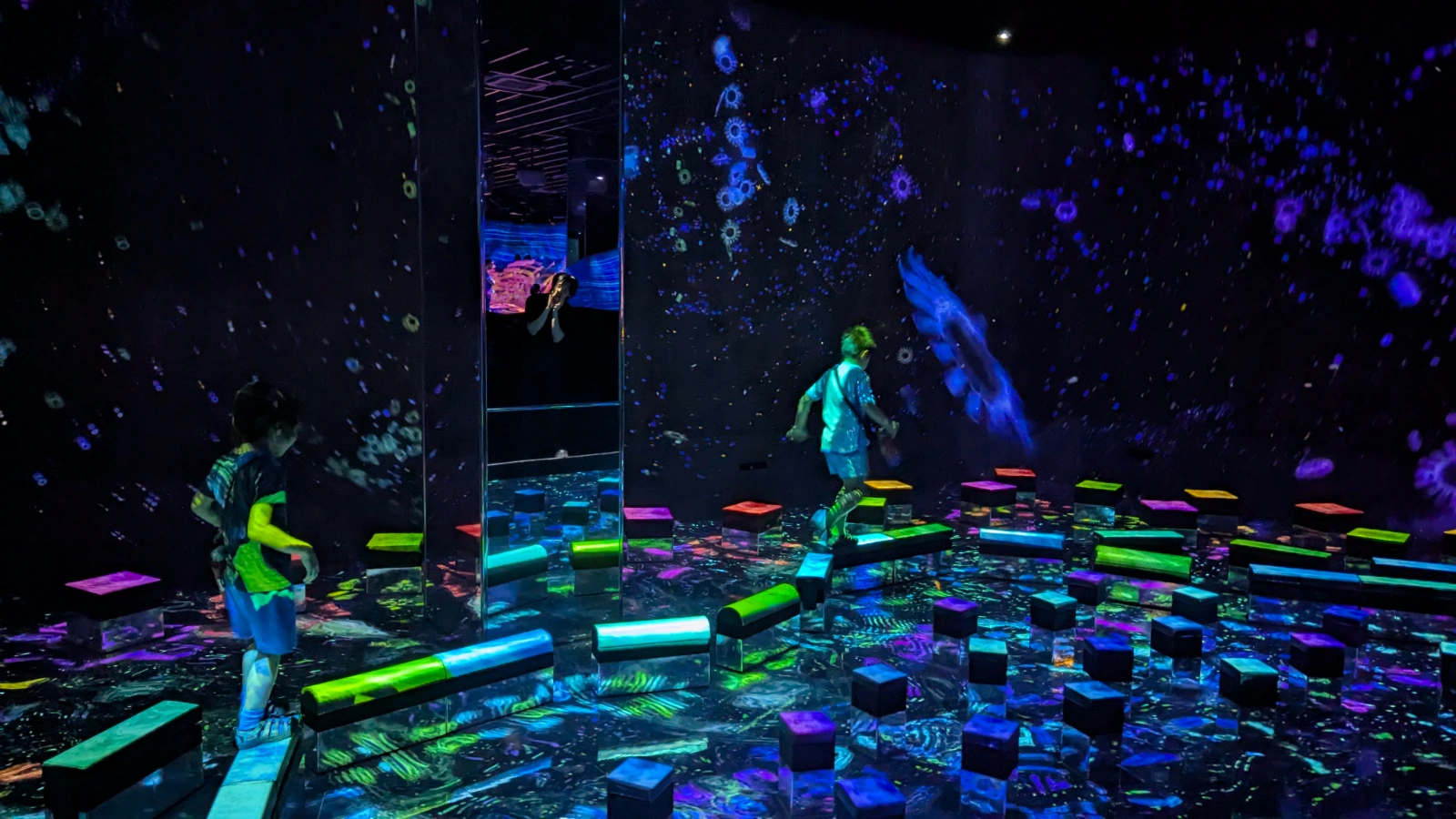
If this isn’t your child: the macaque encounter is memorable for any family that can manage the hike, but the hike is non-negotiable.Kyoto’s teamLab installation is a walk-through digital environment the child moves through and changes by moving, which gives a Dynamo continuous large-motor engagement with no queue lines and no look-don’t-touch rope. Movement is the medium, so the restricted-movement depletion that builds on a temple day never gets a chance to accumulate. A younger Dynamo chases the projections room to room; an older one works out how their motion drives the response. On a rain day, the same movement need is met indoors by the active-play floors at Round One.
Who it costs.The Sensor, at high risk. The mirrored rooms, shifting light, and continuous projection concentrate visual and spatial input with no low-stimulation corner to retreat to mid-visit.
How to make it work.Book a timed entry off-peak and keep the visit to a single loop, so the Dynamo gets the discharge before a sensory-sensitive sibling reaches threshold.
If this isn’t your child: a striking hour for most families, but a sensory-sensitive child should sit this one out rather than push through it.For the Sensor
Stops that let a sensory-loaded child recover.
For a child who depletes through sensory input, the strongest stops are the Arashiyama Bamboo Forest, the Philosopher’s Path, and the Kyoto Botanical Gardens.
The forest is one of the few Kyoto stops where the environment does the work: 15-meter stalks, a soft low-rumble when wind moves through, and a flat, wide path with nothing to decode. For a Sensor child that is a rare piece of Kyoto where input drops rather than climbs, and the shade canopy takes heat load off a warm day. It runs straight into the Tenryu-ji temple grounds, so the calm can extend without re-entering a transport corridor. A younger Sensor walks a short stretch and turns back; an older one takes the full path at their own pace.
Who it costs.The Dynamo, at high risk. It is a look-don’t-touch corridor with no side routes and no scale to convert movement into engagement, so a movement-driven child empties fast here.
How to make it work.Arrive before 7:00 a.m.: at that hour the path is a genuine recovery stop, and by mid-morning the crowd turns it into the opposite.
If this isn’t your child: still worth the early walk for the scene, though a Dynamo needs a discharge stop chained to it.A two-kilometer canal walk through a quiet residential neighborhood, with koi and turtles in the water and little commercial noise outside blossom season. For a Sensor child it is a low-demand interval that gives the eyes something to settle on without asking them to process a crowd at the same time, the ideal reset after one or two higher-stimulation stops. It threads past Ginkaku-ji at the north end and the Nanzen-ji grounds toward the south, so the walk carries its own gentle landmarks. A younger Sensor watches for fish along a single section; an older one walks the length. In the cooler months the same recovery role is served further north by the streamside approach to Kifune Shrine.
Who it costs.The Dynamo, mildly. The unstructured pace and low stimulation are exactly what leave a movement-driven child under-engaged, so it works as a transition rather than a headline for them.
How to make it work.Enter near the Ginkaku-ji end and let the family set the length: the multiple access points mean you can close the walk anywhere without an unfinished feeling.
If this isn’t your child: a pretty, low-effort stroll that suits almost any family as a between-stops breather.Around 3,000 square meters of open lawn with no prescribed path, a climate-controlled conservatory, and a playground on the north end. For a Sensor child the value is the absence of required direction: movement is entirely family-paced, the lawn creates real distance from other visitors, and the conservatory is a quiet, temperature-steady fallback when the outdoors gets too variable. Umekoji Park, the large open lawn beside Kyoto Station, serves the same open-space recovery role at the southern end of the city, a useful second option on a day anchored down there. A younger Sensor decompresses on the grass; an older one takes the conservatory circuit.
Who it costs.The Dynamo, mildly. There is genuine room to run, but the gardens will not hold a movement-driven child for the full suggested visit, so they suit a midday interval rather than a headline stop.
How to make it work.Place it after two or three higher-stimulation stops rather than first, so it lands as the decompression interval it does best.
If this isn’t your child: a calm, low-cost green break that pairs well with a picnic for any family.For the Anchor
Stops with confirmed, predictable structure.
For a child who depletes through unfamiliarity and unconfirmed structure, the strongest stops are the Kyoto Railway Museum, the Nintendo Museum, and Nijo Castle.
The best museum in Kyoto for kids, and a near-perfect Anchor stop: 54 real train cars, a hands-on driving simulator, and Japan’s largest railway model diorama across three stroller-friendly floors, with an internal sequence a structure-reliant child can track from the entrance. The timed diorama show gives the visit a predictable, calendared event to anchor to, and the floor layout moves logically from the locomotive plaza to the interactive exhibits to the play area. It shares a block with the Kyoto Aquarium, so an Anchor family can chain two structured indoor visits without improvising. A younger Anchor settles into the play area; an older one works the simulator.
Who it costs.The Sensor, mildly. The simulator queue and upper floors concentrate crowd noise at weekend peak, though the ground-floor play area runs independently as a decompression valve.
How to make it work.Visit on a weekday and buy the driving-simulator ticket ahead of the visit, since sales open online the evening before and popular slots fill fast.
If this isn’t your child: a reliable rainy-day, half- or full-day stop that works for nearly any family with young children.The Nintendo Museum runs on timed, pre-booked entry and a defined route, which is precisely the confirmed structure an Anchor needs, and it arrives pre-loaded with familiarity: a child who knows the characters walks in already oriented rather than reading a new place cold. The sequence can be confirmed in advance and little about it improvises. The same booked-structure comfort is available on a smaller scale at the Kyoto International Manga Museum and the hands-on Samurai Ninja Museum downtown. A younger Anchor recognizes the characters on sight; an older one navigates a place they effectively already know.
Who it costs.The Sprinter, mildly. The structured route covers real indoor distance across the site, which a low-stamina child feels by the end.
How to make it work.Book the timed ticket the moment your dates are set, because entry is capped and gated, and a confirmed slot is what gives the Anchor the certainty the stop trades on.
If this isn’t your child: a high-demand ticket worth planning around for any family with a Nintendo fan, gated or not.Nijo Castle gives an Anchor a single-direction, non-branching route: the Ninomaru Palace corridor moves one way from entrance to exit, the nightingale floors chirp underfoot as a built-in discovery sequence, and the garden circuit closes the visit on a predictable loop. The whole visit has an order a structure-reliant child can anticipate. It sits within reach of the open grounds of Kyoto Gyoen and Heian Shrine, either of which extends the day on the same low-improvisation footing, and it pairs naturally with the single-loop calm of Kinkaku-ji’s Golden Pavilion across the northwest of the city. A younger Anchor is reassured by the one-way route; an older one anticipates the nightingale floor and the garden.
Who it costs.The Sprinter, at caution. The compound is larger than its map suggests, and the distance from palace to garden circuit can deplete a low-stamina child before the garden, where the visit pays off.
How to make it work.Brief an Anchor child on the shoe-removal transition at the palace entrance before arrival, and enter from the east gate to shorten the approach and save the garden for the end.
If this isn’t your child: a genuinely engaging castle for most families, with the nightingale floor as the moment children remember.For the Sprinter
Short, low-stamina stops with little walking.
For a child who depletes through sustained walking and standing, the strongest stops are the Hozugawa River Boat Ride, Nishiki Market, and Gion Corner.
A 16-kilometer downstream float through a mountain gorge on a wooden riverboat, fully seated for the whole run. For a Sprinter this is the ideal stop: there is nothing to walk, climb, or sustain, the scenery advances on its own, and the child engages with the gorge without spending a unit of the stamina the rest of the day needs. The scenic Sagano railway makes the natural paired outbound ride, up the gorge to Kameoka, so the way out and the float back are both seated. A younger Sprinter watches the boatmen work the poles; an older one takes in the cliff walls and riparian forest.
Who it costs.The Dynamo, at high risk. Two hours of enforced seated stillness with no early exit is the single worst structure for a movement-driven child, who has no outlet for the whole run.
How to make it work.Book ahead on weekends and during blossom and foliage season, typically two to four weeks out, since the boats fill and there is no walk-up recovery. Check height before booking: no one under about 80 cm tall boards, even held in a parent’s arms.
If this isn’t your child: a distinctive two hours for families who handle stillness, and a poor fit for those who need to keep moving.A 400-meter covered arcade with a clear start and end, flat underfoot the whole way, and vendors selling child-sized portions of takoyaki, rolled tamago, mochi, karaage, and matcha sweets. For a Sprinter it asks almost nothing of the legs and gives the visit a move-sample-move rhythm that carries a low-stamina child along without a sustained walk or a standing queue. It sits a short, level distance from Kyoto Station’s own low-effort landmarks: the Daikaidan Great Staircase light display inside the station and the observation deck of Nidec Kyoto Tower opposite, both reachable with minimal walking. A younger Sprinter grazes a few stalls; an older one works the length at their own pace.
Who it costs.The Sensor, at high risk. The enclosed corridor concentrates cooking smells, vendor noise, and crowd density with no side exits, and off-peak timing eases the crowd but not the olfactory load.
How to make it work.Go before 10:30 a.m. or after 3:00 p.m. so the corridor is walkable, and let a selective eater set the pace, since there is almost always something accessible along its length.
If this isn’t your child: a lively food walk for most families, best taken off-peak and skipped by a sensory-sensitive child.Gion Corner condenses several traditional arts into one seated, roughly hour-long stage program, which for a Sprinter is the rare cultural stop that costs no stamina: the child sits, the performance comes to them, and the Reserve stays intact for the rest of the day. It also opens the door to the Gion district’s landmark cluster without a demanding walk, letting a low-stamina family take in the Yasaka Pagoda at Hokan-ji, Yasaka Shrine, and the Kodai-ji grounds in short, self-limited stretches, with the Kiyomizu-dera approach streets, the rock garden at Ryoan-ji, and the five-story pagoda at To-ji available as separate low-effort pairings on other days. A younger Sprinter watches the dance segments; an older one follows the full program.
Who it costs.The Dynamo, at caution. A seated hour offers a movement-driven child no outlet, so it pairs best with a discharge stop rather than another still one.
How to make it work.Take the evening program as the day’s seated anchor, then keep the surrounding Gion landmarks to short, optional strolls a Sprinter can start and stop at will.
If this isn’t your child: an efficient cultural sampler for any family, and a genuine gift to one that tires quickly on foot.Open with the child who runs short first.
The order of a Kyoto day is set by Reserve, not by the map. Each route opens with the stop that protects the named child, then chains to the nearest compatible one.
Settle these first. The Nintendo Museum and the Hozugawa boat are booking-gated: lock their slots before anything else, because a gated stop controls the shape of the day more than the route does. Fushimi Inari and the Bamboo Forest reward a pre-8:00 a.m. arrival. Everything else is walk-up fill-in arranged around those fixed points.
When to go, and what costs nothing.
Early morning is the widest window in Kyoto: the two stops most sensitive to crowds, Fushimi Inari and the Bamboo Forest, are calmest before 8:00 a.m. and change character entirely by mid-morning. Two to three stops is the realistic daily ceiling with children under 10, because the terrain asks for more walking than a map suggests. The free stops carry real weight here: Fushimi Inari, the Bamboo Forest, and the Philosopher’s Path all cost nothing to enter and Nishiki Market is free to walk, and they are also among the stops that protect a child’s Reserve best, so the free route and the calm route are largely the same route.
Three bases that fit a family’s Reserve.
A shortlist chosen for location logic, not price tier. The full set is in the complete Kyoto family hotel guide.
| Property | The LuNi Reason | Budget |
|---|---|---|
| LUNI Pick The Ritz-Carlton Kyoto Riverside, central | A riverside base on the Kamogawa, steps from the Gion landmark cluster and a short flat walk from Nishiki, so a low-stamina child reaches the calm cultural stops without a long approach. The quiet setting protects a sensory-sensitive child’s evening reserve after a full day out. | ¥¥¥ |
| MIMARU Kyoto Station Walk to Kyoto Station | Apartment-style family rooms by the station that hold an Anchor’s routine across a multi-night trip, with the Railway Museum, aquarium, and open station-side green space a short walk away and every rail line out of the city on the doorstep. | ¥¥ |
| Hotel The Celestine Kyoto Gion In Gion | A calm, refined base inside Gion itself, which puts the seated evening program and the district’s pagoda-and-shrine landmarks within a short, self-limited stroll, ideal for a Sprinter route that keeps walking in small stretches. | ¥¥ |
Budget: ¥¥¥
Budget: ¥¥
Hotel The Celestine Kyoto Gion
Budget: ¥¥
For every family-friendly option in the city, see the full Kyoto family hotel guide.