Kinkaku-ji with Kids: the pavilion first, the stairs after.
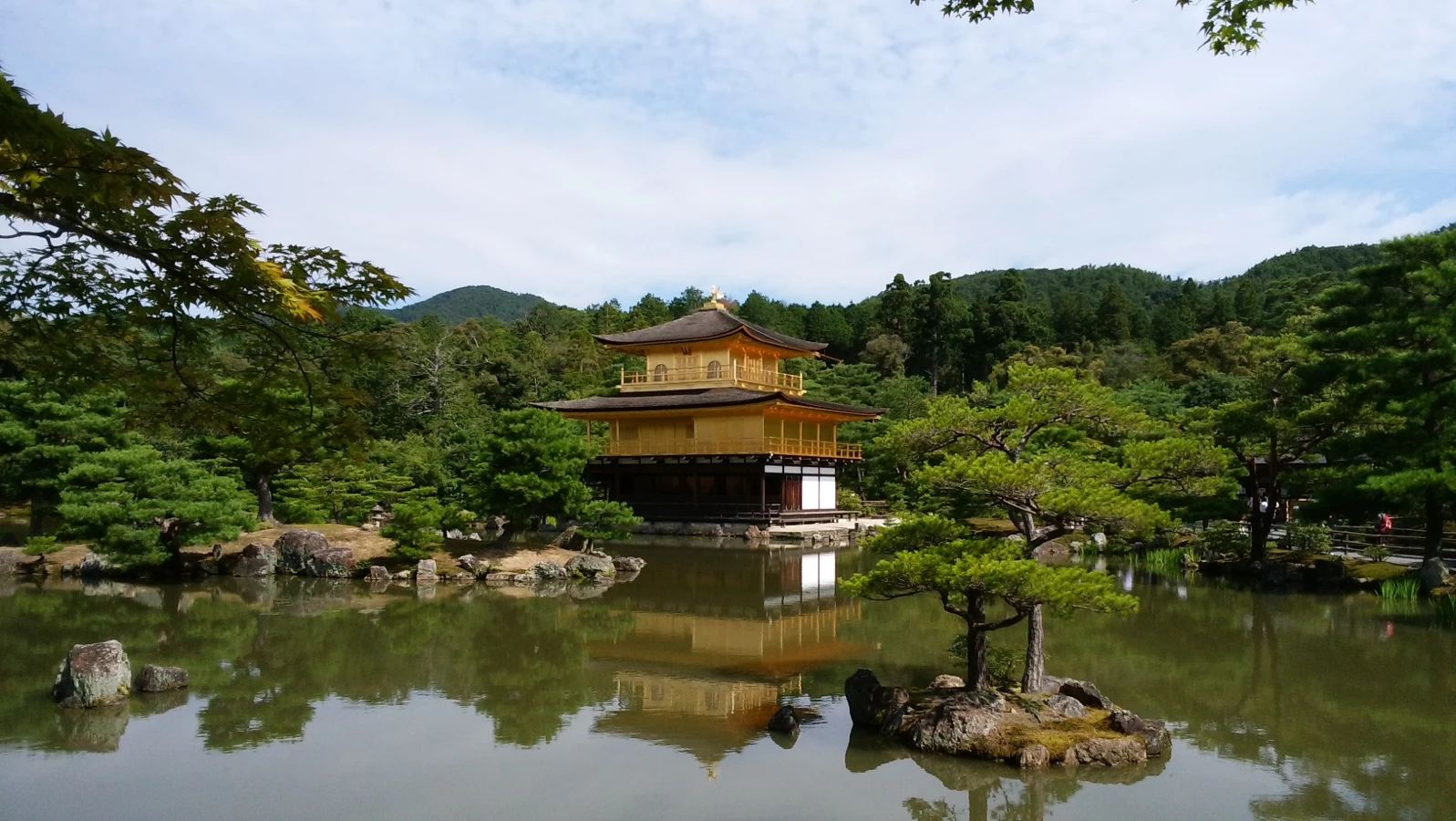
The pavilion is reached without any large steps, and that is the easy half: past it the garden climbs by stairs, and a stroller turns back the way it came.
Fees can differ during special viewings; entry cannot be booked ahead.
Open all year; times can shift during special viewings.
The pavilion comes first, the rest of the garden after.
A walking child finishes the garden; strollers turn back before the stairs.
No large steps up to the Golden Pavilion; stairs follow, so strollers turn back and leave by the entrance.
Some links on this page are affiliate links. LuNi may earn a commission at no extra cost to you.
Is Kinkaku-ji worth it with kids?
The short version, before the costs, the timings and the case for each child.
Yes, for the view, and with the right expectations. Kinkaku-ji is one golden building in a garden, and a child meets it early in the visit, which is the best argument for bringing children: the reward arrives before anyone is tired. The condition is how the smallest child travels. Past the pavilion the path goes up by stairs, and anyone with a stroller is asked to turn back before them, so a family that arrives with a carrier finishes the garden and a family with a stroller does not. The rest is easy to plan for: travel light, eat before the gate, leave early, and take the subway-and-bus route the city recommends for spreading the crowds.
Planning Your Visit to Kinkaku-ji with Kids.
The visit itself is simple; the decisions around it are where a family wins or loses the morning. Start with the route. Several buses run to Kinkakuji-michi, but the city steers visitors onto the subway to Kitaoji and a bus from the terminal there, about a quarter of an hour each, to spread the crowds, and a family gains from doing the same. Then decide how a small child will move. A stroller reaches the pavilion but not the garden beyond it, so a carrier finishes the walk and a stroller does not. Finally, bags and food: the temple has no lockers and nowhere in the garden to eat a packed lunch, so travel light and eat first. Our three-day Kyoto itinerary shows where the temple sits in the week.
Every LuNi attraction guide starts with a visit, with our own children
LuNi rates and writes about attractions only after visiting them with children. Luca and Nico were at Kinkaku-ji, and what they did there is recorded further down this page, including how each child actually met it.
Children arrive with different tolerances: for noise, for lines, for standing still, for being on their feet all day. A guide written for the average of them helps almost nobody. So every place on this site is read four ways, and each verdict says which children it already suits and what makes it work for the rest. Whoever you are bringing, the answer here is built for your family rather than for a general reader.
Restricted-movement depletion builds in a garden made for looking at one building, so give the child a task on the walk and open ground straight after.
Sensory-input depletion runs highest at the one view every visit points toward, so take the city’s crowd-spreading route and keep that stop brief.
Unfamiliarity and unconfirmed structure ease when the whole visit can be told in advance, so name the pavilion, the stairs past it and the exit.
Sustained walking and standing come from the journey and the stairs past the pavilion, so ride the subway leg and carry a small child through.
Hotels we would book for this visit.
Three hotels for a morning at Kinkaku-ji: one with an outdoor pool for the afternoon after a quiet garden, and two central hotels near Nijo Castle for a family giving the temple one morning of a longer week.
| Property | The LuNi Reason |
|---|---|
| LUNI Pick Roku Kyoto, LXR Hotels & Resorts Kita Ward; about 15 minutes’ walk from Kinkakuji-michi | An outdoor pool is the point of it on a Kinkaku-ji day: after a morning of walking quietly through a garden, an afternoon in the water. Under-4s are not admitted; children 4 to 15 use it with a parent from 9:00 to 18:00, and weekends are booked ahead, so reserve before the trip. |
| Hotel The Mitsui Kyoto Nijojo-mae Station exit 2, 3 minutes’ walk | Three minutes from Nijojo-mae Station on the Tozai Line, for a family that wants a central Kyoto base rather than a stay out by the temple. It suits a week in which Kinkaku-ji is one morning among several, each reached from the same front door without changing hotels. |
| Kaya Kyoto Nijo Castle By Nijo Castle, central Kyoto | In the same central area near Nijo Castle, for a family that makes the temple one morning in a longer stay and wants its base by the castle rather than out by the temple. Plan the trip out by subway and bus, the route the city recommends, and leave early. |
Roku Kyoto, LXR Hotels & Resorts
Nearby attractions, matched to your child.
Three pairings for what the garden leaves unmet: a child who needs open ground to cover afterward, a child who needs a seated afternoon and a stroller, and a child who wants a day fixed well in advance.
| Pairing | Why This Solves the After-Visit | For Your |
|---|---|---|
| LUNI Pick Nijo Castle Central Kyoto, walk-up entry | At Nijo Castle a child can cover real ground, about 850 meters from the East Otemon gate to the Honmaru Palace by the shortest route. Restricted-movement depletion from a quiet temple garden needs exactly that: somewhere large to cover on foot, with the palaces optional. | Dynamo |
| Kyoto Railway Museum Kyoto Station side: Umekoji-Kyotonishi Station | After a bus and a garden with stairs, the Kyoto Railway Museum offers free stroller loans while they last, and most of it is indoors. Sustained walking and standing ease when the afternoon can be ridden rather than walked, in a building that is step-free with some exceptions. | Sprinter |
| Nintendo Museum South of the city: Ogura, Uji | The Nintendo Museum is settled before the day: entry is by a named, timed ticket, offered first through a lottery and then first-come as places free up. Unfamiliarity and unconfirmed structure hardly get a start when the whole day, down to the entry time, is known before the family leaves home. | Anchor |
Nijo Castle
Central Kyoto, walk-up entry For YourDynamo
Kyoto Railway Museum
Kyoto Station side: Umekoji-Kyotonishi Station For YourSprinter
Nintendo Museum
South of the city: Ogura, Uji For YourAnchor
How two children actually met this attraction.
Two children stood at the same famous view and found different things in it. One of them barely looked at the building at all; he studied something else entirely and stayed at the edge until he was called away. The other found the one thing underfoot he could turn into a game and spent the visit testing it. Neither did what the postcards suggest, which is to stand, look and move on. That is worth knowing well before arriving, because it means the temple works on children through the small puzzles it offers, not through its fame. For the parent, the lesson is to leave room for the puzzle: a child who has found one stays calm far longer than a child who is being moved along.
Luca spent a long stretch at the main viewing edge looking not at the pavilion but at its reflection in the pond below. He worked out, aloud and to himself, that the reflected image looked sharper and more contained than the building above it, and he wanted to know why. He stayed at that edge longer than anywhere else on the walk, fixed on the water as the crowd moved around him, until told it was time to go.
This is the Sensor pattern, with an analytical hook. A child whose Reserve depletes through sensory input often withdraws from the crowd around a sight rather than from the sight itself, and Luca found one contained thing to study below the level of the crowd. Families with a similar child should look for that kind of small, bounded focus on arrival and point the child toward it, because one thing to study filters out a great deal of what is going on around it.
Nico found the gravel stretches of the path and set himself a task: could he walk the whole stretch without making a sound? He could not. He announced the failure to nobody in particular, tried the same section faster on the theory that speed would make it quieter, and reached the loud conclusion that gravel is “broken rocks that tell on you.” The path had given him something to test, and he spent his energy on it.
This is the Dynamo pattern. A child whose Reserve depletes through restricted movement will pour energy into whatever physical variable a quiet place still allows, and on a garden path Nico found his without anyone having to redirect him. Families with a similar child should look for the one physical thing a constrained route permits and let the child work at it, because a Dynamo with something to test spends far less than one who is simply asked to keep still.
A famous view can be the least interesting thing about a place to a child, and that is worth accepting rather than correcting. Children tend to meet a site like Kinkaku-ji through the small things it offers, a waterfall to find, a tea house to spot on the map, rather than through its fame. Letting a child follow those small puzzles teaches that looking closely is its own reward. A child who has found one detail to wonder about has had a truer visit than one hurried past the postcard.
The LUNI Rating for Kinkaku-ji.
One fact sits under all four verdicts: Kinkaku-ji is a single view that a family reaches early and then walks on from. That suits a child who needs to know the shape of the day. It is harder on a child who needs to move, who gets a garden to look at, and on a child who tires, who meets the stairs past the pavilion after a bus. The hardest reading is for the child most sensitive to input, at a sight the city itself routes crowds around. For a morning under a roof instead, Kyoto’s indoor activities sit on the other side of the ledger.
Keep the walk purposeful, and run afterward. The Dynamo depletes through restricted movement, and Kinkaku-ji is a garden laid out for walking and looking rather than for play. The route reaches the pavilion early, then continues past it through the garden, up stairs and on toward the exit, and a child is asked to treat a garden of about six hundred years with care the whole way. There is nowhere in the garden to eat a packed lunch. For a child who needs to move, that is a long stretch of holding back.
This one can be managed, because the pavilion comes at the start rather than the end, so the payoff is not held back as a reward for patience. Give this child a job on the way around: the waterfall and the tea house on the temple’s map make good targets to find. Then plan somewhere with room to run for straight afterward; the grounds of Nijo Castle are large enough to spend what the garden held in. Do not stack a second temple garden onto the same morning.
What this means for your Dynamo: restricted movement builds in a garden made for looking. A younger Dynamo needs a task on the walk and open ground straight after; an older one can manage the garden if the run comes next.Choose the route, then keep the view brief. The Sensor depletes through sensory input, and Kinkaku-ji concentrates it. The whole visit points at one building, so visitors converge on the same place for the same view, and the approach is busy enough that the city asks visitors to take the subway and a connecting bus to spread the crowds. The temple bans group photographs, video streaming and drones, and a child is surrounded by people doing the one thing everyone came to do: look at the pavilion.
Cut down everything around the view. Take the city’s recommended route, subway to Kitaoji and a bus from the terminal, rather than the direct bus from the station, and arrive near the 9:00 opening. At the viewing point, give the child one thing to look at and a set time, then move on. Past the pavilion the garden continues, and the child can put distance between themselves and the main view. If the child is struggling, the entrance is the way back out.
What this means for your Sensor: sensory input peaks at the one view everyone comes for. A younger Sensor needs a parent close and a short stop at the view; an older one can hold a time limit and move on without being told.Describe the whole route before the gate. The Anchor depletes through unfamiliarity and unconfirmed structure, and Kinkaku-ji can be described completely before the family sets out. The pavilion comes first, reached without any large steps, and the garden then continues past it, by stairs, toward the exit. The temple is open every day of the year from 9:00 to 17:00. Nothing about the visit has to be discovered on the day.
The one change a child may not expect is the stairs, and for a family with a stroller the route is different: stroller and wheelchair users are asked to turn back before the stairs and leave by the entrance. Say which version of the visit the family is doing before arriving, so a turnaround is the plan rather than a surprise. Name the waterfall and the tea house on the way, so the second half of the garden has landmarks of its own.
What this means for your Anchor: a visit that can be told in full leaves unfamiliarity little room. A younger Anchor needs the route named, gate, pavilion, stairs, exit; an older one can follow the temple’s map and lead the way.Ride seated, and carry rather than push. The Sprinter depletes through sustained travel-style walking and standing, and at Kinkaku-ji the cost is split between the journey and the garden. From Kyoto Station, the city’s recommended route is a subway ride of about fifteen minutes to Kitaoji and a bus of about the same from the terminal there; several buses also run direct to Kinkakuji-michi. Inside, the pavilion is reached without any large steps, but the garden past it climbs by stairs.
Spend as little of the child’s walking as possible before the gate, and bring the right equipment. Carry a small child through the garden: a stroller reaches the pavilion but must then turn back and leave by the entrance, and with no lockers at the temple it cannot be left and collected. The temple lends wheelchairs free, first come. Keep the rest of the morning short, so the stairs are the last effort rather than the middle of a long day on foot.
What this means for your Sprinter: the journey and the stairs carry most of the walking and standing. A younger Sprinter needs a carrier and a seated route in; an older one can walk the garden if the journey there was easy.The questions parents actually ask.
Kinkaku-ji is open every day of the year, so the planning is less about tickets than about what the garden does not offer. Elementary and junior high students pay a reduced fee, with no discount for groups. What catches families out is everything else: stairs past the pavilion that turn a stroller back, no lockers or luggage storage, and nowhere in the garden to eat a packed lunch. For the wider question of which Kyoto stop suits which child, and in what order, our Kyoto guide sets them side by side. At the temple itself, the carrier is the one thing to remember.
Is Kinkaku-ji worth visiting with kids?
Yes, for the view, which a child meets early in the visit. The garden walk past the Golden Pavilion climbs by stairs, and stroller and wheelchair users turn back before them and leave by the entrance, so a small child is best carried. There are no lockers and nowhere in the garden to eat a packed lunch, so travel light and eat before.
How much does Kinkaku-ji cost, and do kids pay?
Admission is 500 yen for adults and high school students and 300 yen for elementary and junior high students. Groups of 30 or more enter as a group, with no discount, and fees can differ during special viewings. A family of two adults and two elementary children pays 1,600 yen.
What are Kinkaku-ji’s opening hours?
Kinkaku-ji is open from 9:00 to 17:00 every day of the year, and times can differ during special viewings. The temple’s parking lot, for 250 cars, runs from 8:40 to 17:10 and charges 400 yen for the first hour. City Buses 12, 59, 205 and M1 stop at Kinkakuji-michi.
Is Kinkaku-ji stroller friendly?
Only as far as the pavilion. The path reaches right beside the building without any large steps, but past it there are stairs, and stroller and wheelchair users are asked to turn back before them and leave by the entrance. The garden has no barrier-free provision. Wheelchairs are lent free, first come, and there are multipurpose restrooms.
How do you get to Kinkaku-ji from Kyoto Station?
The city recommends the subway: the Karasuma Line to Kitaoji, about 15 minutes, then City Bus 25 or 205 from platform E of the Kitaoji Bus Terminal, about 15 minutes to Kinkakuji-michi. Bus 205 also runs direct from Kyoto Station, and buses 12, 59 and M1 stop at Kinkakuji-michi as well.
Can you take photos at Kinkaku-ji?
Snapshots on a small camera, for the family’s own enjoyment, yes. Filming for publication to anyone else, social media included, is refused, as is commercial filming, and group photographs, video streaming and drones are banned. Tell an older child before the visit that the pictures are for the family album, not for posting.
Can you eat or leave bags at Kinkaku-ji?
No to both. The temple has no luggage storage and no lockers, so carry belongings or use a station locker, and there is nowhere in the garden to eat a packed lunch. Eat before the gate or after the exit. Assistance dogs are allowed; small pets only fully inside a cage or carrier, never held in arms.
What is there to see past the pavilion?
The garden continues past the Golden Pavilion to a string of named stops on the temple’s map: Anmintaku, the Ryumon waterfall, the Sekkatei tea house and the Fudo hall, with shops and rest areas along the way. For a child, they turn the second half of the visit into a route with landmarks rather than a walk to the exit.
Where Kinkaku-ji fits your Japan trip.
Official site and opening information: Kinkaku-ji (Rokuon-ji)