Kobe with Kids the city that keeps everything close.
Most Japan cities spread a family thin across the map. Kobe is the rare one where harbor, mountain, and old foreign quarter sit close enough that a misread morning can be redirected, not endured.
Best transport and hotel choice. Harborland for waterfront families.
Two covers the city. Three adds Rokko and Arima Onsen.
Strong for under-fives and independent teens alike.
Mild and low-crowd. Summer is beach and indoor season.
Limousine bus to Sannomiya, no transfers. Or about 20 min by JR Special Rapid from Osaka to Sannomiya.
Some links on this page are affiliate links. LuNi may earn a commission at no extra cost to you.
Why Kobe works for families.
In most big Japanese cities a family pays a toll before it arrives anywhere: the route-solving, the exit-hunting, the stairs that appear at the wrong moment. The LUNI Framework tracks what that toll spends, the child’s Reserve, and Kobe’s argument is how little of it this city charges.
Kobe’s case rests on subtraction, and the geography does the subtracting: the fewer navigation decisions a day demands, the more of a child’s Reserve survives it. From a base near Sannomiya Station, a family reaches Harborland, Meriken Park, and Nankinmachi, Kobe’s Chinatown, on foot, the practical advantage that disappears the moment you enter Kyoto or Tokyo’s densest transit zones. The City Loop Bus tightens it further, linking Harborland, Kitano, Sannomiya, and the ropeway and cable-car access points in a single loop that needs no platform transfers or map reading.
The deeper advantage is self-containment. Every major attraction, Kobe Animal Kingdom, the Anpanman Children’s Museum, the Kobe Science Museum, is a closed environment that holds a half-day without re-navigating the city mid-visit, which removes the transit friction that breaks young children’s days. The city’s three vertical zones then give the day a natural shape: harbor-level for mornings, mid-city for afternoons, and Mount Rokko or Arima Onsen for full-day excursions. When humidity or rain ends an outdoor plan, the Mosaic and Umie complex at Harborland delivers weather backup and feeding in one waterfront structure. A depleting morning, in other words, does not have to become a lost afternoon. That is the case for Kobe, and it is a different case from the one Osaka or Kyoto makes.
Kobe’s real gift to parents is the overhead it removes. In Tokyo or Osaka, a large share of a family’s daily energy goes to transit decisions: which line, which exit, how long the walk, whether the stroller fits. In Kobe those decisions are simpler and less frequent, and families who arrive from Tokyo often describe it as the first city of the trip where they felt genuinely present rather than perpetually navigating.
A pacing lens, not a rating.
The LUNI Framework reads a city through how each child depletes, not through whether the city is “good.” Kobe suits all four profiles. What changes is how you sequence the day.
The Dynamo depletes through restricted movement. Kobe is unusually strong here for a geographic reason: Mount Rokko delivers the large-scale physical environment this profile rarely finds in urban Japan, with open air, elevation, running space, and a cable car whose gradient shifts noticeably at the halfway point, opening the harbor view in a single moment that holds a Dynamo’s attention through the ascent without demanding stillness. The Garden Terrace has the paved outdoor room to move freely while parents orient, and the winter Snow Park adds a genuine discharge zone.
The primary risk is the Kitano Ijinkan district, whose quiet, look-but-don’t-touch mansions a Dynamo will not survive past the second house without a prior release. The planning consequence is to reverse the standard sequence: run Rokko or the harbor in the morning and place Kitano in the afternoon, once the tank is drawn down. For a younger Dynamo the cable-car platform is the outlet; for an older one, Rokko’s summit trails turn the same need into a half-day.
The Sensor depletes through sensory input. Kobe offers something most Japanese cities do not: consistent geographic relief valves. When a Sensor reaches threshold in Nankinmachi or at a crowded Harborland event, Meriken Park sits a short walk away with open harbor views, low crowd density outside weekends, and no audio load beyond ambient waterfront sound.
The specific risk is Nankinmachi at its weekend peak, when street-food stalls, recorded music, and vendor calls compress into a narrow corridor and spend the family’s goodwill within fifteen minutes. The planning consequence is to time Chinatown for an early weekday morning during vendor setup, or after 5:30 p.m. once the crowd clears, and to hold the park as a mapped recovery point rather than a destination. The Nunobiki Ropeway to the Herb Garden is the reliable positive: an enclosed, quiet gondola and a structured, fragrant garden where a Sensor reports engagement rather than endurance. A younger Sensor recovers best with the park reset; an older one self-regulates inside the garden’s unhurried layout.
The Anchor depletes through unfamiliarity and unconfirmed structure. Kobe’s food infrastructure helps this child more than Osaka’s or Kyoto’s, because the Mosaic and Umie complex houses Japanese family-restaurant chains, curry counters, and ramen shops under one climate-controlled roof, so a reliable meal is rarely far from the primary attractions. The challenge is the city’s international character: Kitano, Nankinmachi, and Kobe’s European-influenced bakery culture expose an Anchor to food and environments that read as foreign in a way other Japanese cities do not. The planning consequence is to confirm the baseline meal is available at or near the hotel before building a day around Chinatown, and to lean on Sannomiya Station itself, where a convenience-store cluster and a Daiso sit inside the concourse, making every transit touchpoint a confirmed resupply stop. A younger Anchor settles when the day’s shape is named out loud before leaving; an older one regulates on the fixed landmark the station provides.
The Sprinter depletes through sustained walking and standing. Kobe’s compact geography is the single most important structural advantage for this profile: Sannomiya Station to Harborland is roughly two kilometers on a flat, paved waterfront path, and the City Loop Bus erases even that, so less of the day’s capacity is spent on transit and more is preserved for the activities that matter.
The risk is Mount Rokko misplanning. Families who reach the summit without knowing the walk from the cable-car exit to the Garden Terrace find moderate, uneven terrain, not a hiking trail but not a shopping mall either. The planning consequence is to confirm in advance that the summit activities cluster near the arrival point, the Music Box Museum and the Garden Terrace viewing deck are both a short flat walk away, and to treat the longer trails as optional. A younger Sprinter needs the stroller kept for the uneven stretch; an older one paces better when the hard walking lands in the morning, while energy is highest.
What the city works for.
A profile is a depletion mechanism, not an age. Kobe holds up across the span, but what it offers shifts as a child grows.
For a toddler, start at the harbor: walk Meriken Park and the Harborland promenade on a weekday morning, with the stroller along for a slow walker. The Anpanman Children’s Museum in Harborland is the primary toddler anchor: enclosed, themed, high-stimulation indoor space designed for under-fives, with feeding and nursing facilities on site. The one caution is the high ground: on a Mount Rokko or Nunobiki Falls day, a carrier earns its place in the bag.
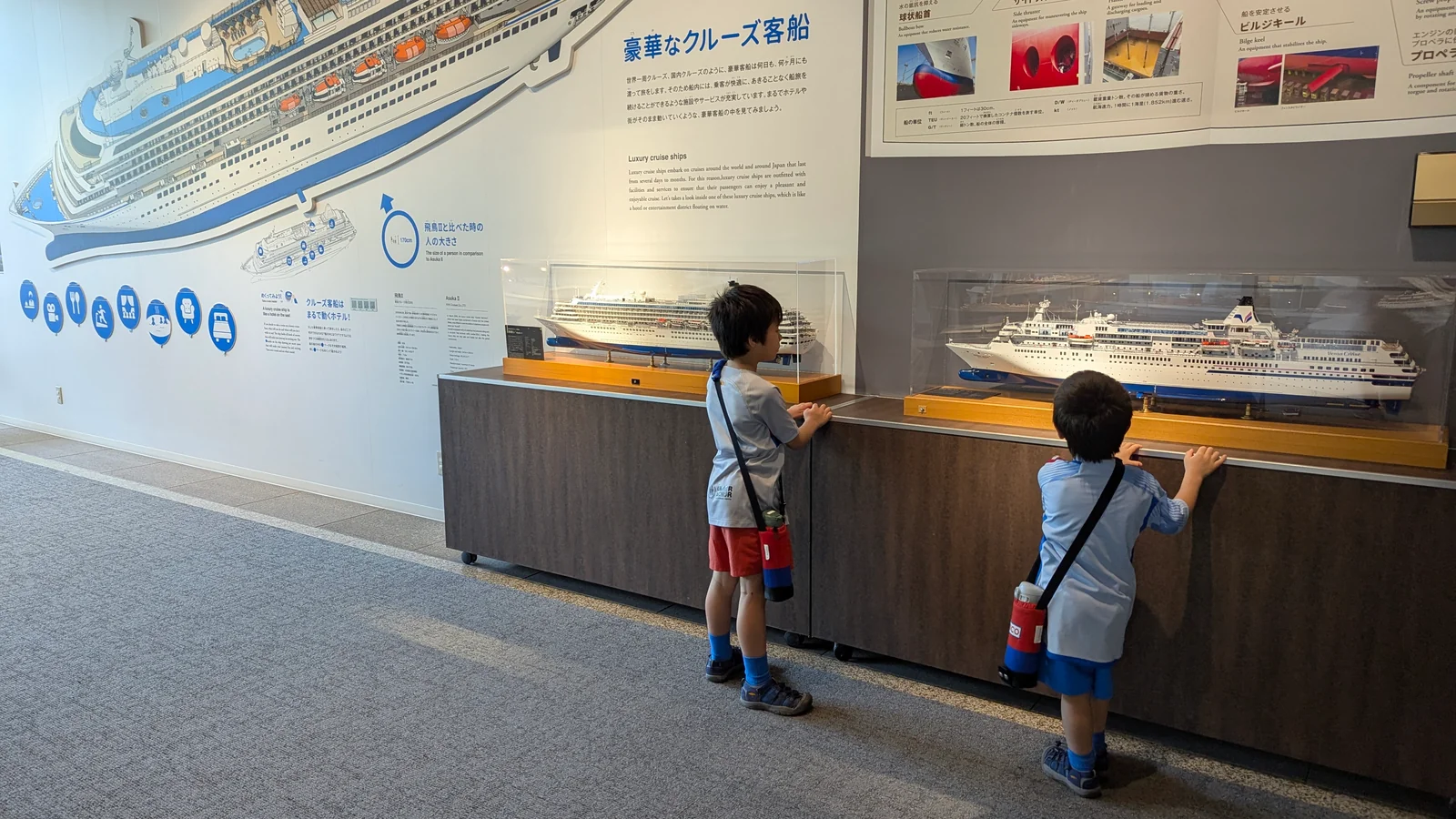
School-age children get the widest version of the city. Kobe Animal Kingdom delivers direct animal interaction across multiple stations, capybara feeding and bird shows among them, structured enough to hold attention but unpredictable enough to generate real excitement. The Kobe Maritime Museum at Meriken Park rewards curiosity with hands-on navigation exhibits that ask no reading stamina, and the Kitano Trick Art Museum, often overlooked in family guides, turns optical-illusion installations into a genuine participatory activity. Kitano is also where this age begins to register Kobe’s layered identity, the foreign mansions and language plaques, on their own terms.
Kobe is a stronger teen destination than its reputation suggests, because its food and subculture are accessible and specific rather than generic. Nankinmachi is a real street-food environment, not a theme-park version of one: a teen old enough to navigate a few blocks can move through the vendor stalls with spending money and return with something they found themselves. The Sannomiya Center Gai arcade connects to independent fashion, chain stores, and retro-game outlets, and Mount Rokko offers a credible outdoor challenge for teens who have exhausted the street-level options by day two.
When to go, by profile.
Autumn and spring carry the lowest Reserve cost for every profile. Summer is a profile-specific choice, not a default.
The strongest windows for families are mid-October through mid-November and the first three weeks of April. Both combine manageable temperatures, low humidity, and Kobe’s best visual conditions without the crowd spikes of Golden Week or the peak cherry-blossom window. Autumn is especially valuable for Sensor and Sprinter children, who feel heat as the first threat to their daily capacity: it delivers Mount Rokko’s foliage at its best and Arima Onsen at its most atmospheric without the summer penalty on walking distances.
Summer is a deliberate choice. July and August bring humidity that shortens a Sprinter’s outdoor capacity and raises the sensory load for a Sensor, so the Suma beaches become the asset and the rest of the itinerary needs substantial indoor backup, which Kobe Animal Kingdom, the Anpanman Museum, and the Harborland complex all supply as heat retreats. Winter carries the Kobe Luminarie, whose harbor illuminations hold children’s attention in a way generic holiday lights do not, though peak evenings draw crowds that a Sensor family should pre-empt by arriving before 5:30 p.m. Golden Week itself demands caution: Kobe Animal Kingdom and the Anpanman Museum run at or near capacity and turn away families without advance timed tickets.
| Season | What It Is Good For | Watch For |
|---|---|---|
| AprilThe spring window | Mild, low humidity, cherry blossom. Suits every profile. | Golden Week crowds from late April. Pre-book the major attractions. |
| Jul–AugBeach and indoor season | Suma beaches, plus Animal Kingdom and Harborland as heat retreats. | Humidity shortens the Sprinter; Nankinmachi’s sensory load peaks. |
| Oct–NovThe strongest window | Rokko foliage, Arima Onsen atmospheric, low crowds. | Cooler summit evenings. Pack a light layer for Mount Rokko. |
April
The spring windowJul–Aug
Beach and indoor seasonOct–Nov
The strongest windowThe questions parents actually ask.
Is Kobe worth visiting with kids?
Yes. Kobe is significantly less crowded and more compact than Osaka, which makes it structurally easier for families with young children or sensory-sensitive kids. Osaka delivers more variety and night-time energy; Kobe delivers breathing room, a navigable flat waterfront, and a self-contained activity density that suits two-to-three-day visits without the logistical overhead of a major city.
How many days do families need in Kobe?
Two full days cover the primary family attractions comfortably. A third day allows a half-day at Arima Onsen or a relaxed Mount Rokko itinerary without compressing the harbor and Kitano experiences. Families combining Kobe with Osaka or Kyoto most commonly allocate two nights, and the JR Special Rapid, about 20 minutes from Osaka to Sannomiya, makes a single day trip genuinely viable for the harbor alone.
Where should families stay in Kobe with kids?
Sannomiya and Kobe Harborland are the two most practical bases. Sannomiya is the city’s transit anchor, with the widest hotel selection and direct lines to Osaka, Kyoto, and Himeji, which makes it the strongest base for first-time families and for Kansai-wide trips. Harborland places families within walking distance of the Anpanman Children’s Museum, the Mosaic and Umie complex, and the waterfront, the highest attraction density in the city for families with toddlers. Kitano, the hillside district above Sannomiya, is the quiet third option: thinner boutique-tier inventory and an uphill walk from the station, traded for the lowest sensory baseline of any Kobe base. For specific properties, see the Kobe family hotels guide.
Is Kobe stroller-friendly?
Take the stroller for the harbor and Sannomiya days. For the Rokko summit or the Nunobiki Falls trail, both mountain outings, pack a carrier.
What is the best time to visit Kobe with kids?
Mid-October through mid-November and the first three weeks of April carry the lowest Reserve cost for every profile: mild temperatures, low humidity, and manageable crowds, without the spikes of Golden Week or cherry-blossom peak. Summer is the harder season, worth choosing mainly for the Suma beaches, and only with substantial indoor backup at Kobe Animal Kingdom, the Anpanman Museum, or Harborland.
What should families eat in Kobe with kids?
Akashiyaki, the local egg-based dumplings dipped in warm dashi, is the most child-compatible Kobe food: softer than standard takoyaki and served without heavy sauce. Kobe beef hamburg steak at mid-range teppanyaki restaurants gives families the Kobe beef experience in a format children actually eat. The Mosaic Mall food court provides reliable Japanese curry and ramen as fallback options.