Tennoji Zoo with Kids:
Tickets, Gates and Choosing Your Route.
Two gates at opposite ends of an eleven-hectare route give the Anchor a published circuit that can be confirmed before arrival, and hand the Sprinter a linear walk whose outbound leg is not the return.
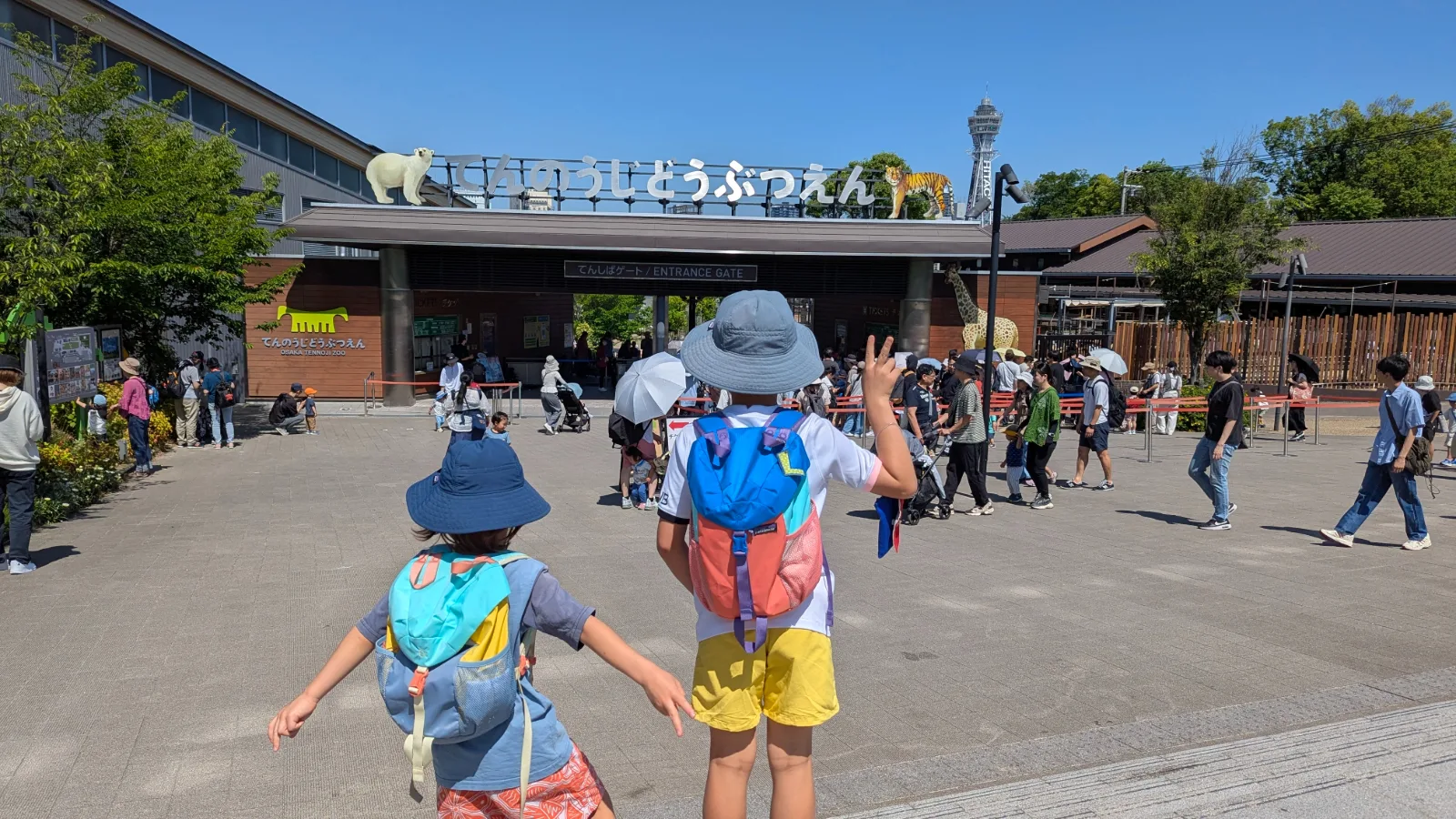
An open ground-level route keeps restricted-movement depletion discharging.
Low-light one-way interiors load the sensory threshold fast.
Published routes and feeding times confirm the day in advance.
A linear site and two gates stretch walking stamina.
Yes, Tennoji Zoo is worth visiting with kids, and it rewards the Dynamo and the Anchor without conditions. The Sensor and the Sprinter are the gated profiles, and one arrival decision clears both: enter at a single gate and run the zoo’s own published one-hour circuit, which leaves the low-light interiors and the full eleven-hectare walk optional rather than assumed.
Some links on this page are affiliate links. LuNi may earn a commission at no extra cost to you.
You have the days. Now the nights.
Where to stay in Osaka →The LUNI Rating for Tennoji Zoo.
LuNi’s opinions are framework-derived, not opinion-derived. Each verdict below is the result of applying The LUNI Framework to a single attraction, measuring it against the third currency every family spends but few track: the child’s reserve. The reasoning that follows is the case.
Bring the Dynamo here and let the route do the work. The Dynamo depletes through restricted movement, and Tennoji Zoo answers that with eleven hectares of ground-level, open-air path and a gate at each end, so the visit is a continuous walk rather than a queue held in place. There is no timed entry, no ride line, and no single bottleneck exhibit that stalls a movement-driven child while the family waits. What the site does impose is direction. The reptile house and the nocturnal house run one-way, and on Golden Week dates the zoo makes part of the main route one-way as well, so the busiest weeks are the ones where a child cannot loop back to the enclosure they liked.
The operational move is to enter at the gate furthest from where you plan to leave and walk the route once in a single direction, so movement stays continuous instead of doubling back over ground already spent. Then use the open lawn immediately outside the Tenshiba Gate as the release: a younger Dynamo gets the grass and, from mid-July to late September, the seasonal water play area, while an older one gets the PANZA activity course at Tenshiba i:na a few steps further on.
What this means for your Dynamo: A single-direction walk across open ground discharges restricted-movement depletion steadily, provided the release stop outside the gate is planned rather than improvised.Bring the Sensor, and decide the order of the day before you walk in. The Sensor depletes through sensory input, and this site holds two registers that generic guides read as one. The savanna and elephant sections are broad, bright and open. The reptile house and the nocturnal house are low-light, one-way, and carry the zoo’s own formal request for quiet, which means a child who wants out has to keep moving forward to get there. From August 2026 the marine zone adds underwater viewing at Polar Bear Coast, joined by design to the penguin and sea lion area, and glass-fronted viewing concentrates visitors in a way open paths do not.
The timing detail most families miss is that the keeper-led feeding sessions land at 11:30, 13:30 and 14:00, so the densest part of the route and the loudest part of the day arrive together. Sequencing solves it: take the open-air sections first and treat the dark interiors as a later, deliberate choice rather than something absorbed at the entrance. A younger Sensor is better served skipping the underwater viewing altogether on a weekend and coming back on a weekday. An older Sensor can run the zoo’s published rain-shelter route in reverse, using the reptile house as a quiet retreat on an empty weekday morning instead of a midday stop.
What this means for your Sensor: The sensory load here is sequenced rather than constant, so a weekday morning arrival and open-air-first routing keep input below threshold.You have the days. Now the nights.
Where to stay in Osaka →Few attractions in Osaka hand an Anchor this much structure before arrival. The Anchor depletes through unfamiliarity and unconfirmed structure, and Tennoji Zoo publishes the structure itself. There are four route options, including two one-hour circuits with named animals, one from each gate. There is a weekly feeding schedule listing the animal, the location, the day and the time. There are step-free directions written per station and per ticket gate. A child who arrives already knowing the shape of the visit is not spending reserve on working it out.
One piece of friction is worth naming, because it is the version of this attraction that costs an Anchor most: the weekday feeding sessions do not run on public holidays, and the raptor session has been suspended since December 2025. A schedule promised and then not delivered is worse than no schedule at all, so check the day-of listing before you make it a promise. A younger Anchor does best when the two daily Friendship Garden observation sessions are named as the fixed points of the visit. An older one can be handed the printed circuit and the feeding clock and allowed to run both, which converts an open-ended walk into a plan the child owns.
What this means for your Anchor: Confirm the route and the feeding schedule the morning of, and the unfamiliarity that normally drains this profile is resolved before the gate.Bring the Sprinter, and choose the short circuit deliberately rather than discovering it halfway. The Sprinter depletes through sustained travel-style walking and standing, and the honest shape of this site is linear, not circular. Eleven hectares with gates at opposite ends means the walk out is not the walk back, and the station approach adds five to ten minutes at each end before the circuit begins, or ten to fifteen on the step-free routes. The zoo publishes one-hour circuits precisely because the full route is long, which is the clearest signal available that the whole site is not the default visit.
Pick the circuit by gate, since the two show different animals: the Tenshiba side takes in the lions and the red pandas, the Shinsekai side the polar bears and the penguins. Choose the gate whose animals the child actually came for, and the shorter route stops feeling like a compromise. A younger Sprinter should be in a rented stroller from the gate rather than an hour in, when the decision is already late. An older one should have a seated stop planned at the Savanna Shop benches on the north side as a scheduled midpoint, not as a rescue after the wall arrives.
What this means for your Sprinter: One gate, one published one-hour circuit, and a seated midpoint keep the walking-and-standing load inside stamina instead of ending the day early.A zoo that publishes a one-hour route alongside a two-hour one has quietly given families permission to choose less, which is a permission most attractions withhold. A child who is shown the shorter circuit and told it was picked for them learns something more durable than the animals themselves: that their limits were read rather than overridden. Children who are trusted to have a ceiling tend to stop hiding it, and a ceiling a parent can see is one the family can plan around.
How two children actually met this attraction.
Here is what Tennoji Zoo looked like through the eyes of two children whose priorities had nothing to do with seeing a hundred and seventy species and everything to do with one bear that would not stop moving, one enclosure that seemed too small, and a statue nobody else stopped for.
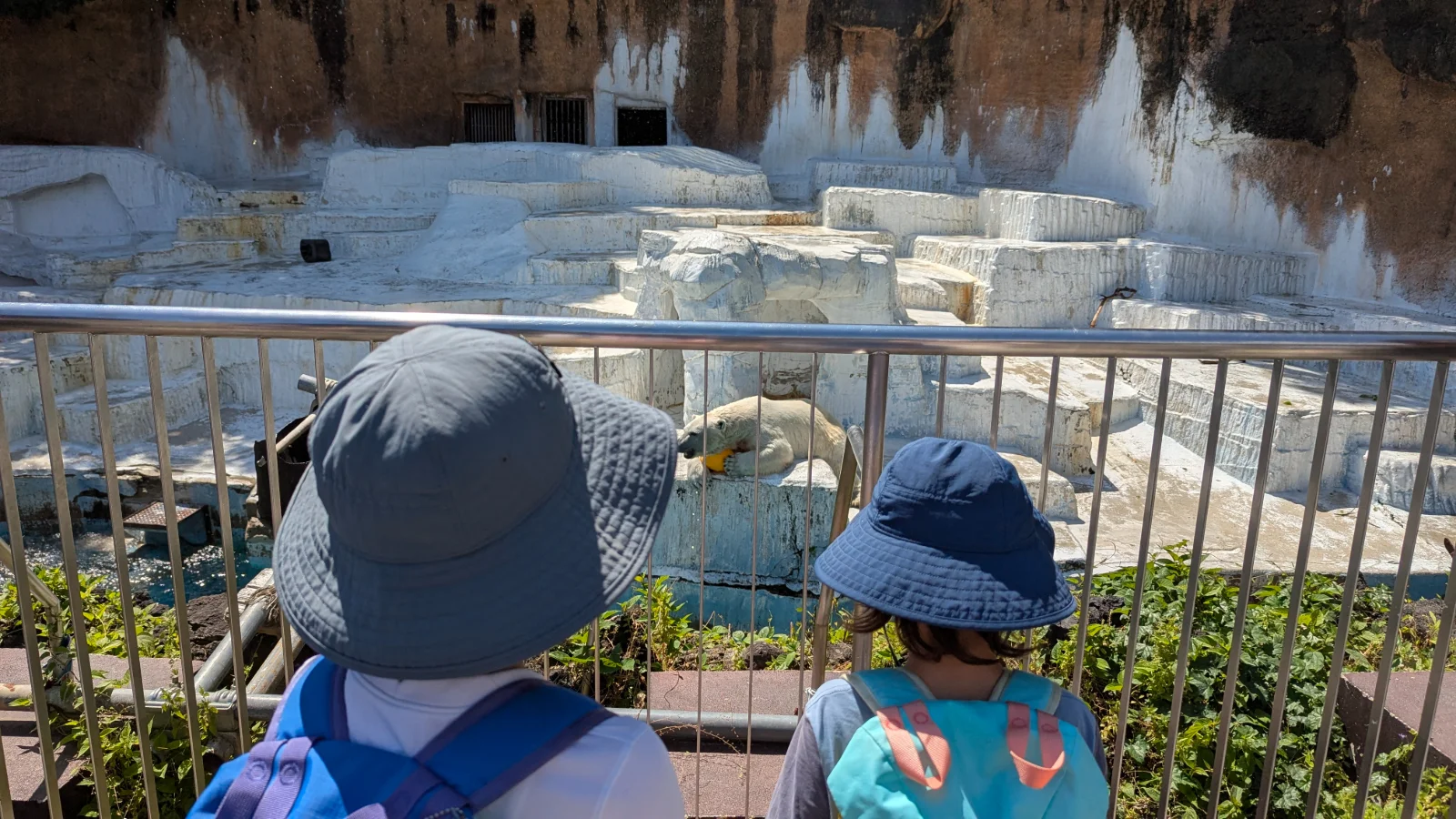
Luca arrived early enough to catch the polar bear at full tilt, running the length of the enclosure, pushing a yellow ball around and dropping in and out of the water, and he stayed with it. Later, when his brother objected that the wolves had too little space, Luca answered it with something he had read rather than something he felt, reporting that the wolves are able to run for roughly as long as a school day. He then found a statue of two monkeys and stopped to read it, coming back with the account that the animals had been used to entertain the public before and during the war. The signs held him as reliably as the enclosures did.
This is the Anchor pattern with an analytical hook. A child whose reserve depletes through unfamiliarity and unconfirmed structure settles fastest when a place can be explained, and Luca resolved both an unfamiliar enclosure and an unfamiliar statue by finding the information that made them make sense. Families with a similar child should treat this zoo’s published material as the lever: the route maps, the feeding schedule and the exhibit signage give an analytical Anchor something to confirm at every stop, which is what keeps the visit from feeling open-ended.
Nico locked onto the polar bear for the same reason and a different one: the bear was moving, and so he could be too, following it from one end of the enclosure to the other as it ran and dropped into the water. The wolf enclosure stopped him cold. He was upset by how little room they seemed to have, and would not be talked out of it until his brother produced the fact about how far they run. What held his attention across the visit was not which animal was rarest but which animal had space.
This is the Dynamo pattern, and it shows up in an unexpected place. A child whose reserve depletes through restricted movement reads restriction everywhere, including in the animals, which is why a small enclosure landed harder for Nico than any rare species did. Families with a similar child should route toward the open-yard exhibits, the savanna zone, the elephant area and the polar bear yards, and treat the compact enclosures as walk-past rather than stop-and-explain, because a Dynamo who is moving past confinement copes with it far better than one asked to stand and study it.
Planning Your Visit to Tennoji Zoo with Kids.
The verdict tells you whether to go. What follows is the operational intel a family needs to act on it: the visit at a glance, the profile-matched pairings worth knowing about nearby, the hotels we would book for this visit, and the questions parents most consistently ask.
Nearby attractions, matched to your child.
Three pairings selected for what each one solves after Tennoji Zoo, profile by profile. The reason matters more than the recommendation.
| Pairing | Why This Solves the After-Visit | For Your |
|---|---|---|
| LUNI Pick Tenshiba and Tenshiba i:na At the Tenshiba Gate | The zoo bounds movement with one-way interiors and a no-balls rule, so a movement-driven child leaves with energy still banked. The park’s open lawn sits directly outside the gate and costs nothing to enter, with a water play area through summer and the PANZA activity course for older children. It is the release stop the zoo route itself cannot provide. | Dynamo |
| Keitakuen Garden Inside Tennoji Park | A stroll garden inside the same park, which means decompression without another transit leg. After the crowd compression of the marine zone and the low-light interiors, a quiet, low-input space is what actually restores this profile rather than a second stimulating stop. Ten minutes here does more than an hour of anything louder. | Sensor |
| Harukas 300 Above Tennoji Station | A 300-meter observation deck reached by elevator, in the same Tennoji block as the Tenshiba Gate. For a child whose remaining stamina is the constraint, it is the rare high-return stop that spends almost no walking, which makes it the right way to close a day that already used its legs on the zoo circuit. | Sprinter |
Tenshiba and Tenshiba i:na
At the Tenshiba Gate For YourDynamo
Keitakuen Garden
Inside Tennoji Park For YourSensor
Harukas 300
Above Tennoji Station For YourSprinter
Hotels we would book for this visit.
Three properties chosen for the specific logistical advantage each delivers for Tennoji Zoo, not for general Osaka stays.
Tennoji Zoo sits inside Tennoji Park with a gate at each end of the site, served by two different station clusters: Shin-Imamiya and Dobutsuen-mae on the Shinsekai side, Tennoji and Osaka Abenobashi on the Tenshiba side. Where a family sleeps therefore decides which gate they use and which half of the route they see first, which is a bigger planning lever here than at a single-entrance attraction.
| Property | The LuNi Reason | Budget |
|---|---|---|
| LUNI Pick OMO7 Osaka by Hoshino Resorts Walking distance to the Shinsekai Gate | OMO7 removes the train from the zoo day. It stands in front of Shin-Imamiya Station and minutes from Dobutsuen-mae, the Shinsekai Gate’s own stations, so the family walks to the gate instead of riding. What it gives up is quiet, since the streets around Shinsekai are loud and bright on the walk back. | ¥¥ |
| Osaka Marriott Miyako Hotel In Abeno Harukas, above Tennoji Station | The reason to book here is the building. The hotel sits in the upper floors of Abeno Harukas, three minutes from JR Tennoji, and the Harukas 300 deck is in the same tower, so the day’s second stop costs an elevator rather than another walk. What it gives up is ground-level ease, since every exit runs through elevators and a concourse. | ¥¥¥ |
| Anda no Mori Osaka Tennoji Tower 3-minute walk from Tennoji Station | The discharge happens indoors here. A kids’ zone with a game corner, a zip line and board games is included in the rate, so a wet afternoon or a shortened circuit does not end a movement-driven child’s day. What it gives up is a calm evening, since an activity-led hotel is busy by design. | ¥¥ |
Budget: ¥¥
Budget: ¥¥¥
Anda no Mori Osaka Tennoji Tower
Budget: ¥¥
The questions parents actually ask.
Is Tennoji Zoo worth visiting with kids?
Yes, Tennoji Zoo is worth visiting with kids, and it rewards the Dynamo and the Anchor without conditions: an open ground-level route discharges restricted-movement depletion, and the zoo’s published circuits and feeding schedule confirm the day before arrival. The Sensor and the Sprinter are the gated profiles, taxed by the low-light one-way interiors and by an eleven-hectare linear site with gates at opposite ends. One decision clears both: enter at a single gate and run the published one-hour circuit rather than the full route.
How long do you need at Tennoji Zoo with kids?
Between one and two hours, and you do not have to guess, because the zoo publishes both a one-hour circuit and a two-hour circuit. The one-hour version differs by gate: lions and red pandas from the Tenshiba side, polar bears and penguins from the Shinsekai side. A Sprinter’s stamina, rather than the number of exhibits, is what sets the real ceiling, so choosing the shorter circuit at the gate is better than abandoning the longer one halfway.
What age is Tennoji Zoo best for?
Roughly 3 to 12 is the core range. Below 3 a child sees the animals but gets nothing from the route structure, and the walking is carried by an adult or a stroller either way. Above 12 the visit holds when there is something to run: the rare-species circuit covering animals held nowhere else in Japan, the native Japanese species route, or the feeding schedule with keeper commentary. Elephant Village and the underwater viewing at Polar Bear Coast also read as new rather than familiar to an older child.
Is Tennoji Zoo too crowded or too much walking for younger or sensitive children?
Both loads are real and both are manageable. The crowd load concentrates on weekends and public holidays, which the zoo names as its congestion days, and peaks around the 11:30, 13:30 and 14:00 feeding sessions. The walking load comes from an eleven-hectare linear site with gates at opposite ends, plus a five to fifteen minute station approach at each end. A weekday morning arrival, open-air sections before the dark interiors, and the published one-hour circuit from a single gate neutralize both for younger and older children alike.
Is Tennoji Zoo included in the Osaka Amazing Pass, and how much are tickets now?
Yes, Tennoji Zoo admission is included in full by the Osaka Amazing Pass; present the pass at either gate. Paying separately, adult entry is ¥800 as of 1 July 2026, up from ¥500, with elementary and junior high students from outside Osaka City at ¥200 and preschool children free. Most English-language sources, including parts of the zoo’s own English site, still show the old ¥500 figure, so budget for the current price.
Is Tennoji Zoo stroller-friendly, and what facilities are there for young children?
Strollers are welcome throughout and can be rented at both gate areas for a fee, and wheelchairs are loaned free at both gates on a first come, first served basis. There are four nursing rooms, coin lockers at both gates, free loaner umbrellas, a first-aid room and a free water refill point. The zoo also publishes step-free directions from each station to each gate, and a barrier-free route inside the grounds. Same-day re-entry is permitted if you tell the gate before leaving, which is the most useful fact here for a family pacing a young child.
How does Tennoji Zoo compare to Osaka Aquarium Kaiyukan for kids?
They solve different profiles. Tennoji Zoo suits the Dynamo, whose restricted-movement depletion is discharged by open outdoor paths and a single-direction route, and the Anchor, who gets published circuits and a fixed feeding schedule to confirm the day by. Kaiyukan is the stronger choice for the Sensor, since a climate-controlled indoor space is easier to pace than open-air crowd compression, and for the Sprinter, since its spiral removes the two-gate walking load. Choose the zoo for movement and open ground, the aquarium for containment and shelter.
Where Tennoji Zoo fits your Japan trip.
Tennoji Zoo rewards the Dynamo and the Anchor without conditions, and the Sensor and the Sprinter with a single shared discipline: enter at one gate, take the published one-hour circuit, and put the open-air sections ahead of the low-light interiors.