Hakone With Kids:which stop is for which child.
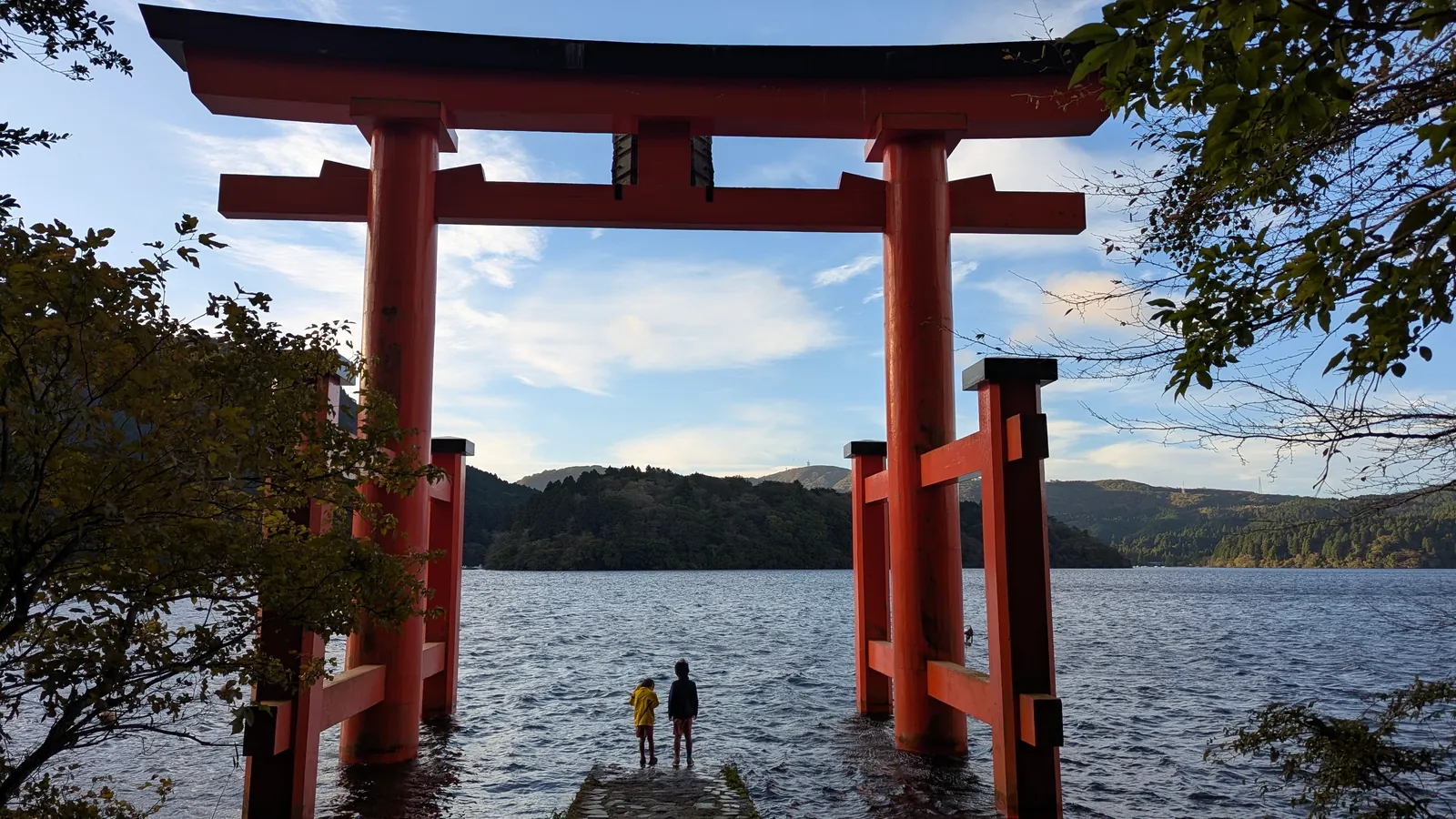
- The One to Start With
- Hakone Open-Air Museum, by its own station
- The Pass to Buy
- Hakone Freepass, two or three days
- Over the Valley
- Hakone Ropeway, a gondola about every minute
- Across the Lake
- The pirate-ship cruise on Lake Ashi
- Plan Around
- Owakudani’s guided trail takes no preschoolers
Hakone with kids works as one loop of rides: the Hakone Tozan Railway up from Hakone-Yumoto, the cable car to Sounzan, the Hakone Ropeway over Owakudani to Togendai, and the pirate-ship cruise across Lake Ashi, all covered by the Hakone Freepass. The Hakone Open-Air Museum, 2 minutes on foot from its own station on the way up, is the stop to start with: strollers are lent free at the desk, and two of its works are built to be climbed and played in. The rest of the loop sits with the child it gives the most to.
Which stop is for which child.
These nine are not ordered best to worst. They are grouped by which child each one is for, across the four profiles of The LUNI Framework. Family travel runs on three currencies, not two: money and time, plus the child’s Reserve, their finite capacity to absorb what travel asks of them. Most of Hakone’s stops hang off one chain of rides, joined in the same buildings at Sounzan and Togendai, so the question is less which stops to see than which end of the chain to start from, and the child who runs short first should decide it. The Dynamo runs short when they cannot move, the Sensor on noise and crowding, the Anchor when nothing is predictable, and the Sprinter on walking and standing. Find your child below, and start there.
Hakone Open-Air Museum, two minutes from its station.
The Open-Air Museum is not the single best stop in Hakone for every child; it is the one that asks least of each of them. It sits 2 minutes on foot from its own station on the Tozan Railway, lends strollers and wheelchairs at no charge, and keeps a nursing room at the new building’s information desk, while free coin lockers at the entrance take the bags. A family with a four-year-old and a twelve-year-old can split between the play net and the tower stair and meet again on the same grounds.
| The Stop | What It Settles | Best For |
|---|---|---|
| Hakone Open-Air MuseumChokoku-no-Mori Station, 2 min on foot | Outdoor grounds, a play net and a tower stair to climb. | Dynamo |
| Hakone Gora ParkGora, Hakone | A hillside garden, free for children of elementary age and under. | Dynamo |
| Hakone ShrineMoto-Hakone port, 10 min on foot | An outdoor shrine whose one indoor room is optional. | Sensor |
| Onshi-Hakone ParkOn Lake Ashi | A free lakeside park with no ticket and no clock. | Sensor |
| Hakone Tozan Railway and Cable CarHakone-Yumoto to Gora, then Sounzan | Three switchbacks a child can count in advance. | Anchor |
| Hakone CheckpointHakone Sekisho-ato bus stop, 2 min on foot | A visit with a stated length, about 45 minutes. | Anchor |
| Hakone RopewaySounzan to Togendai, three legs | A valley crossed without walking, with no booking. | Sprinter |
| OwakudaniThe ropeway’s transfer station | A famous stop every full-line ropeway ride passes through. | Sprinter |
| Hakone Sightseeing CruiseTogendai to Moto-Hakone or Hakone-machi | A barrier-free ship, 3 minutes from the ropeway. | Sprinter |
Hakone Open-Air Museum
Dynamo
Hakone Gora Park
Dynamo
Hakone Shrine
Sensor
Onshi-Hakone Park
Sensor
Hakone Tozan Railway and Cable Car
Anchor
Hakone Checkpoint
Anchor
Hakone Ropeway
Sprinter
Owakudani
Sprinter
Hakone Sightseeing Cruise
Sprinter
For the Dynamo
Stops with ground to cover and something to climb.
Where in Hakone can a child who drains fastest when held still spend it? Off the trains, on open ground.
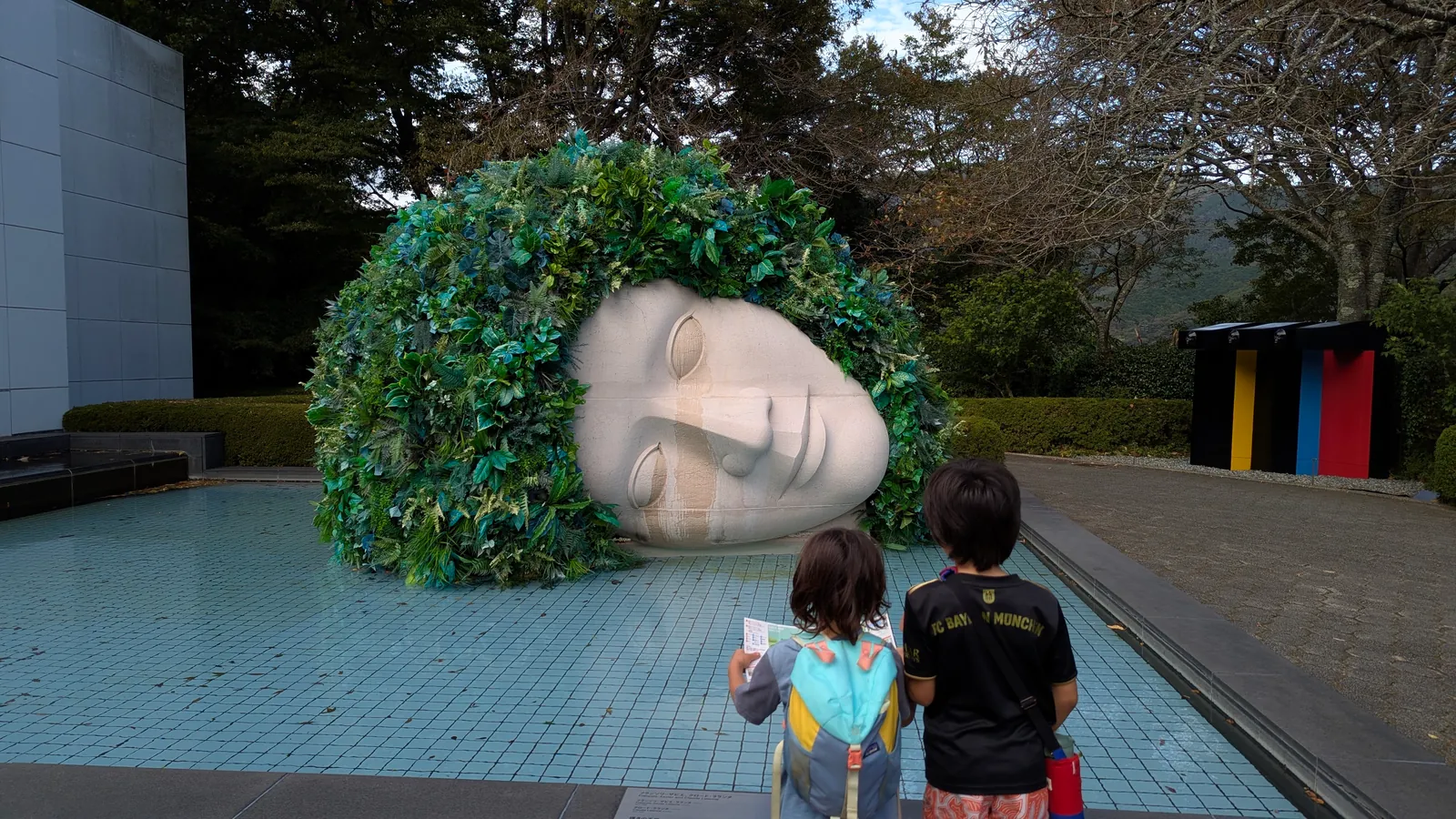
A sculpture museum laid out in the open air, with two works made to be used. The Hakone Open-Air Museum sets its sculpture on outdoor grounds, 2 minutes on foot from Chokoku-no-Mori Station on the Tozan Railway, and two of its works exist to be climbed rather than looked at. For a child who empties out when held still, that is the discharge a gallery cannot give: the Woods of Net is a play work for children of elementary age and under, shoes off, where adults stay off the white mat, and the Symphonic Sculpture is an 18-meter stained-glass tower with a spiral stair to a view over the grounds. A six-year-old spends the energy in the net while a parent watches from the edge; a thirteen-year-old is past the net’s age limit and takes the tower stair instead.
Who it costs.The Sprinter, because the works are spread across outdoor grounds walked between, one piece to the next. Strollers and wheelchairs are lent free at the information desks of the main and new buildings.
How to make it work.Buy the web ticket, 600 yen for an elementary or junior high student against 800 at the window, and 1,800 for an adult against 2,000; preschool children enter free. The museum is open every day from 9:00 to 17:00, last entry 30 minutes before close. The Woods of Net may close in some weather, so ask at the desk before promising it, and keep lunch to the designated places such as the outdoor benches, since eating elsewhere is not allowed.
If this isn’t your child: a sculpture park with a play net and a tower in it, and a long outdoor walk for a child who came to sit.A park on the loop a small child walks straight into. Hakone Gora Park asks no ticket of a small child or a Freepass holder. For a child who needs to move, that changes what a stop is for: a family can walk in, let the energy out for twenty minutes, and leave without having spent anything on the visit. A four-year-old has the run of it; a fourteen-year-old takes it as a short break from the rides.
Who it costs.The Sprinter, and any family with a stroller: the park sits on a mountainside with steep slopes and stairs throughout, and strollers and wheelchairs cannot be used. Its main gate is nearest Koen-shimo station on the cable car; entering by the west gate at Koen-kami makes the walk through the park downhill.
How to make it work.Hakone Gora Park charges 650 yen from junior high up and nothing for children of elementary age and under, and a Freepass holder enters free as well. Go from March to November between 9:00 and 17:00, last entry 16:30; from December to February the park opens 9:30 to 16:30, last entry 16:00. It closes on three maintenance days only: January 1, the third Monday of January and the second Monday of May.
If this isn’t your child: a hillside garden on the way up the mountain, worth a short stop for any child and a long one for none.For the Sensor
Stops where the busy part can be skipped and the space is wide.
Where does a child who runs short on noise and crowding get room? Down at the lake.
A lakeside shrine whose one ticketed room can be taken or left. Hakone Shrine sits 10 minutes on foot from Moto-Hakone port, where the lake cruise docks, and its one paid room, the treasure hall, is a separate ticket. For a child who runs short on noise and crowding, that separation is the point: the visit can stay outdoors, and the indoor room is added only on a day the child has the capacity for it. A five-year-old can be given the outdoor visit alone; a teenager who wants the history takes the treasure hall, which is discounted on the Freepass.
Who it costs.The Sprinter, who walks the 10 minutes each way from the port and then climbs about 90 stone steps on the main approach; a side approach through the woods has no steps, and wheelchairs take the elevator from the treasure hall.
How to make it work.Arrive by the lake boat to Moto-Hakone, or by bus, and use the Moto-Hakone port stop between 10:00 and 16:00, when the bus stop at the shrine entrance is not served. The treasure hall ticket is 300 yen for an elementary child and 500 from junior high up. Treasure hall admission runs 9:00 to 16:00 and the hall closes at 16:30, with temporary closures for exhibit changes. The amulet office keeps 8:15 to 17:00 at normal times.
If this isn’t your child: a shrine at the end of the lake crossing, and an easy add to the cruise for any child.A free prefectural park on Lake Ashi, with nothing to book. Onshi-Hakone Park charges no entry. For a child who runs short on noise and crowding, a free park means the visit can end the moment it stops working, with no ticket wasted and no timed slot to sit through. A small child can be carried out after ten minutes; an older one can be left to the view while a sibling rests.
Who it costs.The Anchor, for whom a park with no route, no ticket and no set length gives nothing to hold the visit to, unless the parent sets the plan before arriving.
How to make it work.Set the length of the stop before going in, so the Anchor has it too. The park’s lakeside observation hall closes only from December 29 to January 3. Parking runs 7:00 to 21:00, entry to 19:00. Getting there: the bus for Hakone-machi port or Hakone Sekisho-ato from Hakone-Yumoto, about 40 minutes (about 55 from Odawara), to the Onshi-Koen-mae stop.
If this isn’t your child: a free park by the lake, worth it on a day that has already been loud, and slight on a day that has not.For the Anchor
Stops with a fixed sequence or a stated length.
Which stops let a child who needs the day confirmed know what comes next? The ones that run to a pattern.
A mountain railway that reverses three times on the way up, in full view. The Hakone Tozan Railway climbs 8.9 kilometers from Hakone-Yumoto to Gora in about 40 minutes, at a grade of 80 per mille, and reverses at three switchbacks, Deyama, Ohiradai and Kami-Ohiradai, where the driver and the conductor change ends. For a child who depletes through unfamiliarity, a ride with a sequence that can be told in advance is a ride already known: three stops to watch for, and the same change each time. At Gora the cable car takes over for 1.2 kilometers and 209 meters of rise to Sounzan, about 10 minutes. A five-year-old counts the switchbacks; a teenager can be told that 80 per mille means 80 meters of climb for every kilometer.
Who it costs.The Dynamo, whose movement stops for about 40 minutes of climbing train and then about 10 of cable car before the next stop.
How to make it work.Ride on the Freepass, which covers the Tozan Line and the cable car without limit. At Hakone-Yumoto an elevator runs from the platform to the second-floor gates for a stroller, and the bus stands sit across the deck.
If this isn’t your child: the way up the mountain for every family on the loop, and a ride worth taking slowly for any child who likes trains.A stop that states its own visit length. Hakone Checkpoint gives a standard visit of about 45 minutes and sits 2 minutes on foot from the Hakone Sekisho-ato bus stop. For a child who needs the day confirmed, a stop with a known length and a short, known walk from the bus is one whose shape can be described on the way, start to finish. A seven-year-old is told it is a 45-minute stop; a fifteen-year-old can be handed the timing to run.
Who it costs.The Dynamo, on the bus rather than at the site: about 40 minutes from Hakone-Yumoto, or about 55 from Odawara, each way for a child who cannot sit.
How to make it work.Entry is 250 yen for an elementary child and 500 from junior high up, 150 and 400 on the Freepass. Open every day, 9:00 to 17:00 from March to November and 9:00 to 16:30 from December to February, last entry 30 minutes before close.
If this isn’t your child: a short, well-bounded history stop, worth the bus for an older child and a stretch for a young one.For the Sprinter
Stops where a gondola or a ship does the carrying.
Where can a child who runs out on walking and standing see the most of Hakone? From the rides themselves.
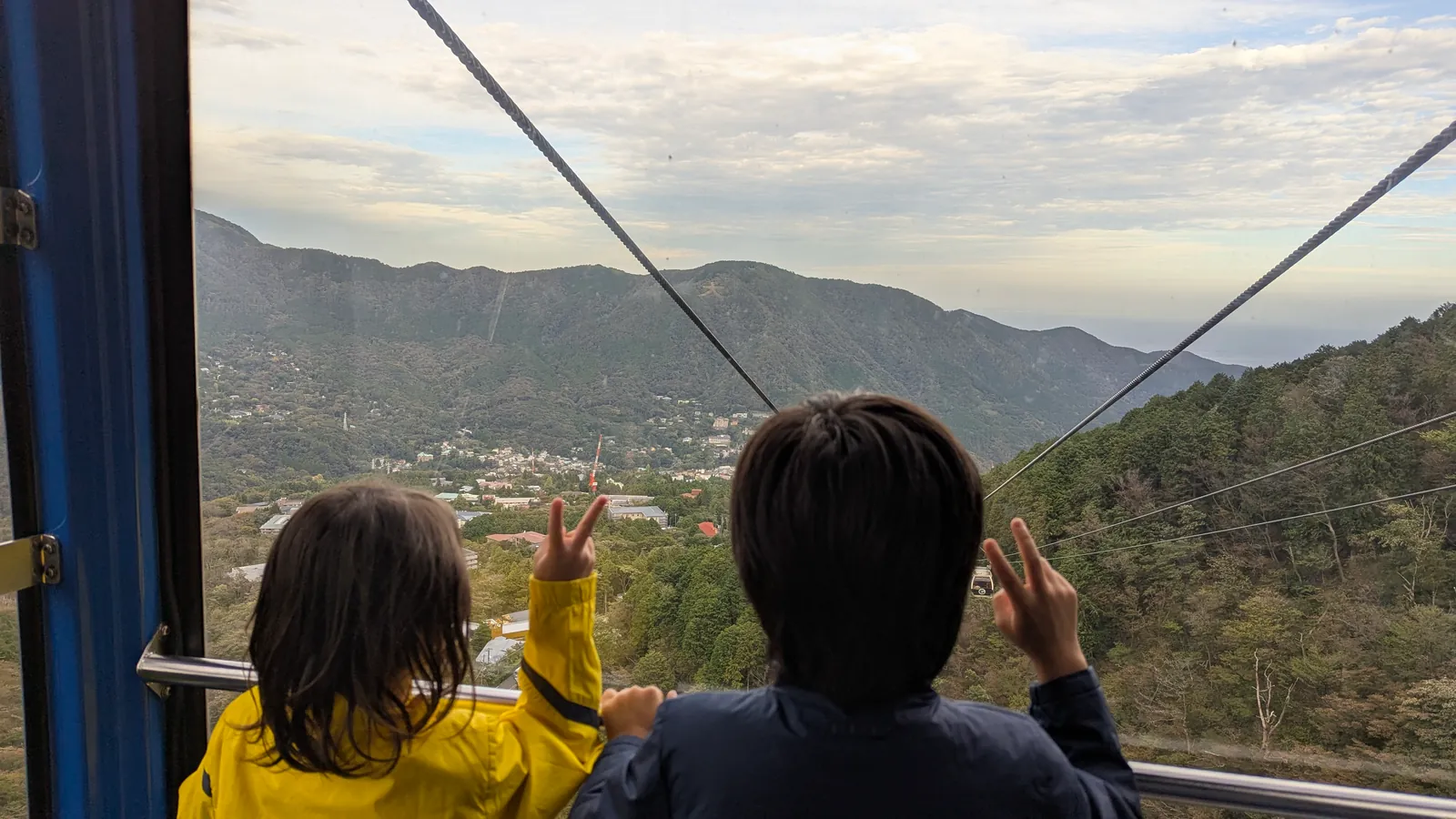
Three gondola legs across the valley, with a gondola about every minute. The Hakone Ropeway runs from Sounzan through Owakudani and Ubako to Togendai, about 10 minutes a leg, in 18-person gondolas that come about every minute. For a child who runs out on walking and standing, that is a valley crossed without a step, from a station 2 minutes on foot from the cable car in the same building, with a line that keeps moving. Every station has a baby room for nursing and diapers, and wheelchair users ride in the gondola. A four-year-old has the window; a teenager watches for Mt. Fuji, visible between Ubako and Owakudani and between Owakudani and Sounzan.
Who it costs.The Anchor, because the ropeway takes no bookings and gives no priority boarding, and it stops for wind of 30 meters a second or more, abnormal weather, a breakdown, volcanic gas readings and an annual maintenance period.
How to make it work.Ride it before mid-afternoon: it runs 9:00 to 17:00 from February to November and 9:00 to 16:15 in December and January. Without the Freepass, buy to your final station, since stopovers are allowed: one way is 2,000 yen for an adult and 700 for a child, valid for the day, and a round trip 3,000 and 1,000, valid for two days. Because of volcanic gas, the operator does not let anyone with allergic asthma, a bronchial, lung or heart condition or a pacemaker, or anyone feeling unwell, ride between Sounzan and Ubako.
If this isn’t your child: the ride that makes the loop, for every family on it, and the one stop a child who cannot walk far should not miss.The volcanic valley at the ropeway’s transfer station, where every full-line ride changes gondolas. Every ride along the whole Hakone Ropeway changes gondolas at Owakudani, so a family crossing the valley is already there. For a child who runs out on walking, that is a famous stop with no detour to reach it: OWAKUDANI KITCHEN is on the station’s second floor, and the black eggs are sold at the Kurotamago-kan and Gokuraku-jaya shops. The guided Nature Trail, a loop of about 700 meters and 40 minutes, is the one part with an age floor: preschool children may not join, and an elementary child goes only with a guardian of junior high age or older, and no one with asthma or a respiratory or heart condition may join. A five-year-old gets the eggs and the view; a ten-year-old with a parent can book the trail.
Who it costs.The Anchor, if the trail is the plan: it runs by reservation only, at four set times for 30 people each, with a Japanese-only guide, and it is canceled for rain heavy enough for an umbrella, wind around 10 meters a second, fog, snow or ice, warnings, gas levels, or an earthquake of intensity 3 or more since the night before.
How to make it work.Never promise the trail; promise the eggs, which Kurotamago-kan sells from 9:00 to 16:40. The trail leaves at 10:00, 11:30, 13:00 and 14:30 and costs 800 yen per person on the day, cashless only. The ropeway operator also asks pregnant women, newborns, infants and older people to consider not riding, since even trace gas levels can bring on an asthma attack. In winter the operator warns it can feel below freezing even by day, and the leaves around Owakudani turn from late October.
If this isn’t your child: the famous stop of Hakone, reached by every full-line ropeway ride, and walked only by a family that booked and got lucky.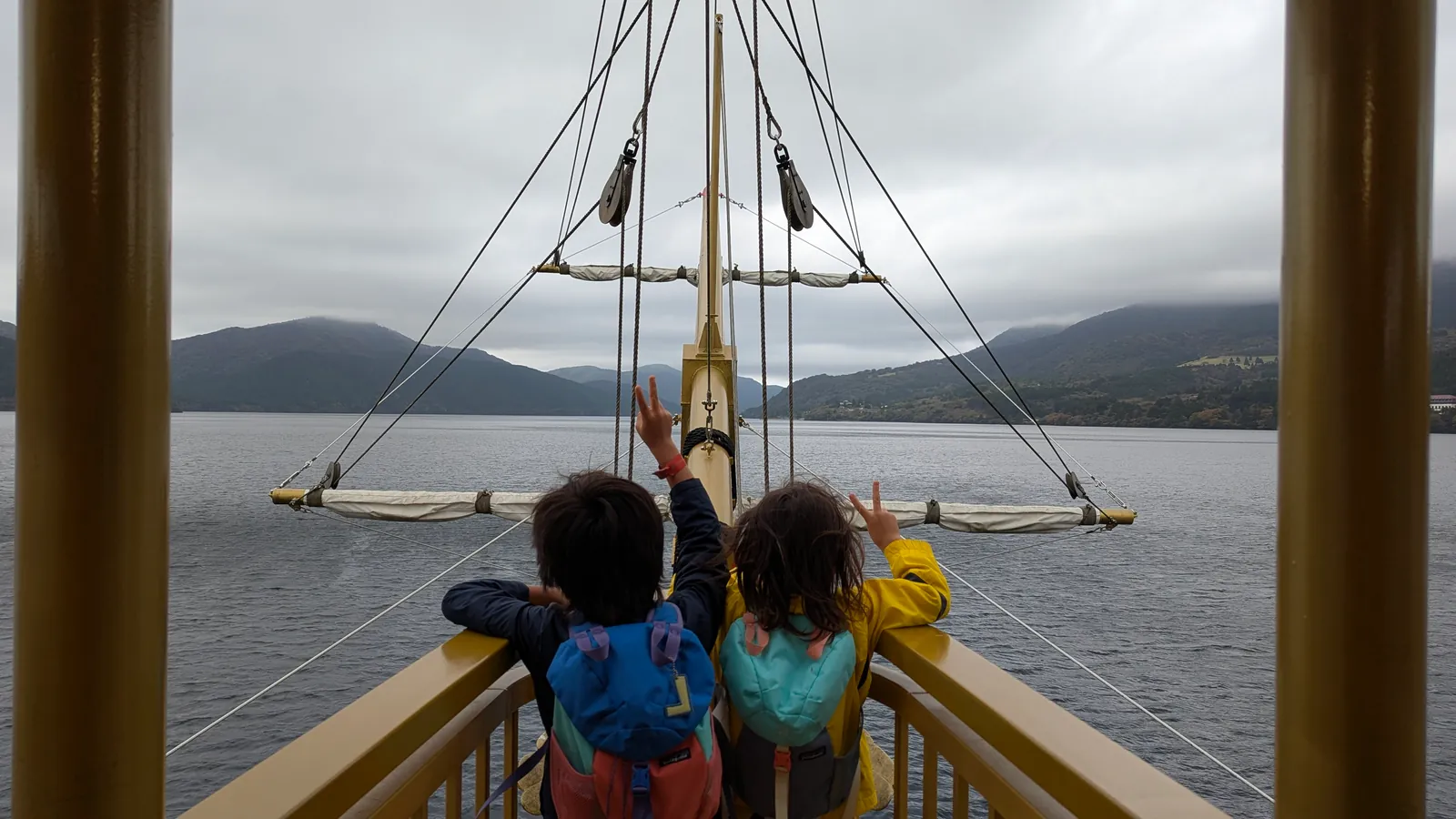
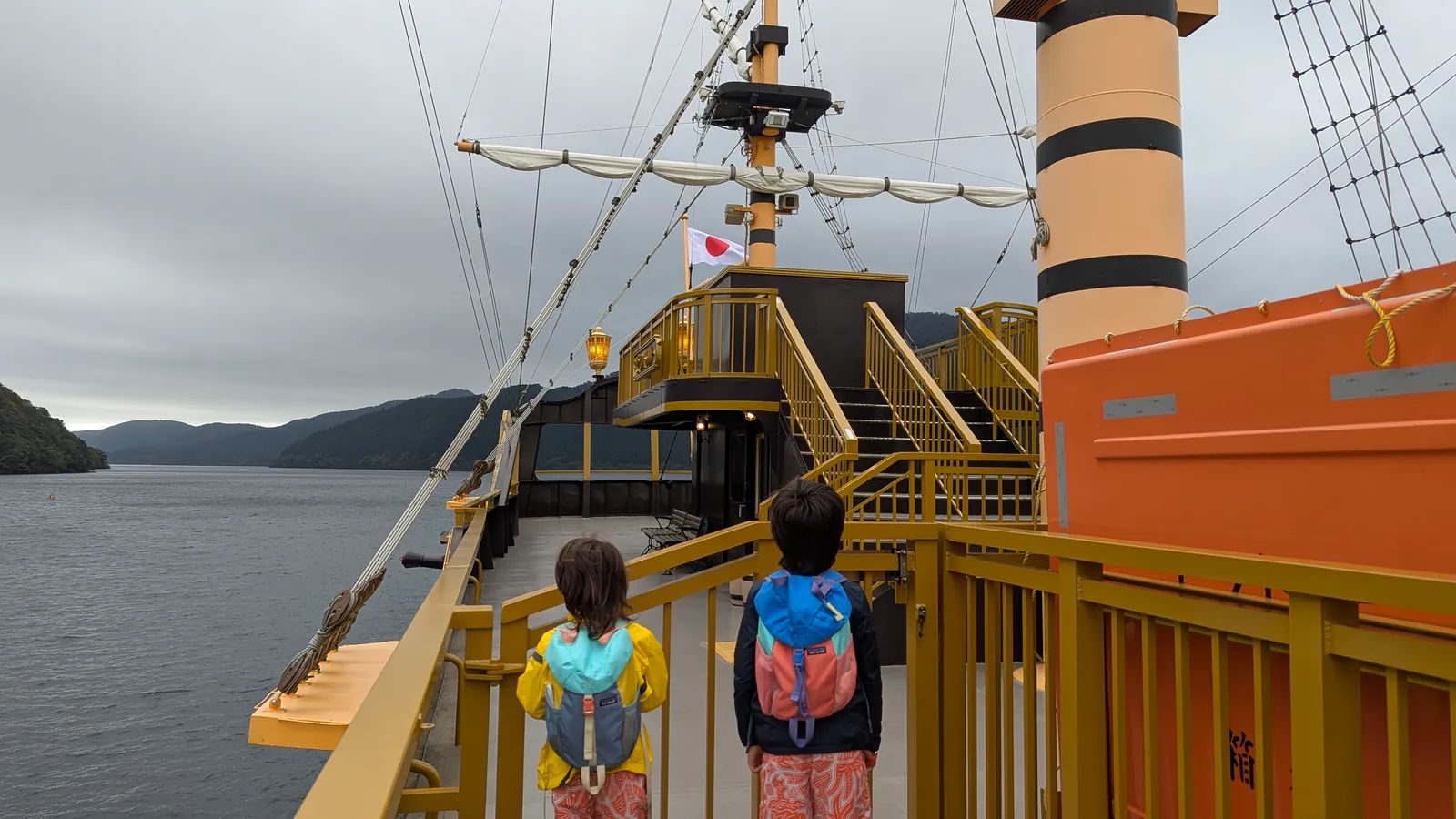
Pirate ships across Lake Ashi, boarded 3 minutes from the ropeway. The Hakone Sightseeing Cruise crosses Lake Ashi from Togendai to Hakone-machi or Moto-Hakone in about 25 to 35 minutes one way, and its pier at Togendai is 3 minutes on foot from the ropeway, in the same building. For a child who runs out on walking and standing, the crossing adds almost no walking to the loop, and all three ships are barrier-free, with toilets aboard, multipurpose ones included, and a snack kiosk. A three-year-old rides for the ship; a thirteen-year-old rides for the crossing.
Who it costs.The Anchor, mildly: fog or strong wind can change or cancel a sailing, and only groups of 15 or more can book a sailing.
How to make it work.Ride on the Freepass, which covers the ordinary cabin without limit; the special cabin costs extra each time, 800 yen for an adult and 400 for a child on the Togendai leg. Without the pass, one way from Togendai is 1,700 for an adult and 850 for a child, and a round trip 3,000 and 1,300; the adult fare starts at junior high. Boarding opens about 5 to 10 minutes before departure, and the winter schedule, December 1 to March 19, runs some sailings longer.
If this isn’t your child: the lake crossing every Hakone loop includes, and a ship most children remember whichever profile they are.Open with the child who runs short first.
The loop sets the order, and the child sets the direction. Up from Hakone-Yumoto, the riding alone runs about 40 minutes on the railway, 10 on the cable car, three legs of about 10 on the ropeway and 25 to 35 on the lake, so a family that also stops is out all day. The ropeway’s closing time decides how late the valley can be crossed.
What the pass covers, and what it does not.
The Hakone Freepass covers the Tozan Railway, the cable car, the ropeway and the ship without limit, with designated Tozan Bus sections and the sightseeing loop bus, and it brings discounts at about 70 places, Gora Park free among them. From Shinjuku it costs 7,100 yen for an adult and 1,600 for a child for two days, or 7,500 and 1,850 for three; from Odawara, 6,000 and 1,500, or 6,400 and 1,750. The Romancecar is a separate charge, and the Izu-Hakone Bus is not covered. Children under 6 need no ticket; on the Tozan Bus, up to two ride free with each paying adult or child.
How to make it work. Off the loop, Hakone Glass no Mori is 20 minutes from Gora on the sightseeing loop bus, S or M, open 10:00 to 17:30, last entry 17:00, and closed for 11 days from the day after Coming-of-Age Day in January; it has many steps, so plan the stroller around them.
The questions parents actually ask.
What are the best things to do in Hakone with kids?
The Hakone Open-Air Museum first, 2 minutes from Chokoku-no-Mori Station, because preschool children enter free and its play net and tower suit most children. After that it depends on the child: Gora Park for one who needs to move, Hakone Shrine and Onshi-Hakone Park for one who needs space, the Tozan Railway and Hakone Checkpoint for one who needs the day confirmed, and the ropeway, Owakudani and the lake cruise for one who cannot walk far.
Is Hakone good for toddlers?
Yes, with three limits. The Open-Air Museum lets preschool children in free and lends strollers, with a nursing room at the new building, and every ropeway station has a baby room. The limits: Owakudani’s guided Nature Trail takes no preschool children, strollers cannot be used in Gora Park, and the ropeway operator asks newborns and infants, among other sensitive people, to consider not riding because of volcanic gas. Beyond Hakone, the guide to Japan with toddlers plans the rest of the trip.
Is the Hakone Freepass worth it for a family?
For the loop, yes. It covers the Tozan Railway, the cable car, the ropeway and the ship without limit, and from Shinjuku it costs 7,100 yen for an adult and 1,600 for a child for two days. A child’s round trip on the ship alone is 1,300 and on the ropeway 1,000, and the pass also makes Gora Park free and cuts Hakone Checkpoint to 150 for a child.
What happens if the ropeway or the boat is not running?
Both stop for weather. The ropeway halts for wind of 30 meters a second or more, abnormal weather, volcanic gas readings and an annual maintenance period, and fog or strong wind can change or cancel a sailing. Keep the Open-Air Museum, Gora Park and the Tozan Railway as the day that does not depend on either.
Can children walk the trail at Owakudani?
Only from elementary school age, with a guardian of junior high age or older, and not for anyone with asthma or a respiratory or heart condition. The guided Nature Trail, about 700 meters and 40 minutes, runs by reservation at four set times, costs 800 yen per person, cashless, and is canceled for rain, wind, fog, gas levels or a recent earthquake. Every ride along the whole ropeway still changes gondolas at Owakudani station.
Is Hakone good for teenagers?
Yes. A teenager can climb the Open-Air Museum’s 18-meter stained-glass tower, join Owakudani’s guided trail, where a junior high student can be the guardian a younger sibling needs, and watch for Mt. Fuji from the ropeway between Ubako and Sounzan. The ship, the shrine’s treasure hall and Gora Park charge the adult price from junior high, while the Open-Air Museum keeps junior high students on its 800-yen ticket. The guide to Japan with teens covers the wider trip.