Fuji Five Lakes With Kids:which stop is for which child.
- The One to Start With
- Fuji-Q Highland, free at the gate
- For a Small Child
- Thomas Land’s indoor playground, no height limit
- Without Walking
- Fuji Safari Park, driven in your own car
- On the Water
- Lake Yamanaka’s boat, a loop of about 20 minutes
- Plan Around
- Fuji-Q’s thrill rides start at 110 to 140 cm
Around the Fuji Five Lakes and on Mt. Fuji’s Shizuoka side, a day with kids is built from very different pieces: the rides at Fuji-Q Highland, the boats on Lake Yamanaka and Lake Kawaguchi, a drive among the animals at Fuji Safari Park, and a 400-meter footbridge at the Mishima Skywalk. Fuji-Q Highland is the place to start, because entry is free, so a family pays only for the rides each child takes, and its Thomas Land has an indoor playground with no height or age limit. The rest sits with the child it gives the most to.
Which stop is for which child.
These eight are not ordered best to worst. They are grouped by which child each one is for, across the four profiles of The LUNI Framework. Family travel runs on three currencies, not two: money and time, plus the child’s Reserve, their finite capacity to absorb what travel asks of them. Around Mt. Fuji the stops sit on two sides of the mountain, the lakes on one and Shizuoka on the other, so the first decision is which side a day goes to, and the child who runs short first should make it. The Dynamo runs short when they cannot move, the Sensor on noise and crowding, the Anchor when nothing is predictable, and the Sprinter on walking and standing. Find your child below, and start there.
Fuji-Q Highland, free at the gate.
Fuji-Q Highland is the stop to start with because it charges nothing at the gate. Each child’s day is priced by the rides that child takes, and Thomas Land inside gives a small child an indoor playground with no height or age limit, Thomas and Percy’s Fun Ride, and a mini coaster from age 3, while a teenager of 125 centimeters or more has Takabisha and Eejanaika. A family with a four-year-old and a fourteen-year-old can split for the morning and meet again inside the same park.
| The Stop | What It Settles | Best For |
|---|---|---|
| Fuji-Q HighlandFuji-Q Highland Station, Fujikyu Line | Free entry, with rides paid one by one or by pass. | Dynamo |
| Mishima SkywalkAbout 20 min from JR Mishima Station | A 400-meter footbridge and a dinosaur maze. | Dynamo |
| Lake YamanakaThe Swan Lake boat and the KABA bus | A lakeshore with a boat loop of about 20 minutes. | Sensor |
| Chureito PagodaArakurayama Sengen Park, Fujiyoshida | A park open 24 hours, so the family picks the hour. | Sensor |
| Narusawa Ice Cave and Fugaku Wind CaveTwo caves, ticketed separately | A cave course of about 15 minutes at the Wind Cave. | Anchor |
| Lake Kawaguchi boatsFunatsu pier and Oishi Park | Boats that run to set hours. | Anchor |
| Fuji Safari ParkSusono, about 15 min from Susono IC | A safari driven in the family car, parking free. | Sprinter |
| Shiraito FallsFujinomiya, 10 min on foot from parking | A falls 150 meters wide, close to the car. | Sprinter |
Fuji-Q Highland
Dynamo
Mishima Skywalk
Dynamo
Lake Yamanaka
Sensor
Chureito Pagoda
Sensor
Narusawa Ice Cave and Fugaku Wind Cave
Anchor
Lake Kawaguchi boats
Anchor
Fuji Safari Park
Sprinter
Shiraito Falls
Sprinter
For the Dynamo
Stops where a child is on their feet and choosing the next thing.
A child whose energy builds when movement is restricted needs somewhere to spend it after the train or the car. These two give it room.
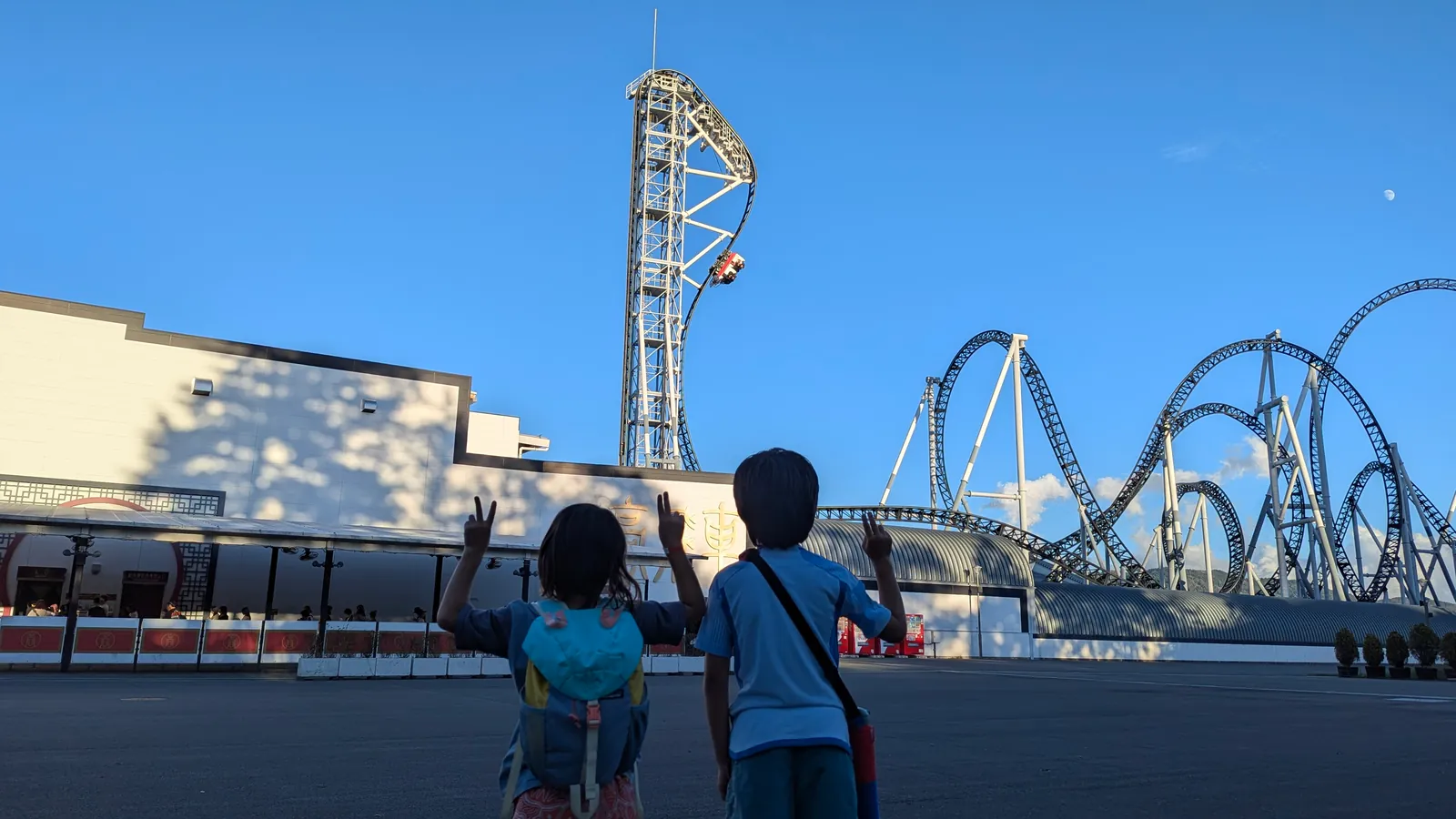
A ride park that charges nothing at the gate, with a gentle land for small children inside. Fuji-Q Highland charges no entry: a free entry ticket comes from the window or online, and each ride needs a ride ticket unless the family holds a pass. For a child whose energy builds when movement is restricted, that changes the visit: they can range between the rides, and the family pays only for the ones taken. Inside, Thomas Land has Thomas’ Dokidoki Playground, an indoor playground with no height or age limit, and Nia and Animal Coaster, a mini coaster from age 3. A four-year-old spends the morning in Thomas Land; a thirteen-year-old takes FUJIYAMA, from 110 centimeters, and the bigger coasters.
Who it costs.The Sprinter, since a ride park is crossed on foot between rides all day; strollers rent at either entrance.
How to make it work.Thomas’ Dokidoki Playground is 500 yen. For a small child, the Thomas Land Pass covers its 12 rides without limit, 2,500 to 2,800 yen for an elementary child and 2,000 to 2,300 from age 1, against 4,400 to 5,100 and 2,100 to 2,600 for the One Day Pass, 5,500 to 7,400 through high school and 6,000 to 7,900 for an adult; rides outside Thomas Land need separate tickets, and prices vary by date. A One Day Pass or Afternoon Pass for a child from age 1 to preschool is bought by QR ticket or at the window on the day. Thomas Land’s playground, Thomas and Percy’s Fun Ride and its mini coaster each require a companion of junior high age or older for a preschool child, and on FUJIYAMA a rider from 110 to under 130 centimeters needs the same companion.
How to make it work on the day.Strollers are 500 yen, cash only (1,000 is taken up front and 500 returned), seated models with no recline, for a child from 7 months. Hours are set by the date, so check the park’s calendar: most October and November days run 9:00 to 19:00, and most December and January days 10:00 to 17:00.
If this isn’t your child: a park that works in Thomas Land for a small child and on the coasters for a tall teenager, and asks a lot of walking of everyone in between.A 400-meter footbridge, with a dinosaur maze beside it. The Mishima Skywalk is a 400-meter suspension bridge for people on foot only, and its Dinosaur Adventure is a dinosaur maze and an AR dinosaur shooting game. For a child who builds up when held still, a bridge is a walk with somewhere to get to, and a maze is a place to spend what a long car or bus ride stored up. A five-year-old takes the maze; a teenager takes the bridge at a pace of their own.
Who it costs.The Sprinter, since the visit is the bridge, crossed on foot; strollers and wheelchairs are lent free at the ticket office and the entry gate.
How to make it work.The bridge is open every day from 9:00 to 17:00, and Dinosaur Adventure runs 10:00 to 16:00 on the days its monthly calendar sets, except in stormy weather. Prices are dynamic, set at the start of each month through the end of the next: from 1,100 yen for an adult, 500 for junior high and high school students and 200 for an elementary child, with the other activities charged separately. Parking is free for 400 cars, paid in busy seasons, and entry to it may be limited when it is busy, so come by the route bus from Mishima Station, or from Moto-Hakone port and Hakone-Yumoto, when you can. Coin lockers cost 500 yen.
If this isn’t your child: a bridge and a maze, a short stop for any child, and reachable by bus from the Hakone side.For the Sensor
Stops with open air and a choice of hour.
A child who runs short on sensory input does best where the space is wide and the family sets the timing. The lakes and the pagoda park allow both.
A lake to walk along, with a short boat loop and an amphibious bus on it. Lake Yamanaka’s Swan Lake boat makes a loop of about 20 minutes. For a child who runs short on sensory input, a lakeshore and a short loop on open water give space, and an end the child can see coming. The KABA amphibious bus is the livelier ride. A three-year-old rides the boat; a teenager can take the KABA bus.
Who it costs.The Anchor, since the boat’s winter service changes: some sailings stop, and the boat may run as the cruiser New Wakafuji instead, or stop in bad weather.
How to make it work.The Swan Lake boat is 1,200 yen for an adult and 600 for a child of elementary age, 4 to 12, with children 3 and under free, and some sailings stop from December to February. The KABA bus is 2,800 yen from junior high up and 1,400 for a child from age 3 through elementary, 3,000 and 1,500 from July 1 to August 31. Book the KABA bus from 30 days ahead up to 30 minutes before; seats are assigned, and the ticket desk is on the second floor of Mori no Eki Asahigaoka. Children 2 and under cannot ride unless they can sit in a seat, and then pay the child fare; there is no infant fare. A preschool child must ride with someone of junior high age or older.
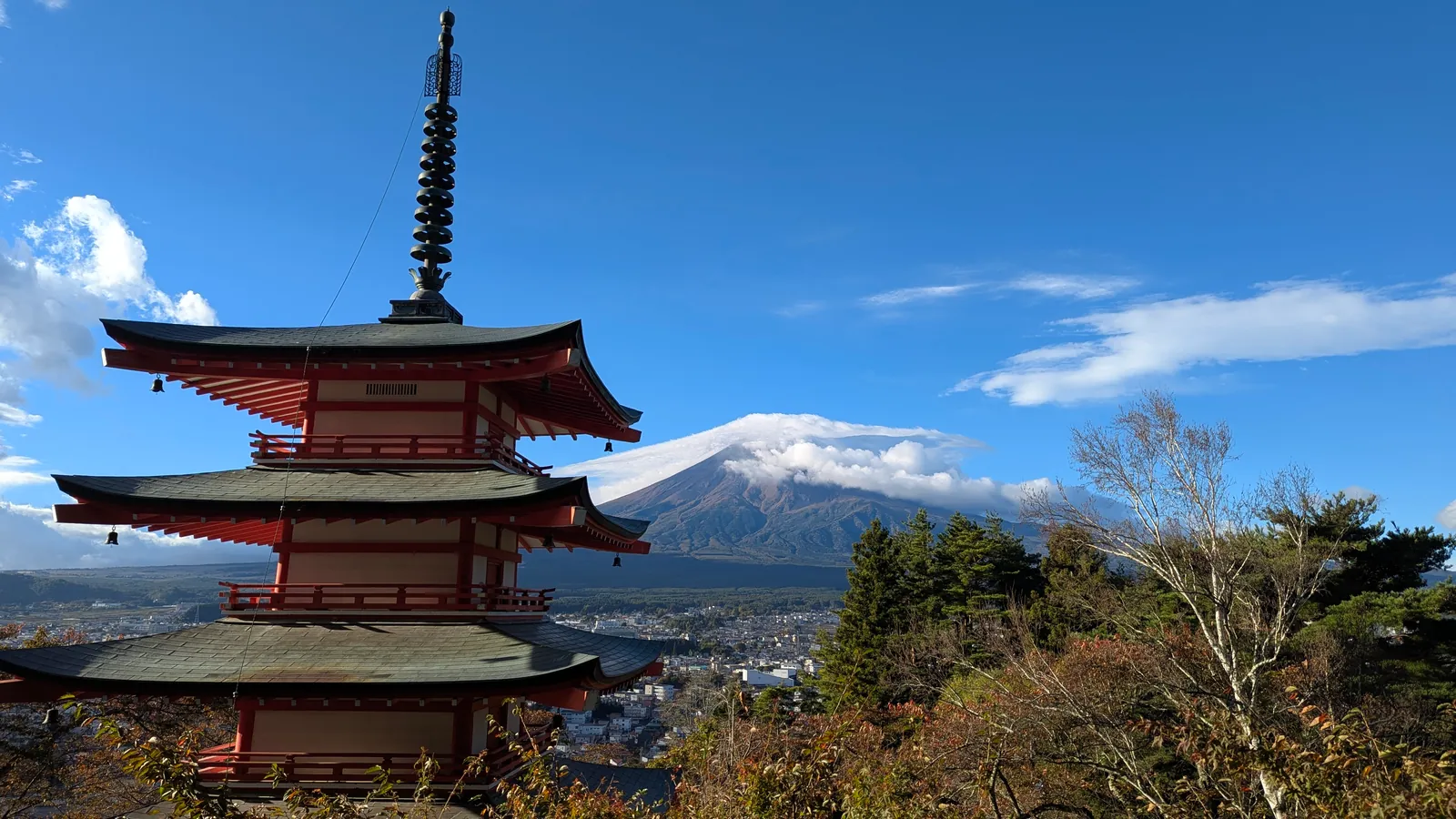
If this isn’t your child: a lake to end any day on, with a short boat loop for a child who wants something to do.The famous pagoda view, in a park that never closes. Arakurayama Sengen Park, home of the Chureito Pagoda, is a public park open 24 hours and lit at night. For a child who runs short on sensory input, a park with no closing time lets the family pick the hour that suits the child, at first light or into the evening light-up. A five-year-old needs only a few minutes at the top; a fifteen-year-old can plan the light-up photograph.
Who it costs.The Sprinter, since the famous view comes from a deck the family reaches by climbing the park’s steps.
How to make it work.The climb itself and the walk from Shimo-Yoshida Station are planned in the Mt. Fuji guide. By car, lot 1 costs 1,500 yen for up to 6 hours and holds 88 cars, lots 2 and 3 cost 1,000 and lot 4 costs 1,500. The light-up starts at 16:00 in December, January and February, 17:00 in March, April, October and November, 18:00 in May and 19:00 from June to September, each evening until 21:50, and light-up times can change.
If this isn’t your child: the pagoda view at the top of the stair, worth it for a child with legs left and easy to skip for one without.For the Anchor
Stops with a set course or a printed schedule.
A child who depletes through unfamiliarity and unconfirmed structure needs the day told in advance. These two can be told start to finish.
Two caves on short courses, one with ice that does not melt even in summer. The Fugaku Wind Cave’s visitor course takes about 15 minutes and passes ice pillars that do not melt even in summer, lava shelves and rope-shaped lava; the Narusawa Ice Cave is a separate ticket. For a child who depletes through unfamiliarity, a course with a stated length can be described before going in, start to finish. A six-year-old is told it is a fifteen-minute walk past ice; a teenager can be given the lava shapes to find.
Who it costs.The Sprinter and any family with a small child, at the Ice Cave: its loop goes down about 100 slippery steps to 21 meters underground and back up, and passes sideways under a ceiling 91 centimeters high. It does not admit a child under 100 centimeters (as a guide, about age 3 to 4) or one who cannot walk it unaided, no child may be carried on the back or in arms, and pregnant women cannot enter. The Wind Cave, a horizontal cave easy for children to walk, starts down a few steps under a low ceiling.
How to make it work.Each cave costs 350 yen for an adult and 200 for a child of elementary age or younger. Both caves keep the same seasonal hours: 9:00 to 17:30 from August 1 to October 15; 9:00 to 17:00 from October 16 to November 15 and from March 16 to July 31; 9:00 to 16:30 from November 16 to February 15 and from March 1 to 15; and 9:00 to 16:00 from February 16 to the end of February. Weather or the state of the caves can change them. Both caves run one way, so a child cannot turn back partway, and neither has a toilet inside; both stay near freezing, 0 to 4 degrees Celsius. The Ice Cave’s loop takes 6 to 7 minutes.
If this isn’t your child: a short stop underground, for any child willing to go into a cave.Two boats on Lake Kawaguchi, each running to set hours. The Lake Kawaguchi sightseeing boat Appare sails to set seasonal hours. A second boat, the Oishi Park Line Ensoleille, crosses between Oishi Park and Funatsu. For a child who depletes through unconfirmed structure, a boat that runs to hours fixed in advance makes a day that can be told before it starts. A seven-year-old is told which boat brings them back; a teenager can be handed the last-boat time to keep.
Who it costs.The Dynamo, who sits for the crossing rather than moving.
How to make it work.Appare costs 1,000 yen for an adult and 500 for an elementary child, and sails 9:00 to 16:30 from April to October, 9:00 to 17:30 in Golden Week and from mid-July through August, and 9:30 to 16:00, every 30 minutes, from November to March. The Ensoleille is 1,000 and 500 one way, 1,800 and 900 for a round trip. From Oishi pier the first Oishi Park boat leaves at 9:20 and the last at 15:50, or 16:45 in summer and Golden Week and 14:50 in winter; from Funatsu the first leaves at 9:45 and the last at 16:15, 17:15 or 15:15. A set ticket covers the Mt. Fuji Panoramic Ropeway and either boat, Appare or the Ensoleille, for 1,700 yen for an adult and 850 for a child, valid for two days.
If this isn’t your child: the lake-level view of the area, an easy outing for any child and the frame of a day for one who needs the plan fixed.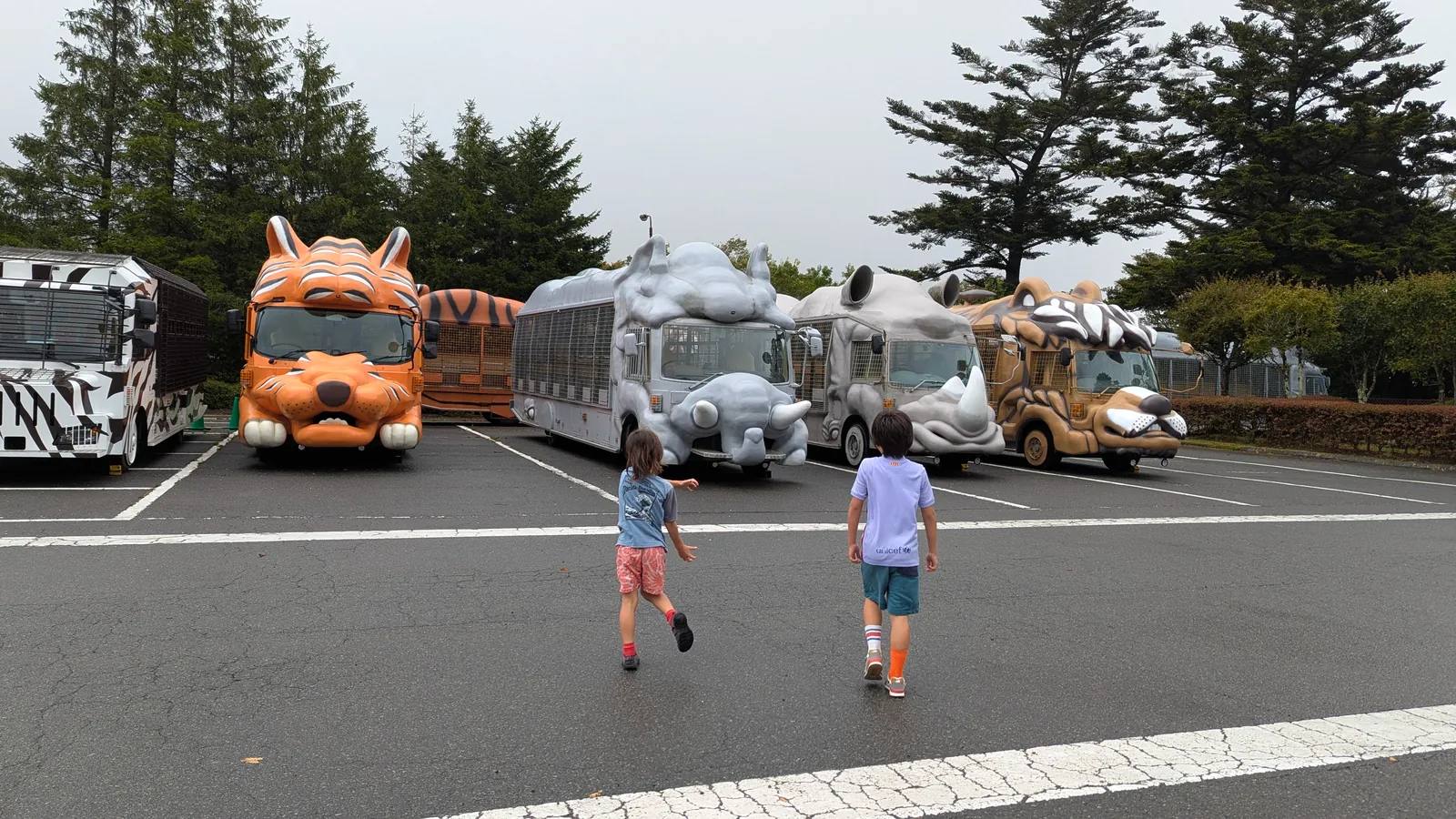
For the Sprinter
Stops where a car or a short path does the work.
A child who runs out on sustained walking and standing can still see the Shizuoka side’s big sights, because neither asks much of their legs.
A safari driven in the family car, with the walking left optional. Fuji Safari Park’s admission covers driving the Safari Zone in your own car and the walk-through petting zone, where some feeding and riding cost extra, and parking is free. For a child who runs out on walking and standing, the car does the carrying through the animals, and the walking parts can be kept short. A three-year-old watches; a fourteen-year-old spots the animals first.
Who it costs.The Dynamo, buckled into a car or a bus seat for the drive through the Safari Zone.
How to make it work.Admission is 3,200 yen from high school age up, 2,000 for a child from age 4 through junior high, and nothing for children 3 and under. Open cars, canvas tops, trucks, cars with 10 centimeters or less of ground clearance, and motorbikes cannot enter the Safari Zone; they must transfer to one of the park’s tour buses, such as the Jungle Bus. The Jungle Bus costs 1,500 yen a person, charged from age 3, and the Super Jungle Bus 2,100 a person, which children under elementary age cannot ride. Children under 3 ride the Jungle Bus free on a parent’s lap, one per parent, and no child rides either bus without a parent. Entry reception runs 9:00 to 16:30 from March 11 to October 31, 9:00 to 15:30 in November and 10:00 to 15:30 from December 1 to March 10, and there is no re-entry.
How to make it work without a car.Take the bus from Gotemba Station’s Fujisan-guchi stop 4, any bus for Jurigi, Grinpa or Yeti, for 880 yen.
If this isn’t your child: a day of animals that asks little of a child’s legs, and a long sit for one who needs to move.A falls 150 meters wide, ten minutes on foot from the parking lot. Shiraito Falls spreads across a curved cliff 150 meters wide, and almost all of its water is spring water from Mt. Fuji. From the parking lot it is 5 minutes on foot to Otodome Falls and 5 more to Shiraito, with a tourist information office and public toilets at the parking lot. For a child who runs out on walking and standing, a famous sight ten minutes from the car, with a second falls halfway, can be reached before the legs give out. A four-year-old sees Otodome Falls first and can turn back there; a teenager walks on to Shiraito.
Who it costs.The Sprinter, only if the family goes down to the basin: a wheelchair can reach the viewing space at the top of the stairs, and the basin of the falls is about 100 steps below it.
How to make it work.Parking runs 9:00 to 17:00, with entry until 30 minutes before, and to 16:30 in winter. Without a car, the Fujikyu Shizuoka Bus takes about 30 minutes from JR Fujinomiya Station; by car it is about 30 minutes from the Fuji or Shin-Fuji interchange.
If this isn’t your child: a short walk to a big sight, worth the drive for any child.Open with the child who runs short first.
The region splits in two, and the family’s base decides which half a day takes. The lakes side, Fujiyoshida, Lake Kawaguchi and Lake Yamanaka, is reached by the Fujikyu Line from JR Otsuki, with through trains from Tokyo and from Takao to Kawaguchiko every day; the Shizuoka side, Mishima, Susono and Fujinomiya, is a car or bus day. Keep each day to one side, and open it with the child who runs short first.
The train in, and two more stops.
On the Fujikyu Line, an adult ticket from Otsuki costs 980 yen to Shimo-Yoshida, where the walk to the Chureito Pagoda starts, 1,100 to Fuji-Q Highland and 1,170 to Kawaguchiko; children pay half, rounded up to the next 10 yen, and IC card fares differ. Oshino Hakkai, eight spring ponds, is listed among the parts of the Mt. Fuji World Heritage site.
How to make it work. The Kawaguchiko Music and Forest Museum opens 10:00 to 17:30, last entry 17:00, and charges 1,000 yen for an elementary or junior high student on any day, 1,800 to 2,300 for an adult by day and season, and nothing for preschool children.
The questions parents actually ask.
What are the best things to do around the Fuji Five Lakes with kids?
Fuji-Q Highland first, because entry is free, Thomas Land suits a small child and the big rides suit a tall teenager. After that it depends on the child: the Mishima Skywalk for one who needs to move, Lake Yamanaka and the Chureito Pagoda for one who needs space, the caves and the Lake Kawaguchi boats for one who needs the day confirmed, and Fuji Safari Park and Shiraito Falls for one who cannot walk far.
Is the Fuji Five Lakes area good for toddlers?
Yes, with Thomas Land at Fuji-Q at the center of it: its indoor playground has no height or age limit, and its mini coaster takes a child from age 3, with a companion of junior high age or older for any preschool child. Children 3 and under ride Lake Yamanaka’s boat free and enter Fuji Safari Park free. The limits: a child 2 or under rides the KABA bus only if they can sit in a seat, the Narusawa Ice Cave admits no child under 100 centimeters and no child carried in arms, and the Chureito Pagoda’s view is at the top of a long stair. Beyond the lakes, the guide to Japan with toddlers plans the rest of the trip.
Is Fuji-Q Highland free to enter?
Yes. Entry is free with a free entry ticket from the window or online, and each ride needs a ride ticket unless the family holds a pass. The One Day Pass is priced by date, 4,400 to 5,100 yen for an elementary child and 6,000 to 7,900 for an adult; the Thomas Land Pass, 2,500 to 2,800 for an elementary child, covers Thomas Land’s 12 rides only.
How tall does a child need to be for Fuji-Q’s big rides?
Between 110 and 140 centimeters, ride by ride. FUJIYAMA and the Tekkotsubanchou swing take riders from 110 centimeters, with a companion of junior high age or older below 130; ZOKKON starts at 120, Takabisha and Eejanaika at 125, Tondemina at 137 and Panic Clock at 140, where a child under 10 also needs that companion. Thomas Land’s indoor playground has no height limit.
Do you need to book anything ahead?
Book the KABA bus on Lake Yamanaka, which takes reservations from 30 days ahead up to 30 minutes before. From July 10 to September 10, the bus from Mishima Station to Fuji Safari Park needs a reservation too. At Fuji-Q, the free entry ticket comes from the window or online, and a One Day Pass for a child from age 1 to preschool is bought by QR ticket or at the window on the day.
Is the area good for teenagers?
Yes. Fuji-Q Highland’s Takabisha and Eejanaika take riders from 125 centimeters, at the junior high and high school price of 5,500 to 7,400 yen for the One Day Pass, and Fuji Safari Park keeps junior high students on its 2,000-yen child ticket. The guide to Japan with teens covers the wider trip.