Kiyomizu-dera with Kids: how you arrive decides the day.
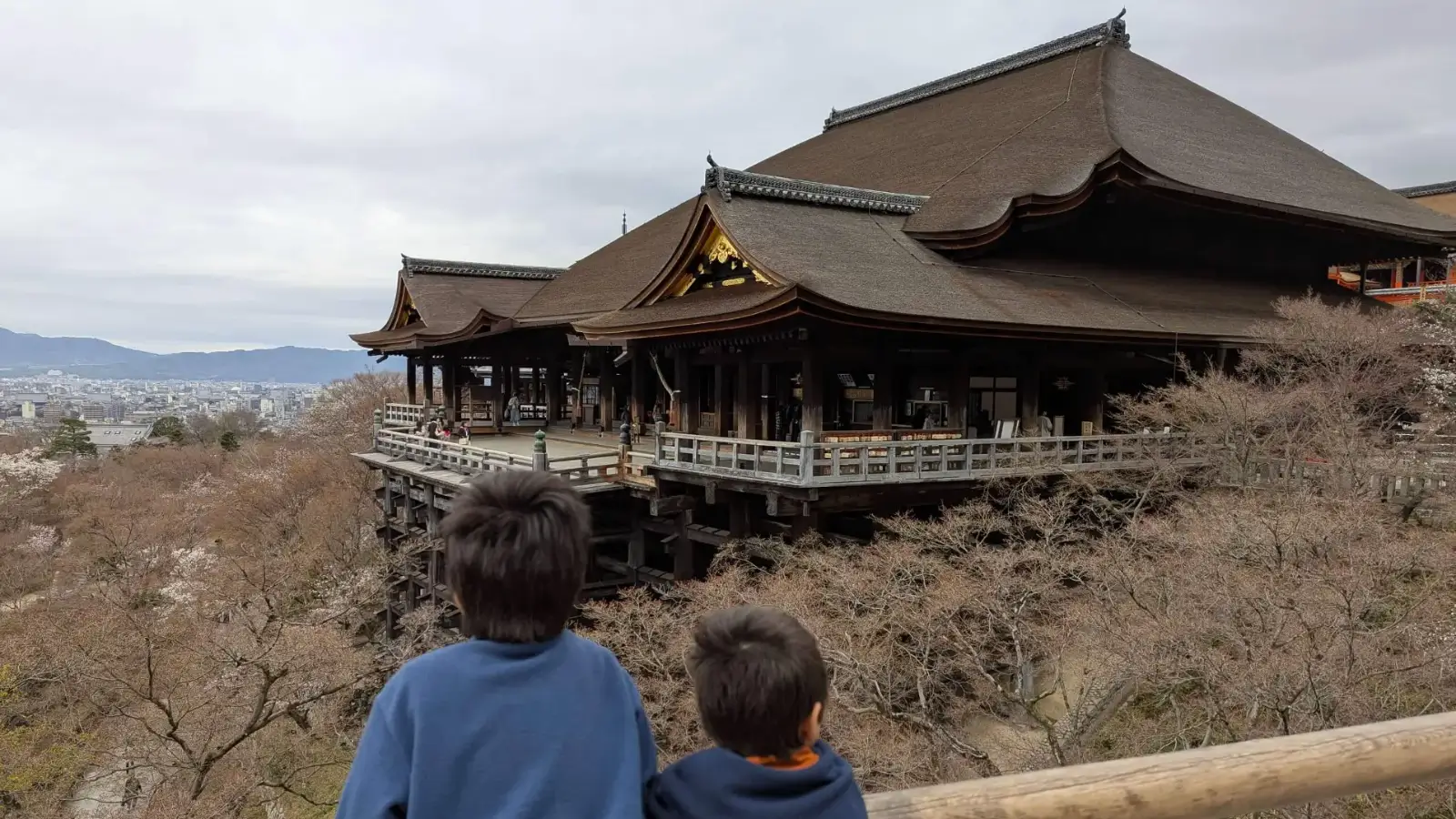
The temple sits at the top of a slope with only two ways up, and how a family climbs it decides whether a child arrives curious or already tired.
No group discount; a disability card admits the holder and one companion free. Entry cannot be booked ahead.
Closes 18:00 most of the year, 18:30 in July and August, and 21:30 on the three night viewings.
About ten minutes up the slope from the bus stops, then the grounds.
A step-free path takes a stroller to the Main Hall and around the grounds.
A path just left of the main route reaches the Main Hall; a stroller can then circle the whole precinct.
Some links on this page are affiliate links. LuNi may earn a commission at no extra cost to you.
Is Kiyomizu-dera worth it with kids?
The short version, before the costs, the timings and the case for each child.
Yes, and it gives children more to do than most famous temples. The wooden stage stands on eighteen pillars joined without a single nail, a fact a child can check by looking, and at the Otowa Waterfall visitors catch water from three streams with ladles. The catch is getting there. The temple sits at the top of a slope, reached by one of two lanes up the hill, so the condition is the hour: go at the early opening, before the approach street fills for the day, and push a stroller up the step-free path that starts just left of the main route and then circles the whole precinct. That climb, made early, is the whole difference between a curious child and a tired one.
Planning Your Visit to Kiyomizu-dera with Kids.
Almost every decision here is about the approach. Choose the hour first: the gates open early every day of the year, and the street leading up to them is very busy in the daytime, so an early start buys a calmer climb. Choose the way up next, because there are only two. From the Gojozaka or Kiyomizu-michi bus stop it is about ten minutes on foot, from the Keihan station about twenty-five, and there is no parking at the temple. Then decide how a small child travels: a step-free path runs from just left of the main route to the Main Hall and on around the grounds, so a stroller works and a carrier is optional. Our Kyoto guide shows what fills the rest of a Higashiyama day.
Every LuNi attraction guide starts with a visit, with our own children
LuNi rates and writes about attractions only after visiting them with children. Luca and Nico were at Kiyomizu-dera, and what they did there is recorded further down this page, including how each child actually met it.
Children arrive with different tolerances: for noise, for lines, for standing still, for being on their feet all day. A guide written for the average of them helps almost nobody. So every place on this site is read four ways, and each verdict says which children it already suits and what makes it work for the rest. Whoever you are bringing, the answer here is built for your family rather than for a general reader.
Restricted-movement depletion builds on a stage where the view asks for stillness, so let the climb up count as the movement and keep the stage short.
Sensory-input depletion stays manageable in outdoor grounds at the 6:00 opening, so arrive early and be back down before the approach street fills.
Unfamiliarity and unconfirmed structure ease when the visit is a few named places, so describe the gate, the stage and the waterfall before arriving.
Sustained walking and standing begin before the gate, uphill from every bus stop, so take the nearest stop and bring a stroller for the step-free path.
Hotels we would book for this visit.
Three hotels chosen around the early opening: one on the temple’s own approach street, one with an indoor pool, and one for a family that puts the room ahead of the location.
| Property | The LuNi Reason |
|---|---|
| LUNI Pick The Hotel Seiryu Kyoto Kiyomizu Kiyomizu-michi bus stop, 4 minutes | On the temple’s own approach, the street that runs up to the gate. That street is very crowded in the daytime, which is the whole argument for sleeping on it: the family can walk up at the 6:00 opening, see the stage and the waterfall early, and be back for breakfast as the day’s crowds arrive. |
| Four Seasons Hotel Kyoto | Four Seasons Hotel Kyoto has an indoor pool, for a family that gives the temple an early morning and wants the afternoon indoors and in the water. It sits in the same ward as the temple’s approach, which keeps the early start from becoming a long journey across the city before the climb even begins. |
| Park Hyatt Kyoto 6 minutes’ walk from the Higashiyama Yasui bus stop | Park Hyatt Kyoto is six minutes’ walk from the Higashiyama Yasui bus stop, for a family that puts the room first. The early start matters more here than at almost any other temple, since the approach fills during the day, so confirm the route to the temple when booking and plan to leave early. |
The Hotel Seiryu Kyoto Kiyomizu
Nearby attractions, matched to your child.
Three pairings for what the temple leaves unmet: a child who wants a longer climb with room to move, a child who wants the next place’s rules known in advance, and a child who needs to ride rather than walk afterward.
| Pairing | Why This Solves the After-Visit | For Your |
|---|---|---|
| LUNI Pick Fushimi Inari South of the center: JR Inari Station | The mountain paths of Fushimi Inari, lined with about ten thousand torii, give a moving child far more ground than a temple stage, and entry is free. Restricted-movement depletion lifts on a climb the child sets the pace of, though a Sprinter’s walking and standing run long there. | Dynamo |
| Nijo Castle Central Kyoto, grounds and palaces | At Nijo Castle the rules are clear enough to teach on the way: shoes off and no photographs in the palaces, no drinks while walking, no going back in once you leave. Unfamiliarity and unconfirmed structure ease when a child knows the next place’s rules before the family arrives. | Anchor |
| Kyoto Railway Museum Kyoto Station side: Umekoji-Kyotonishi Station | After a morning that began on a slope, the Kyoto Railway Museum is an afternoon on wheels: mostly indoors, with free strollers while they last and stroller parking inside. Sustained walking and standing drop when the rest of the day’s distance is covered sitting down. | Sprinter |
Fushimi Inari
South of the center: JR Inari Station For YourDynamo
Nijo Castle
Central Kyoto, grounds and palaces For YourAnchor
Kyoto Railway Museum
Kyoto Station side: Umekoji-Kyotonishi Station For YourSprinter
How two children actually met this attraction.
Two children went to the same temple and came away with different stories, and neither was about the view. One of them spent his time on the stage, working out how it was built, and the panorama behind him barely registered. The other went straight for the water and wanted another turn the moment his first was over. Both found something to do with their hands or their heads, and both would have been bored by a visit that was only about looking. Neither of them asked about the history, and neither needed to. That is the useful part for a parent: Kiyomizu-dera works on children through its engineering and its one hands-on ritual, so point them at those, and let the famous view be the adults’ reward.
Luca spent most of his time on the wooden stage working out how its pillars could carry the weight of the deck without a single nail. He had spotted the interlocking joints from a distance and wanted to find the point where the structure’s logic became visible up close. He never found that single point, but by the time the family moved on he had picked out three different kinds of joint, and lost track of time doing it.
This is the Anchor pattern, with a strong analytical pull. A child whose Reserve depletes through unfamiliarity and unconfirmed structure settles fastest when a place offers a system to decode, and a stage held together without nails is exactly that: a fixed, knowable piece of engineering that rewards close looking. For a child like this, the stage is the anchor of the visit rather than the view, and it is worth building in more time there than the plan suggests.
Nico announced, about forty seconds after reaching the waterfall, that he had chosen the wrong stream and needed to go again. When he was told his turn was done, he did not let it drop. He spent the next several minutes arguing, in full detail, that the cup he had used was too small to count, which meant, by his logic, that his turn had not really happened yet.
This is the Dynamo pattern. A child whose Reserve depletes through restricted movement wants to repeat an action that engages the body until it feels finished, and a short turn at the water sits right against that instinct. For families with a child like this, the fix is to agree on how many turns the child gets and what counts as one before joining the line, so the limit is known going in and does not become the thing the visit gets stuck on.
Kiyomizu-dera shows children that a sacred place can also be a feat of building, and that the two belong together. A wooden stage standing out over a hillside invites a child to ask how it holds, and the ladles at the Otowa Waterfall let them take part in a custom rather than only watch one. History lands differently when a child can touch it or work it out. A visit that meets their curiosity through hands and questions teaches that the past was made by people, and can still be understood.
The LUNI Rating for Kiyomizu-dera.
One fact sits under all four verdicts: the temple is at the top of a slope, and every family climbs to it. For a child who tires on foot, that climb comes before anything worth seeing, and it is why that child pays most here. For the others, the grounds are outdoors, the visit can be described stop by stop, and the early opening gives a calmer start, so two do well. The Dynamo’s difficulty comes from the stage, where the best view asks a moving child for stillness. For a hotel that turns the 6:00 start into a short walk, our Kyoto hotel guide weighs the options.
Count the climb as the movement, and keep the stage short. The Dynamo depletes through restricted movement, and the heart of Kiyomizu-dera asks for the opposite. The wooden stage, about thirteen meters high and about two hundred square meters across, is a place for standing at the rail and looking out, and it is shared with everyone else who came to do the same. The rules keep the rest of the grounds calm too: no entry to planted or roped-off areas, no eating while walking, no sitting down in the way. A child who meets a striking place by moving is asked to hold still inside it.
Count the climb as the movement. The walk up from the bus is about ten minutes on a slope, and a child can lead it. Then keep the stage visit short and definite, and make the Otowa Waterfall, where the child gets to do something with their hands, the next goal. The Jishu Shrine is closed, with no reopening date, so do not promise a run in that direction. Plan the afternoon somewhere with room to move, not a second temple.
What this means for your Dynamo: restricted movement builds on the stage. A younger Dynamo needs to lead the climb and reach the waterfall quickly; an older one can take the stage if the afternoon has room to run.Arrive at six, and the morning is on your side. The Sensor depletes through sensory input, and the single most useful fact about Kiyomizu-dera for this child is its hour: the gates open at 6:00 every day of the year. The approach street is very busy in the daytime, and a family that climbs at opening meets it before that. The grounds are outdoors, and the step-free path circles the whole precinct, so a child who needs a break can be walked on rather than held in place.
Everything here turns on the hour. Plan the day around the opening rather than fitting the temple into the middle of it: breakfast early, the climb at six, the stage and the waterfall while the day is young, and back down before the street fills. The rules help a sensitive child too, since nobody may block others by sitting down, eating on the move is not allowed, and tripods and drones are banned. The visit then asks little of this child that a quiet morning walk would not.
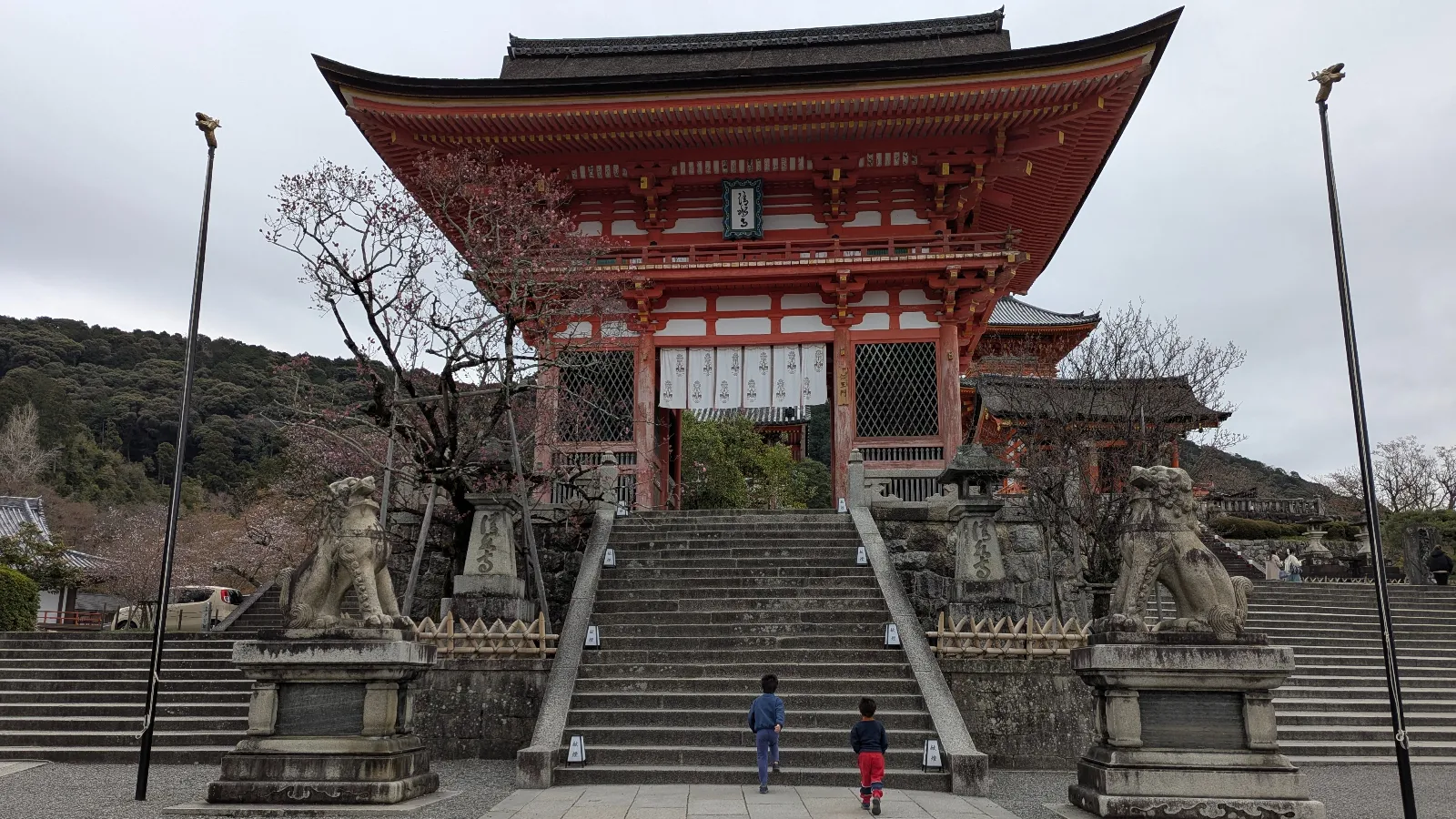
What this means for your Sensor: sensory input stays manageable if the visit starts at opening. A younger Sensor needs the early climb and a short loop; an older one can take the whole precinct before the street fills.Name the stops, and settle the waterfall in advance. The Anchor depletes through unfamiliarity and unconfirmed structure, and Kiyomizu-dera can be told as a short list of named places: the gate at the top of the slope, the Main Hall and its stage, the Otowa Waterfall. The grounds open at the same time every day of the year. A map at the Todoroki-mon shows the step-free route around the grounds, for a family that needs it.
The one moment to prepare is the waterfall, where the child does something rather than watches. Visitors catch water from the three streams with ladles, and a child who likes rules will want to know exactly what to do before the turn comes. Describe it on the way up, decide as a family how many turns each child gets, and say it again in the line. Tell the child too that the Jishu Shrine is closed, so a closed gate is expected rather than a surprise.
What this means for your Anchor: unfamiliarity eases when every stop is named. A younger Anchor needs the waterfall explained before the line; an older one can lead the family from the gate to the water.Take the shortest way up, and push rather than carry. The Sprinter depletes through sustained travel-style walking and standing, and at Kiyomizu-dera the walking comes first and cannot be avoided. There are only two ways in, both up a slope: Kiyomizu-zaka to the Nio-mon, or Chawan-zaka. The walk from the Gojozaka or Kiyomizu-michi bus stops is about ten minutes, from the Keihan station about twenty-five, and there is no parking at the temple. Vehicle entry by the Chawan-zaka road is the wheelchair route, not a family drop-off.
Inside, the rules take away the easy rests: no sitting down where it blocks others, and no eating while walking or standing. Those rules are the heart of the difficulty. The answer is a shorter approach, and wheels. Take the bus to the nearer stops rather than walking from the station, and bring a stroller for the step-free path that starts just left of the front route and circles the whole precinct. Keep the rest of the day’s walking light.
What this means for your Sprinter: walking and standing arrive before the gate. A younger Sprinter needs a stroller on the step-free path and the nearest bus stop; an older one can walk up if little else that day is on foot.The questions parents actually ask.
Kiyomizu-dera sits at the top of a slope with only two ways up, so the plan turns on the climb rather than the tickets. The gates open early every day of the year, and a step-free stroller route runs from beside the main path, one that most visitors never notice. The one change to know about before going is the closed Jishu Shrine. For how the temple fits into a first trip to the city, the Kyoto family travel guide covers the whole picture, from how many days to give Kyoto to where to stay. At the temple itself, the early hour does most of the work.
Is Kiyomizu-dera worth visiting with kids?
Yes. The wooden stage stands on eighteen pillars joined without a single nail, and at the Otowa Waterfall visitors catch water from three streams with ladles, which gives children something to do as well as something to see. The approach is uphill from every bus stop, so go early, and use the step-free path if the family has a stroller.
How much is admission to Kiyomizu-dera?
Kiyomizu-dera charges an admission fee, and there is no group discount. Disability-card holders and one companion are admitted free on showing the card at the gate; advance applications go by reply postcard about two weeks ahead.
What are Kiyomizu-dera’s opening hours?
The gates open at 6:00 every day of the year. Closing is 18:00 for most of the year and 18:30 from July 1 to August 13 and from August 17 to 31. At the spring, Obon and late-November night viewings the temple stays open until 21:30, with last entry at 21:00; the windows change each year.
Is Kiyomizu-dera stroller friendly?
Yes, on a set route. Immediately to the left of the front route, a path with no steps leads to the Main Hall, and from there a stroller can circle the whole precinct on the same route as a wheelchair. Diapers can be changed in the accessible restrooms. The approach streets outside the gate still run uphill.
How do you get to Kiyomizu-dera?
Take City Bus 206 or 100 to Gojozaka, then walk about 10 minutes, or bus 207 to Kiyomizu-michi, also about 10 minutes on foot. Keihan Kiyomizu-Gojo Station is about 25 minutes’ walk. There is no parking in the grounds, and the two ways in, Kiyomizu-zaka and Chawan-zaka, both climb to the temple.
What rules should families know at Kiyomizu-dera?
The grounds include the plaza at the Nio-mon and the road outside. No food or drink may be brought in except capped bottles, and eating while walking or standing is not allowed. Take trash home, do not sit where you block others, keep out of planted or roped-off areas, and leave drones, tripods and pets, other than assistance dogs, behind.
Is the Jishu Shrine open?
No. The Jishu Shrine is closed for building and grounds works, and neither the end of the works nor a reopening date has been set. Plan the visit without it, and tell children in advance, so that a closed gate is expected rather than a disappointment on the day.
What do children do at the Otowa Waterfall?
Visitors catch water from each of the three streams with ladles and pray for the purification of the six senses. For a child it is the one part of the visit where they do something rather than look, so explain it on the way up and agree beforehand on how many turns each child will get.
Where Kiyomizu-dera fits your Japan trip.
Official site and opening information: Kiyomizu-dera