Kids Plaza Osaka with Kids: time it around the school groups.

Kids Plaza fills with school groups on weekday mornings in season and calms after 14:30, so the hour you arrive shapes the day more than the floor you start on.
Ages 3 to 5 ¥500; under 3 free. No booking needed; a cheaper weekday afternoon ticket is sold in set date ranges.
Closed the 2nd and 3rd Mondays (the next day after a holiday), the 4th Monday in August, and December 28 to January 2.
Same-day re-entry is through the third-floor exit, for the whole party.
The tube slider needs 100 cm; the fourth-floor playroom is for ages 0 to 2 with a parent.
Twenty free strollers for children up to age 2, and parking beside the play floors.
Some links on this page are affiliate links. LuNi may earn a commission at no extra cost to you.
Is Kids Plaza Osaka worth it with kids?
The short version, before the costs, the timings and the case for each child.
Yes, and it is a strong indoor day for a child who needs to move, provided the family chooses its hours with care. Kids Plaza is a children’s museum over several floors: Kids Town on the fourth is a climbing space of winding corridors, walls and suspension bridges, and a street of role-play stations sits beside it. What decides the day is who else is there. In the school-trip seasons, weekday mornings are crowded with groups until the middle of the afternoon, and the rest of the day is relatively calm. It is also a building that asks parents to stay close: children come with a guardian, who keeps them in sight throughout, so plan to follow them rather than wait at the edge. Pack lunch, because there is no restaurant inside.
Planning Your Visit to Kids Plaza Osaka with Kids.
Three decisions set the visit before anyone buys a ticket. The first is the hour. In the school-trip seasons, weekday mornings are crowded with groups, and the weekday afternoon ticket, sold in set date ranges, costs less for the calmer half of the day. The second is the slider, the thing most children will ask about: it needs 100 centimeters of height and on weekdays closes just as the afternoon ticket goes on sale, so a family choosing the afternoon should say so before the trip, not at the top of the stairs. The third is lunch. There is no restaurant, so pack food and plan to eat it in the fourth-floor multipurpose room together. Kids Plaza is an afternoon, so the morning is free for another of Osaka’s family stops, or for a slow start.
Every LuNi attraction guide starts with a visit, with our own children
LuNi rates and writes about attractions only after visiting them with children. Luca and Nico were at Kids Plaza Osaka, and what they did there is recorded further down this page, including how each child actually met it.
Children arrive with different tolerances: for noise, for lines, for standing still, for being on their feet all day. A guide written for the average of them helps almost nobody. So every place on this site is read four ways, and each verdict says which children it already suits and what makes it work for the rest. Whoever you are bringing, the answer here is built for your family rather than for a general reader.
Restricted-movement depletion spends itself on Kids Town’s climbing walls and suspension bridges, so let the child climb, with a parent’s eyes on them throughout.
Sensory-input depletion peaks while school groups fill weekday mornings, so arrive after 14:30 on a school-trip weekday; summer vacation is busy all day.
Unfamiliarity and unconfirmed structure ease at Kids Street’s role-play stations, which open at 10:15, so name the stations and that opening time first.
Sustained walking and standing ease with lunch rooms, lockers and same-day re-entry, so plan one sit-down inside and one break out of the building.
- Cost
- ¥1,500 adults / ¥800 ages 6 to 15Ages 3 to 5 ¥500; under 3 free. No booking needed; a cheaper weekday afternoon ticket is sold in set date ranges.
- Booking
- Weekday afternoon ticketWeekdays from 14:00 in set date ranges, after school groups leave; summer vacation is busy all day. ¥1,000 adults, ¥500 children.
Hotels we would book for this visit.
Three Osaka family hotels for a family basing in the north of the city for its Osaka days, each chosen so the slow morning before a calm Kids Plaza afternoon is easy to spend well, the pick first.
| Property | The LuNi Reason |
|---|---|
| LUNI Pick Imperial Hotel Osaka | Imperial Hotel Osaka is for a family planning the calm weekday afternoon at Kids Plaza. The morning before it has nowhere it must be, which is the point: a slow start, a quiet hour, and a child who arrives at the building rested rather than already spent by a morning of sightseeing. |
| Hilton Osaka Hotel | Hilton Osaka is a natural base for a family doing Kids Plaza as one day among several in the city. A central base keeps each day’s first journey simple, so the afternoon at the museum can be the day’s main event rather than the end of a long ride for a child who tires. |
| Hotel Granvia Osaka | Hotel Granvia Osaka is for a family that wants the same central base for the whole stay. After an afternoon of climbing in Kids Town, a child needs the evening quiet and the route back familiar, and staying in one place all week gives them both, night after night. |
Nearby attractions, matched to your child.
Three pairings for what Kids Plaza leaves unmet: a child who needs open air after a day indoors, a child who wants a visit with a clear shape, and a child who needs a calmer room to look at.
| Pairing | Why This Solves the After-Visit | For Your |
|---|---|---|
| LUNI Pick Tennoji Zoo Closed Mondays; entry until 16:00 | After a day under a roof, Tennoji Zoo gives a Dynamo open-air paths to walk at the child’s own pace, and re-entry if the family tells the gate first. Restricted-movement depletion needs ground outdoors, and after a building of climbing walls a child can walk as far as the paths allow. | Dynamo |
| Osaka Castle Road train from Morinomiya Station | At Osaka Castle the tower can be described in full beforehand: an elevator to the fifth floor, stairs to the eighth, stairs all the way down. Unfamiliarity eases on a plan that exact, though a Sprinter’s walking and standing are spent on step-free park routes of over a kilometer. | Anchor |
| Osaka Aquarium Kaiyukan Kaiyukan West Pier, a minute from the door | A calmer room to look at: Osaka Aquarium Kaiyukan admits visitors in fifteen-minute slots, with e-tickets from thirty days ahead, and runs no dolphin or sea lion shows. Sensory input is easier to manage in a building that paces its arrivals, so book a slot. | Sensor |
Tennoji Zoo
Closed Mondays; entry until 16:00 For YourDynamo
Osaka Castle
Road train from Morinomiya Station For YourAnchor
Osaka Aquarium Kaiyukan
Kaiyukan West Pier, a minute from the door For YourSensor
How two children actually met this attraction.
Two children spent the same visit in completely different ways, and neither spent it where a parent would have guessed. One found a single exhibit and treated it as a problem to solve; the other found the floor built for running and ran it until he stopped. That split is the honest shape of Kids Plaza with siblings: the building holds very different children at once, but it holds them in different places. A family that expects to move through it together, floor by floor, will spend the visit negotiating. A family that lets each child find a corner, with a parent keeping each one in sight, gets a much easier afternoon, and nobody has to be dragged away from the thing that caught them.
Luca spent the first forty minutes at the water-dynamics exhibit and nowhere else, working through a systematic series of valve adjustments to watch how the changing water pressure redirected floating balls through the track. He did not approach the Kids Town climbing structure once during that stretch. The exhibit had handed him an analytical problem, and until he understood how the mechanism behaved, every other floor of the museum was peripheral to him.
This is the Anchor pattern, with an analytical pull. A child whose Reserve depletes through unfamiliarity settles once he can confirm how something behaves, and Luca did it by turning one exhibit into a system to solve before anything else in the building counted. For families with a similar child, let the first thing that catches them run its course, and resist steering them to Kids Town on the plan’s schedule: the understanding they build there keeps the rest of the visit steady.
Nico used Kids Town as a high-speed transit system for an uninterrupted hour, running the ramps, dropping through the slide tubes, and repeating the circuit without stopping at a single surrounding exhibit. The end, when it came, was sudden. He went from full sprint to complete stillness inside five minutes, found a bench by the mock supermarket, and sat there without speaking while his system reset.
This is the Dynamo pattern, including its ending. A child whose Reserve depletes through restricted movement runs as long as a space allows and then stops fast, which is exactly what Nico did. For families with a similar child, plan for the stop rather than being surprised by it: know where the family will sit when it comes, on the benches of Kids Hiroba or in the fourth-floor lunch room, and have food ready, because the reset cannot be hurried.
A children’s museum built for doing rather than looking gives a child a permission that daily life rarely grants: to touch everything, to try on a role, to make noise with a purpose. In Kids Town a child can climb, invent and play at running a small world, and the freedom to choose what comes next builds a quiet confidence. Parents often feel they should direct. The better visit lets the child lead, because children learn most deeply through play they chose, and they remember how capable they felt long after the exhibits fade.
The LUNI Rating for Kids Plaza Osaka.
One fact sits under all four verdicts: Kids Plaza is a building of separate places, and each child does best in a different one. Kids Town is where a moving child spends energy, so that child is well served. The weekday-morning crowds of the school-trip seasons are why a child sensitive to input needs a plan, eased by the afternoon. Kids Street’s stations give a child who needs structure a set of known jobs, and the lunch rooms and re-entry rule give a tired child a way to stop. On a wet week, it is the building among Osaka’s indoor days with a room for every child.
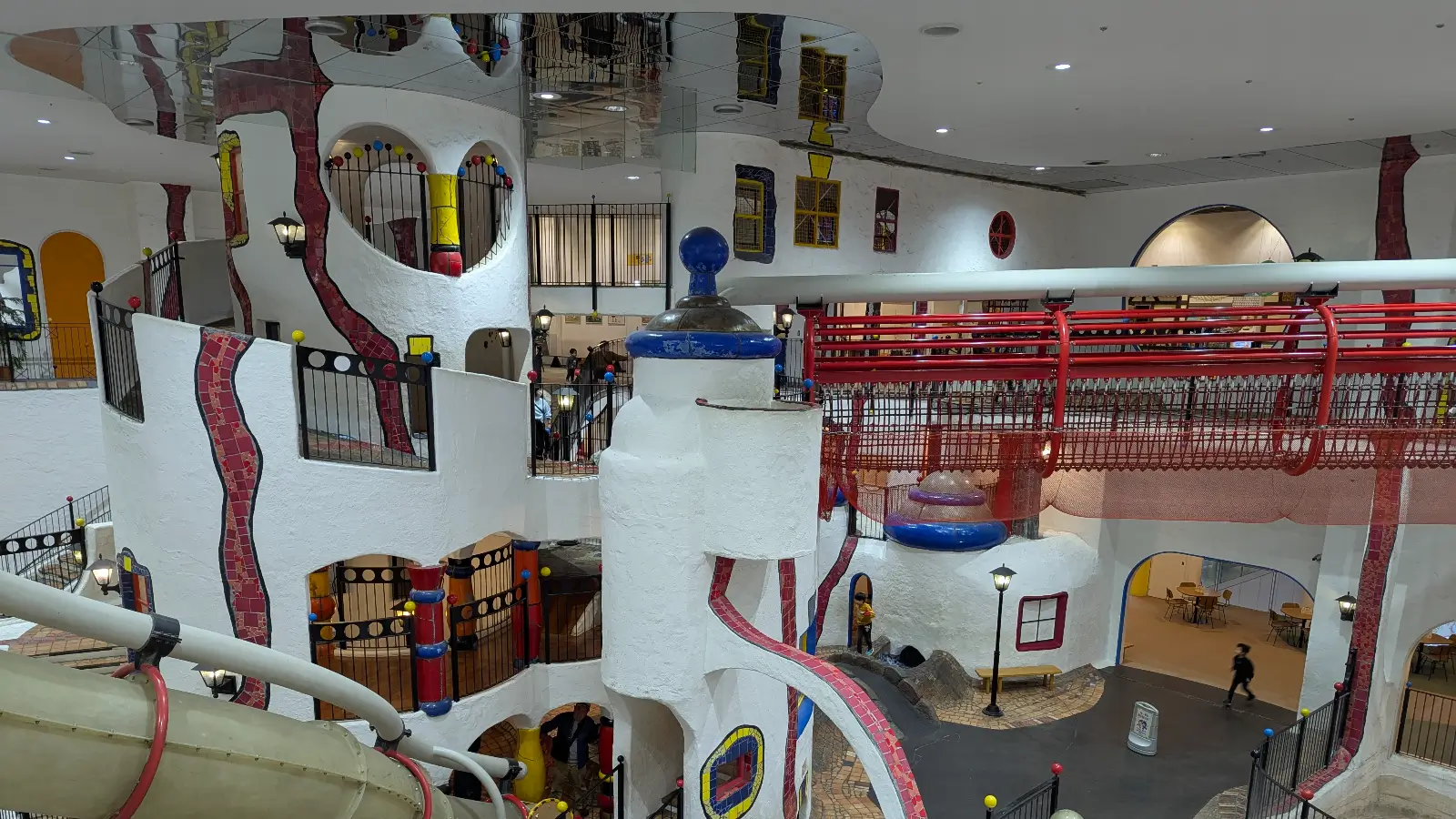
Let the child climb, and keep watching. The Dynamo depletes through restricted movement, and Kids Town on the fourth floor is built against it: winding corridors, climbing walls, suspension bridges, and a tube slider that drops a child from the fifth floor into the fourth. Designed by Hundertwasser, it gives a moving child somewhere to put the energy a morning of trains has stored up. The rule that shapes the visit is simple: children come with a guardian, who is asked not to take their eyes off them.
So plan to follow, not to wait at the edge. The slider has limits of its own: a height minimum, no adults at all, one rider at a time, and on weekdays it stops in the early afternoon, well before it does on weekends. A family that also wants the calmer weekday afternoon will find the slider closed by then, and should decide with the child which matters more before the day, not at the top of the stairs.
What this means for your Dynamo: restricted movement spends itself in Kids Town. A younger Dynamo needs a parent close behind on the bridges and walls; an older one, over 100 centimeters, can take the slider before 14:00 on a weekday.Come after 14:30, not at the opening. The Sensor depletes through sensory input, and at Kids Plaza the input that matters most is other people. In the school-trip seasons, late April to late June, late September to early December, and February to mid-March, weekdays are crowded from the 9:30 opening until 14:30, and relatively calm after it. The weekday afternoon ticket, sold from 14:00, exists for exactly that window, after the groups have left.
That turns the usual advice upside down. The morning, when a family feels freshest, is when a sensitive child meets the building at its fullest. On a weekday in season, arrive after 14:30 on the afternoon ticket, on sale from 14:00, and let the child choose one floor to start on. Or plan the visit outside those seasons and outside the summer vacation, late July to late August, when the building is busy morning and afternoon. Keep the first circuit short either way, so the child learns the building before it has a chance to overwhelm them.
What this means for your Sensor: sensory input peaks while school groups fill the building. A younger Sensor needs the weekday afternoon and a short first circuit; an older one can manage a morning visit outside the school-trip seasons and the summer vacation.Tell them the stations open at 10:15. The Anchor depletes through unfamiliarity and unconfirmed structure, and Kids Street on the fourth floor supplies structure in a form children already understand: Kids Mart, a post center, a police box called Kids KOBAN, a clinic and a hair salon, each a pretend job with rules a child can learn in a minute. The catch is the clock. Kids Mart and the post center open three quarters of an hour after the building does, and stations can pause or change hours on the day.
So a family arriving at the 9:30 opening should not promise the stations first. Say the order out loud on the way: three quarters of an hour somewhere else, then Kids Street when it opens, then lunch in the fourth-floor multipurpose room, where packed lunches are allowed. The re-entry rule is worth explaining too, because the whole family leaves and returns together through the third-floor exit, ticket in hand, and a child who knows that feels no break in the day.
What this means for your Anchor: unfamiliarity eases when the stations and their hours are known in advance. A younger Anchor needs the 10:15 opening named before arriving; an older one can plan the order of stations and run it.Plan the sit-down before the child needs it. The Sprinter depletes through sustained travel-style walking and standing, and Kids Plaza’s advantage is that it is one indoor building with places to sit and eat. There is no restaurant, but packed lunches are welcome in the fourth-floor multipurpose room and at the round tables near Kids Lab, and Kids Hiroba on the fifth floor takes a family’s own mat when no event is on. Free return lockers mean nobody carries the bags all day.
The ticket’s re-entry rule is what saves the day. A family may leave through the third-floor exit and come back the same day on the same ticket, so a tired child can have a real break outside rather than another hour on their feet inside. The rule is strict: no child leaves alone, and no adult leaves with a child still inside, even for a moment. Build that into the plan early, and a long day holds together.
What this means for your Sprinter: walking and standing ease with seats, lockers and re-entry. A younger Sprinter needs the lunch room fixed into the day as a stop; an older one can use the re-entry for a break outside the building.The questions parents actually ask.
School groups fill Kids Plaza on weekday mornings in the school-trip seasons, and the afternoons are calmer. The slider needs a height, lunch has set rooms, and a family can step out and come back, all together. The rules shift with the day of the week, the season and the child’s height, so check the date and measure the child before the trip. Children are asked to stay with a guardian throughout, which is the rule that shapes a parent’s afternoon most. A child told the slider’s height and closing time at home meets the rule as a plan, not a refusal.
Is Kids Plaza Osaka worth visiting with kids?
Yes, for a child who needs to move and a child who likes a job to do, provided the family picks its hours. Kids Town has climbing walls, suspension bridges and a tube slider; Kids Street has role-play stations. In the school-trip seasons, weekday mornings are crowded with school groups, so a child who tires of crowds does better in the afternoon.
How much are Kids Plaza Osaka tickets?
Adults aged 16 and over pay 1,500 yen, children aged 6 to 15 pay 800 yen, and children aged 3 to 5 pay 500 yen; under 3 enter free. School year can move a child: a 6-year-old still in kindergarten pays 500 yen, and a 15-year-old in high school pays 1,500. Two adults and two children aged 6 to 15 pay 4,600 yen.
When is Kids Plaza Osaka least crowded?
In the school-trip seasons, late April to late June, late September to early December and February to mid-March, weekdays are crowded from 9:30 to 14:30 and relatively calm after that. The summer vacation, late July to late August, is busy all day. A weekday afternoon ticket, cheaper than the full one, is sold from 14:00 in set date ranges outside it.
What are Kids Plaza Osaka’s opening hours and closing days?
Kids Plaza opens from 9:30 to 17:00, with last entry at 16:15. It closes on the second and third Monday of each month, or the next day when that Monday is a holiday, on the fourth Monday in August, and from December 28 to January 2. It can also close temporarily, so check the calendar before planning a Monday.
What does the tube slider at Kids Plaza Osaka require?
The slider drops from the fifth floor into Kids Town on the fourth. Riders must be at least 100 centimeters tall and go one at a time, and adults aged 16 and over may not ride. It runs 10:00 to 14:00 on weekdays and to 16:30 on weekends and holidays. Children in short sleeves wear protectors, and some shoes are refused.
Can you bring food into Kids Plaza Osaka?
Yes, and plan to, because there is no restaurant. Packed lunches can be eaten in the fourth-floor multipurpose room and at the round tables near Kids Lab, and in Kids Hiroba on the fifth floor, on your own mat, when no event is running; it has benches but no tables. There are vending machines on both floors, and free return lockers.
Can you leave Kids Plaza Osaka and come back the same day?
Yes. Same-day re-entry is through the third-floor exit on showing the ticket. The rule is strict: a child may not leave alone, and adults may not leave with a child still inside, even for a moment. Children are asked to come with a guardian, who is asked to keep them in sight for the whole visit, so plan every break for everyone at once.
Is Kids Plaza Osaka good for babies and toddlers?
Yes, with a room of their own. Peekaboo, on the fourth floor, is the playroom for children aged 0 to 2, and older siblings may go in with them. The fourth floor, with Kids Town beside it, is the one recommended for the youngest visitors. The tube slider stays out of reach until a child is 100 centimeters tall, whatever their age.
Where Kids Plaza Osaka fits your Japan trip.
Official site and opening information: Kids Plaza Osaka (Osaka Education Promotion Foundation)