Arashiyama Monkey Park With Kids:
a hike, not a zoo.
The mandatory twenty-minute mountain ascent is the whole story here: the same relentless climb that discharges a high-energy child before the macaques even appear is the barrier that puts a low-stamina child under pressure from the gate.
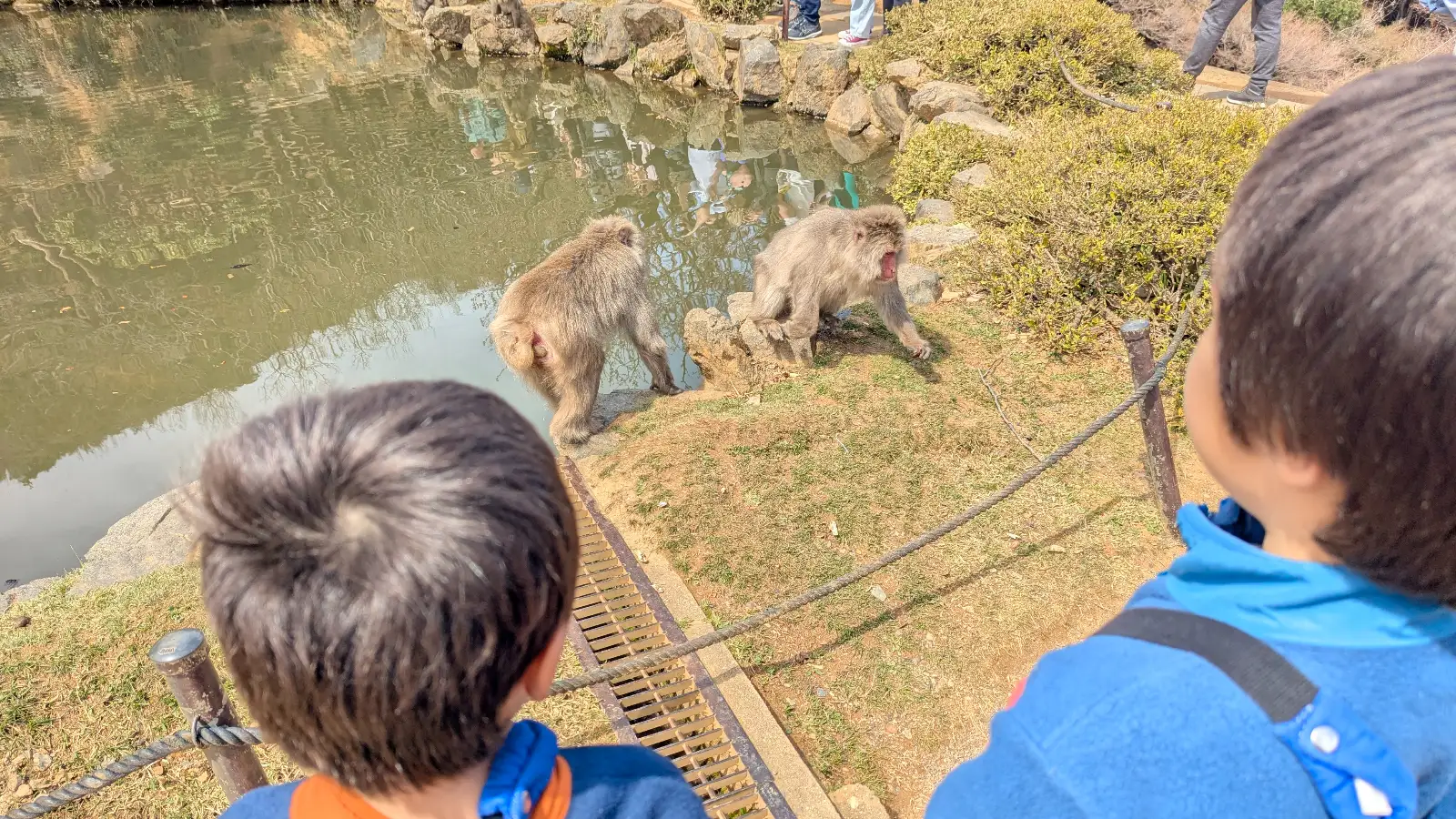
The climb discharges restless movement before the summit.
Crowds and macaques press hardest around the hut.
Free-roaming macaques offer no rules to hold onto.
A no-bypass climb with no early exit route.
Yes, Arashiyama Monkey Park is worth visiting with kids, and it rewards a high-energy child more precisely than almost any other Kyoto attraction. The visit turns on stamina: a child who depletes through sustained walking and standing needs a structured hiking carrier and generous rest stops built in, or the twenty-minute ascent becomes the day’s breaking point rather than its highlight.
Some links on this page are affiliate links. LuNi may earn a commission at no extra cost to you.
Which costs your child more,
a museum or a playground?
You have the days. Now the nights.
Where to stay in Kyoto →The LUNI Rating for Arashiyama Monkey Park.
LuNi’s opinions are framework-derived, not opinion-derived. Each verdict below is the result of applying The LUNI Framework to a single attraction, measuring it against the third currency every family spends but few track: the child’s reserve. The reasoning that follows is the case.
Send a Dynamo up this trail and let them set the pace at the front. The Dynamo depletes through restricted movement, and the only route to the macaques is an unbroken twenty-minute climb of steep stairs and uneven steps with no queue and no waiting room. That continuous physical demand acts as a discharge valve, spending the restless energy that would otherwise build with nothing to do. By the time the summit arrives, the child has earned the payoff rather than been contained on the way to it.
The adaptation spans the age range. A four-year-old Dynamo climbs best with a hand to hold and permission to lead the group; a fourteen-year-old climbs best when the ascent is framed as the day’s exertion quota, so the contained summit that follows reads as a reward rather than a restriction. Either way, position the child at the front of the family, not managed from behind.
What this means for your Dynamo: The climb discharges restricted-movement energy before the summit, so let them lead the ascent and cycle in and out of the enclosed feeding hut in short intervals rather than anchoring there.Steer a Sensor toward the open edges of the summit, not into the feeding hut. The Sensor depletes through sensory input, and the intuitive move, retreating into the enclosed hut, is the wrong one here. The hut is the single most concentrated point on the mountain: a small contained space packed with people, echoing voices, and macaques pressing against the mesh on every exterior wall. The genuine relief is the opposite direction, out toward the open perimeter where the summit overlooks the city and up the slope above the hut, where both crowd density and macaque concentration thin out.
Working from the edges inward is what keeps the sensory load manageable. For a younger Sensor, make an open perimeter spot with a city view the arrival base and approach the macaques in short, chosen bursts from there. For an older Sensor, point them to the higher ground above the hut as a reset they can self-select, so they step back up and out to the quiet margins rather than deeper into the crowded center.
What this means for your Sensor: Manage the sensory-input load by basing at the open perimeter or the slope above the hut, and approaching the denser center only in short, self-chosen bursts.You have the days. Now the nights.
Where to stay in Kyoto →Give an Anchor the script before the climb, then let them watch from the edge before they commit. The Anchor depletes through unfamiliarity and unconfirmed structure, and the free-roaming summit operates without the posted rules or predictable animal behavior this profile leans on for comfort. The macaques move without pattern, break proximity without warning, and respond to eye contact in ways no sign fully prepares a child for. The unknown is the friction, and it is real enough to gate the visit.
Confirmed structure neutralizes most of it. For a younger Anchor, show a short video of the feeding-hut mechanics beforehand, the mesh, the food, the macaque grip, so the interaction carries a script they have already seen. For an older Anchor, position them near the summit entrance to observe the general movement patterns from a comfortable distance before stepping onto the open deck. The feeding hut’s repeating loop of mesh, food, and response is the most reliable entry point, because it is consistent enough to predict.
What this means for your Anchor: Convert the unfamiliarity into confirmed structure by pre-loading the feeding-hut script and letting them observe macaque movement from the entrance edge before committing to the open deck.Plan a Sprinter’s visit around the climb, or reconsider whether this is the right day for it. The Sprinter depletes through sustained travel-style walking and standing, and the approach is a continuous uphill climb on steep terrain with no shortcut, no bypass, and no exit route that skips the full ascent. A child who runs out of stamina halfway up cannot be returned to flat ground without finishing either the climb or the descent. That absence of an escape hatch is what makes the trail the single highest-friction moment of the visit for this profile.
The visit is still workable with the right preparation. Swap the stroller for a structured hiking carrier at the entrance gate for a younger Sprinter, and budget at least thirty minutes beyond the standard ascent time to use every resting bench on the trail. For an older Sprinter, map the mid-trail bench locations in advance and pace the climb as timed intervals with checkpoints, so rest is planned rather than a mid-ascent surrender. Pack high-calorie snacks either way.
What this means for your Sprinter: Protect against walking-and-standing depletion with a hiking carrier from the gate, pre-mapped bench checkpoints, and thirty extra minutes built into the ascent.The wire mesh feeding screen does more than separate a child from the macaques. It hands a hesitant child a rare kind of agency in an unfamiliar wildlife setting: watch a parent pass food through the mesh first, see the macaque grip and retrieve it without incident, then choose, entirely on their own timeline, whether to try it too. What looks like a small feeding ritual is really a child deciding to move from watching to doing, and the trips that build a child’s confidence are the ones that keep that decision theirs rather than the family’s.
How two children actually met this attraction.
Here is what the Arashiyama summit looked like through the eyes of two children whose priorities had nothing to do with the panoramic Kyoto views and everything to do with the specific mechanics of what the macaques were choosing to do.
Luca spent most of the visit at the feeding-hut mesh, ignoring the view entirely, tracking which food items the macaques retrieved most efficiently and whether they showed a consistent preference between apple slices and peanuts across repeated interactions. What actually held him was not the animals so much as the grip pattern their fingers used on the wire. He worked through a theory about finger dexterity that had little to do with wildlife observation in any conventional sense, and had to be pulled away from the screen when the family was ready to descend.
This is the Anchor pattern. A child whose reserve depletes through unfamiliarity and unconfirmed structure copes by anchoring on a single mechanical system rather than trying to absorb a whole chaotic scene at once. The mesh, the food, and the macaque response form a loop short enough to analyze and consistent enough to build a theory around, which is exactly the predictable structure this profile needs to feel settled in an environment that would otherwise read as unruly. Families with an Anchor child should point them at the hut’s repeating mechanics first and let the open summit come second.
Nico treated the stair trail as a race he was winning until roughly the halfway point, at which stage he revised his position to claim the benches had been the real objective all along and that stopping was the strategy. He recovered fully the moment he reached the open summit, then immediately tried to hold sustained eye contact with the nearest macaque, which took two firm redirections before he accepted this was a park rule and not an adult opinion. His energy ran highest at the start of the climb and dipped exactly when the trail was longest, which is the pattern to expect.
This is the Dynamo pattern. A child whose reserve depletes through restricted movement almost always overestimates early stamina on a sustained climb, and this trail is long enough that the miscalculation lands before the child expects it. The recovery is typically fast once the summit delivers on its promise, because the open animal environment provides the immediate physical payoff this profile needs to reframe the effort as worthwhile rather than wasted. Families with a Dynamo child should expect the mid-climb dip, treat the benches as checkpoints rather than failures, and trust that the summit resets the day.
Planning Your Visit to Arashiyama Monkey Park with Kids.
The verdict tells you whether to go. What follows is the operational intel a family needs to act on it: the visit at a glance, the profile-matched pairings worth knowing about nearby, the hotels we would book for this visit, and the questions parents most consistently ask.
Nearby attractions, matched to your child.
Three pairings selected for what each one solves after Arashiyama Monkey Park, profile by profile. The reason matters more than the recommendation.
| Pairing | Why This Solves the After-Visit | For Your |
|---|---|---|
| LUNI Pick Togetsukyo Bridge Riverside 5-minute walk | The flat, open riverbank right after the descent is the recovery zone a Sprinter needs before any further movement is possible. There are no queues, no stairs, and no obligation to keep walking once the family reaches the water. A riverside snack stop here also heads off the energy crash that otherwise arrives fifteen to twenty minutes later on the walk toward the bamboo grove. | Sprinter |
| Sagano Scenic Railway 20-minute ride | After the free-roaming unpredictability of the summit, this seated ride gives an Anchor exactly what the mountain withheld: a fixed route, a clear start and finish, and a defined seat, so the experience is structured and rule-bound from the moment it begins. The scenery continues without asking the child to decode anything new. | Anchor |
| Tenryu-ji Temple Gardens 15-minute walk | The flat, wide garden paths offer a calm, low-stimulation contrast to the rugged mountain terrain and the unpredictable open summit. They ask nothing further of a child physically while giving a Sensor a visually distinct, quiet environment to reset in after the sensory load of the macaque deck. | Sensor |
Togetsukyo Bridge Riverside
5-minute walk For YourSprinter
Sagano Scenic Railway
20-minute ride For YourAnchor
Tenryu-ji Temple Gardens
15-minute walk For YourSensor
Hotels we would book for this visit.
Three properties chosen for the specific logistical advantage each delivers for Arashiyama Monkey Park, not for general Kyoto stays.
Arashiyama Monkey Park sits across the Togetsukyo Bridge on the west edge of Kyoto, a district well removed from the central hotel clusters around Kyoto Station. Families who commute in from central Kyoto arrive with transit fatigue already accumulating before a single step on the stair ascent, the one segment of this visit where full child stamina is non-negotiable. Staying in Arashiyama itself is what protects that stamina.
| Property | The LuNi Reason | Budget |
|---|---|---|
| LUNI Pick Suiran, A Luxury Collection Hotel, Kyoto Walk to the trail entrance | Within easy walking distance of the trail entrance, this property lets families begin the stair ascent while children are at peak morning energy and return to the room for immediate recovery once the descent is done. It is a logistical advantage no other tier of accommodation in this location can match. | ¥¥¥ |
| MUNI KYOTO by Onko Chishin Near Togetsukyo Bridge | Proximity to the Togetsukyo Bridge means families bypass all cross-city transit and reach the ticket gate within minutes of leaving the room. That preserves the child stamina the trail demands before any of it has been spent on trains and platforms. | ¥¥¥ |
| The GrandWest Arashiyama Near the trail base | Larger suite configurations give a Dynamo a room that absorbs post-summit energy, while proximity to the trail base lets families reach the entrance ahead of the mid-morning crowd volume that builds on the stairs. | ¥¥ |
Suiran, A Luxury Collection Hotel, Kyoto
Budget: ¥¥¥
Budget: ¥¥¥
Budget: ¥¥
The questions parents actually ask.
Is Arashiyama Monkey Park worth visiting with kids?
Yes. The combination of a physically demanding outdoor trail and genuine wild macaque observation makes this one of the most distinctive family experiences in Kyoto, and it rewards a high-energy child more precisely than almost any comparable attraction. It does not replicate what a zoo delivers, and for a family with the right child that distinction is the entire point. The one profile it genuinely tests is a low-stamina child, for whom the no-bypass climb needs a hiking carrier and built-in rest stops.
How long do you need at Arashiyama Monkey Park with kids?
The complete visit runs about two hours from the entrance gate back to flat ground. The ascent takes twenty to thirty minutes at a realistic family pace, followed by roughly an hour at the summit. A low-stamina child needs an extra thirty minutes for trail rest stops, while a high-energy child may climb faster but should still be given the full hour at the top rather than rushed back down.
What age is Arashiyama Monkey Park best for?
Ages six and up get the most from this visit. By six, most children have the stamina to manage the stair ascent without being carried and the maturity to follow the safety rules around eye contact and sudden movements near the macaques. Under-sixes can visit but need sustained physical support on the trail and close behavioral management at the summit.
Is Arashiyama Monkey Park suitable for sensitive or anxious children?
It is manageable with a specific strategy, though the intuitive move is the wrong one. A sensory-sensitive child does best at the open edges of the summit, out along the perimeter overlooking the city or up the slope above the feeding hut, where crowds and macaques both thin out. The hut itself is the most concentrated point on the mountain, a small contained space full of people and animals pressing on the mesh, so it tends to overload rather than soothe. Base a sensitive child at the quiet margins and approach the busier center only in short, self-chosen bursts. (A routine-reliant Anchor is different: for that child the hut’s predictable feeding mechanics are a genuine anchor.)
Can you bring a stroller to Arashiyama Monkey Park?
No. The approach transitions almost immediately into a steep stair ascent unsuited to wheels of any kind, there is no storage at the entrance gate, and no route bypasses the stairs. Leave the stroller at your accommodation or in a coin locker at the nearest station before crossing the Togetsukyo Bridge, and strap toddlers into a soft structured hiking carrier before the approach. Families who want to skip the cross-town transit with young children altogether can check private car charters to reach the trailhead directly.
How does Arashiyama Monkey Park compare to the Jigokudani snow monkeys for kids?
Both put families among wild Japanese macaques, but the logistics differ sharply. Jigokudani, in Nagano, is a long day trip from Kyoto and centers on monkeys bathing in a hot spring, viewed along a mostly flat forest walk. Arashiyama is a short hop within Kyoto but demands a steep twenty-minute climb and offers free-roaming macaques on an open summit with a hands-on feeding hut. For a Kyoto-based family, Arashiyama is the far more practical choice; Jigokudani earns the trip only if the snow-monkey hot-spring image is the specific goal.
Should you visit Arashiyama Monkey Park before or after the bamboo grove?
Schedule the monkey park first, always. The mountain trail demands the most physical output of any Arashiyama experience, and a child who arrives at the stairs already depleted from the bamboo grove walk faces a far higher risk of a mid-ascent cascade. The bamboo grove is flat, paved walking, so it works as a natural recovery destination afterward rather than a warm-up.
Where Arashiyama Monkey Park fits your Japan trip.
Arashiyama Monkey Park rewards the Dynamo without conditions, works for the Sensor when the family bases at the open perimeter and the slope above the hut rather than the crowded center, works for the Anchor when the hut’s predictable feeding mechanics are used as the entry point, and asks the most of the Sprinter, for whom the no-bypass climb needs a structured hiking carrier and rest stops built into the ascent.