Best Beaches Near Tokyo With Kids:all eight shores.

- Does Tokyo Have Beaches?
- Yes: Odaiba, though its water is closed
- Easiest With Young Children
- Katase Higashihama, five minutes on foot
- On the Enoden
- Yuigahama, five minutes from its station
- Ramp and Beach Chair
- Chigasaki: mats, a ramp, an amphibious chair
- Shade Has a Price
- Miura Kaigan: the one shaded rest is a paid tent
Which shore is baby-friendly, which is less crowded, and where swimming is allowed at all, with how each beach day is reached by train or bus.
Some links on this page are affiliate links. LuNi may earn a commission at no extra cost to you.
Yes, Tokyo has beaches, and eight shores sit inside a family day out of the city, though the one in the city itself, Odaiba, is closed to swimming all year. The easiest with young children is Katase Higashihama, five minutes on foot from Katase-Enoshima Station; Yuigahama matches it on the Enoden. What decides a beach day near Tokyo is the last leg: a five-minute walk from a platform, or a bus ride past one, separates a short day from a long one with wet clothes and a tired child. And each of the eight runs its own season.
What a beach day near Tokyo actually asks for.
Family travel runs on three currencies, not two. Money and time, plus the child’s Reserve: their finite capacity to absorb what travel asks of them. A beach spends almost none of it on the sand. It spends it on everything wrapped around the sand.
Two shores, and both are five minutes from a platform.
The coastal line that runs from Fujisawa round to Kamakura puts its stations on the beach rather than near it. These are the two shores a family reaches without a bus, a taxi or a walk in the sun with everything in their arms.
Five Minutes to Shallow Water: Katase Higashihama, Fujisawa.
Five minutes on foot from Katase-Enoshima Station to the sand, and the shore shelves gently a long way out, so the depth a small child wants sits close to where the bags went down. The same five minutes saves the day at the other end, when the walk is paid a second time in damp clothes. The one thing to warn a child about is the swimming area itself: it is marked by flags Fujisawa resets each day against the sea, blue to swim, yellow for care, red for out, so the rule they were given last time may not be the rule today, and a child who needs the shape of a day confirmed in advance will want that said on the train.
The Most Watched Water on the Coast: Yuigahama, Kamakura.
Rescue drones, AI rip-current detection, a conditions flag system and a staffed post put more attention on this water than on any other shore here. Kamakura also takes out most of what a beach day does to a child who empties out on noise and crowding: speakers and instruments are banned, drinking on the sand is banned, barbecues are out all season, and 890 meters of shore leaves room to put real distance between your family and the next one. The train decides the walk, though. Wadazuka, Yuigahama and Hase each sit five minutes from the sand on the Enoden while Kamakura Station is fifteen, and a boardwalk of roughly 800 meters with mats takes wheels down to the water, with amphibious chairs lent at weekends and two staff to bring a user to the edge.
Three off one station, and only one you can walk to.
Zushi Station is the hinge for this whole stretch of coast. One of these shores is ten minutes on foot from it and the other two are a bus ride past it, which with children and beach bags is not a small distinction: walking to Morito takes about forty-five minutes, which is why nobody does it.
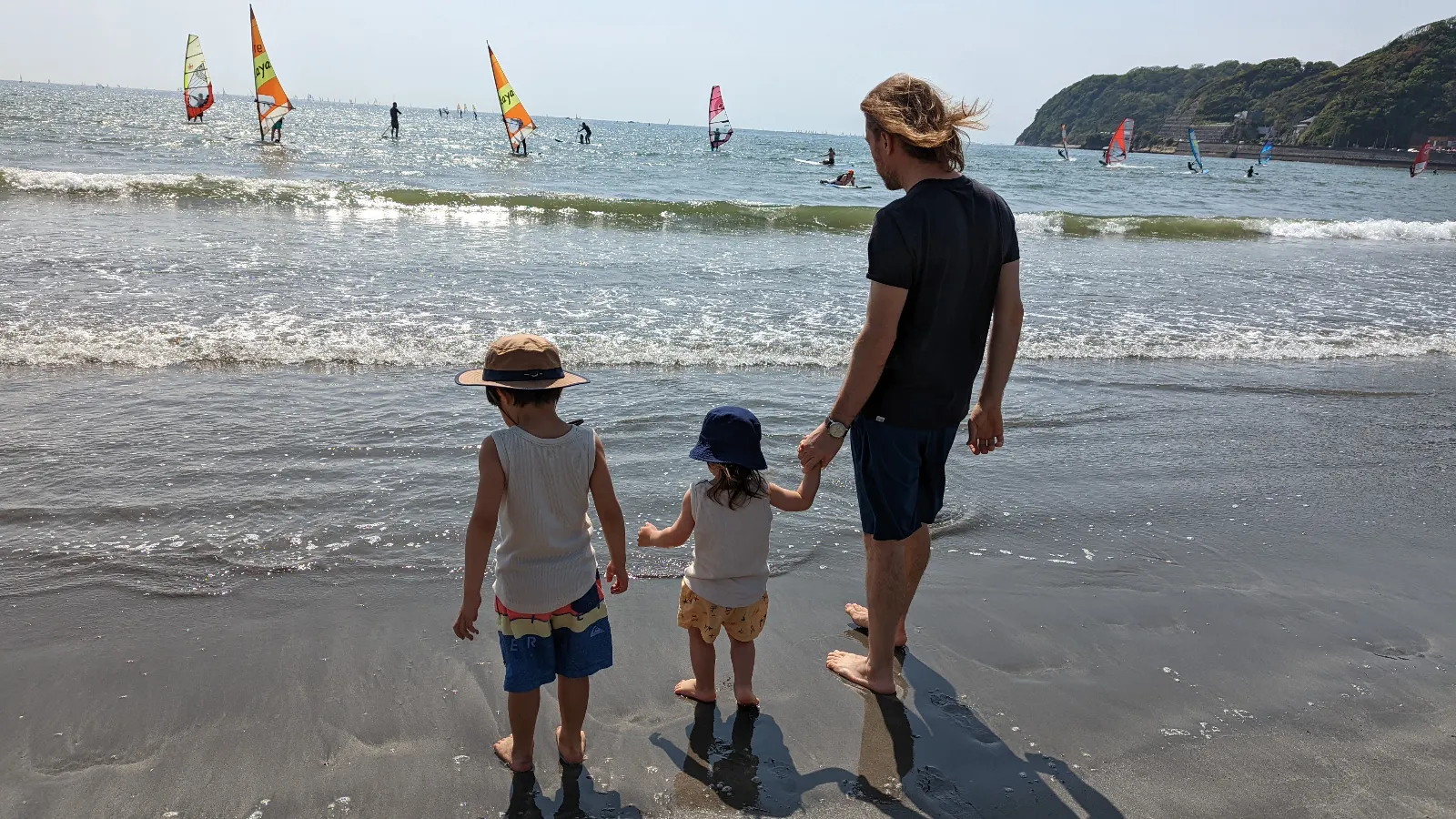
Borrow the Life Jackets, Don’t Pack Them: Zushi Beach, Zushi.
Zushi keeps about 130 children’s life jackets at its central watch post and lends them free, along with a beach wheelchair, which is a real subtraction from the pile a parent solves before leaving the hotel. Nurses work that post alongside the lifeguards, and the sand is about ten minutes on foot from either JR Zushi or Keikyu Zushi-Hayama, so the exit is not the event. Drinking and barbecues are confined to the beach houses and amplified sound is banned outright, but the beach houses run to around forty and form a near-continuous wall of catering along the back of the sand, so a child who drains on unfiltered noise has no quiet end to retreat to.
Hayama’s Gentlest Water, at the End of a Bus Ride: Morito, Hayama.
Calm waves over a gently shelving shore on Hayama’s widest sand, which makes this the easiest water here for a child who is not yet a swimmer, and barrier-free mats run across sections of it for wheelchairs, strollers and anyone who finds soft sand hard going. What Morito does not give a family is anything behind the sand, so the lunch and the shade come in with you. The last leg is a Keikyu bus from Zushi Station, about fifteen minutes and 250 yen, and the town keeps its family zones alcohol-free, which gathers families with young children into one marked stretch, so the calmest coast here is at its densest exactly where you are meant to sit.
Quiet Because People Live Behind It: Isshiki, Hayama.
Mikaoka hill closes one end, the Imperial Villa grounds close the other and houses stand along the back, which is a ceiling on noise held down by property lines rather than by a summer policy, and that is why it holds on a Saturday in August. It runs the same season, the same hours and the same lifeguard cover as Morito, with barrier-free mats in places and vendors for food, so the trade is not safety and it is not facilities. It is reach: the bus from Zushi Station takes about twenty minutes, there is no station at all, and nothing behind the sand is organized for a child to do, so for a child who runs down when they cannot move the sea is the only channel and a windy day takes it away.
Two you go to on purpose.
Neither of these is on the way to anything and neither is a beach you end up at. One is the only shore in the prefecture with a way into the sea for a child on wheels. The other is the only one with shade.
A Mat, a Ramp, and a Chair That Floats: Southern Beach Chigasaki, Chigasaki.
Kanagawa’s first permanent barrier-free beach, and the one shore here where a child who uses a wheelchair gets into the water rather than as far as the edge of it. Accessibility mats cross the sand, aluminum ramps bridge the step up to the beach houses, and amphibious wheelchairs go out free with no reservation, though a life jacket is required to enter the water in one and an adult has to come in too, two for preference. Surfing is kept out of the swimming area during operating hours, which removes the one thing that makes a shared shore unpredictable for a small child. The catch is the approach: about twenty minutes on foot from the station, the longest walk in this set, and the second twenty are walked wet, so take the bus.
The Only Shade Here Is Rented: Miura Kaigan, Miura.
The one shaded rest space on this coast is a stretch tent covering more than 200 square meters, with about 90 square meters of tatami seating under it, and it is a paid space where reservations take priority, so shade here is something you book rather than something you find. In the summer beach season Keikyu also runs a sand play area with operable mini-excavators, 1,000 yen for up to four people on an IC card, which hands a child who cannot sit still a sanctioned job with a visible result in a way that open sand does not. Against that, the season is the shortest and the latest to start of the eight, and the beach houses have come down to a single trailer, so the beach you describe on the way down may not be the beach you walk onto.
One inside the city, and you cannot swim at it.
The only bayfront shore in this set, and the only one that is not a beach day at all. It is worth knowing precisely because of what it takes out.
No Swimming, Any Day of the Year: Odaiba Kaihin Koen, Tokyo.
Swimming is prohibited here, with no season and no exception, and that is the item’s central fact rather than its disappointment. Taking the swim out removes the loudest and densest part of a beach day, the changing, the crush at the shoreline, the cycles of children coming out cold and going back in, and what is left is roughly 800 meters of sand brought up from Kozushima, three minutes on foot from the Yurikamome, with paid showers and lockers behind it at 200 and 300 yen. As the lowest-input version of a beach a family reaches without leaving Tokyo it is genuinely useful; as the beach day a family flew for it is not a candidate, and a child who discharges through movement will find the one climbable thing in the park inside an hour, because the water is closed to them.
Nothing here takes a reservation. Everything here has a date on it.
No beach on this coast books, so there is nothing to lock in, which is exactly why the date does all the work and the bus timetable does the rest.
The jellyfish warning has no date on it.
There is no week the jellyfish arrive on this coast. There is a trigger. Portuguese man o’ war wash in when the southerly wind blows hard, and they stay dangerous after they die, so the one lying on the sand that your child wants to prod is the one to walk away from. The toxin in the tentacles is strong enough that a sting hurts badly, and a second sting can bring on anaphylaxis.
If a child is stung, rinse the site with seawater rather than fresh water, because fresh water makes the stinging cells fire. Lift any tentacle away with a tool rather than a hand, cool the skin, and get medical help for anything beyond a local mark. The mid-August arrival date repeated all over the internet is not a Kanagawa fact, so read the wind instead of the calendar.
The questions parents actually ask.
What is the best beach near Tokyo for families with kids?
There is no single answer, because a family takes one beach day and the right shore depends on the child. Katase Higashihama is five minutes from the train with water that shelves gently. Zushi lends life jackets free. Chigasaki gets a wheelchair into the sea. Miura is the only one with shade, and you pay for it.
Are there lifeguards at the beaches near Tokyo?
Yes, at every one of them except Odaiba, and only inside each city’s own summer season. Zushi staffs nurses alongside its lifeguards. Kamakura adds rescue drones and AI rip-current detection to the flag system. Fujisawa defines the swimmable hours as the hours its lifeguards are on the sand. Outside the season nobody is there, so the watching is yours.
Can you swim at Odaiba Beach in Tokyo?
No. Swimming at Odaiba Kaihin Koen is prohibited, with no season and no exception to it. What is there instead is roughly 800 meters of sand brought up from Kozushima, three minutes on foot from the Yurikamome, with paid showers and lockers behind it. Treat it as a sand afternoon inside the city rather than as a beach day, and it earns its place.
When is the swimming season at beaches near Tokyo?
There is no single season, only eight municipal ones, and they do not line up. Most open at the start of July and shut at the end of August, Zushi and Katase Higashihama run on into early September, and Miura is the shortest and the latest to start. Outside the window the lifeguards, the showers and the beach houses are simply gone.
Which beach near Tokyo is easiest to reach with young children?
Katase Higashihama, at five minutes on foot from Katase-Enoshima Station. Yuigahama matches it on the Enoden, because Wadazuka, Yuigahama and Hase all sit five minutes from the sand while Kamakura Station is fifteen. Zushi is about ten minutes. Chigasaki is twenty on foot, and Morito and Isshiki have no station at all, only a bus from Zushi Station.
Which beach near Tokyo works for a child who uses a wheelchair?
Southern Beach Chigasaki, which is Kanagawa’s first permanent barrier-free beach. Mats cross the sand, aluminum ramps bridge the step up, and amphibious wheelchairs go out free without a reservation, though a life jacket is required in the water and an adult has to come in too. Yuigahama is the alternative, with a boardwalk and chairs lent at weekends.